100+ AI Visibility Terms & MetricsOptimize content so AI systems can extract, summarize, and reference your answers in generated responses.
AEO Performance measures how effectively a brand appears and performs across AI answer engines using visibility, mentions, citations, Share of Voice, prompt coverage, competitor benchmarks, and AI referral traffic.
AEO Tracking is the continuous measurement of Answer Engine Optimization performance using prompts, AI visibility, mentions, citations, Share of Voice, competitors, traffic, and historical changes to evaluate optimization efforts over time.
Adobe LLM Optimizer, now evolving into Adobe Brand Visibility, is an enterprise AI search optimization platform for measuring brand visibility, prompts, citations, competitors, AI traffic, and optimization opportunities across generative search experiences.
Software systems that perform tasks and retrieve information using large language models.
Responses generated by AI systems that synthesize information from multiple sources.
References and acknowledgments that indicate where AI-generated information originated.
Comparing AI visibility performance against competitors and industry averages.
Sources and links used by AI systems to support generated responses.
AI Citation Analysis examines the domains, URLs, sources, competitors, and citation patterns used in AI-generated answers to identify Citation Rate, source influence, citation gaps, and opportunities to improve AI Search visibility.
AI Citation Opportunities are prompts, topics, queries, and sources where a brand has the potential to earn more citations in AI-generated answers by identifying citation gaps, demand, competition, and relevant content or authority actions.
Strategies aimed at increasing the likelihood of being cited by AI systems.
Improving content so AI systems can understand, retrieve, and cite it effectively.
Structured outlines designed to guide the creation of AI-friendly content.
Planning and organizing content to improve discoverability and citation opportunities.
Evaluating how competitors perform and appear within AI-generated responses.
Automated bots that discover and collect information for AI retrieval systems.
The process through which AI systems identify and surface information.
Ahrefs is a search marketing platform whose Brand Radar product measures AI visibility, mentions, citations, Share of Voice, prompts, competitors, and brand presence across AI search and other discovery channels.
Occurrences where brands, products, or entities appear in AI-generated answers.
An AI Rank Tracker monitors where and how brands appear across AI-generated answers, measuring rankings, mentions, citations, prompt visibility, competitors, and changes across AI Search platforms.
AI Rank Tracking is the process of measuring how brands appear, rank, and gain visibility across AI-generated answers by monitoring prompts, mentions, citations, competitors, and historical performance over time.
Suggestions generated by AI systems to improve visibility and performance.
How brands are perceived and represented in AI-generated responses.
AirOps is an AI search and content engineering platform for tracking prompts, mentions, citations, competitors, pages, and AI visibility, then turning those insights into prioritized content and off-site optimization workflows
AI-powered experiences that generate answers instead of returning lists of links.
Metrics and insights used to measure performance across AI search platforms.
AI Search Monitoring is the continuous observation of prompts, brand visibility, mentions, citations, competitors, sources, rankings, and other signals to detect meaningful changes across AI-generated answers over time.
Improving content and authority signals to increase visibility in AI-generated answers.
Services such as ChatGPT, Gemini, Perplexity, and Google AI experiences that provide AI-generated answers.
The practice of improving a brand’s content, authority, retrievability, and technical presence so it can be discovered, cited, mentioned, and recommended across AI-powered search experiences.
The proportion of AI visibility a brand owns compared with competitors.
Visits and interactions originating from AI-powered platforms.
Measuring visits and engagement originating from AI-powered experiences.
The degree to which brands appear across AI-generated responses and platforms
Analyzing visibility metrics, trends, and performance within AI-generated answers.
AI Visibility Metrics measure how brands perform across AI-generated answers using visibility, mentions, citations, Share of Voice, prompt coverage, competitor performance, AI referral traffic, and historical trends.
Tracking how frequently and prominently brands appear across AI platforms.
A metric used to quantify overall visibility across answer engines and AI platforms.
AI Visibility Tracking is the continuous process of monitoring how a brand appears across AI-generated answers by tracking prompts, mentions, citations, competitors, Share of Voice, sources, rankings, and changes over time.
Automated sequences of actions designed to support AI-driven processes.
Conversational interfaces powered by AI agents capable of performing tasks and retrieval.
Amplitude is a digital analytics platform whose AI Visibility capabilities help teams track brand mentions, citations, competitors, sentiment, AI traffic, conversions, and optimization opportunities across AI search.
Ansvisor is an open-source AI Search Intelligence Platform for measuring AI visibility, understanding how answer engines represent brands, discovering opportunities, and turning insights into actions.
AI systems that generate direct answers by combining information from multiple sources.
Data and analysis used to understand visibility, citations, and performance across answer engines.
arXiv is an open-access research repository where researchers share and discover scholarly papers across computer science, mathematics, physics, statistics, economics, and other fields, including foundational research on AI, LLMs, information retrieval, and generative search.
Athena HQ is an AI search optimization platform for monitoring brand visibility, prompts, citations, competitors, sentiment, and content opportunities across major AI search engines.
Bing Webmaster Tools is Microsoft's search and AI performance platform for monitoring Bing Search visibility, crawling, indexing, technical SEO, and citation activity across Microsoft Copilot, AI-generated Bing summaries, and select partner AI experiences.
The level of trust and credibility associated with a brand.
Recognized products, organizations, and concepts associated with a brand.
References to a company or product across AI-generated answers and sources.
How frequently and prominently a brand appears across digital channels and AI systems.
Bright Data is a web data and AI search infrastructure platform for collecting real-time answers, citations, source metadata, rankings, and search results from major AI engines and traditional search platforms.
Brantial is a GEO and AI visibility platform for measuring prompts, citations, competitors, sentiment, AI traffic, and technical readiness, then turning those insights into prioritized actions and content workflows.
OpenAI's search experience that combines web information with conversational answers.
Measuring source usage, citation frequency, and answer coverage.
The influence and trustworthiness of domains frequently cited by AI systems.
The percentage of answers where sources are cited.
How often a source appears in AI-generated responses.
Tracking source domains and URLs cited in AI-generated responses.
Claude's search and retrieval capabilities that allow Anthropic's AI models to access, retrieve, and synthesize information from external sources.
Cloudflare is a web infrastructure and security platform whose AI Crawl Control capabilities help websites monitor, manage, block, allow, and analyze AI crawlers while tracking AI referrals and robots.txt compliance.
cloro is an AI search and SERP data API for tracking brand mentions, citations, Share of Voice, source positions, and visibility across major AI search engines using structured raw data.
Cognizo is an AI search and AEO platform for monitoring brand visibility, prompts, citations, competitors, AI traffic, crawler activity, and optimization opportunities across AI search engines.
Conductor is an enterprise AEO and SEO platform for tracking AI visibility, mentions, citations, competitors, sentiment, personas, AI traffic, conversions, and technical website health across AI and traditional search.
The perceived expertise and trustworthiness of content.
The recency of information available for retrieval and citation.
The process of locating relevant information for answer generation.
The amount of text an AI model can consider at one time.
Search experiences based on natural language interactions instead of keywords.
Competitive Intelligence for AI Search is the process of analyzing how competing brands appear across AI-generated answers by comparing visibility, mentions, citations, Share of Voice, prompts, sources, and performance gaps.
Copy.ai is a GTM AI and content automation platform that helps teams create, optimize, and scale on-brand content for SEO, AEO, GEO, and AI-powered discovery using AI agents and automated workflows.
DataForSEO is a search and AI data infrastructure platform whose AI Optimization API provides structured LLM responses, brand mentions, citations, AI search volume, prompts, and source intelligence for building AI visibility and GEO workflows.
A measure used to estimate the credibility and strength of websites.
Occurrences where a website or domain appears in AI responses.
Retrieving information in real time while generating responses.
Experience, Expertise, Authoritativeness, and Trustworthiness signals used to evaluate content quality.
Signals related to experience, expertise, authoritativeness, and trustworthiness.
Elmo is an open-source, self-hostable AI Visibility and AEO platform for tracking brand mentions, citations, competitors, prompts, Share of Voice, query fan-out, opportunities, and visibility trends across major AI answer engines.
Numerical representations used to capture semantic meaning.
The perceived credibility and importance of entities recognized by AI systems.
Connecting recognized entities to structured knowledge sources.
The process of identifying people, brands, products, and concepts within content.
Adapting AI models using specialized datasets.
Large-scale AI models trained on massive datasets to support various tasks.
Frase is an SEO and AI search content platform for researching, creating, optimizing, publishing, and monitoring content while tracking brand mentions, citations, competitors, and visibility across major AI answer engines.
Framer is an AI-powered website builder and CMS for creating, managing, optimizing, and publishing modern websites with built-in SEO tools, AI agents, analytics, hosting, localization, and support for AI-readable content.
Gauge is an AI visibility and GEO platform for tracking prompts, brand mentions, citations, competitors, AI traffic, crawler activity, and optimization opportunities across major AI search engines.
Google's AI-powered search experience based on Gemini models.
Optimizing content for discovery and citation within generative AI systems.
GeoGenie is a full-stack Generative Engine Optimization platform for researching AI Search demand, generating and monitoring prompts, tracking brand visibility, Share of Voice and citations, analyzing citation supply chains, auditing AI crawlability, and turning AI Search gaps into content and off-site actions.
GetCito is an open-source AI Visibility and GEO platform for monitoring brand mentions, citations, competitors, prompts, sentiment, AI-driven traffic, and crawler activity while combining AI Search analytics with optimization recommendations and optional human GEO services.
Google's conversational search experience powered by AI.
AI-generated summaries displayed directly within Google Search results.
A Google AI Overviews Tracker monitors how websites and brands appear in Google AI Overviews, including visibility, citations, cited URLs, competitors, queries, and historical changes.
Google Analytics 4 (GA4) is Google's web and app analytics platform that can measure identifiable AI referral traffic, landing pages, engagement, key events, ecommerce activity, and downstream business outcomes from AI-powered discovery.
Google Merchant Center is Google's commerce data and AI shopping platform for managing product information, free listings, shopping performance, AI visibility insights, and increasingly agentic commerce experiences across Google Search, AI Mode, AI Overviews, Gemini, YouTube, Maps, Lens, and other Google surfaces.
Google Search Console (GSC) is Google's search performance and technical monitoring platform for measuring queries, impressions, clicks, CTR, pages, indexing, and increasingly visibility within generative AI experiences such as Google AI Overviews and AI Mode.
Measurements used to evaluate generative search visibility.
Grok's AI-powered search and answer experience that combines large language models, web retrieval, and real-time information sources.
Using external sources to improve factual accuracy.
Instances where AI systems generate inaccurate or fabricated information.
Combining semantic search with keyword matching for better retrieval.
HubSpot Content Hub is an AI-powered content marketing and CMS platform for creating, managing, personalizing, optimizing, and measuring websites, blogs, landing pages, podcasts, and other content while connecting publishing workflows with CRM data and HubSpot’s broader AEO ecosystem.
User evaluations used to improve AI systems.
Indicators that reveal what users are trying to accomplish.
The ability of content to be discovered and processed by search systems.
The process of finding relevant information to answer queries.
Aligning content with the underlying purpose of user questions.
Connections between pages that help content discovery.
Jasper AI is an enterprise marketing and GEO platform for measuring AI visibility, citations, competitors, sentiment, and search opportunities, then turning those insights into governed, brand-aligned content and optimization workflows.
Understanding the stages users follow before making decisions.
Understanding the stages users follow before making decisions.
Structured relationships between entities used to enhance understanding.
Entity-based information boxes shown in search experiences
Accessing relevant information from internal or external sources.
AI systems trained to understand and generate language.
AI systems trained to understand and generate human language.
LLM Pulse is an AI visibility and GEO platform for tracking prompts, brand mentions, citations, competitors, sentiment, AI traffic, Query Fan-Out, and optimization opportunities across major AI search engines.
An LLM Rank Tracker monitors how a brand appears across AI-generated answers by tracking prompts, mentions, citations, competitors, answer visibility, and historical rank tracking data across large language models.
LLMrefs is an AI search analytics platform that uses a keyword-first approach to track brand visibility, Share of Voice, citations, competitors, and rankings across major AI search engines.
LLM SEO is the practice of improving how a brand and its content are discovered, understood, mentioned, cited, and represented in answers generated by large language models and AI Search platforms.
Techniques used to improve content accessibility for language models.
An experimental file intended to help AI systems discover important resources.
Specific and detailed questions with lower search volume.
Infrastructure that enables AI systems and tools to securely exchange context and capabilities.
The number of times a brand appears in responses.
Tracking how brands and entities appear across AI-generated responses.
Microsoft's AI-powered assistant and search platform that combines large language models, web search, enterprise data, and productivity tools.
Techniques that guide AI systems toward desired behavior.
The amount of information an AI model can process simultaneously.
Moz is an SEO and AI Search platform that combines keyword research, rankings, crawling, link intelligence, Brand Authority, AI visibility tracking, prompt research, AI Overviews analysis, and GEO content workflows.
AI systems capable of understanding text, images, audio, and video.
Using multiple retrieval stages to answer complex queries.
The prominence of content across search and discovery experiences.
The company behind ChatGPT and GPT models.
Factors influencing AI visibility and citations.
Opttab is an AI Visibility and GEO platform for tracking prompts, brand mentions, citations, sentiment, competitors, prompt demand, AI-driven traffic, crawler activity, content opportunities, and agentic commerce across AI-powered discovery environments.
Otterly AI is an AI search monitoring and optimization platform for tracking brand mentions, citations, competitors, prompts, sentiment, and visibility across major AI search engines.
Peec AI is an AI search analytics platform for tracking brand visibility, position, sentiment, competitors, prompts, and sources across AI-generated search experiences.
An AI-powered answer engine that emphasizes source citations.
Profound is an AI search and AEO platform for monitoring brand visibility, analyzing citations and prompts, tracking AI traffic, and improving presence across answer engines.
Analyzing prompts and questions that influence AI visibility and demand.
The percentage of prompts where a brand appears.
Designing prompts to improve AI outputs.
Prompt-Level Visibility measures whether and how a brand appears for individual AI Search prompts, including brand mentions, citations, answer prominence, competitors, and changes over time.
Tracking visibility across prompts, languages, and regions.
Estimated demand levels for AI-related questions and prompts.
The extent to which a brand appears across prompts.
Promptwatch is an AI visibility and GEO platform for tracking prompts, brand mentions, citations, competitors, crawler activity, AI traffic, and content opportunities across AI search engines.
Visibility across different AI platforms.
Combining retrieval systems with language models to improve factual accuracy.
Signals influencing visibility across search systems.
Factors influencing search visibility and content prominence.
Rank Tracking Data is the historical measurement data used to analyze how a brand, website, or competitor appears across tracked queries, prompts, AI-generated answers, citations, and AI Search platforms over time.
The usefulness and accuracy of generated answers.
How easily AI systems can discover and reuse content.
The component responsible for finding relevant information.
The sequence of steps used to gather context.
The underlying objective behind a user query.
Searchable is an AI search visibility and optimization platform for monitoring brand presence, prompts, citations, competitors, and opportunities across AI-powered search experiences.
Schema markup designed to improve content interpretation and retrieval.
Structured data that helps machines understand webpage content.
Screaming Frog SEO Spider is a website crawler and technical SEO auditing tool that can analyze site architecture, metadata, links, structured data, JavaScript rendering, content, and crawlability while integrating AI models, embeddings, semantic analysis, and MCP workflows for AI Search, AEO, and GEO analysis.
Scrunch is an AI search monitoring and optimization platform for tracking brand presence, prompts, citations, competitors, personas, geographies, and source influence across major AI platforms.
Search techniques based on meaning and context rather than keywords.
Search Engine Land is a search marketing publication covering SEO, PPC, AI Search, AEO, GEO, Google AI Overviews, LLM visibility, citations, retrieval, and the changing search landscape.
Semrush is a search marketing platform whose AI Visibility Toolkit helps brands measure mentions, citations, prompts, competitors, sentiment, and visibility across AI search alongside traditional SEO data.
The percentage of visibility a brand owns relative to competitors.
Shopify is an ecommerce platform that helps merchants manage products, storefronts, checkout, orders, analytics, and increasingly AI-powered product discovery through Shopify Catalog and Agentic Storefronts across channels such as ChatGPT, Google AI Mode, Gemini, Microsoft Copilot, Meta, and Shop.
Similarweb is a digital intelligence and AI Search analytics platform for measuring website and market traffic, competitive performance, search demand, AI-referred traffic, brand visibility, prompts, citations, sentiment, topics, and content opportunities across generative AI discovery environments.
The trustworthiness and influence of information sources.
The process of identifying and acknowledging the origins of information.
The degree of trust and authority associated with cited sources.
The variety of domains referenced by AI systems.
The overall usefulness, relevance, and reliability of information sources.
Surfer is a search optimization platform whose AI Tracker and AI Search Analytics capabilities help teams measure brand visibility, mentions, citations, sentiment, competitors, and content opportunities across major AI search engines.
Machine-readable information used to describe webpage content
Machine-readable information that helps AI systems understand content and entities.
Responses generated by combining multiple sources
The level of expertise demonstrated around a subject.
Groups of related pages organized around a central theme
Grouping related themes and concepts.
Measuring visits and engagement originating from AI systems.
Indicators that help establish credibility and reliability.
Databases optimized for storing and searching embeddings.
Mathematical representations used in semantic retrieval.
Finding information based on semantic similarity.
Visby AI is an AI Visibility and GEO platform for tracking brand mentions, prompts, competitors, Share of Voice, and visibility trends across AI answer engines while turning detected gaps into prioritized GEO tasks, content actions, and measurable AI traffic outcomes.
Metrics used to evaluate AI search performance.
Tracking brand exposure across AI platforms.
Metrics used to quantify AI search performance.
Bots that collect and process online information.
Webflow is a website experience platform for designing, managing, optimizing, and publishing websites, with native AI Search capabilities for prompt tracking, AI visibility, citations, LLM bot activity, AI referral analytics, AEO recommendations, and content optimization.
The process of discovering and organizing web content.
Accessing live web information during answer generation.
White Label AI SEO is a service model where agencies and consultants deliver AI Search optimization, AEO, GEO, AI visibility monitoring, citation analysis, and related services to clients under their own brand using a third-party platform or specialist provider.
Wix is an AI-powered website and business platform for creating, managing, optimizing, and growing websites, with native AI Search capabilities for AI visibility, citations, competitor analysis, brand perception, AI traffic, bot activity, llms.txt, NLWeb, and agent connectivity
WordPress is an open-source content management system for publishing and managing websites, pages, articles, media, and structured content. Its extensible architecture, APIs, AI capabilities, and publishing ecosystem make it an important content infrastructure layer for SEO, AEO, GEO, and AI Search optimization.
Writesonic is an AI search growth platform for tracking brand visibility, prompts, citations, competitors, sentiment, Query Fan-Out, AI traffic, and optimization opportunities across major AI search engines.
Improving content efficiency and visibility performance.
Yoast SEO is an SEO and AI Search optimization platform for WordPress and Shopify that combines content and technical SEO with structured data, llms.txt, AI-readable schema, AI content optimization, crawler controls, and brand visibility monitoring across ChatGPT, Claude, Gemini, and Perplexity.
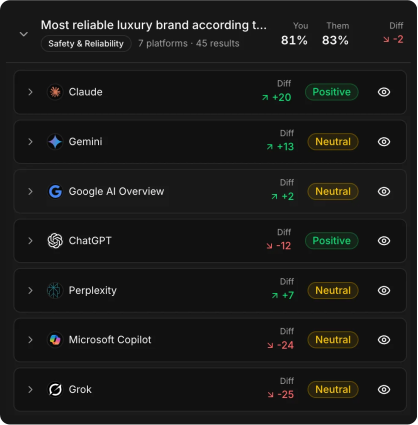
Understand, measure, and optimize your AI visibility.
✓ Add brand, domains and competitors
✓ Discover prompts and growth opportunities
✓ Track your AI visibility across major AI platforms
✓ Monitor citations, mentions, and competitors
✓ Measure AI traffic and customer discovery
✓ Receive AI recommendations based on AI insights
✓ Optimize authority, trust, and content quality
✓ Create content, automate analysis, & action with agents


.svg)