

Adobe LLM Optimizer
What is Adobe LLM Optimizer?
Adobe LLM Optimizer is an enterprise AI search and generative discovery optimization platform designed to help organizations understand and improve how their brands and content appear across AI-powered search experiences.
The product combines AI visibility measurement, prompt research and monitoring, brand presence analysis, citations, competitive intelligence, agentic and referral traffic, technical diagnostics, and optimization workflows.
In August 2026, Adobe began transitioning Adobe LLM Optimizer into Adobe Brand Visibility. The updated product combines the existing LLM Optimizer capabilities with AI market intelligence powered by Semrush Enterprise AIO.
Existing LLM Optimizer customers are being moved into the enhanced Adobe Brand Visibility experience without needing to rebuild their existing prompt strategies or workflows.
What is Adobe Brand Visibility?
Adobe Brand Visibility is the evolution of Adobe LLM Optimizer and provides a broader environment for measuring, understanding, and improving brand performance across AI-generated search experiences.
The platform combines two complementary measurement approaches.
First, it provides immediate market-level AI visibility data using Semrush's large AI prompt dataset, allowing organizations to understand their baseline visibility before configuring their own prompt library.
Second, teams can create and maintain a curated set of prompts that Adobe monitors on an ongoing basis to measure Brand Presence and changes in visibility over time.
This creates both a discovery layer for understanding the wider AI search market and a monitoring layer for strategically important brand prompts.
What does Adobe LLM Optimizer do?
Adobe LLM Optimizer helps organizations understand how their brands and websites appear within AI-generated answers and then identify actions that may improve future visibility.
Teams can use the platform to investigate questions such as:
- How visible is our brand across AI search?
- Which prompts and topics drive visibility?
- Which competitors appear more frequently?
- Which pages and third-party domains are cited?
- How do AI systems describe our brand?
- Which AI agents are accessing our website?
- Does AI referral traffic contribute to engagement or conversions?
- Which optimization opportunities should we prioritize?
What are the key features of Adobe LLM Optimizer?
Adobe LLM Optimizer and Adobe Brand Visibility combine AI search intelligence, optimization, traffic analytics, and enterprise workflows.
- AI Visibility: Provides immediate visibility intelligence using Semrush Enterprise AIO data.
- Visibility Overview: Tracks AI visibility, mentions, monthly audience, cited pages, and performance trends.
- Prompt Research: Helps teams discover topics, prompts, brands, and sources associated with AI search demand.
- Prompt Management: Provides a dedicated environment for building and maintaining an actively monitored prompt library.
- Prompt Strategy: Recommends prompts using sources such as Semrush, Google Search Console, Synthetic Personas, and Citation Attempt data.
- Brand Presence: Measures how often and in what context brands appear within monitored AI responses.
- Market Comparison: Benchmarks brand visibility against competing organizations and identifies topic and source gaps.
- Citation Analysis: Identifies owned pages and third-party domains cited by AI systems.
- Source Opportunities: Surfaces sources that support competitors but do not currently support the tracked brand.
- Agentic Traffic: Helps teams understand how AI agents access and interact with website content.
- Referral Traffic: Measures website visits originating from AI-powered search experiences.
- URL Inspector: Provides page-level analysis for AI discovery and optimization.
- Optimization Opportunities: Detects on-page, technical, and off-site actions that may improve AI visibility.
- Opportunity Workspace: Organizes optimization initiatives into strategies with ownership, execution, and outcome tracking.
- Impact Measurement: Helps teams evaluate whether implemented changes improve AI visibility or other outcomes.
- MCP and A2A Support: Enables integration with agent-based systems and external AI workflows.
Which AI platforms does Adobe Brand Visibility track?
Adobe's enhanced AI Visibility experience currently supports analysis across:
- ChatGPT.
- Google AI Overviews.
- Google AI Mode.
- Gemini.
Teams can filter AI Visibility data by platform and market to understand how performance differs between AI search experiences and regions.
Platform coverage may differ between the immediate Semrush-powered AI Visibility dataset and other Adobe monitoring or traffic workflows, so organizations should evaluate coverage according to the specific capability they intend to use.
How does Adobe measure AI visibility?
Adobe's enhanced AI Visibility capability uses Semrush Enterprise AIO data to provide an immediate baseline of how brands appear across AI-generated responses.
The system currently draws from a Semrush AI dataset containing hundreds of millions of prompts, allowing organizations to analyze AI visibility without first defining a custom prompt strategy.
Key measurements include:
- AI Visibility.
- Mentions.
- Monthly Audience.
- Cited Pages.
- Topic performance.
- Prompt performance.
- Competitor visibility.
- Cited sources.
Adobe defines AI Visibility as a comparative measure of how frequently a brand is mentioned relative to the median number of competitor mentions.
Teams can then drill into the topics, prompts, brands, and sources contributing to that visibility.
How does Prompt Research work in Adobe LLM Optimizer?
Prompt Research helps teams discover the questions and topics shaping AI-generated search behavior within a particular market.
Instead of beginning with a website or custom prompt list, teams enter a topic and Adobe surfaces related topics, prompts, brands, and source domains associated with that subject.
Prompt Research can show metrics such as:
- Related topic AI volume.
- Unique topics.
- Unique prompts.
- Unique brands.
- Unique source domains.
- Search intent.
- Topic relevancy.
Teams can inspect the AI responses and citations behind individual prompts and then promote useful findings into their actively monitored prompt library.
How does Prompt Management work in Adobe?
Prompt Management is the workspace used to build and maintain the prompts an organization actively tracks over time.
It consists of two main layers: Prompt Strategy and Prompt Library.
Prompt Strategy helps organizations discover potential questions worth monitoring, while Prompt Library contains the curated prompts actually used to measure ongoing Brand Presence.
Suggested prompts can currently originate from:
- Semrush market and competitor data.
- Google Search Console.
- Synthetic Personas.
- Citation Attempt activity.
This allows teams to build a prompt strategy from multiple signals rather than relying entirely on manually brainstormed questions.
What are Citation Attempt suggestions?
Citation Attempt is an Adobe workflow that uses observed AI agent behavior to identify additional prompts worth monitoring.
Adobe analyzes pages that AI systems repeatedly access as potential citation sources and uses the content of those pages to generate suggested prompts.
This creates a feedback loop between agentic website activity and prompt strategy.
Instead of choosing every prompt manually, teams can identify pages AI systems already appear interested in and expand monitoring around the questions those pages may answer.
How does Adobe analyze citations and sources?
Adobe Brand Visibility provides several views for understanding the websites and pages influencing AI-generated responses.
Teams can investigate:
- Owned pages cited by AI systems.
- Third-party source domains.
- Prompts associated with individual sources.
- Competitor citations.
- Source gaps.
- Source opportunities.
Source Opportunities highlights third-party domains that cite competing brands but do not currently mention or support the tracked brand.
This can help inform digital PR, partnerships, content distribution, authority building, and off-site optimization strategies.
How does Adobe analyze competitors?
Adobe's Market Comparison capability allows teams to benchmark their brand against other players across AI search.
Comparisons can include:
- AI Visibility.
- Mentions.
- Audience.
- Topics.
- Prompts.
- Citations.
- Source domains.
Adobe can classify competitive gaps into Missing, Shared, and Unique opportunities.
Missing gaps identify situations where competing brands appear in AI-generated answers while the analyzed brand does not, providing a direct starting point for optimization.
How does Adobe track brand presence and sentiment?
Adobe's Brand Presence dashboards provide response-level analysis of how a brand appears within monitored AI-generated answers.
Teams can investigate where the brand appears, how frequently it is mentioned, whether its content is cited, and how AI-generated descriptions change over time.
Sentiment analysis adds context by helping organizations understand whether AI systems describe the brand positively, neutrally, or negatively.
This makes AI visibility relevant not only to SEO and AEO teams but also to brand, communications, reputation, and PR teams.
How does Adobe monitor AI agent traffic?
Adobe Brand Visibility includes Agentic Traffic capabilities designed to help organizations understand how AI agents interact with website content.
Agentic activity can reveal which pages AI systems access while retrieving information or attempting to construct citations.
This provides a technical and behavioral layer beyond final answer monitoring and can help teams investigate whether important pages are being discovered by AI systems.
Agentic activity also feeds into workflows such as Citation Attempt, which uses repeated citation-related access patterns to generate new prompt suggestions.
How does Adobe connect AI visibility with referral traffic?
Adobe can connect AI search visibility with website analytics through Adobe Analytics and Adobe Customer Journey Analytics.
This allows organizations to investigate whether AI-powered search contributes to measurable business activity such as:
- Referral visits.
- Engagement.
- Customer journeys.
- Conversions.
- Downstream business outcomes.
This is particularly relevant for enterprise organizations that want to evaluate AI visibility alongside existing customer and digital experience data.
What are Optimization Opportunities in Adobe LLM Optimizer?
Adobe automatically identifies optimization opportunities that may improve brand presence and citation performance across AI search.
These opportunities can include:
- Adding structured content.
- Improving page summaries.
- Correcting canonical issues.
- Unblocking AI crawlers.
- Resolving technical errors.
- Improving on-page content.
- Influencing authoritative third-party sources.
Adobe prioritizes opportunities using signals such as competitor gaps, trending topics, and performance data.
This extends the platform from monitoring into prescriptive optimization.
What is Opportunity Workspace?
Opportunity Workspace is Adobe's environment for organizing, executing, and measuring AI visibility optimization initiatives.
Related optimization opportunities can be grouped into Strategies around a common objective.
Teams can use the workspace to:
- Prioritize optimization work.
- Assign ownership.
- Coordinate implementation.
- Track status.
- Measure outcomes.
The workspace supports both automated and manual optimization workflows across on-site and off-site opportunities.
For supported opportunity types, Adobe's Impact Measurement Engine can be used to evaluate whether implemented changes produced measurable improvements.
How does Adobe optimize on-site and off-site AI visibility?
Adobe LLM Optimizer provides recommendations across both owned websites and external sources.
On-site recommendations can address technical accessibility, content structure, schema, summaries, canonicals, and other factors affecting retrieval and citation readiness.
Off-site recommendations can identify third-party publications, forums, and other authoritative sources that may influence AI-generated answers.
Adobe can recommend activities such as link-building and forum engagement while monitoring resulting brand mentions.
This reflects the fact that AI search visibility can depend on both owned content and information distributed across the broader web.
Does Adobe LLM Optimizer support MCP and agent workflows?
Yes. Adobe lists support for Model Context Protocol (MCP) and Agent-to-Agent (A2A) workflows within LLM Optimizer.
These capabilities are designed to make AI search intelligence and optimization workflows available to external agents and automated systems.
For enterprise teams, this can enable Adobe's visibility and optimization data to participate in broader agentic marketing and content workflows.
Who is Adobe LLM Optimizer for?
Adobe LLM Optimizer and Adobe Brand Visibility are primarily designed for organizations that need enterprise-scale AI search measurement, optimization, governance, and integration with broader digital experience systems.
Potential users include:
- Enterprise SEO teams.
- AEO and GEO teams.
- Content marketing teams.
- Brand and communications teams.
- Digital experience teams.
- Growth teams.
- Digital PR teams.
- Analytics teams.
- Large organizations managing multiple brands and markets.
The integration with Adobe Analytics, Customer Journey Analytics, and other Adobe Experience Cloud products can be particularly relevant to organizations already operating within Adobe's enterprise ecosystem.
How does Adobe LLM Optimizer fit into AI SEO, AEO, and GEO?
Adobe LLM Optimizer operates within the broader AI search optimization ecosystem associated with AI SEO, Answer Engine Optimization (AEO), and Generative Engine Optimization (GEO).
The platform supports these disciplines through AI visibility measurement, prompt research, citations, competitor analysis, agentic traffic, referral analytics, technical optimization, and on-site and off-site recommendations.
With the transition to Adobe Brand Visibility and integration of Semrush Enterprise AIO data, Adobe combines large-scale market discovery with actively monitored prompts and optimization workflows.
This creates a broader enterprise workflow from understanding market visibility to selecting opportunities, implementing changes, and measuring outcomes.
How is Adobe LLM Optimizer different from traditional SEO tools?
Traditional SEO tools primarily analyze keywords, rankings, backlinks, technical SEO, and organic search traffic.
Adobe LLM Optimizer focuses on an additional discovery environment created by AI-generated answers.
Teams can investigate questions such as:
- Does AI mention our brand?
- Which competitors receive greater visibility?
- Which pages are cited?
- Which third-party sources influence AI answers?
- Which prompts and topics represent the greatest opportunities?
- Are AI agents attempting to access our pages?
- Does AI search contribute to engagement or conversions?
- Which optimization initiatives should be implemented next?
Adobe therefore complements traditional SEO with AI search intelligence, optimization, agentic analytics, and enterprise execution workflows.
What should teams consider when evaluating Adobe LLM Optimizer?
Organizations evaluating Adobe should consider whether they need a dedicated AI visibility tracker or a broader enterprise AI search optimization environment connected to analytics, content, digital experience, and workflow systems.
Important considerations include:
- Required AI engine coverage.
- Market and geographic requirements.
- Prompt discovery and monitoring needs.
- Competitive benchmarking.
- Agentic traffic analysis.
- Referral and conversion measurement.
- On-site and off-site optimization workflows.
- Adobe Experience Cloud integration.
- Enterprise governance requirements.
Teams should also understand the ongoing transition from Adobe LLM Optimizer to Adobe Brand Visibility because product names, dashboards, and capabilities are currently evolving.
Adobe LLM Optimizer and the AI Search tools ecosystem
Adobe LLM Optimizer represents Adobe's enterprise approach to AI search visibility and optimization.
Its evolution into Adobe Brand Visibility combines LLM Optimizer's monitoring and optimization workflows with Semrush Enterprise AIO market intelligence.
The resulting product connects large-scale prompt discovery, brand visibility, citations, competitive analysis, agentic traffic, referral analytics, and optimization execution within the broader Adobe Experience Cloud ecosystem.
Ansvisor maintains a broader directory of AI SEO, AEO, GEO, AI visibility, and AI search tools to help teams understand this evolving ecosystem and evaluate platforms based on their specific requirements.
Official source
Adobe LLM Optimizer / Brand Visibility documentation
FAQ
What is Adobe LLM Optimizer?

Adobe LLM Optimizer is an enterprise AI search optimization platform that helps brands measure visibility, prompts, citations, competitors, agentic traffic, referral traffic, and optimization opportunities across generative search. The product is currently evolving into Adobe Brand Visibility.
What is Adobe Brand Visibility?
Adobe Brand Visibility is the evolution of Adobe LLM Optimizer. It combines LLM Optimizer's existing monitoring and optimization workflows with AI market intelligence powered by Semrush Enterprise AIO
Which AI platforms does Adobe Brand Visibility track?
The enhanced AI Visibility capability currently supports ChatGPT, Google AI Overviews, Google AI Mode, and Gemini, with filtering by AI engine and market
Does Adobe support custom prompt tracking?
Yes. Prompt Management includes Prompt Strategy and Prompt Library, allowing teams to discover suggestions and maintain a curated prompt set for recurring Brand Presence monitoring. Suggestions can originate from Semrush, Google Search Console, Synthetic Personas, and Citation Attempt data.
Does Adobe turn AI visibility insights into optimization actions?
Yes. Adobe automatically identifies on-page, technical, and off-site opportunities and provides an Opportunity Workspace for organizing strategies, assigning ownership, executing work, and measuring outcomes.
Everything You Need to Improve Your AI Visibility
Track how your brand appears across AI platforms, understand what drives visibility, and turn insights into measurable actions.
Platform Features
Explore all features →Answer Engine Insights
Understand how AI platforms talk about your brand.
Prompt Intelligence
Discover and monitor the prompts shaping your AI visibility.
Citations Monitoring
Track which sources AI platforms cite and where your brand appears.
AI Traffic Analytics
Measure visits coming from ChatGPT, Gemini, Claude, and more.
Competitor Benchmarking
Compare AI visibility and uncover competitive gaps and opportunities.
Action Center
Turn AI Search signals into prioritized actions and executable tasks.
AI Visibility Trackers
Explore AI Visibility Platform →ChatGPT Visibility Tracker
Track brand mentions, citations, prompts, and visibility across ChatGPT.
Google AI Overviews Rank Tracker
Monitor where and how your brand appears in Google AI Overviews.
Google AI Mode Visibility Tracker
Track your brand's visibility across Google AI Mode experiences.
Gemini Visibility Tracker
Understand how your brand appears across Google Gemini responses.
Microsoft Copilot Visibility Tracker
Monitor your brand's presence across Microsoft Copilot answers.
Perplexity Visibility Tracker
Track brand mentions, citations, and visibility across Perplexity.
From AI Visibility insights to action.
Explore the complete Ansvisor platform for AI Search intelligence, optimization, and growth.
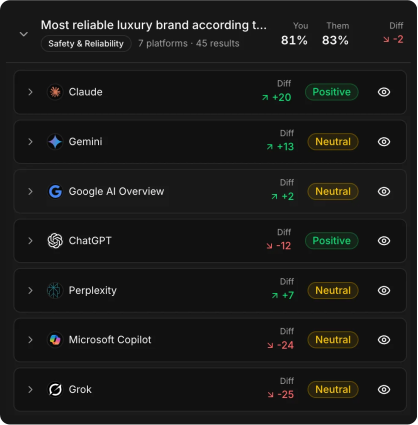
Win customers from all major AI platforms
Understand, measure, and optimize your AI visibility via Ansvisor.
✓ Add brand, domains and competitors
✓ Discover prompts and growth opportunities
✓ Track your AI visibility across major AI platforms
✓ Monitor citations, mentions, and competitors
✓ Measure AI traffic and customer discovery
✓ Receive AI recommendations based on AI insights
✓ Optimize authority, trust, and content quality
✓ Create content, automate analysis & action with AI agents
AI Visibility Terms
Continue exploring key AI visibility concepts.
AI Visibility
Measure and improve how often your brand appears in AI-generated answers.
Learn more →Answer Engine Optimization (AEO)
Strategies for increasing visibility in answer engines and AI summaries.
Learn more →Generative Engine Optimization (GEO)
Optimizing content for AI-powered discovery experiences.
Learn more →ChatGPT Search
Understand how OpenAI retrieves and synthesizes information.
Learn more →Google AI Overviews
AI-generated summaries that appear directly in Google Search.
Learn more →Perplexity Search
Explore how Perplexity cites and presents sources.
Learn more →AI Citations
References and sources used by AI systems to support answers.
Learn more →Citation Authority
Measure the quality and influence of cited sources.
Learn more →Retrievability
How easily AI systems can discover and reuse your content.
Learn more →New terms are added regularly.
Help us improve the page or suggest a new term →
Cihan Geyik
Co-founder at Ansvisor
Cihan Geyik is the co-founder of Ansvisor, an open-source AI Visibility platform for AI Search. With more than 15 years of experience in digital marketing and growth, he writes about AI visibility, AI search, AEO, GEO, citations, and answer engines. He focuses on helping brands understand and improve their presence across ChatGPT, Gemini, Perplexity, Google AI Overviews, and other AI-powered discovery platforms.
Get more Ansvisor insights in Google
Add Ansvisor as a Preferred Source to see more of our AI Search, AEO, GEO, and AI Visibility insights across Google.
Make Your Brand Visible in AI Answers.

INDUSTRIES


© 2026 Ansvisor. All rights reserved. Ansvisor is an open-source AI Search Intelligence Platform for AI Visibility. Ansvisor is a brand owned and operated by Empler AI Inc.


.svg)