



Framer
What is Framer?
Framer is an AI-powered website builder and content management platform used to design, manage, optimize, and publish websites.
It combines a visual design canvas with CMS functionality, managed hosting, SEO controls, analytics, localization, collaboration tools, code components, and AI agents.
Framer is commonly used for business websites, SaaS websites, startup sites, marketing pages, portfolios, directories, blogs, landing pages, and CMS-driven content experiences.
Within AI Search, Framer is relevant primarily as the website, content, and implementation layer where organizations can make their information accessible, structured, machine-readable, and easier to optimize for traditional search and AI-powered discovery.
Why is Framer relevant to AI Search?
AI Search optimization depends partly on how clearly a website exposes its information to search engines, crawlers, retrieval systems, and AI agents.
Framer provides several capabilities that support this foundation, including:
- Server-side pre-rendered HTML.
- AI-readable Markdown versions of pages.
- Automatically generated XML sitemaps.
- Automatically generated robots.txt files.
- Custom robots.txt support on supported plans.
- Metadata controls.
- Canonical URLs.
- Redirects.
- JSON-LD structured data.
- CMS content.
- Dynamic pages.
- Custom code.
- Localization.
- Analytics.
- AI-assisted website and content management.
These features make Framer useful as an implementation environment for SEO, AEO, GEO, and broader AI Search strategies.
Is Framer an AI Search platform?
Not in the same sense as a dedicated AI Search Intelligence platform.
Framer helps teams build, publish, structure, and optimize websites, but it does not systematically monitor external prompts across AI systems, calculate cross-platform AI visibility, or compare brand and competitor mentions inside generated answers.
A useful distinction is:
AI Search Intelligence → Opportunity → Website or Content Action → Framer → Measurement
Framer provides the environment where many identified opportunities can be implemented.
What is Framer 3.0?
Framer 3.0 was introduced in June 2026 and expanded Framer's AI capabilities significantly.
The release introduced Agents directly into the Framer canvas, alongside features including Branching and an updated collaborative workflow.
Framer Agents can work directly on website projects and help with activities such as:
- Designing pages.
- Creating sections.
- Editing copy.
- Creating responsive breakpoints.
- Adding effects.
- Creating components.
- Writing code.
- Working with CMS content.
- Organizing styles.
- Analyzing site information.
This moves Framer beyond a traditional visual website builder toward a more agent-assisted website production environment.
What are Framer Agents?
Framer Agents are AI-powered assistants that work directly inside a Framer project.
Users can describe a website, page, section, design change, content update, or functionality they need, and the Agent can make editable changes directly within the canvas.
Framer positions this workflow around maintaining visual control: teams can start from an AI-generated result and continue editing the design manually.
A typical workflow can be represented as:
Prompt → AI Agent → Website Change → Human Review → Publish
Can Framer AI create entire websites?
Yes.
Framer's AI website builder allows users to start from a prompt, brief, existing idea, or blank canvas and generate an initial website direction.
The Agent can create elements such as:
- Page structure.
- Sections.
- Headlines.
- Draft copy.
- Visual layouts.
- Responsive designs.
- Components.
The resulting website remains editable inside the Framer canvas.
Can Framer AI manage CMS content?
Yes.
Framer Agents can work directly with CMS collections and content.
Current Framer capabilities include using AI to:
- Create CMS collections.
- Populate collections.
- Refine CMS content.
- Rewrite copy.
- Organize content.
- Work with collection relationships.
- Perform bulk content operations.
This can make Framer useful for larger content-driven websites where content structure and website design need to remain connected.
What is the Framer CMS?
Framer CMS is the structured content-management layer within Framer.
It allows teams to create collections containing repeatable fields such as:
- Titles.
- Text.
- Images.
- Dates.
- Categories.
- Links.
- Rich text.
- References.
- Other structured fields.
A dynamic CMS template can then generate individual pages from those collection items.
This makes Framer suitable for websites containing blogs, glossaries, resources, directories, case studies, solution pages, industry pages, documentation, or other repeatable content types.
Why is Framer CMS relevant to AI Search?
AI Search optimization often requires improving large groups of related pages rather than optimizing only a homepage.
A structured CMS makes it easier to maintain consistency across information such as:
- Entity descriptions.
- Definitions.
- Categories.
- Product information.
- Author information.
- Industry pages.
- FAQs.
- Metadata.
- Structured data.
This can make it easier to implement AI Search recommendations at scale while preserving a consistent content model.
Can Framer support large content websites?
Yes.
Framer's CMS is designed to support dynamic websites containing large collections of content.
Framer also uses Traffic-aware Pre-Rendering and dynamic optimization mechanisms intended to keep publishing and optimization efficient as sites grow.
Scale itself does not guarantee AI Search performance, however.
Large numbers of repetitive, low-value, or poorly differentiated pages can still create content-quality problems regardless of the CMS being used.
Does Framer support SEO?
Yes.
Framer includes built-in SEO tools and automatically handles several technical elements of publishing.
SEO-related capabilities include:
- Page titles.
- Meta descriptions.
- Canonical URLs.
- Indexing controls.
- Redirects.
- XML sitemaps.
- robots.txt.
- Structured data through JSON-LD.
- Semantic HTML.
- Performance optimization.
- CMS-specific metadata.
These capabilities provide a technical foundation for both traditional search and AI Search optimization.
How does Framer support AEO?
Answer Engine Optimization focuses on improving how information is understood and selected by systems that provide direct answers.
Framer supports AEO by giving teams control over the website content that may become an answer source.
Examples include:
- Clear question-and-answer sections.
- Structured page hierarchy.
- Detailed definitions.
- Product and service information.
- Comparison pages.
- FAQ content.
- Schema markup.
- Author and organization information.
- Internal linking.
Framer does not determine whether an answer engine will actually select the content, but it provides the infrastructure where these improvements can be implemented.
How does Framer support GEO?
Generative Engine Optimization focuses on improving how brands, entities, products, services, and information appear inside generative search systems.
Framer can support GEO actions such as:
- Expanding missing topic coverage.
- Improving entity descriptions.
- Creating comparison content.
- Publishing supporting research.
- Adding FAQs.
- Improving structured information.
- Updating outdated content.
- Improving internal links.
- Adding relevant evidence and references.
The CMS and website builder provide the implementation environment, while external AI Search measurement is required to understand whether those changes improve visibility.
Does Framer make websites readable by AI agents?
Yes.
Framer specifically provides infrastructure designed to make published websites readable by AI agents and crawlers.
Every Framer page is pre-rendered to HTML on Framer's servers before it is served.
This means crawlers that do not execute JavaScript can still receive important page content including:
- Headings.
- Paragraphs.
- Semantic HTML.
- Page titles.
- Meta descriptions.
- Open Graph information.
- Canonical URLs.
- JSON-LD structured data.
This is particularly relevant because some automated retrieval systems do not behave like full browser environments.
Does Framer provide Markdown versions of pages for AI agents?
Yes.
Framer can serve a clean Markdown representation of published pages from the same URL when an AI tool requests Markdown content.
This gives compatible AI agents a simplified representation of the website's text and structure.
The feature is designed to make content easier for AI tools to read and understand without requiring website owners to maintain a separate Markdown site.
Does Markdown access guarantee AI visibility?
No.
Making content easier for AI agents to retrieve does not guarantee that an AI system will cite, mention, recommend, or rank that content.
A useful distinction is:
Accessible → Retrieved → Evaluated → Selected → Cited or Recommended
Framer can improve the accessibility layer, while the remaining decisions belong to the external search or AI system.
Does Framer support llms.txt?
Yes.
Framer allows supported sites to host an llms.txt file at the root of the domain.
The file can provide additional guidance and structured information to AI agents and automated tools that interact with the website.
Framer supports static files that can be served at paths such as:
https://example.com/llms.txt
The use of llms.txt is optional and should be considered an additional machine-readable discovery mechanism rather than a guaranteed AI visibility signal.
Does Framer generate robots.txt automatically?
Yes.
Framer automatically generates a robots.txt file for every published site.
The file can be accessed at:
https://example.com/robots.txt
Framer also allows custom robots.txt files to be uploaded through Static Files on supported plans.
This allows website owners to manage crawler access more deliberately when needed.
Which AI crawlers can access Framer websites?
Framer states that it regularly tests published sites with major search and AI crawlers.
Examples currently listed by Framer include:
- Googlebot.
- GoogleOther.
- Google-Extended.
- Bingbot.
- GPTBot.
- PerplexityBot.
- Other supported search crawlers.
Framer's automatically generated robots.txt configuration allows search and AI crawlers by default, although site owners can apply different restrictions.
Does Framer generate XML sitemaps?
Yes.
Framer automatically generates and maintains an XML sitemap for every published site.
The sitemap can normally be accessed at:
https://example.com/sitemap.xml
The sitemap updates as published website content changes.
Sitemaps help search engines discover website pages but do not guarantee indexing, rankings, citations, or AI visibility.
Can Framer connect with Google Search Console?
Yes.
Framer provides documented workflows for verifying a site with Google Search Console.
Website owners can use Search Console to monitor:
- Queries.
- Impressions.
- Clicks.
- CTR.
- Pages.
- Indexing.
- Other Google Search performance signals.
Framer's automatically generated sitemap can also be submitted to Google Search Console.
Can Framer use structured data?
Yes.
Framer allows structured data such as JSON-LD to be added through Custom Code.
Structured data can describe entities such as:
- Organizations.
- People.
- Products.
- Articles.
- Software applications.
- Breadcrumbs.
- Events.
- Other supported entities.
Structured data can also be generated dynamically on CMS detail pages using CMS variables.
Can every Framer CMS page have unique structured data?
Yes.
Framer allows CMS variables to be inserted into Custom Code.
This means individual CMS pages can output different JSON-LD values based on their underlying content fields.
For large structured content systems, this can help maintain page-specific entity information without manually writing schema for every URL.
Does schema markup guarantee AI visibility?
No.
Structured data provides explicit machine-readable context, but it does not guarantee that an AI system will retrieve or cite a page.
AI Search performance can also depend on:
- Content relevance.
- Source authority.
- Topical coverage.
- Entity clarity.
- External references.
- Retrieval behavior.
- Competitive source selection.
Does Framer support canonical URLs?
Yes.
Framer automatically generates canonical tags based on the site's connected domain.
Custom canonical URLs can also be configured when a site is served through alternative infrastructure such as a reverse proxy or subdirectory.
Canonical URLs help search engines understand which version of duplicated or accessible content should be treated as primary.
Does Framer support redirects?
Yes.
Framer allows website owners to configure redirects from one URL to another.
Redirects can be useful when:
- Changing page URLs.
- Migrating a website.
- Replacing older pages.
- Reorganizing information architecture.
- Consolidating duplicated content.
Maintaining correct redirects can protect search equity when website structures change.
Can Framer pages be localized?
Yes.
Framer includes Localization functionality for creating multiple language and regional versions of website content.
Teams can manage localized versions of both canvas content and CMS content.
Localization is particularly relevant to international AI Search because user prompts, search demand, terminology, competitors, and source selection can vary significantly by language and market.
Does Framer support AI translation?
Yes.
Framer provides AI-assisted translation capabilities within Localization.
Auto Translate can automatically keep supported locales synchronized when content is added or updated in the canvas or CMS.
Teams can also choose to translate selected pages or content manually.
AI-generated translations should still be reviewed when terminology, legal language, brand voice, or technical accuracy is important.
Why is localization important for AI Search?
AI visibility is not necessarily identical across countries and languages.
A brand can be highly visible in English-language prompts while having much weaker visibility in another language.
Localized Framer websites can help organizations create market-specific content for:
- Local terminology.
- Country-specific products.
- Regional services.
- Local competitors.
- Local customer questions.
- Language-specific informational intent.
Does Framer include analytics?
Yes.
Framer provides built-in privacy-focused website analytics.
Available metrics currently include information such as:
- Live visitors.
- Unique visitors.
- Pageviews.
- Bounce rate.
- Average session duration.
- Traffic sources.
- UTM parameters.
- Popular pages.
- Entry pages.
- Exit pages.
- Countries.
- Devices.
- Browsers.
- Operating systems.
These metrics can help website owners understand what visitors do after reaching the site.
Can Framer Analytics identify AI referral traffic?
Potentially.
Framer Analytics includes traffic-source reporting, so identifiable referral sources from AI platforms may appear when the browser or referring system provides sufficient information.
However, Framer Analytics should not be treated as a complete measurement system for all AI-influenced traffic.
A visitor may discover a brand through an AI answer and later visit directly, search for the brand, use another device, or follow a link that does not preserve referral information.
In those situations, the original AI influence may not be identifiable.
Can Framer measure AI Visibility?
Not natively.
Framer manages the website and can measure website activity, but it does not systematically collect external AI answers across multiple platforms.
It therefore does not natively provide comprehensive measurement of:
- Tracked AI prompts.
- Brand mentions.
- AI citations.
- AI Share of Voice.
- Competitor visibility.
- Prompt-level rankings.
- Recommendation frequency.
These areas require dedicated AI Search monitoring.
Can Framer measure ChatGPT visibility?
No, not by itself.
Framer can make website content accessible to crawlers such as GPTBot and may identify some referral traffic from AI platforms, but neither of these capabilities reveals how often the brand appears inside ChatGPT responses.
Prompt-level monitoring requires collecting and analyzing responses directly from the AI platform.
Can Framer monitor AI citations?
No.
Framer can host the URLs that AI systems may cite, but it does not systematically monitor whether those pages are actually referenced across ChatGPT, Claude, Gemini, Perplexity, Copilot, or other AI systems.
Citation Intelligence requires external AI-answer monitoring.
Can Framer measure AI Share of Voice?
No, not natively.
AI Share of Voice requires repeatedly testing a defined set of prompts and comparing how often a brand appears relative to relevant competitors.
This is a different task from hosting, publishing, or analyzing website traffic.
Can Framer connect with external analytics tools?
Yes.
Framer supports Custom Code that can be used to add external analytics and marketing scripts.
Examples can include:
- Google Analytics 4.
- Meta Pixel.
- LinkedIn tracking.
- Other analytics or marketing platforms.
This allows organizations to combine Framer's website infrastructure with broader analytics and business measurement systems.
Can Framer use custom code?
Yes.
Framer allows custom CSS, JavaScript, third-party scripts, structured data, analytics tags, and other integrations to be added to websites.
Custom code can be applied globally or to selected pages depending on the implementation.
This gives technical teams additional flexibility when built-in capabilities are not sufficient.
Can Framer Agents write code?
Yes.
Framer's AI Agent can generate custom code components based on natural-language instructions.
A user can describe an interaction or feature and allow the Agent to create code that remains connected to the Framer project.
The generated implementation should still be reviewed and tested before production deployment.
Does Framer support external AI agents?
Yes.
Framer supports workflows with external AI coding and agent environments.
Current Framer documentation includes integrations with tools such as:
- Claude Code.
- Codex in ChatGPT.
- Cursor.
- Other supported external agents.
These agents can interact with areas of a Framer project such as CMS content, pages, localization, redirects, and other supported website-management capabilities.
Why are external agents important for AI Search workflows?
External agents can reduce the gap between identifying an optimization opportunity and implementing it.
A traditional workflow may look like:
AI Search Analysis → Recommendation → Manual Brief → Website Team → Framer Update
A more integrated workflow can potentially become:
AI Search Analysis → Opportunity → Authorized Agent → Framer Draft or Update → Human Review → Publish
Human approval, permissions, testing, and governance remain important whenever automated tools can modify production websites.
Can Framer be used for programmatic content?
Yes.
Framer CMS supports structured content models, dynamic pages, CSV imports, bulk operations, collection relationships, and repeatable templates.
This can support content programs such as:
- Glossaries.
- Directories.
- Industry pages.
- Location pages.
- Resource libraries.
- Comparison pages.
- Knowledge hubs.
- Use-case pages.
Programmatic publishing should still prioritize useful differentiation and genuine information value.
Can Framer be used to create AI Search content hubs?
Yes.
The combination of CMS collections, dynamic pages, internal linking, structured data, localization, and AI-assisted content management makes Framer suitable for large structured knowledge systems.
Examples include:
- AI visibility glossaries.
- Product education hubs.
- Industry resources.
- Research libraries.
- Technical documentation.
- Comparison libraries.
- Frequently asked question collections.
How can Framer support content recommendations?
Framer itself can help create and modify website content, but deciding what should be improved requires additional evidence.
Useful external signals can include:
- Search demand.
- AI prompt visibility.
- AI citations.
- Competitor performance.
- Website analytics.
- Business outcomes.
Once an opportunity is identified, Framer can serve as the implementation environment where the content is created, updated, tested, and published.
How can Ansvisor work with Framer?
Ansvisor is an AI Search Intelligence platform that can help Framer teams discover relevant prompts, analyze AI visibility and citations, identify competitor and content gaps, and determine which AEO and GEO opportunities deserve action.
Using Ansvisor, Framer website owners can use Prompt Discovery, Citation Intelligence, AI Visibility Analysis, and AEO and GEO content recommendations to identify opportunities for increasing qualified AI traffic and strengthening their presence across AI-powered discovery environments.
The resulting intelligence can then be turned into website changes inside Framer.
Potential actions include:
- Improving an existing Framer CMS page.
- Expanding missing topic coverage.
- Creating content for high-value prompts.
- Strengthening pages with weak AI citation visibility.
- Improving entity information.
- Creating comparison or FAQ content.
- Updating outdated information.
- Improving internal linking.
This connects AI Search measurement directly with the website environment where teams can act on the findings.
How can Ansvisor support Prompt Discovery for Framer websites?
AI Search users frequently express intent through conversational prompts rather than traditional keyword searches.
Ansvisor can help identify prompts relevant to the products, services, topics, audience, and existing search demand associated with a Framer website.
Those prompts can then be monitored to understand:
- Whether the brand appears.
- Which competitors appear.
- Which pages receive citations.
- Which external sources influence answers.
- Which topics have limited visibility.
- Where new content opportunities exist.
These insights can inform which Framer pages should be created or improved.
How can Ansvisor Citation Intelligence help Framer websites?
Citation Intelligence reveals which URLs and external sources AI systems rely on when generating answers.
For a Framer website, this can help answer questions such as:
- Which Framer pages are already cited?
- Which prompts trigger those citations?
- Which competitor URLs are cited instead?
- Which third-party sources influence the answer?
- Which existing pages have citation gaps?
- Where new supporting content may be needed?
These signals can help teams prioritize website changes using observed AI behavior rather than generic optimization assumptions.
How can Ansvisor support Framer content recommendations?
A Framer website may contain many potential optimization opportunities, but not every page should receive the same priority.
Ansvisor can combine AI Search signals with available search and website-performance context to identify which opportunities may matter more.
Potential recommendations can include:
- Optimize an existing page rather than create a duplicate.
- Expand a page around uncovered prompts.
- Improve pages with weak citation visibility.
- Create content for meaningful visibility gaps.
- Protect content already contributing to traffic or business outcomes.
The broader workflow can be represented as:
Analytics → Opportunities → Actions → Framer Content → Measurement
Can Framer be part of an automated AI Search workflow?
Yes.
Framer's Agents, CMS, external-agent integrations, custom code, and website-management capabilities make it suitable for increasingly automated content workflows.
A possible workflow is:
Prompt Monitoring → AI Visibility Analysis → Opportunity Detection → Content Recommendation → Framer Draft → Review → Publish → Measure Again
Organizations should maintain appropriate review and publishing controls before automated systems are allowed to change live website content.
What is the difference between Framer and an AI Search Intelligence platform?
Framer and AI Search Intelligence platforms operate at different stages of the website optimization process.
Framer primarily helps answer:
- How do we build the website?
- Where do we manage content?
- How do we design pages?
- How do we publish changes?
- How do we manage CMS content?
- How do we expose content to crawlers?
An AI Search Intelligence platform helps answer:
- Which prompts matter?
- Where is the brand visible?
- Which competitors appear?
- Which URLs receive citations?
- Which sources influence AI answers?
- Where are the visibility gaps?
- What should be improved next?
The two systems are therefore complementary rather than substitutes.
Can Framer replace an AI visibility platform?
No.
Framer provides the website, CMS, publishing, analytics, and implementation infrastructure.
It does not independently provide continuous cross-platform monitoring of prompts, brand mentions, citations, competitors, or AI Share of Voice.
A practical workflow can combine the two:
Measure → Understand → Prioritize → Update Framer → Measure Again
Does using Framer automatically improve AI visibility?
No.
Framer provides a technically strong environment for publishing accessible and structured websites, but choosing a particular website builder does not automatically cause AI systems to cite or recommend a brand.
AI Search performance can depend on:
- Content quality.
- Topical relevance.
- Entity clarity.
- Source authority.
- External citations.
- Competitive coverage.
- Freshness.
- Retrieval behavior.
- Platform-specific ranking systems.
What are the limitations of Framer for AI Search?
Framer provides useful website and AI infrastructure, but it has clear limitations as an AI Search solution.
- It does not natively monitor prompts across external AI platforms.
- It does not calculate cross-platform AI visibility.
- It does not provide native competitor AI Share of Voice.
- It does not systematically collect citations from AI answers.
- AI-readable Markdown does not guarantee citations.
- llms.txt does not guarantee AI visibility.
- AI crawler access does not guarantee retrieval or recommendation.
- AI referral analytics cannot capture every AI-influenced journey.
Framer should therefore be viewed as a modern website, CMS, and implementation layer within a broader AI Search strategy.
Is Framer an AI visibility tool?
No. Framer is primarily an AI-powered website builder and CMS rather than a dedicated AI visibility monitoring platform.
It helps organizations create, structure, expose, manage, and optimize the content that AI systems may discover.
AI Search Intelligence platforms such as Ansvisor complement Framer by identifying prompt, visibility, citation, competitor, and content opportunities that can then be translated into changes on the website.
Is Framer an AEO or GEO tool?
Framer is not primarily an AEO or GEO analytics platform.
However, it can be an important implementation environment for both.
Teams can use Framer to execute AEO and GEO recommendations by improving content structure, adding new pages, updating existing information, publishing structured data, improving internal links, and expanding topical coverage.
Who should use Framer for AI Search optimization?
Framer can be particularly useful for teams that want a visual, AI-assisted website environment while maintaining control over content and publishing.
Relevant users include:
- Startups.
- SaaS companies.
- B2B companies.
- Marketing teams.
- Growth teams.
- Content teams.
- SEO teams.
- AEO and GEO practitioners.
- Designers.
- Developers.
- Agencies.
- Product marketers.
- Enterprise teams.
Framer and the AI Search ecosystem
Framer occupies the website design, CMS, publishing, technical SEO, AI-agent accessibility, analytics, and increasingly agent-assisted implementation layer of the AI Search ecosystem.
Its infrastructure helps teams create and expose the pages, entities, product information, research, FAQs, comparisons, and other information that search engines and AI systems may retrieve.
Framer's server-rendered HTML, AI-readable Markdown, automatic sitemap and robots.txt files, structured-data support, CMS, AI Agents, and external-agent workflows make it especially relevant to websites preparing for AI-powered discovery.
However, managing the website and measuring how the website performs inside external AI systems remain different tasks.
A broader workflow can be represented as:
Prompt Discovery → AI Visibility & Citation Analysis → Opportunity → AEO/GEO Action → Framer → Measurement
Using Ansvisor, an AI Search Intelligence platform, Framer website owners can use Prompt Discovery, Citation Intelligence, AI Visibility Analysis, and AEO and GEO content recommendations to identify opportunities for increasing qualified AI traffic and strengthening their presence across AI-powered discovery environments.
This connects intelligence about what happens inside AI answers with the Framer environment where teams can implement and publish the resulting actions.
Ansvisor maintains a broader AI Visibility Glossary covering the platforms, website systems, technologies, metrics, and optimization concepts shaping AI Search, AEO, GEO, AI SEO, and AI visibility.
Official Sources:
Framer CMS:
https://www.framer.com/cms/
Framer SEO documentation:
https://www.framer.com/help/seo/
FAQ
What is Framer?

Framer is an AI-powered website builder and CMS for designing, managing, optimizing, and publishing websites. It combines a visual canvas, AI agents, CMS, SEO controls, analytics, localization, hosting, and code capabilities in one environment.
Is Framer good for AI Search, AEO, and GEO?
Yes, primarily as an implementation platform. Framer provides server-rendered HTML, AI-readable Markdown, sitemaps, robots.txt, structured data, CMS content, metadata controls, and other infrastructure useful for search and AI discovery. It does not guarantee AI visibility.
Does Framer make websites readable by AI agents?
Yes. Framer states that pages are pre-rendered to HTML and can also be served as structured Markdown to compatible AI tools. Its default robots.txt allows major AI and search crawlers, subject to site-level restrictions.
Can Framer measure ChatGPT mentions and AI citations?
Not natively. Framer can provide website analytics and may identify some referral sources, but it does not systematically monitor prompts, brand mentions, citations, competitors, or AI Share of Voice across external AI systems.
How can Ansvisor help a Framer website?
Ansvisor can help Framer teams discover relevant prompts, analyze AI visibility and citations, identify competitor and content gaps, and generate AEO and GEO optimization opportunities. Those insights can then be implemented through Framer pages, CMS content, or agent-assisted workflows.
Everything You Need to Improve Your AI Visibility
Track how your brand appears across AI platforms, understand what drives visibility, and turn insights into measurable actions.
Platform Features
Explore all features →Answer Engine Insights
Understand how AI platforms talk about your brand.
Prompt Intelligence
Discover and monitor the prompts shaping your AI visibility.
Citations Monitoring
Track which sources AI platforms cite and where your brand appears.
AI Traffic Analytics
Measure visits coming from ChatGPT, Gemini, Claude, and more.
Competitor Benchmarking
Compare AI visibility and uncover competitive gaps and opportunities.
Action Center
Turn AI Search signals into prioritized actions and executable tasks.
AI Visibility Trackers
Explore AI Visibility Platform →ChatGPT Visibility Tracker
Track brand mentions, citations, prompts, and visibility across ChatGPT.
Google AI Overviews Rank Tracker
Monitor where and how your brand appears in Google AI Overviews.
Google AI Mode Visibility Tracker
Track your brand's visibility across Google AI Mode experiences.
Gemini Visibility Tracker
Understand how your brand appears across Google Gemini responses.
Microsoft Copilot Visibility Tracker
Monitor your brand's presence across Microsoft Copilot answers.
Perplexity Visibility Tracker
Track brand mentions, citations, and visibility across Perplexity.
From AI Visibility insights to action.
Explore the complete Ansvisor platform for AI Search intelligence, optimization, and growth.
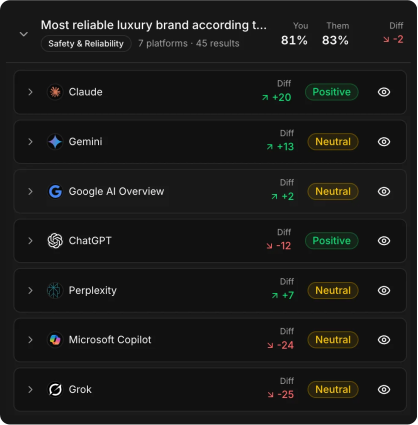
Win customers from all major AI platforms
Understand, measure, and optimize your AI visibility via Ansvisor.
✓ Add brand, domains and competitors
✓ Discover prompts and growth opportunities
✓ Track your AI visibility across major AI platforms
✓ Monitor citations, mentions, and competitors
✓ Measure AI traffic and customer discovery
✓ Receive AI recommendations based on AI insights
✓ Optimize authority, trust, and content quality
✓ Create content, automate analysis & action with AI agents
AI Visibility Terms
Continue exploring key AI visibility concepts.
AI Visibility
Measure and improve how often your brand appears in AI-generated answers.
Learn more →Answer Engine Optimization (AEO)
Strategies for increasing visibility in answer engines and AI summaries.
Learn more →Generative Engine Optimization (GEO)
Optimizing content for AI-powered discovery experiences.
Learn more →ChatGPT Search
Understand how OpenAI retrieves and synthesizes information.
Learn more →Google AI Overviews
AI-generated summaries that appear directly in Google Search.
Learn more →Perplexity Search
Explore how Perplexity cites and presents sources.
Learn more →AI Citations
References and sources used by AI systems to support answers.
Learn more →Citation Authority
Measure the quality and influence of cited sources.
Learn more →Retrievability
How easily AI systems can discover and reuse your content.
Learn more →New terms are added regularly.
Help us improve the page or suggest a new term →
Cihan Geyik
Co-founder at Ansvisor
Cihan Geyik is the co-founder of Ansvisor, an open-source AI Visibility platform for AI Search. With more than 15 years of experience in digital marketing and growth, he writes about AI visibility, AI search, AEO, GEO, citations, and answer engines. He focuses on helping brands understand and improve their presence across ChatGPT, Gemini, Perplexity, Google AI Overviews, and other AI-powered discovery platforms.
Get more Ansvisor insights in Google
Add Ansvisor as a Preferred Source to see more of our AI Search, AEO, GEO, and AI Visibility insights across Google.
Make Your Brand Visible in AI Answers.

INDUSTRIES


© 2026 Ansvisor. All rights reserved. Ansvisor is an open-source AI Search Intelligence Platform for AI Visibility. Ansvisor is a brand owned and operated by Empler AI Inc.