


AI Visibility Monitoring
Why AI Visibility Monitoring matters
AI Visibility Monitoring is the continuous process of tracking how brands, products, services, websites, and other entities appear across AI-powered search and answer engines.
Unlike traditional search monitoring, which commonly focuses on keyword rankings, search impressions, clicks, and organic traffic, AI Visibility Monitoring measures what happens inside AI-generated answers. It helps organizations understand whether their brands are mentioned, which sources are cited, which competitors appear, and how visibility changes across prompts, topics, platforms, and time.
As platforms such as ChatGPT Search, Perplexity Search, and Google AI Overviews increasingly influence discovery and decision-making, organizations need to understand how they are represented across AI-powered discovery environments.
AI Visibility Monitoring can help organizations:
- Track brand visibility over time.
- Identify changes in AI-generated answers.
- Monitor brand mentions and citations.
- Measure visibility across strategically important prompts.
- Compare performance with competitors.
- Understand platform-level visibility differences.
- Measure the impact of AEO, GEO, and AI Search optimization initiatives.
- Detect emerging opportunities and visibility risks.
- Identify topics where competitors have stronger coverage.
- Connect AI visibility with identifiable AI-referred traffic.
Continuous monitoring turns AI Visibility from a point-in-time observation into a measurable performance signal that can be compared historically.
It can also provide the measurement foundation for an AEO strategy, helping teams understand whether Answer Engine Optimization initiatives correspond with measurable changes in mentions, citations, prompt coverage, competitive visibility, and other AI Search signals.
What is AI Visibility Monitoring?
AI Visibility Monitoring is the repeated measurement of brand and source presence within a defined set of AI-generated answers.
A monitoring program typically starts with a portfolio of strategically relevant prompts and tracks how those prompts are answered across selected AI platforms. The resulting answers can then be analyzed for signals such as brand mentions, citations, competitors, recommendations, and source visibility.
A simplified monitoring process looks like:
Prompts → AI Answers → Brand Presence → Mentions → Citations → Competitors → Historical Change
The purpose is not to observe every private AI conversation. Instead, organizations build a representative measurement set that reflects important customer questions, topics, products, categories, competitors, and commercial intents.
Why is continuous AI Visibility Monitoring important?
AI-generated answers are dynamic. The same or similar prompt can produce different responses as models, retrieval systems, web sources, competitor content, and platform features change.
A single manual test can show what happened at one moment, but it provides limited information about whether the result is persistent or whether visibility is improving or declining.
Continuous monitoring adds historical context:
Baseline → Repeated Measurement → Change Detection → Analysis → Action → Measurement Again
This allows teams to distinguish isolated observations from broader visibility trends.
For example, an organization can investigate whether:
- A previously visible brand disappears from important prompts.
- A competitor begins appearing more frequently.
- A website gains or loses citations.
- A new source becomes influential across a topic.
- Visibility improves after content optimization.
- A new AI platform begins producing different competitive results.
What should organizations monitor?
AI Visibility Monitoring typically combines several categories of signals rather than relying on a single visibility metric.
Common signals include:
- AI Mentions.
- AI Citations.
- AI Share of Voice.
- AI Visibility.
- Prompt Coverage.
- Citation Rate.
- Recommendation presence.
- Competitor visibility.
- Platform-level visibility.
- Topic-level visibility.
- Historical gains and losses.
- AI Referral Traffic where identifiable.
Each metric describes a different part of AI-powered discovery.
For example:
- AI Visibility measures whether the brand appears across the monitored answer set.
- AI Mentions identify when the brand becomes part of an answer.
- AI Citations show when owned pages or domains are referenced as sources.
- Share of Voice provides competitive context.
- Prompt Coverage measures how broadly the brand appears across strategically relevant questions.
- AI Referral Traffic measures identifiable visits originating from AI-powered platforms.
Monitoring multiple signals provides a more complete understanding of performance than relying on one aggregated score.
How AI Visibility Monitoring works
AI Visibility Monitoring platforms can repeatedly collect and analyze AI-generated answers for a defined set of prompts.
A typical monitoring workflow includes:
- Define the brand, products, competitors, and topics to monitor.
- Create or discover strategically relevant prompts.
- Group prompts by topic, intent, product, market, or customer journey.
- Select relevant AI Search and answer-engine platforms.
- Capture AI-generated answers.
- Detect brand and competitor mentions.
- Extract citations and source URLs.
- Calculate visibility and competitive metrics.
- Store historical results.
- Detect meaningful changes and opportunities.
Capabilities such as Prompt Monitoring, Citation Monitoring, and AI Search Analytics help organizations understand how visibility evolves across answer engines.
Why are prompts important for AI Visibility Monitoring?
Prompts are one of the primary measurement units of AI Visibility because users interact with AI systems through questions, instructions, comparisons, and conversational requests.
Traditional rank tracking often begins with:
Keyword → Search Results → Position
AI Visibility Monitoring can instead examine:
Prompt → AI Answer → Brand Presence → Mention or Citation → Competitive Position
A representative prompt portfolio can include:
- Informational questions.
- Category discovery prompts.
- Product or service recommendations.
- Best-product or best-provider questions.
- Alternative searches.
- Competitor comparisons.
- Use-case questions.
- Problem-solving prompts.
- High-intent commercial questions.
Monitoring only branded prompts can produce an incomplete view of visibility. Organizations also need to understand whether they appear when users ask broader category, problem, comparison, and recommendation questions.
What is Prompt Coverage in AI Visibility Monitoring?
Prompt Coverage describes how broadly a brand appears across a defined portfolio of strategically relevant prompts.
For example, a company may appear frequently for informational questions but have weak visibility for product comparisons or high-intent recommendation prompts.
Prompt Coverage can therefore be analyzed by:
- Topic.
- Intent.
- Product.
- Use case.
- Customer journey stage.
- Platform.
- Market or region.
This helps teams identify where visibility is concentrated and where meaningful coverage gaps remain.
How do you monitor AI Mentions?
AI Mention monitoring tracks when a brand, company, product, service, or other entity appears within monitored AI-generated answers.
Teams can analyze:
- How frequently the brand is mentioned.
- Which prompts generate mentions.
- Which topics produce brand visibility.
- Which platforms mention the brand.
- Which competitors appear alongside the brand.
- Whether mention frequency increases or decreases over time.
Mention context is also important. Being named inside an answer does not necessarily mean the brand is being recommended.
This is why mention monitoring should be combined with citations, competitive visibility, prompt context, and other answer-level signals.
How do you monitor AI Citations?
AI Citation monitoring measures when a domain or individual URL appears as a source within an AI-generated answer.
Organizations can track:
- Total owned citations.
- Citation Rate.
- Unique cited URLs.
- Unique cited domains.
- Prompts generating citations.
- Pages receiving citations.
- Competitor citations.
- Third-party cited sources.
- Citation gains and losses.
Mentions and citations should be treated as separate signals:
Mention → Entity Presence
Citation → Source Presence
A brand may be frequently mentioned while receiving few citations to its own domain. Conversely, an owned page can sometimes be used as a source without the brand becoming a prominent part of the generated answer.
How do you monitor AI Share of Voice?
AI Share of Voice compares a brand's presence with selected competitors across a defined AI Search measurement set.
It can help answer questions such as:
- Which brands dominate important prompt clusters?
- Is our relative visibility improving?
- Which competitors are gaining visibility?
- Where are we underrepresented?
- Which topics have the largest competitive visibility gaps?
AI Share of Voice should always be interpreted within the prompts, competitors, platforms, markets, languages, and time period included in the analysis.
AI Share of Voice ≠ Total Market Share
It represents competitive visibility within the monitored AI answer set.
How do you monitor competitors in AI Search?
Competitor monitoring applies comparable AI Visibility measurements to competing brands.
Organizations can compare:
- AI Visibility.
- Brand mentions.
- Prompt Coverage.
- Share of Voice.
- AI citations.
- Citation Rate.
- Recommendation presence.
- Platform coverage.
- Topic-level performance.
- Historical gains and losses.
Competitive monitoring provides context that absolute visibility metrics cannot provide alone.
For example, a brand's visibility may increase while a competitor grows even faster. Without competitive context, the first increase could appear stronger than it actually is within the monitored market.
How do you monitor AI Visibility across multiple platforms?
AI Visibility should generally be measured across the AI-powered platforms relevant to an organization's audience and market.
The same prompt can produce different answers, sources, brands, citations, and recommendations across different platforms.
Multi-platform monitoring can reveal:
- Where the brand has its strongest visibility.
- Where competitors outperform it.
- Which platforms cite owned content most frequently.
- Where important prompt gaps exist.
- How visibility changes independently across platforms.
This means strong visibility on one answer engine should not automatically be interpreted as strong AI Visibility everywhere.
How do you monitor AI Visibility over time?
Historical monitoring stores comparable measurements so teams can understand whether visibility is improving, declining, or shifting.
Changes can be evaluated across:
- Individual prompts.
- Prompt clusters.
- Topics.
- Competitors.
- Citations.
- Platforms.
- Products.
- Markets.
- Defined time periods.
Historical measurement makes it possible to establish a baseline before major optimization initiatives.
A simple framework is:
Before Optimization → AEO/GEO Action → After Optimization → Compare Results
This does not prove that every observed change was caused by the optimization. Models, competitors, retrieval systems, and available sources can also change. However, historical measurement provides a stronger basis for evaluating performance than isolated snapshots.
How can AI Visibility Monitoring measure AEO performance?
AI Visibility Monitoring provides a measurement layer for Answer Engine Optimization (AEO).
Teams can establish a baseline before optimization work and then monitor whether relevant signals change afterward.
For example:
- Did visibility improve for targeted prompts?
- Did Prompt Coverage expand?
- Did owned citation frequency increase?
- Did Share of Voice improve against competitors?
- Did previously absent pages begin receiving citations?
- Did visibility improve on targeted AI platforms?
This creates an optimization feedback loop:
Measure → Identify Gap → Optimize → Monitor → Compare → Learn
Monitoring therefore helps transform AEO from a collection of tactics into a measurable and iterative process.
How can AI Visibility Monitoring support GEO?
Generative Engine Optimization (GEO) focuses on improving how information is discovered, retrieved, represented, or cited within generative AI experiences.
AI Visibility Monitoring can help measure whether GEO initiatives correspond with changes in:
- Brand visibility.
- Source visibility.
- Citations.
- Prompt Coverage.
- Competitor performance.
- Platform-level visibility.
AEO, GEO, and AI Search Optimization therefore depend on measurement systems that can show whether optimization work is producing observable changes.
How does AI Visibility Monitoring relate to AI Referral Traffic?
AI Visibility measures presence inside AI-generated answers, while AI Referral Traffic measures identifiable website visits originating from AI-powered platforms.
These are related but distinct stages:
Prompt → AI Answer → Visibility → Citation or Link → AI-Referred Visit
A brand can gain meaningful visibility without receiving a direct website visit. Similarly, an AI citation does not guarantee a click.
This distinction can be summarized as:
Visibility ≠ Citation ≠ Traffic ≠ Conversion
Monitoring these signals separately helps organizations understand different stages of AI-powered discovery rather than treating website traffic as the only measure of success.
What are AI Visibility Monitoring KPIs?
AI Visibility Monitoring KPIs are measurable targets used to determine whether performance is moving toward a desired outcome.
Depending on the organization, KPIs can include:
- Increase AI Visibility.
- Increase high-value Prompt Coverage.
- Increase owned citations.
- Improve Citation Rate.
- Increase Share of Voice.
- Reduce competitor visibility gaps.
- Expand visibility across additional AI platforms.
- Increase identifiable AI Referral Traffic.
KPIs become more useful when they are connected with specific topics, prompts, competitors, opportunities, and actions rather than monitored as isolated dashboard numbers.
How organizations use AI Visibility Monitoring
Organizations can use AI Visibility Monitoring across marketing, SEO, content, brand, product, competitive intelligence, and growth workflows.
Common use cases include:
- Tracking overall brand performance.
- Measuring AEO and GEO initiatives.
- Monitoring competitor visibility.
- Identifying content opportunities.
- Finding citation gaps.
- Tracking recommendation and comparison prompts.
- Monitoring brand representation.
- Detecting visibility gains and losses.
- Reporting AI Search trends.
- Prioritizing optimization opportunities.
Platforms such as Ansvisor enable organizations to monitor visibility across prompts, competitors, answer engines, topics, regions, and languages while tracking changes over time.
Ansvisor also connects AI Visibility Monitoring with prompt intelligence, citation analysis, competitor benchmarking, AI Traffic Analytics, Agent Chat, and prioritized actions so teams can move from measurement toward optimization.
How do you turn AI Visibility Monitoring into action?
Monitoring becomes more valuable when detected changes lead to investigation and action.
For example, monitoring can reveal:
- A high-value prompt where the brand is absent.
- A competitor gaining visibility across an important topic.
- A previously cited page losing citation coverage.
- Strong brand mentions but weak owned-domain citations.
- A platform where the brand consistently underperforms.
- A new third-party source becoming influential.
- A prompt cluster where demand is strong but coverage is weak.
These signals can then lead to actions such as:
- Creating new content.
- Optimizing an existing page.
- Expanding topic coverage.
- Strengthening citation-worthy information.
- Improving internal linking.
- Closing competitor content gaps.
- Building relevant third-party authority.
- Investigating platform-specific visibility gaps.
The workflow becomes:
Monitoring → Signal → Opportunity → Action → Measurement → Validation
How often should AI Visibility be monitored?
There is no universal monitoring frequency that is appropriate for every organization.
The appropriate cadence can depend on:
- The importance of the prompts being tracked.
- The number of AI platforms monitored.
- The competitiveness of the category.
- How frequently content is updated.
- The speed of optimization activity.
- The amount of historical detail required.
High-priority prompts may justify more frequent monitoring, while broader or slower-moving topics can be measured less frequently.
Consistency is particularly important because irregular measurement can make historical comparisons harder to interpret.
What are the limitations of AI Visibility Monitoring?
AI Visibility Monitoring provides useful performance intelligence, but the results should be interpreted within the boundaries of the measurement methodology.
Important limitations include:
- AI-generated answers can vary between repeated runs.
- Models and retrieval systems can change.
- Different platforms can produce different answers for the same prompt.
- Results may vary by location and language.
- A monitored prompt portfolio does not represent every private AI conversation.
- A brand mention does not necessarily represent a recommendation.
- A citation does not necessarily generate a click.
- AI Referral Traffic does not capture every AI-influenced customer journey.
- Different monitoring platforms may calculate visibility metrics differently.
These limitations make consistent methodology, representative prompt selection, historical tracking, and multi-signal measurement especially important.
Common AI Visibility Monitoring mistakes
Common mistakes include:
- Monitoring only one AI platform.
- Tracking only citations or mentions.
- Using inconsistent prompt sets.
- Tracking only branded prompts.
- Ignoring competitor visibility.
- Ignoring platform-level differences.
- Measuring only short-term changes.
- Relying on a single aggregated visibility score.
- Measuring visibility without establishing a baseline.
- Collecting data without connecting it to optimization actions.
A stronger monitoring strategy combines multiple platforms, metrics, representative prompts, competitive context, and historical data to understand how AI-generated visibility changes over time.
AI Visibility Monitoring and AI Search Intelligence
AI Visibility Monitoring answers an important question:
How is our brand's presence across AI Search changing?
AI Search Intelligence expands that question by connecting visibility with prompts, demand, citations, competitors, sources, traditional search data, AI-referred traffic, opportunities, and actions.
This creates a broader intelligence loop:
Prompts → AI Answers → Visibility → Mentions → Citations → Competitors → Opportunities → Actions → Measurement
In this model, AI Visibility Monitoring is not simply a reporting function. It provides the historical measurement layer required to identify meaningful changes, prioritize opportunities, evaluate optimization initiatives, and determine what teams should investigate or improve next.
FAQ
What is AI Visibility Monitoring?

AI Visibility Monitoring is the continuous tracking of brand visibility across AI-powered search and answer engines.
Why is AI Visibility Monitoring important?
It helps organizations understand how AI systems represent, recommend, and cite their brands over time.
What metrics should organizations monitor?
Important metrics include AI Visibility, mentions, citations, Share of Voice, prompt coverage, and competitor visibility.
How often should AI Visibility be monitored?
Because AI-generated answers change frequently, organizations typically monitor visibility continuously or at regular intervals.
Which tools help with AI Visibility Monitoring?
AI Visibility Platforms like Ansvisor help organizations monitor prompts, citations, competitors, AI traffic, and visibility trends across multiple answer engines.
Everything You Need to Improve Your AI Visibility
Track how your brand appears across AI platforms, understand what drives visibility, and turn insights into measurable actions.
Platform Features
Explore all features →Answer Engine Insights
Understand how AI platforms talk about your brand.
Prompt Intelligence
Discover and monitor the prompts shaping your AI visibility.
Citations Monitoring
Track which sources AI platforms cite and where your brand appears.
AI Traffic Analytics
Measure visits coming from ChatGPT, Gemini, Claude, and more.
Competitor Benchmarking
Compare AI visibility and uncover competitive gaps and opportunities.
Action Center
Turn AI Search signals into prioritized actions and executable tasks.
AI Visibility Trackers
Explore AI Visibility Platform →ChatGPT Visibility Tracker
Track brand mentions, citations, prompts, and visibility across ChatGPT.
Google AI Overviews Rank Tracker
Monitor where and how your brand appears in Google AI Overviews.
Google AI Mode Visibility Tracker
Track your brand's visibility across Google AI Mode experiences.
Gemini Visibility Tracker
Understand how your brand appears across Google Gemini responses.
Microsoft Copilot Visibility Tracker
Monitor your brand's presence across Microsoft Copilot answers.
Perplexity Visibility Tracker
Track brand mentions, citations, and visibility across Perplexity.
From AI Visibility insights to action.
Explore the complete Ansvisor platform for AI Search intelligence, optimization, and growth.
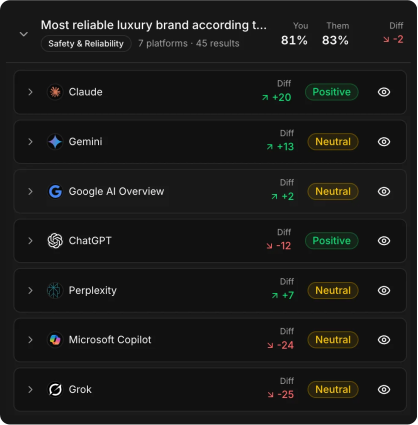
Win customers from all major AI platforms
Understand, measure, and optimize your AI visibility via Ansvisor.
✓ Add brand, domains and competitors
✓ Discover prompts and growth opportunities
✓ Track your AI visibility across major AI platforms
✓ Monitor citations, mentions, and competitors
✓ Measure AI traffic and customer discovery
✓ Receive AI recommendations based on AI insights
✓ Optimize authority, trust, and content quality
✓ Create content, automate analysis & action with AI agents
AI Visibility Terms
Continue exploring key AI visibility concepts.
AI Visibility
Measure and improve how often your brand appears in AI-generated answers.
Learn more →Answer Engine Optimization (AEO)
Strategies for increasing visibility in answer engines and AI summaries.
Learn more →Generative Engine Optimization (GEO)
Optimizing content for AI-powered discovery experiences.
Learn more →ChatGPT Search
Understand how OpenAI retrieves and synthesizes information.
Learn more →Google AI Overviews
AI-generated summaries that appear directly in Google Search.
Learn more →Perplexity Search
Explore how Perplexity cites and presents sources.
Learn more →AI Citations
References and sources used by AI systems to support answers.
Learn more →Citation Authority
Measure the quality and influence of cited sources.
Learn more →Retrievability
How easily AI systems can discover and reuse your content.
Learn more →New terms are added regularly.
Help us improve the page or suggest a new term →
Cihan Geyik
Co-founder at Ansvisor
Cihan Geyik is the co-founder of Ansvisor, an open-source AI Visibility platform for AI Search. With more than 15 years of experience in digital marketing and growth, he writes about AI visibility, AI search, AEO, GEO, citations, and answer engines. He focuses on helping brands understand and improve their presence across ChatGPT, Gemini, Perplexity, Google AI Overviews, and other AI-powered discovery platforms.
Make Your Brand Visible in AI Answers.

INDUSTRIES


© 2026 Ansvisor. All rights reserved. Ansvisor is an open-source AI Search Intelligence Platform for AI Visibility.


.svg)
