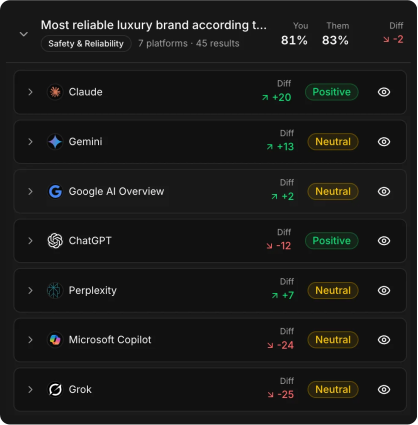
Elmo is an open-source AI Visibility and Answer Engine Optimization platform for monitoring and improving how brands appear across AI-powered search and answer engines.
The platform tracks how AI systems mention, cite, and describe a brand across a defined portfolio of prompts.
Elmo can also benchmark competitors, analyze the sources behind AI-generated answers, monitor visibility trends, investigate individual responses, and identify opportunities for improving AI Search presence.
The name Elmo is derived from LLM Optimization, or LLMO, one of several terms used to describe optimization for AI-powered discovery.
Elmo describes its broader category using terms including:
Yes.
Elmo is an open-source project published on GitHub under the MIT License.
Organizations can inspect the source code, deploy the application on their own infrastructure, modify the software, and audit how visibility metrics are collected and calculated.
This makes transparency and self-hosting central parts of Elmo's product model rather than optional enterprise features.
The official source repository is available at:
https://github.com/elmohq/elmo
Yes.
Elmo is designed to support self-hosted deployments.
Organizations can run the platform on their own infrastructure instead of sending their complete AI visibility monitoring history to a managed SaaS environment.
This can be relevant to teams that prioritize:
Yes.
Elmo's open-source software can be self-hosted without a software license fee.
Organizations remain responsible for their own infrastructure and any third-party AI, scraping, or model-provider costs required by their configuration.
This distinction is important:
Open-Source Software Cost ≠ Infrastructure and AI Provider Cost
Yes.
In addition to the open-source self-hosted product, Elmo provides a managed cloud service.
The managed version allows teams to use Elmo without operating the underlying infrastructure themselves.
This creates two primary deployment models:
Self-Hosted → Run Elmo on your own infrastructure
Cloud → Elmo manages the deployment
Elmo provides a command-line interface designed to simplify local and self-hosted deployment.
The official quickstart currently uses the Elmo CLI together with Docker Compose.
The basic deployment workflow involves installing the CLI, initializing configuration, and starting the Elmo stack.
Elmo's current open-source repository documents a technology stack including:
Because the source code is public, developers can inspect the current architecture directly instead of relying exclusively on vendor documentation.
Traditional SEO tools primarily measure what happens around search-engine results.
AI answer engines introduce another discovery environment.
A potential customer can ask an AI system a question and receive a generated response containing brands, products, comparisons, recommendations, and citations.
The user may form an opinion about a company before ever visiting its website.
The journey can therefore become:
Prompt → AI Answer → Brand Mention → Citation → Website Visit → Business Outcome
Elmo primarily measures the upstream AI answer stages of this journey.
Elmo is designed to monitor a broad range of AI models and answer engines.
Its current official product materials list environments including:
Elmo also supports model access through APIs and OpenRouter, allowing its monitoring architecture to extend beyond a fixed list of providers.
Yes.
ChatGPT is one of the major AI answer environments supported by Elmo.
Elmo can run monitored prompts and analyze whether ChatGPT mentions the tracked brand, which competitors appear, and which sources are associated with the response.
Yes.
Claude is included in Elmo's current supported model coverage.
This allows organizations to compare their visibility across Claude with other AI environments rather than relying on a single answer engine.
Yes.
Gemini is included in Elmo's current AI model coverage.
Elmo can use monitored prompts to analyze brand and competitor presence across Gemini responses.
Yes.
Perplexity is supported within Elmo's monitoring environment.
Its source-oriented answer format also makes Perplexity particularly relevant to AI citation analysis.
Yes.
Google AI Overviews is included in Elmo's current platform coverage.
This allows teams to include Google's generative search experience alongside conversational AI systems in the same broader visibility strategy.
Yes.
Google AI Mode is also listed among Elmo's supported AI Search environments.
This is important because AI Mode represents a more conversational Google Search experience than conventional search-result pages.
Yes.
Grok is included in Elmo's current model coverage.
Organizations can therefore include Grok when comparing brand visibility across different AI ecosystems.
Yes.
Microsoft Copilot is listed among the AI systems supported by Elmo.
This expands monitoring beyond standalone AI chat products into Microsoft's AI-powered discovery ecosystem.
Elmo supports multiple methods for interacting with AI systems.
Its official product documentation describes using web-based retrieval for certain environments as well as APIs or OpenRouter for supported models.
Users can also bring their own provider credentials.
The specific collection method can therefore differ between AI platforms.
An AI model accessed through an API does not always behave identically to a consumer-facing search or chat product.
Differences can involve:
Understanding how a monitoring platform obtains responses is therefore important when interpreting AI visibility data.
Elmo's dashboard is designed to summarize the main signals associated with AI Search visibility.
Current product functionality includes measurements and analysis around:
AI Visibility represents how frequently the tracked brand appears across the monitored AI answer environment.
Instead of measuring a conventional search ranking, Elmo analyzes generated responses to determine whether the brand is present.
The relevant unit is therefore the answer rather than a traditional SERP position.
Share of Voice provides a competitive view of AI visibility.
It helps teams understand how their presence compares with competing brands across monitored prompts and AI responses.
This can reveal situations where a competitor is consistently surfaced by AI systems while the tracked brand is absent.
Share of Voice should be interpreted within the monitored prompt set and model coverage rather than as a universal measurement of the entire AI ecosystem.
Yes.
Competitor benchmarking is a core Elmo capability.
Teams can compare their brand against competitors appearing within the same monitored AI responses.
This helps answer questions such as:
Yes.
The brands that appear inside AI-generated answers do not necessarily match the websites competing for conventional organic rankings.
AI systems may introduce different:
AI visibility monitoring can therefore reveal a different competitive landscape from traditional SEO.
Yes.
Prompt monitoring is one of Elmo's central capabilities.
Users can create and organize a portfolio of prompts relevant to their brand, products, services, competitors, and market.
Elmo repeatedly runs those prompts against supported AI environments and stores the resulting responses for analysis.
Elmo provides prompt-management functionality including search, filtering, and tagging.
Tags can help organize larger prompt portfolios around dimensions such as:
Visibility can then be analyzed at the individual prompt level.
An aggregate visibility score can hide important differences between customer questions.
For example, a company could have strong visibility for informational questions while being absent from high-intent comparison prompts.
Prompt-level analysis helps expose those differences.
Yes.
Elmo includes a Deep Dive workflow for inspecting individual monitored AI responses.
Users can investigate:
This is important because an aggregate metric cannot explain the full context of a brand mention.
Being mentioned does not automatically mean being recommended.
A brand could appear as:
Inspecting the actual response provides context behind the visibility score.
Yes.
Citation Intelligence is a major part of Elmo's current product.
The platform identifies domains and individual URLs used as sources within monitored AI responses.
This allows teams to investigate where AI systems obtain information about topics relevant to their brand.
Elmo's current citation environment can help teams analyze:
This adds an information-source layer to AI visibility monitoring.
Generative Engine Optimization is not only about the content published on a company's own website.
AI systems can rely on information from many external sources.
Citation analysis can reveal whether important answers are being influenced by:
The appropriate optimization action depends on the source landscape.
A citation gap occurs when important AI-generated answers rely on sources that do not support or represent the tracked brand effectively.
For example, competitors may be repeatedly cited while the tracked company's content is absent.
A citation gap can lead to several possible actions:
Yes.
Elmo's current citation interface categorizes sources to make the citation landscape easier to interpret.
Categories can distinguish sources associated with the brand, competitors, social platforms, and other source types.
This can help determine whether a visibility problem is primarily an owned-content problem or a third-party authority problem.
Query fan-out analysis examines the additional search terms or queries that an AI Search system can generate while researching an original user request.
An AI answer engine may not process a prompt as a single conventional search query.
Instead, it can decompose or rewrite the request into multiple retrieval queries.
Elmo provides visibility into these generated search terms.
Query fan-out helps explain the retrieval path between a user's original question and the sources selected for the final answer.
The journey can look like:
User Prompt → Query Fan-Out → Retrieval → Sources → Generated Answer
Understanding this intermediate layer can reveal topics and terminology that may not be obvious from the original prompt alone.
No.
The original prompt represents what the user asked.
Fan-out queries represent additional retrieval-oriented searches generated during the AI system's research process where those signals are observable.
The distinction is:
User Prompt ≠ Query Fan-Out Query
Yes.
Elmo includes an Opportunities layer designed to turn monitoring data into potential actions.
The platform can generate recommendations involving:
Recommendations are intended to help teams move from measurement toward optimization.
Elmo's current product materials describe opportunities as being ranked by expected impact.
The objective is to avoid presenting every visibility gap as equally important.
Teams can use these recommendations as starting points for deciding which AI Search actions deserve attention.
AI-generated answers frequently rely on sources outside the company's own website.
If an influential third-party domain repeatedly shapes answers around an important topic, publishing another owned article may not address the underlying visibility gap.
The action may instead involve:
Yes.
Elmo stores visibility history so teams can monitor how their brand and competitors change over time.
Historical analysis can reveal:
Not by themselves.
AI answers are stochastic and can change because of model updates, retrieval changes, source changes, market developments, and other factors.
A visibility increase following an optimization is useful evidence, but correlation alone does not establish causation.
A central benefit of Elmo's self-hosted architecture is that organizations can operate the application and its data infrastructure themselves.
This provides greater control over prompt portfolios, historical response data, competitor information, and internal monitoring records.
Organizations remain responsible for the privacy, security, and compliance of their own deployment and connected third-party providers.
AI Visibility is still an emerging measurement category.
Different platforms can define visibility, citations, Share of Voice, sentiment, and other metrics differently.
Because Elmo is open source, technical teams can inspect the implementation rather than treating every score as an unexplained black box.
This can make it easier to understand:
No.
Open source makes the methodology inspectable.
It does not automatically make every methodology objectively correct or universally applicable.
Users should still evaluate whether a metric matches their business question and AI Search strategy.
Yes.
The MIT-licensed repository allows developers to inspect and modify the application according to the license terms.
Technical teams can therefore adapt self-hosted deployments for their own infrastructure and workflows.
Yes.
Elmo supports agency-oriented use cases and currently promotes white-label capabilities.
Open-source deployment can also be relevant to agencies that want more control over infrastructure, client data, branding, and operating costs.
Yes.
Ecommerce companies can monitor prompts related to:
Citation and competitor analysis can help reveal which sources influence AI-generated product recommendations.
Yes.
B2B organizations can monitor commercial questions involving:
These prompts can influence vendor consideration before a prospect visits the company's website.
Yes.
Answer Engine Optimization is one of Elmo's primary use cases.
Elmo measures whether brands appear inside answers, analyzes the sources behind those answers, and surfaces opportunities intended to improve future visibility.
Yes.
Elmo explicitly positions itself for Generative Engine Optimization as well as AEO and LLMO.
A simplified Elmo GEO workflow is:
Track → Analyze → Identify Gap → Optimize → Track Again
No.
Elmo can monitor AI answers, identify citation patterns, and surface potential optimization opportunities.
External AI providers independently determine which information to retrieve, cite, and recommend.
No monitoring platform can deterministically control those decisions.
Google Search Console provides first-party information from Google's search ecosystem for verified websites.
Elmo monitors generated answers across multiple AI environments.
The distinction can be summarized as:
Google Search Console → Search Performance
Elmo → Cross-Platform AI Answer Visibility
Google Analytics primarily measures behavior after a visitor reaches a connected website or application.
Elmo primarily analyzes what happens before the visit inside AI-generated answers.
The broader journey is:
Elmo → AI Answer Visibility
Web Analytics → On-Site Behavior
Traditional rank tracking asks where a page ranks for a defined search query.
Elmo asks whether a brand appears inside an AI-generated answer, which competitors appear, and which sources are cited.
This means the measurement unit changes from:
Keyword → Ranking Position
to:
Prompt → Generated Answer → Brand & Citation Analysis
Elmo positions itself as an open-source and self-hostable alternative to commercial AI visibility platforms such as Profound, Peec AI, and Otterly AI.
The most fundamental difference is the deployment and software model.
With Elmo, organizations can inspect the source code and operate the platform on their own infrastructure.
Feature depth, datasets, platform coverage, enterprise functionality, support, and methodologies differ between products and should be evaluated independently.
Elmo and GetCito both operate in the open-source AI Visibility and GEO ecosystem.
Elmo maintains its primary open-source project under the elmohq organization and positions the product around transparent, self-hosted AI visibility tracking and optimization.
GetCito combines AI visibility software with a broader managed GEO services model.
Because the projects and their relationship can evolve, organizations evaluating either platform should inspect the current repositories, release history, licenses, and product documentation directly.
Elmo and Ansvisor both have open-source foundations and operate in AI Search visibility and intelligence.
Elmo emphasizes transparent, self-hostable monitoring of prompts, mentions, citations, competitors, query fan-out, and AI visibility opportunities.
Ansvisor is an AI Search Intelligence platform centered on connecting AI behavior with search and business data and moving from analytics into prioritized opportunities and actions.
The platforms therefore overlap in AI visibility monitoring while emphasizing different broader workflows.
Elmo can provide AI answer monitoring and transparent visibility data.
Ansvisor can add a broader intelligence layer around Prompt Discovery, Citation Intelligence, search data, business signals, opportunity prioritization, and operational actions.
A combined conceptual model is:
AI Search Data + Search Data + Business Data → Analytics → Opportunities → Actions → Validation
Elmo already spans more than basic analytics.
Its monitoring environment produces information about prompts, visibility, competitors, citations, query fan-out, and trends.
Its Opportunities functionality then uses this information to recommend potential actions involving content, existing pages, and third-party sources.
This can be represented as:
AI Responses → Analytics → Opportunities → Optimization
Additional search, business, conversion, and customer data can further prioritize those opportunities according to commercial impact.
Important considerations include:
These limitations should be considered when using Elmo data for strategic decisions.
Elmo can be particularly relevant to organizations that want AI visibility monitoring with greater software and data control.
Potential users include:
Elmo represents an important development within the AI Search software ecosystem because it applies an open-source and self-hostable model to AI visibility monitoring.
Instead of requiring organizations to rely exclusively on a proprietary SaaS dashboard, Elmo allows teams to inspect the source code, operate the software themselves, retain greater control over their data, and audit how metrics are implemented.
At the analytics layer, Elmo monitors prompts, brand visibility, competitors, Share of Voice, citations, query fan-out, individual AI responses, and historical trends.
At the opportunity layer, it can identify content to create, existing pages to improve, and third-party sources worth investigating.
Its broader AI Search workflow can therefore be represented as:
Prompt → AI Answer → Brand Visibility → Citation → Opportunity → Optimization
Using Ansvisor, organizations can extend this type of AI visibility data into a broader AI Search Intelligence model connecting AI behavior with search data, business data, Prompt Discovery, Citation Intelligence, opportunities, actions, and validation.
Both approaches demonstrate how open-source software can provide an alternative to black-box AI Search measurement.
The broader operating model becomes:
AI Search Data + Search Data + Business Data → Analytics → Opportunities → Actions → Validation → Learning
Ansvisor maintains a broader AI Visibility Glossary covering Elmo and the open-source projects, commercial platforms, metrics, technologies, protocols, datasets, and optimization concepts shaping AI Search, AEO, GEO, and LLMO.
Elmo is an open-source AI Visibility and AEO platform for monitoring how AI answer engines mention and cite brands. It supports prompt tracking, competitor benchmarking, citation analysis, Share of Voice, query fan-out, individual response analysis, historical trends, and optimization opportunities.
Yes. Elmo's source code is publicly available on GitHub under the MIT License. It can be self-hosted for free, allowing organizations to inspect the code, control their own deployment and audit how metrics are calculated.
Elmo currently lists ChatGPT, Claude, Gemini, Grok, Mistral, Perplexity, Copilot, DeepSeek, Google AI Mode and Google AI Overviews among its supported environments. It also supports APIs/OpenRouter and bring-your-own provider keys.
Yes. Elmo analyzes cited domains and URLs, new and dropped sources, source categories, competitor presence and Share of Voice. Users can also inspect individual responses to see which brands and sources appeared.
Yes. Elmo's Opportunities functionality turns monitoring data into recommendations such as content to create, existing pages to refresh and third-party sources to investigate, with recommendations prioritized by impact
Understand, measure, and optimize your AI visibility via Ansvisor.
✓ Add brand, domains and competitors
✓ Discover prompts and growth opportunities
✓ Track your AI visibility across major AI platforms
✓ Monitor citations, mentions, and competitors
✓ Measure AI traffic and customer discovery
✓ Receive AI recommendations based on AI insights
✓ Optimize authority, trust, and content quality
✓ Create content, automate analysis & action with AI agents
Continue exploring key AI visibility concepts.
Measure and improve how often your brand appears in AI-generated answers.
Learn more →Strategies for increasing visibility in answer engines and AI summaries.
Learn more →Optimizing content for AI-powered discovery experiences.
Learn more →Understand how OpenAI retrieves and synthesizes information.
Learn more →AI-generated summaries that appear directly in Google Search.
Learn more →Explore how Perplexity cites and presents sources.
Learn more →References and sources used by AI systems to support answers.
Learn more →Measure the quality and influence of cited sources.
Learn more →How easily AI systems can discover and reuse your content.
Learn more →New terms are added regularly.
Help us improve the page or suggest a new term →
Co-founder at Ansvisor
Cihan Geyik is the co-founder of Ansvisor, an open-source AI Visibility platform for AI Search. With more than 15 years of experience in digital marketing and growth, he writes about AI visibility, AI search, AEO, GEO, citations, and answer engines. He focuses on helping brands understand and improve their presence across ChatGPT, Gemini, Perplexity, Google AI Overviews, and other AI-powered discovery platforms.
© 2026 Ansvisor. All rights reserved. Ansvisor is an open-source AI Search Intelligence Platform for AI Visibility.