

AI & Infrastructure

(RAG) Retrieval Augmented Generation

An AI architecture that combines information retrieval with language model generation to produce more accurate, current, and grounded responses.
June 27, 2026
Cihan Geyik
Table of Content

Why Retrieval-Augmented Generation (RAG) matters

Retrieval-Augmented Generation (RAG) is an AI architecture that combines information retrieval with large language model generation. Instead of relying solely on model training data, RAG systems retrieve relevant information from external sources before generating responses.

RAG has become one of the foundational technologies behind modern AI search engines, answer engines, enterprise AI systems, and conversational assistants because it enables AI models to access current, relevant, and verifiable information.

Benefits of RAG include:

  • Improve answer accuracy.
  • Reduce hallucinations.
  • Support real-time information.
  • Increase transparency.
  • Enable domain-specific knowledge.

Many modern AI search experiences rely on RAG architectures to provide trustworthy and up-to-date answers.

How Retrieval-Augmented Generation works

A typical RAG system combines retrieval and generation in several stages.

  • Receive the user query.
  • Interpret user intent.
  • Retrieve relevant information.
  • Rank retrieved content.
  • Inject context into the model.
  • Generate the final answer.

Rather than generating responses entirely from model memory, the language model uses retrieved information as additional context during answer generation.

This approach allows AI systems to incorporate current information, proprietary data, and trusted sources.

What technologies enable RAG?

Modern RAG systems combine multiple AI technologies.

Many advanced RAG systems also incorporate hybrid search, query expansion, query fan-out, reranking, and multi-step retrieval techniques.

How RAG affects AI visibility

RAG fundamentally changes how brands and content are discovered within AI systems.

Organizations with authoritative, retrievable, and well-structured information are more likely to be retrieved and cited within RAG-powered answer systems.

Strategies such as AI Content Optimization, Answer Engine Optimization (AEO), and LLM Optimization often focus on improving performance within retrieval-based AI architectures.

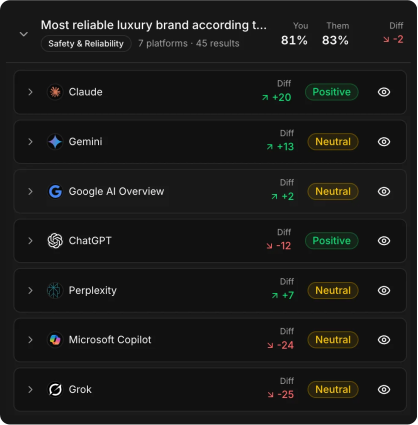
Platforms such as Ansvisor help organizations understand how RAG-powered answer engines retrieve, cite, recommend, and synthesize information by analyzing prompts, citations, competitors, retrieval patterns, and AI visibility performance across multiple platforms.

Common misconceptions

Common misconceptions about RAG include:

  • RAG eliminates hallucinations.
  • RAG replaces model training.
  • Retrieval quality is unimportant.
  • All AI search systems use identical RAG architectures.
  • Adding more data always improves results.

Retrieval-Augmented Generation represents one of the most important architectural advances in modern AI because it enables language models to combine reasoning capabilities with external knowledge retrieval.

Also known as; Retrieval Augmented Generation, Retrieval-Augmented AI, Retrieval-Based Generation, Grounded Generation

FAQ

Frequently asked questions.

What is Retrieval-Augmented Generation (RAG)?

RAG is an AI architecture that combines information retrieval with language model generation to produce more accurate and grounded answers.

Why is RAG important?

It improves answer accuracy, reduces hallucinations, enables real-time information retrieval, and supports domain-specific knowledge.

How does RAG work?

RAG systems retrieve relevant information, inject it into the model context, and generate answers using both retrieved content and model reasoning.

How does RAG affect AI visibility?

RAG systems prioritize retrievable, authoritative, and trustworthy content, making retrieval quality a key factor in AI visibility.

Which tools help analyze RAG-powered AI search?

AI Visibility Platforms like Ansvisor help organizations analyze retrieval patterns, citations, competitors, authority signals, and AI visibility performance across RAG-based answer engines.
Build your AI visibility advantage.

Understand, measure, and optimize your AI visibility.

✓ Add brand, domains and competitors
✓ Discover prompts and growth opportunities
✓ Track your AI visibility across major AI platforms
✓ Monitor citations, mentions, and competitors
✓ Measure AI traffic and customer discovery
✓ Receive AI recommendations based on AI insights
✓ Optimize authority, trust, and content quality
✓ Create content, automate analysis & action with AI agents


Start Free Trial →Take Product Tour →
Help us grow the AI Visibility Grossary

New terms are added regularly.

Help us improve the page or suggest a new term →
About the Author
Cihan Geyik

Cihan Geyik

Co-founder at Ansvisor

Cihan Geyik is the co-founder of Ansvisor, an open-source AI Visibility platform for AI Search. With more than 15 years of experience in digital marketing and growth, he writes about AI visibility, AI search, AEO, GEO, citations, and answer engines. He focuses on helping brands understand and improve their presence across ChatGPT, Gemini, Perplexity, Google AI Overviews, and other AI-powered discovery platforms.

Summarize with ChatGPT
Summarize with Claude
Summarize with Google
Summarize with Perplexity
Summarize with Grok