


Brintial
What is Brantial?
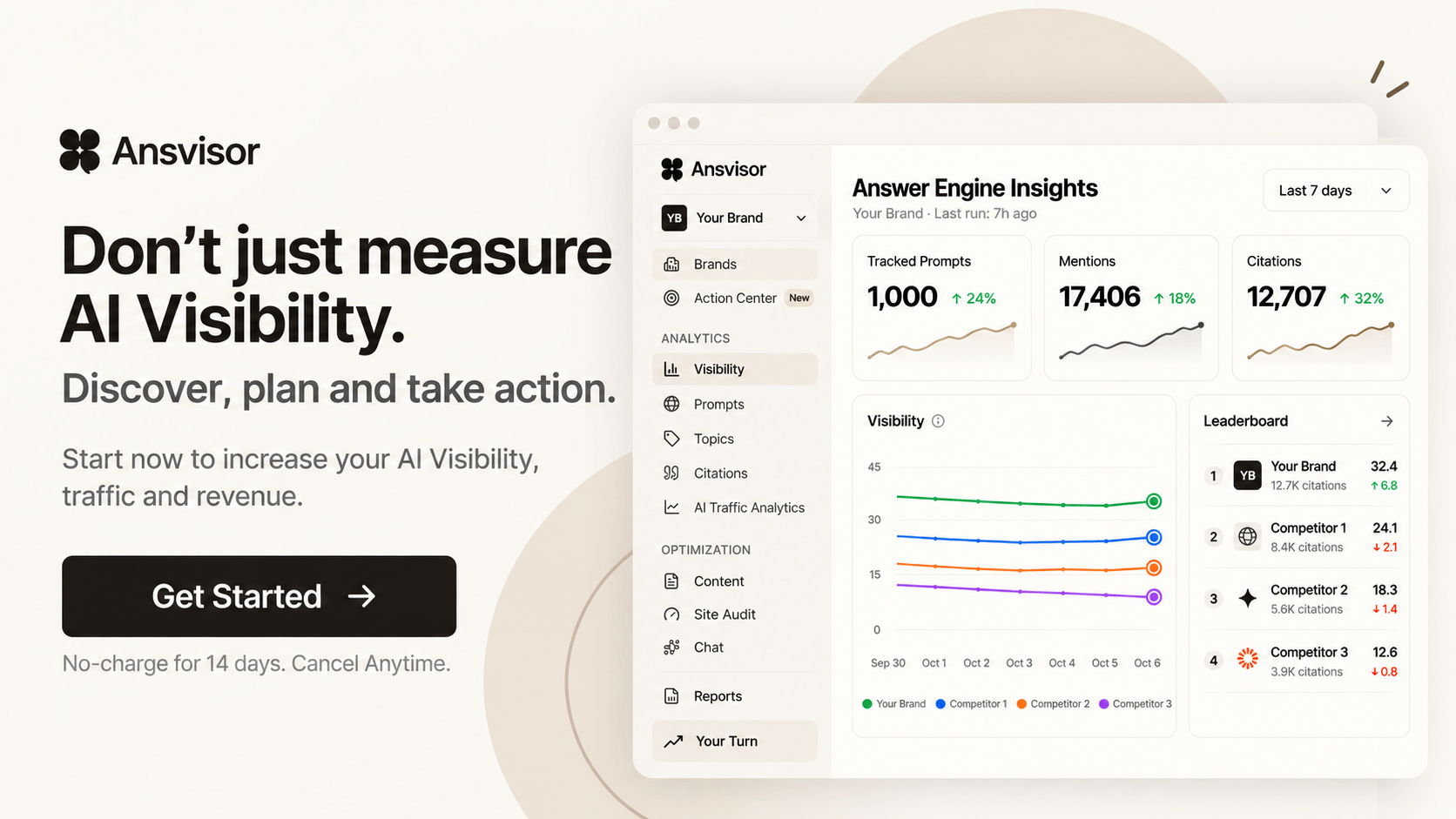
Brantial is a Generative Engine Optimization (GEO) and AI visibility platform designed to help organizations measure, understand, and improve how their brands appear across AI-powered search and answer engines.
The platform combines AI visibility monitoring, prompt intelligence, citation and source analysis, competitor benchmarking, sentiment and positioning analysis, technical auditing, AI traffic attribution, workflow automation, and optimization recommendations.
Brantial's product philosophy is built around a four-stage workflow: measure current AI search performance, prioritize the highest-impact gaps, execute recommended fixes, and then evaluate whether those changes improved visibility or traffic.
What does Brantial do?
Brantial monitors AI-generated answers across supported answer engines and analyzes how brands, competitors, sources, citations, sentiment, and positioning change over time.
Teams can use this data to identify where their brand is visible, where competitors perform better, which sources influence important answers, and which pages or topics may require improvement.
Brantial also includes an execution layer that can turn detected gaps into prioritized tasks and draft website changes, allowing teams to move from monitoring into implementation within the same workflow.
What are the key features of Brantial?
Brantial combines AI search analytics, optimization, execution, and business-performance measurement within one platform.
- AI Visibility Analysis: Tracks brand visibility trends, mentions, positioning, sentiment, sources, and competitive performance.
- Prompt Volumes: Helps teams analyze prompt demand, user intent, competition, and country-level targeting.
- Brand Potential Score: Provides an additional prioritization signal around prompt and keyword opportunities.
- Action Center: Converts findings into prioritized tasks ranked by potential impact and effort.
- Workflow Agent: Analyzes a page, identifies structural and intent gaps, produces targeted revisions, and creates a reviewable output.
- Site Auditor: Evaluates technical factors such as robots.txt, llms.txt, ai.txt, structured data, schema, and crawler accessibility.
- Source Analysis: Maps the publications, forums, websites, and social sources influencing AI-generated answers.
- Sentiment & Claims: Evaluates how AI systems describe a brand and helps identify inaccurate or problematic claims.
- Rival Radar: Detects competitor visibility changes and can surface the likely reasons behind them.
- Traffic & Attribution: Connects AI search performance with Search Console and GA4 data to analyze traffic, conversions, and business impact.
- Feed & Product Optimization: Supports AI shopping and product discovery through feed, schema, and product-content analysis.
- llms.txt Generator: Helps generate and evaluate llms.txt, ai.txt, and robots.txt files.
- Partner Workspace: Supports multi-client workflows, white-label reporting, pitch environments, and role management.
Which AI platforms does Brantial track?
Brantial currently provides monitoring across several major AI search and answer engines.
Its platform and pricing materials reference support for:
- ChatGPT.
- Google AI Overviews.
- Google Gemini.
- Perplexity.
- Claude.
- Microsoft Copilot.
- Grok.
- Mistral and Meta AI on higher-tier configurations.
Engine availability varies by subscription. Starter provides a smaller engine set, Growth expands coverage, and Enterprise can support broader or custom configurations.
How does Brantial measure AI visibility?
Brantial analyzes AI-generated responses across monitored prompts and converts those answers into a set of visibility and competitive metrics.
The platform reports signals such as:
- Brand mentions.
- Citation rate.
- Share of Voice.
- Sentiment.
- Brand position within answers.
- Prompt-level visibility.
- Citing sources.
- AI referral traffic.
- Assisted conversions.
These measurements can be reviewed across models, competitors, prompts, date ranges, and other dimensions to understand how AI search performance changes over time.
How does prompt monitoring work in Brantial?
Prompts represent the questions and searches that users may ask AI systems while researching products, services, brands, or categories.
Brantial sends tracked prompts across supported answer engines and analyzes the resulting responses for visibility, citations, competitors, sentiment, and position.
Prompt intelligence also includes demand and intent information designed to help teams distinguish between high-value commercial questions and lower-priority monitoring opportunities.
This allows marketers to prioritize AI search work based on both current performance and the potential value of the underlying prompt.
What is Brand Potential Score in Brantial?
Brantial uses Brand Potential Score as one of the signals for prioritizing opportunities within AI search.
The score is associated with prompt and keyword intelligence and is intended to help teams evaluate which search opportunities may deserve greater attention.
Prompt volume, user intent, competition, market context, and existing visibility can all provide useful context when prioritizing AI search initiatives.
Rather than treating every prompt equally, this approach helps teams focus resources on opportunities more likely to contribute to meaningful brand or business outcomes.
How does source and citation analysis work in Brantial?
Brantial analyzes the sources referenced by AI answer engines to show which websites, publishers, forums, and social platforms influence generated responses.
Teams can use source analysis to understand:
- Which owned pages receive AI citations.
- Which competitor pages appear as sources.
- Which third-party domains influence important prompts.
- Which source categories dominate a topic.
- Where citation gaps exist.
- Which external sites may deserve greater attention.
These insights can inform content strategy, digital PR, partnerships, authority building, and third-party distribution.
How does Brantial analyze competitors?
Brantial compares tracked brands with competitors across monitored prompts and answer engines.
Competitive analysis can reveal differences in:
- Visibility.
- Share of Voice.
- Position.
- Sentiment.
- Citations.
- Source presence.
- Prompt performance.
Rival Radar extends this analysis by identifying situations where a competitor overtakes the tracked brand and surfacing a possible root cause and recommended counter-action.
This can help teams treat competitor monitoring as an optimization input rather than only a benchmarking exercise.
What is Action Center in Brantial?
Action Center is Brantial's prioritization layer for turning analytics findings into structured work.
Instead of leaving teams with a list of visibility gaps, Action Center ranks potential tasks according to impact and effort and highlights opportunities that may be achievable more quickly.
Potential actions can include:
- Improving an existing page.
- Addressing a missing topic.
- Strengthening internal linking.
- Adding or correcting structured data.
- Improving crawler accessibility.
- Addressing competitor citation gaps.
- Correcting inaccurate brand information.
Progress tracking can then be used to follow these tasks through implementation.
What is Workflow Agent in Brantial?
Workflow Agent is Brantial's execution layer for applying selected AI search recommendations to website content.
A team can provide a URL and the workflow analyzes the existing page, its structure, intent alignment, and content quality before producing targeted revisions.
The workflow can also recommend changes involving structured data and internal linking.
Brantial states that these changes are produced as drafts rather than being automatically published by default. Outputs can be reviewed before they are pushed live, with automated publishing treated as an optional workflow.
How does Brantial audit technical AI readiness?
Brantial's Site Auditor evaluates technical elements that may influence whether AI crawlers and answer engines can discover and interpret website content.
The audit can include checks around:
- robots.txt.
- llms.txt.
- ai.txt.
- Schema markup.
- Structured data.
- Crawler permissions.
- AI accessibility.
This provides a technical layer alongside prompt, citation, and visibility monitoring.
How does Brantial analyze sentiment and brand claims?
AI search performance is not only about whether a brand appears. The way that brand is described can also influence user perception.
Brantial includes sentiment and claim analysis designed to identify how AI systems describe a brand and whether important statements are aligned with the organization's intended positioning.
This analysis can help surface:
- Positive or negative sentiment.
- Positioning drift.
- Incorrect product or company claims.
- Outdated information.
- Brand narrative inconsistencies.
These findings can support SEO, AEO, brand, communications, and reputation-management teams.
How does Brantial connect AI visibility with traffic and conversions?
Brantial connects AI search analytics with traditional website-performance data through integrations such as Google Search Console and Google Analytics 4.
Teams can use these integrations to investigate AI referral traffic and compare AI search performance with website outcomes.
Potential measurements include:
- AI-sourced sessions.
- Search Console clicks and queries.
- Conversions.
- Revenue.
- Landing-page performance.
- Changes in visibility before and after optimization.
This helps organizations evaluate whether AI search improvements are associated with measurable business results rather than relying only on visibility scores.
What integrations does Brantial support?
Brantial connects with several search, analytics, publishing, e-commerce, and communication systems.
Current integrations include:
- Google Search Console.
- Google Analytics 4.
- WordPress.
- Shopify.
- Slack.
Its current roadmap also references integrations such as Looker Studio, MCP Server, Zapier, and webhooks.
Teams should distinguish between integrations already available and those still listed as in development when evaluating the platform.
Who is Brantial for?
Brantial is designed for organizations that want both AI search measurement and workflows for acting on that data.
Potential users include:
- SEO and AI Search teams.
- AEO and GEO practitioners.
- Content teams.
- Brand and communications teams.
- Growth teams.
- E-commerce teams.
- Agencies.
- Enterprise marketing organizations.
Its multi-client and white-label capabilities also make the platform relevant to agencies and partners managing AI visibility for several brands.
How does Brantial fit into AI SEO, AEO, and GEO?
Brantial operates within the broader AI search optimization ecosystem associated with AI SEO, Answer Engine Optimization (AEO), and Generative Engine Optimization (GEO).
These disciplines expand search optimization beyond traditional rankings by examining how brands are mentioned, cited, positioned, described, and recommended within AI-generated answers.
Brantial supports this process through prompt monitoring, citation analysis, competitor intelligence, technical auditing, traffic attribution, prioritized recommendations, and workflow execution.
Its product structure is designed to move from measurement toward implementation rather than treating AI visibility analytics as the final output.
How is Brantial different from traditional SEO tools?
Traditional SEO platforms primarily analyze keywords, rankings, backlinks, technical performance, and organic search traffic.
Brantial focuses on the additional discovery layer created by AI-generated answers.
Teams can investigate questions such as:
- Does AI mention our brand?
- Which competitors appear more frequently?
- Which pages receive citations?
- How does AI describe our brand?
- Which sources influence important answers?
- Which technical issues affect AI discovery?
- Which optimization tasks should we prioritize?
- Did the resulting changes improve traffic or visibility?
Brantial therefore complements traditional SEO analytics with an AI search monitoring and execution layer.
What should teams consider when evaluating Brantial?
Organizations evaluating Brantial should consider their required answer-engine coverage, prompt limits, number of brands, scanning frequency, competitor monitoring requirements, content workflows, integrations, geographic markets, and budget.
Teams should also evaluate whether they primarily need monitoring or whether prioritization, content execution, technical auditing, AI traffic attribution, and multi-client workflows are important to their use case.
Engine coverage and scan frequency vary by plan, while some integrations and developer capabilities are still listed as in development.
As with other AI search platforms, organizations should evaluate visibility, citations, sentiment, traffic, conversions, and business outcomes together rather than relying on one score alone.
Brantial and the AI Search tools ecosystem
Brantial is one of several platforms developed to help organizations measure and improve visibility across AI-generated search experiences.
Its approach combines prompt and citation monitoring with prioritization, workflow execution, technical auditing, competitor intelligence, and traffic attribution.
The broader ecosystem includes dedicated AI visibility platforms, citation intelligence products, prompt analytics tools, AI traffic systems, content optimization platforms, and traditional SEO products expanding into AI search.
Ansvisor maintains a broader directory of AI SEO, AEO, GEO, AI visibility, and AI search tools to help teams understand this evolving ecosystem and evaluate platforms based on their specific requirements.
Official source
FAQ
What is Brantial?

Brantial is a GEO and AI visibility platform that combines prompt and citation monitoring, competitor intelligence, technical auditing, prioritized recommendations, workflow execution, and traffic attribution across AI search.
Which AI platforms does Brantial track?
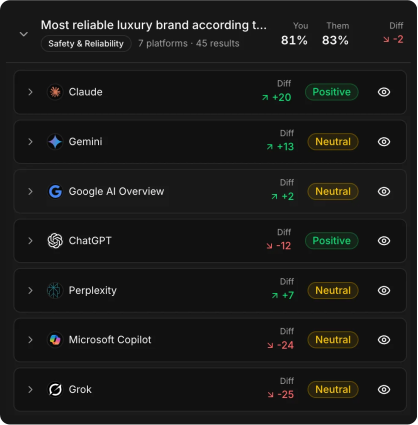
Brantial supports ChatGPT, Google AI Overviews, Gemini, Perplexity, Claude, Microsoft Copilot, and Grok across its current Growth offering, with broader coverage available at higher tiers.
Does Brantial only monitor AI visibility?
No. Brantial also provides Action Center and Workflow Agent capabilities designed to prioritize findings and produce reviewable content, schema, and internal-linking changes
Does Brantial connect AI visibility with traffic and conversions?
Yes. Brantial integrates with Google Search Console and GA4 to compare AI search performance with sessions, clicks, conversions, and revenue-related outcomes
Does Brantial provide technical AI readiness auditing?
Yes. Its Site Auditor evaluates elements including robots.txt, llms.txt, ai.txt, schema, and crawler accessibility as part of its AEO/GEO technical analysis.
Everything You Need to Improve Your AI Visibility
Track how your brand appears across AI platforms, understand what drives visibility, and turn insights into measurable actions.
Platform Features
Explore all features →Answer Engine Insights
Understand how AI platforms talk about your brand.
Prompt Intelligence
Discover and monitor the prompts shaping your AI visibility.
Citations Monitoring
Track which sources AI platforms cite and where your brand appears.
AI Traffic Analytics
Measure visits coming from ChatGPT, Gemini, Claude, and more.
Competitor Benchmarking
Compare AI visibility and uncover competitive gaps and opportunities.
Action Center
Turn AI Search signals into prioritized actions and executable tasks.
AI Visibility Trackers
Explore AI Visibility Platform →ChatGPT Visibility Tracker
Track brand mentions, citations, prompts, and visibility across ChatGPT.
Google AI Overviews Rank Tracker
Monitor where and how your brand appears in Google AI Overviews.
Google AI Mode Visibility Tracker
Track your brand's visibility across Google AI Mode experiences.
Gemini Visibility Tracker
Understand how your brand appears across Google Gemini responses.
Microsoft Copilot Visibility Tracker
Monitor your brand's presence across Microsoft Copilot answers.
Perplexity Visibility Tracker
Track brand mentions, citations, and visibility across Perplexity.
From AI Visibility insights to action.
Explore the complete Ansvisor platform for AI Search intelligence, optimization, and growth.
Win customers from all major AI platforms
Understand, measure, and optimize your AI visibility via Ansvisor.
✓ Add brand, domains and competitors
✓ Discover prompts and growth opportunities
✓ Track your AI visibility across major AI platforms
✓ Monitor citations, mentions, and competitors
✓ Measure AI traffic and customer discovery
✓ Receive AI recommendations based on AI insights
✓ Optimize authority, trust, and content quality
✓ Create content, automate analysis & action with AI agents
AI Visibility Terms
Continue exploring key AI visibility concepts.
AI Visibility
Measure and improve how often your brand appears in AI-generated answers.
Learn more →Answer Engine Optimization (AEO)
Strategies for increasing visibility in answer engines and AI summaries.
Learn more →Generative Engine Optimization (GEO)
Optimizing content for AI-powered discovery experiences.
Learn more →ChatGPT Search
Understand how OpenAI retrieves and synthesizes information.
Learn more →Google AI Overviews
AI-generated summaries that appear directly in Google Search.
Learn more →Perplexity Search
Explore how Perplexity cites and presents sources.
Learn more →AI Citations
References and sources used by AI systems to support answers.
Learn more →Citation Authority
Measure the quality and influence of cited sources.
Learn more →Retrievability
How easily AI systems can discover and reuse your content.
Learn more →New terms are added regularly.
Help us improve the page or suggest a new term →
Cihan Geyik
Co-founder at Ansvisor
Cihan Geyik is the co-founder of Ansvisor, an open-source AI Visibility platform for AI Search. With more than 15 years of experience in digital marketing and growth, he writes about AI visibility, AI search, AEO, GEO, citations, and answer engines. He focuses on helping brands understand and improve their presence across ChatGPT, Gemini, Perplexity, Google AI Overviews, and other AI-powered discovery platforms.
Get more Ansvisor insights in Google
Add Ansvisor as a Preferred Source to see more of our AI Search, AEO, GEO, and AI Visibility insights across Google.
Make Your Brand Visible in AI Answers.

INDUSTRIES


© 2026 Ansvisor. All rights reserved. Ansvisor is an open-source AI Search Intelligence Platform for AI Visibility. Ansvisor is a brand owned and operated by Empler AI Inc.


.svg)