Why Topic Modeling matters
Topic Modeling is a technique used to identify, organize, and analyze hidden themes, topics, and semantic patterns within large collections of content, documents, queries, or conversations. It helps AI systems and organizations understand how information is structured and related.
As AI search increasingly relies on semantic understanding rather than keyword matching, topic modeling has become an important tool for content strategy, information retrieval, and AI visibility optimization.
Benefits of topic modeling include:
- Discover hidden topics.
- Improve content organization.
- Identify semantic relationships.
- Support topic authority.
- Improve AI visibility strategies.
Topic modeling enables organizations to understand how users, search engines, and AI systems perceive and organize information.
How Topic Modeling works
Topic modeling algorithms analyze patterns and relationships across large datasets.
- Collect content data.
- Extract meaningful terms.
- Identify semantic relationships.
- Group related concepts.
- Generate topic clusters.
- Measure topic importance.
For example, a topic modeling system may identify that concepts such as AI Visibility, AI Citations, Prompt Monitoring, and Answer Engine Optimization frequently appear together and belong to the same semantic domain.
Modern AI systems increasingly use embeddings and language models rather than relying solely on traditional statistical topic modeling techniques.
What technologies enable Topic Modeling?
Topic modeling combines several AI and analytics technologies.
Traditional methods such as Latent Dirichlet Allocation (LDA) are increasingly complemented by embedding-based and transformer-based approaches.
How Topic Modeling affects AI visibility
Topic modeling helps organizations understand and optimize their topical coverage.
Organizations that understand topic relationships and semantic coverage are more likely to improve retrievability, authority, and visibility across AI search ecosystems.
Strategies such as AI Content Strategy, Answer Engine Optimization (AEO), and AI Content Optimization frequently rely on topic modeling insights.
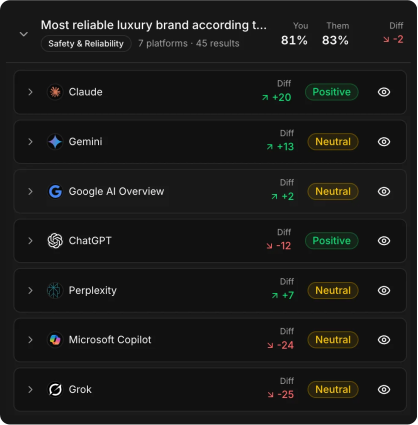
Platforms such as Ansvisor help organizations analyze topic relationships, prompt clusters, competitors, content gaps, authority signals, and AI visibility opportunities across answer engines.
Common misconceptions
Common misconceptions about topic modeling include:
- Topic modeling only counts keywords.
- Every document belongs to a single topic.
- Traditional topic models are sufficient for AI search.
- More topics always improve analysis.
- Topic modeling automatically creates authority.
As AI search systems increasingly rely on semantic understanding, topic modeling has evolved from a statistical analysis technique into a foundational method for understanding knowledge structures, content relationships, and AI discoverability.








.svg)
