


AI & Infrastructure

Hallucination

The generation of incorrect, fabricated, misleading, or unsupported information by AI systems while presenting it as factual.
June 27, 2026
Cihan Geyik
Table of Content

Why Hallucination matters

Hallucination refers to the generation of incorrect, fabricated, misleading, or unsupported information by AI systems while presenting it with confidence. Hallucinations occur when language models produce outputs that appear plausible but are not grounded in factual information or reliable sources.

As AI-powered search and answer systems increasingly influence business decisions, research, and customer journeys, reducing hallucinations has become one of the most important challenges in modern AI.

Understanding hallucinations helps organizations:

  • Improve answer reliability.
  • Increase user trust.
  • Reduce misinformation.
  • Improve citation quality.
  • Build safer AI experiences.

While modern AI systems have significantly reduced hallucinations compared to earlier models, hallucination remains an inherent challenge of generative AI.

Why do AI hallucinations happen?

Hallucinations can occur for several reasons.

  • Incomplete training data.
  • Lack of external knowledge.
  • Weak retrieval systems.
  • Ambiguous prompts.
  • Reasoning errors.
  • Outdated information.
  • Overgeneralization.

Unlike databases or search engines, language models generate the most statistically probable response rather than directly retrieving verified facts.

How do modern AI systems reduce hallucinations?

Modern AI systems use several techniques to reduce hallucinations.

Systems that retrieve information from trusted sources before generating answers generally produce more accurate and reliable outputs.

How Hallucinations affect AI search

Hallucinations influence several aspects of AI-powered search experiences.

  • Answer accuracy.
  • User trust.
  • Citation reliability.
  • Brand reputation.
  • Recommendation quality.
  • Search adoption.

Concepts such as Source Authority, Content Authority, and E-E-A-T Signals help answer engines identify trustworthy information and reduce hallucination risk.

Platforms such as Ansvisor help organizations analyze how brands are represented across AI-generated answers, identify factual inaccuracies, monitor citations, and understand how answer engines retrieve and ground information.

Common misconceptions

Common misconceptions about hallucinations include:

  • All AI mistakes are hallucinations.
  • Citations guarantee correctness.
  • Fine-tuning eliminates hallucinations.
  • Larger models never hallucinate.
  • Hallucinations can be completely removed.

Hallucinations can be reduced through retrieval, grounding, and trust signals, but current AI systems cannot eliminate them entirely. Understanding and monitoring hallucinations remains essential for building reliable AI experiences.

Also known as; AI Hallucination, Model Hallucination, LLM Hallucination, Fabricated Output

FAQ

Frequently asked questions.

What is a hallucination in AI?

A hallucination occurs when an AI system generates incorrect, fabricated, or unsupported information while presenting it as factual.

Why do AI models hallucinate?

Hallucinations can result from incomplete training data, weak retrieval systems, ambiguous prompts, or reasoning errors.

Can hallucinations be eliminated?

No. Current AI systems can reduce hallucinations significantly, but they cannot eliminate them completely.

How do AI systems reduce hallucinations?

How do AI systems reduce hallucinations?

Which tools help analyze hallucinations in AI search?

AI Visibility Platforms like Ansvisor help organizations monitor citations, analyze answer quality, identify inaccuracies, and understand how AI search systems retrieve and generate information.
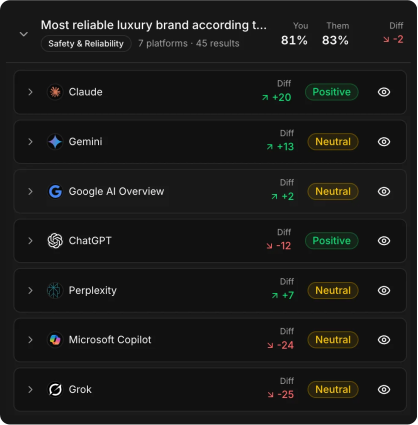
Build your AI visibility advantage.

Understand, measure, and optimize your AI visibility.

✓ Add brand, domains and competitors
✓ Discover prompts and growth opportunities
✓ Track your AI visibility across major AI platforms
✓ Monitor citations, mentions, and competitors
✓ Measure AI traffic and customer discovery
✓ Receive AI recommendations based on AI insights
✓ Optimize authority, trust, and content quality
✓ Create content, automate analysis & action with AI agents


Start Free Trial →Take Product Tour →
Help us grow the AI Visibility Grossary

New terms are added regularly.

Help us improve the page or suggest a new term →
About the Author
Cihan Geyik

Cihan Geyik

Co-founder at Ansvisor

Cihan Geyik is the co-founder of Ansvisor, an open-source AI Visibility platform for AI Search. With more than 15 years of experience in digital marketing and growth, he writes about AI visibility, AI search, AEO, GEO, citations, and answer engines. He focuses on helping brands understand and improve their presence across ChatGPT, Gemini, Perplexity, Google AI Overviews, and other AI-powered discovery platforms.

Summarize with ChatGPT
Summarize with Claude
Summarize with Google
Summarize with Perplexity
Summarize with Grok