AI Citation Opportunities are prompts, topics, queries, and sources
where a brand has the potential to earn additional citations in AI-generated answers.
They help teams move beyond measuring existing citations to identifying where new
source visibility may be achievable.
An opportunity can appear when competitors are cited but your domain is absent,
when an important prompt has weak citation coverage, or when related search demand
reveals topics where stronger content could improve the likelihood of being used
as a source.
Citation Data → Find Gaps → Measure Opportunity → Take Action → Track Results
How do you find AI Citation Opportunities?
Citation opportunities can be identified by analyzing which domains and URLs are
already cited for strategically important prompts and comparing those results with
your own citation coverage.
Ansvisor's
AI Citation Monitoring
can be used to track your own and competitor citations at the prompt and source level.
This helps reveal prompts where other sources are cited while your domain is absent.
Common opportunities include:
- Competitors receiving citations where your domain is not cited.
- High-value prompts with weak owned citation coverage.
- Relevant third-party sources repeatedly appearing in AI answers.
- Topics with demand but limited brand or source visibility.
- Existing pages that could be improved for stronger source relevance.
How do prompts, demand, and competition help prioritize opportunities?
Not every citation gap has equal value. Prompt-level demand and competition can
help determine which opportunities deserve attention first.
With
AI Prompt Tracking & Volumes,
teams can evaluate prompts alongside search demand and traditional-search
competition difficulty. This adds prioritization context to citation opportunities
instead of treating every missing citation as equally important.
Citation Gap + Relevant Demand + Competition Difficulty + Business Value → Priority Opportunity
How does Query Fan-Out reveal citation opportunities?
A single AI Search prompt can represent a broader information need. Related
subqueries can reveal the supporting questions and topics that may influence how
an answer is constructed.
Query Fan-Out
helps expand a prompt into related queries, making it easier to discover additional
content gaps and citation opportunities beyond the original question.
Prompt → Query Fan-Out → Related Questions → Content Gaps → Citation Opportunities
How to improve AI citations
Teams looking for
how to improve AI citations
should begin with evidence rather than optimizing every page equally. Identify
prompts where your brand has a realistic citation gap, inspect the sources already
being cited, and determine what information or authority signals are missing.
Potential actions can include improving existing content, creating content for
uncovered questions, strengthening factual clarity and supporting evidence, or
increasing relevant third-party brand presence.
How to increase AI citations
Understanding
how to increase AI citations
requires measuring results after optimization. A completed content or authority
action does not automatically mean a citation will be gained.
Ansvisor's
AI Search KPIs & Actions
can connect detected opportunities with prioritized actions and measurable KPIs,
creating a workflow from discovery to execution and validation.
Opportunity → Action → Measure Citation Change → Validate
How do citation opportunities differ across AI Search platforms?
Brand and citation visibility can differ between AI-powered discovery environments,
so opportunities should also be evaluated at the platform level.
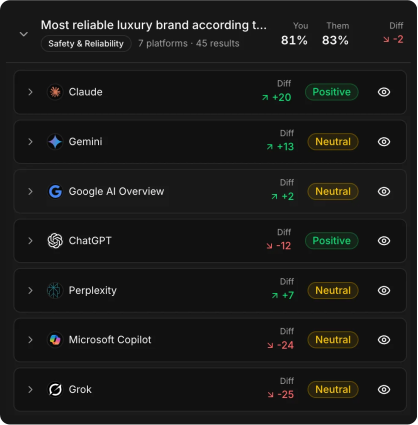
Teams can
track brand visibility in ChatGPT
to identify prompts where their brand or sources are missing, while also monitoring
how competitors appear across relevant answers.
Similarly, teams can
track brand visibility in Google AI Overviews
to understand where their brand, pages, and competitors appear across Google's
AI-generated search experiences.
A citation opportunity on one platform does not guarantee the same opportunity
exists on another, which makes platform-level measurement important.
From AI Citation Opportunities to action
The purpose of finding citation opportunities is not simply to create a larger
list of missing citations. The goal is to identify gaps with enough demand,
relevance, competitive context, and business value to justify action.
Prompts → Citations → Query Fan-Out → Demand & Competition → Opportunity → Action → Measurement
By combining citation data with prompt demand, competition, related queries, and
historical performance, teams can prioritize the opportunities most likely to
matter rather than treating every citation gap equally.








.svg)
