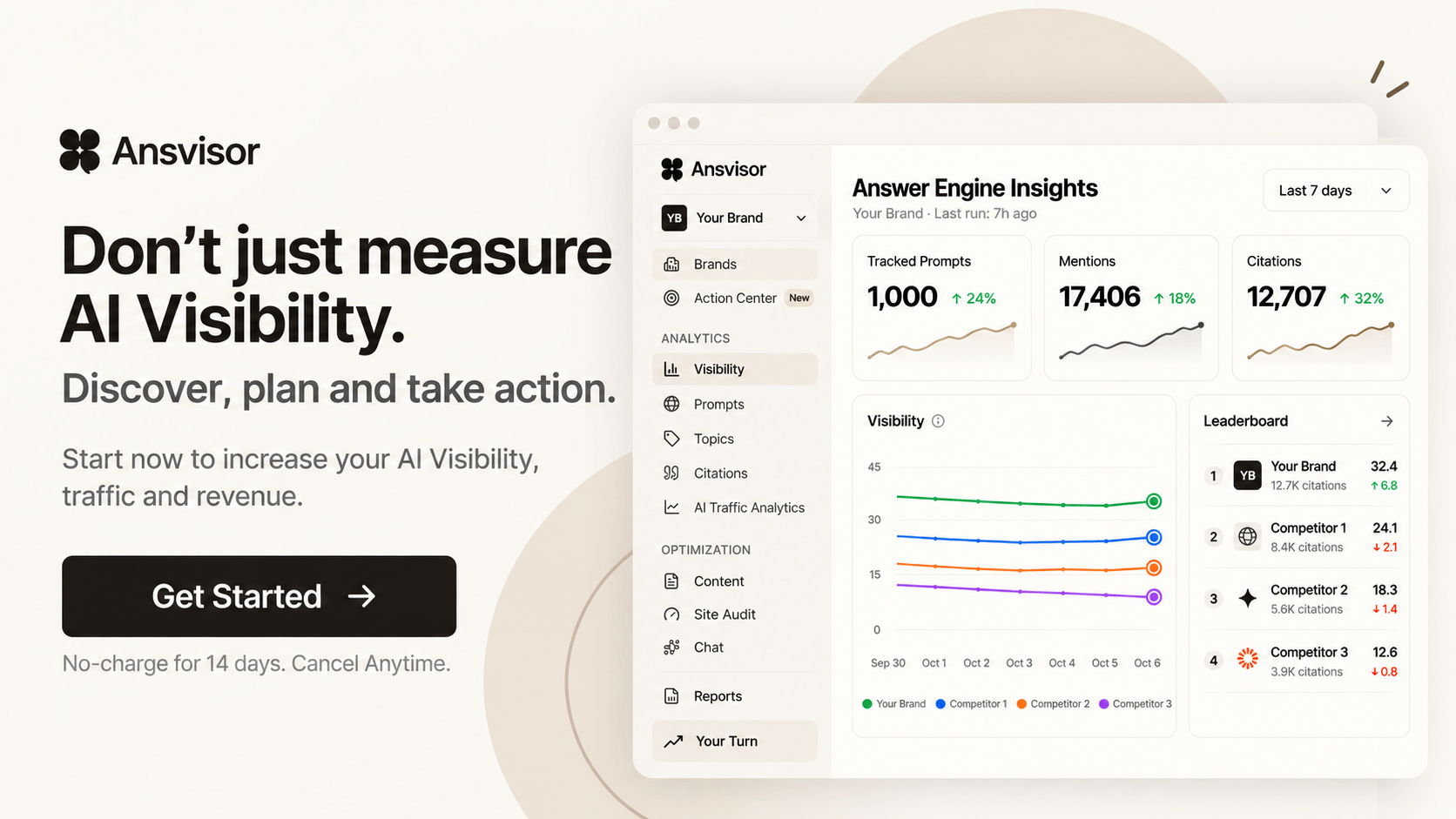



DataForSEO
What is DataForSEO?
DataForSEO is a search data infrastructure platform that provides APIs for SEO, search engine results, keywords, competitors, domains, backlinks, business data, and AI-powered search analytics.
For AI search, DataForSEO provides an AI Optimization API designed for Generative Engine Optimization (GEO), Answer Engine Optimization (AEO), AI visibility measurement, conversational search research, and LLM benchmarking.
Rather than operating primarily as a packaged AI visibility dashboard, DataForSEO provides structured data that software companies, agencies, developers, SEO platforms, and enterprise teams can use to build their own AI search analytics, monitoring, reporting, and optimization systems.
What is the DataForSEO AI Optimization API?
The AI Optimization API is DataForSEO's collection of APIs for accessing structured information about AI-generated search experiences.
It combines several different data layers:
- LLM Responses API: Generates and retrieves structured responses from supported large language models.
- LLM Scraper API: Collects responses from consumer-facing ChatGPT search experiences.
- AI Keyword Data API: Provides AI search volume and intent information for conversational queries.
- LLM Mentions API: Provides large-scale data about brand, keyword, website, source, and citation mentions across AI search.
Together, these APIs can support prompt research, AI visibility measurement, citation intelligence, competitive analysis, and custom GEO platforms.
What does DataForSEO do for AI search?
DataForSEO provides the underlying data needed to understand how brands, products, competitors, websites, and topics appear across AI-generated search experiences.
Teams can use DataForSEO to investigate questions such as:
- How does ChatGPT respond to a particular question?
- Does Claude mention our brand?
- Which domains receive citations in AI answers?
- Which pages are cited most frequently?
- How much AI search demand exists around a topic?
- Which brands dominate a category across AI responses?
- How does visibility change by platform, market, or language?
Because the results are delivered through APIs, organizations can define their own metrics, dashboards, workflows, and scoring systems.
What are the key AI search features of DataForSEO?
DataForSEO combines real-time LLM responses with large-scale historical and aggregated AI search data.
- LLM Responses: Retrieves structured answers from supported language models.
- LLM Mentions: Provides aggregated mention data for brands, keywords, websites, and sources.
- AI Citations: Identifies domains and pages cited within AI-generated answers.
- AI Search Volume: Provides demand estimates for topics and conversational queries.
- Prompt Intelligence: Provides access to large datasets of AI prompts and related response data.
- Source Intelligence: Identifies domains and pages repeatedly used as sources within AI search.
- Competitive Visibility: Allows teams to compare brand and competitor presence across AI-generated answers.
- Real-Time LLM Benchmarking: Runs specific questions across selected AI models for direct comparison.
- Location and Language Targeting: Supports geographic and language-specific AI search analysis where available.
- Structured API Responses: Returns AI search information as structured data for analytics and product development.
- High-Volume API Access: Supports programmatic collection at a scale suitable for software products and enterprise systems.
Which AI platforms does DataForSEO support?
DataForSEO's AI Optimization API supports several major AI search and large language model platforms.
Current LLM Responses support includes:
- ChatGPT.
- Claude.
- Gemini.
- Perplexity.
DataForSEO's broader AI Optimization data also includes Google AI Overviews through its LLM Mentions and AI search datasets.
Platform coverage varies between individual APIs. For example, LLM Responses and LLM Mentions are different products and do not necessarily provide identical engine coverage.
What is the DataForSEO LLM Responses API?
LLM Responses API allows developers to send queries to supported large language models and receive structured responses through DataForSEO.
Current supported model families include ChatGPT, Claude, Gemini, and Perplexity.
Each platform has its own Models endpoint so developers can select the specific model version they want to test.
This can be used for:
- Brand monitoring.
- Competitor analysis.
- Prompt testing.
- Model benchmarking.
- Content research.
- AI response comparison.
Because the responses are structured, they can be stored and compared across models, prompts, and time periods.
What is the DataForSEO LLM Scraper API?
The LLM Scraper API is designed to collect results from consumer-facing AI search interfaces rather than only generating responses through standard model APIs.
DataForSEO currently provides a ChatGPT LLM Scraper that supports location and language targeting.
The API can also force web search for supported requests and return expanded citation information when available.
This distinction can matter because consumer-facing AI search experiences may use retrieval systems, browsing, citations, or search behaviors that differ from standard LLM API responses.
What is the DataForSEO LLM Mentions API?
LLM Mentions API provides large-scale aggregated data about how brands, websites, keywords, and topics appear across AI-generated search results.
Instead of running only one prompt at a time, teams can query DataForSEO's broader AI search dataset to investigate patterns across large numbers of prompts and responses.
The API provides metrics such as:
- LLM mentions.
- AI search volume.
- Sources.
- Citations.
- Top mentioned domains.
- Top mentioned pages.
- Competitive visibility.
This makes the LLM Mentions API useful for market-level AI visibility research as well as brand-specific monitoring.
How large is DataForSEO's LLM Mentions dataset?
DataForSEO maintains a very large database of AI search prompts and related response data.
The total number of available prompts changes continuously as the dataset grows, so organizations should refer to DataForSEO's current product dashboard or documentation for the latest number.
The dataset includes millions of conversational searches and hundreds of millions of AI-search-related records, allowing teams to perform broader market analysis without manually tracking every prompt themselves.
This large-scale dataset is one of the main differences between the LLM Mentions API and real-time prompt execution APIs.
How does DataForSEO provide AI citation data?
DataForSEO can identify the domains and pages AI systems reference as sources within generated responses.
Citation analysis can be performed through the LLM Mentions API by limiting the search scope to sources.
Teams can use this data to determine:
- How frequently a domain receives AI citations.
- Which pages are cited most often.
- Which third-party sources dominate a topic.
- Which competitors receive stronger citation coverage.
- Which sources are associated with the highest AI search demand.
This can support digital PR, citation intelligence, content optimization, authority building, and competitive research.
What are Top Mentioned Domains in DataForSEO?
The LLM Mentions API can group AI search results by the domains most frequently associated with a topic or target.
Top Mentioned Domains allows teams to identify the websites that appear most often within relevant AI responses and citations.
Domain-level data can include measurements such as:
- Mention counts.
- AI search volume.
- Source relevance.
- Platform-specific visibility.
This can help organizations understand which publishers, competitors, forums, or authoritative sources influence AI-generated answers around a market.
What are Top Mentioned Pages in DataForSEO?
Top Mentioned Pages provides a more granular view of AI search visibility by grouping results around individual URLs rather than domains.
This can help teams understand which specific pages are frequently associated with a particular brand, keyword, topic, or citation pattern.
Page-level intelligence can reveal:
- High-performing owned pages.
- Competitor pages frequently cited by AI.
- Third-party resources influencing AI responses.
- Content formats that repeatedly receive visibility.
This information can support page-level optimization and citation strategies.
What is AI Search Volume in DataForSEO?
AI Search Volume is a demand metric designed to estimate how frequently particular topics, keywords, or conversational queries are used within AI-powered search environments.
Traditional keyword volume measures demand within conventional search engines, while AI Search Volume attempts to provide a corresponding signal for conversational and generative search behavior.
Teams can use AI Search Volume to prioritize:
- Prompts.
- Topics.
- Content opportunities.
- Competitor gaps.
- AI visibility initiatives.
Combining visibility with demand can help organizations focus on questions that matter more to their market instead of treating every AI prompt as equally important.
How can DataForSEO be used for AI visibility tracking?
DataForSEO can supply the data layer behind a custom AI visibility monitoring system.
A typical workflow can include:
- Select strategically important prompts or topics.
- Run queries through LLM Responses or LLM Scraper.
- Collect brand and competitor mentions.
- Extract citations and sources.
- Combine results with LLM Mentions data.
- Calculate custom visibility metrics.
- Store results over time.
- Visualize trends in an internal or client-facing dashboard.
This allows organizations to define their own AI Visibility Score, Share of Voice methodology, weighting system, and reporting logic.
How can DataForSEO be used for competitor analysis?
DataForSEO can help organizations compare their AI search presence with competitors across both real-time responses and aggregated mention datasets.
Teams can investigate:
- Which competitors appear most frequently.
- Which competitors receive more citations.
- Which sources support competitors.
- Which prompts or topics favor competitors.
- How visibility differs between AI engines.
- Which pages contribute to competitor visibility.
Because the data is delivered through APIs, teams can define any competitor set and calculation methodology required for their specific market.
How can DataForSEO be used for prompt research?
DataForSEO combines AI prompt data with search demand and intent signals, making it useful for discovering questions that may matter within AI search.
Teams can use this data to identify:
- High-demand AI queries.
- Conversational versions of traditional keywords.
- Commercial-intent prompts.
- Competitor-related questions.
- Topic clusters.
- Content gaps.
These findings can then be used as inputs for prompt monitoring, content planning, GEO strategy, or AI visibility products.
How does DataForSEO combine traditional search and AI search data?
One of DataForSEO's advantages is that its AI Optimization APIs sit alongside a large collection of traditional search APIs.
Organizations can combine AI search information with data such as:
- Google search results.
- Keyword search volume.
- Search intent.
- Backlinks.
- Domain analytics.
- Competitor rankings.
- Google Trends.
- Business listings.
This can help teams investigate relationships between traditional search visibility and AI-generated discovery.
How is DataForSEO different from AI visibility dashboards?
Dedicated AI visibility platforms usually combine prompt management, data collection, dashboards, competitors, citations, workflows, and recommendations within one application.
DataForSEO primarily provides the underlying data APIs.
Instead of requiring organizations to adopt a predefined interface or metric, DataForSEO provides:
- Raw and structured LLM responses.
- Large-scale mentions data.
- AI search volume.
- Citation and source data.
- Model-specific responses.
- Location and language parameters.
- High-volume API access.
Organizations then determine how those inputs should be scored, stored, analyzed, and displayed.
This provides greater flexibility but usually requires more engineering and analytics work than a ready-made AI visibility platform.
Can AI visibility platforms use DataForSEO?
Yes. DataForSEO can function as the data provider behind AI visibility and Generative Engine Optimization products.
A software platform can use DataForSEO for:
- Prompt discovery.
- AI search volume.
- LLM response collection.
- Brand detection.
- Competitor analysis.
- Citation intelligence.
- Source analysis.
The platform can then apply proprietary logic for scoring, recommendations, opportunity detection, workflow management, and reporting.
This allows AI visibility software companies to focus on their intelligence and user experience layers without building every underlying data source themselves.
How can agencies use DataForSEO?
Agencies can use DataForSEO to build custom or white-label AI search reporting for multiple clients.
Potential agency workflows include:
- AI visibility dashboards.
- Client-specific Share of Voice reports.
- AI citation reports.
- Prompt research.
- Competitor benchmarking.
- GEO opportunity research.
- Automated reporting.
Because the data is API-based, agencies can control the presentation, methodology, branding, and reporting frequency.
How does DataForSEO support high-volume AI search products?
DataForSEO is designed as a programmatic data provider and supports high request volumes suitable for software platforms and enterprise workflows.
For example, the LLM Mentions API currently supports thousands of API requests per minute, subject to account and concurrency limits.
This allows organizations to build monitoring products that operate at a much larger scale than manual AI prompt checking.
Usage-based pricing also allows teams to scale consumption according to the volume of data they need.
Does DataForSEO provide AI-optimized API responses?
Yes. DataForSEO provides an AI-optimized API response format designed for applications that will pass API data into language models or agent workflows.
By using supported AI-optimized endpoints, responses can remove unnecessary fields, omit empty values, simplify numeric information, and return a more compact JSON structure.
This can reduce unnecessary token usage when DataForSEO data is consumed by AI agents or other LLM-powered systems.
How does DataForSEO fit into AI SEO, AEO, and GEO?
DataForSEO primarily operates at the data and measurement infrastructure layer of AI SEO, Answer Engine Optimization (AEO), and Generative Engine Optimization (GEO).
It provides the evidence needed to understand:
- What AI systems answer.
- Which brands they mention.
- Which sources they cite.
- How much demand exists around a topic.
- Which competitors dominate AI search.
- How results vary between models and markets.
Other platforms can then use this data to create recommendations, content workflows, visibility scoring, alerts, and optimization actions.
Who is DataForSEO for?
DataForSEO is primarily designed for organizations that need programmatic search and AI data rather than a fixed user interface.
Potential users include:
- AI visibility software companies.
- SEO platforms.
- Developers.
- AI Search and GEO teams.
- Agencies.
- Search intelligence platforms.
- Marketing analytics teams.
- Enterprise data teams.
- Competitive intelligence teams.
- AI agent developers.
Its API-first model can be particularly useful when data ownership, scale, custom scoring, product development, or integration with internal systems are important requirements.
What should teams consider when evaluating DataForSEO?
Organizations evaluating DataForSEO should first decide whether they need a packaged AI visibility product or the underlying data needed to build their own system.
Important considerations include:
- Engineering resources.
- Required AI platform coverage.
- Real-time versus historical data needs.
- Prompt and mention volume.
- AI search volume requirements.
- Location and language coverage.
- Custom scoring requirements.
- Data warehouse infrastructure.
- API cost and request volume.
Teams that want dashboards, recommendations, and turnkey workflows may prefer a dedicated AI search intelligence platform.
Teams that want flexible raw data, custom metrics, and large-scale programmatic access may find DataForSEO particularly useful.
DataForSEO and the AI Search tools ecosystem
DataForSEO occupies the data infrastructure layer of the AI search tools ecosystem.
Its AI Optimization API provides structured LLM responses, scraped AI search results, AI keyword data, mentions, citations, source intelligence, and AI search volume that can power custom dashboards, AI visibility platforms, GEO research systems, and internal analytics.
The broader ecosystem includes packaged AI visibility platforms, prompt intelligence products, citation analytics tools, content optimization systems, crawler analytics platforms, and traditional SEO products expanding into AI search.
Ansvisor maintains a broader directory of AI SEO, AEO, GEO, AI visibility, and AI search tools to help teams understand these different layers and evaluate platforms based on their specific requirements.
Official sources
DataForSEO AI Optimization API
DataForSEO AI Optimization API documentation
FAQ
What is DataForSEO?

DataForSEO is a search data infrastructure platform whose AI Optimization API provides structured LLM responses, AI search volume, brand and domain mentions, citations, prompt data, and source intelligence for AI search and GEO applications.
Which AI platforms does DataForSEO support?
Its current LLM Responses API supports ChatGPT, Claude, Gemini, and Perplexity. The broader AI Optimization dataset also includes Google AI Overviews through LLM Mentions and related AI-search data products.
Does DataForSEO provide AI citation data?
Yes. LLM Mentions can be scoped to cited sources to retrieve citation counts, while other endpoints provide top cited domains and pages associated with brands, topics, and AI search demand.
Does DataForSEO provide AI search volume?
Yes. AI Search Volume is available through its AI Optimization data products and can be used alongside mentions and citations to understand the demand associated with AI search topics and prompts.
Can AI visibility platforms use DataForSEO as their data provider?
Yes. DataForSEO explicitly positions its AI Optimization data for software companies building AI visibility and generative-search tracking products, allowing those platforms to add their own scoring, workflows, recommendations, and user experience on top of the raw data.
Everything You Need to Improve Your AI Visibility
Track how your brand appears across AI platforms, understand what drives visibility, and turn insights into measurable actions.
Platform Features
Explore all features →Answer Engine Insights
Understand how AI platforms talk about your brand.
Prompt Intelligence
Discover and monitor the prompts shaping your AI visibility.
Citations Monitoring
Track which sources AI platforms cite and where your brand appears.
AI Traffic Analytics
Measure visits coming from ChatGPT, Gemini, Claude, and more.
Competitor Benchmarking
Compare AI visibility and uncover competitive gaps and opportunities.
Action Center
Turn AI Search signals into prioritized actions and executable tasks.
AI Visibility Trackers
Explore AI Visibility Platform →ChatGPT Visibility Tracker
Track brand mentions, citations, prompts, and visibility across ChatGPT.
Google AI Overviews Rank Tracker
Monitor where and how your brand appears in Google AI Overviews.
Google AI Mode Visibility Tracker
Track your brand's visibility across Google AI Mode experiences.
Gemini Visibility Tracker
Understand how your brand appears across Google Gemini responses.
Microsoft Copilot Visibility Tracker
Monitor your brand's presence across Microsoft Copilot answers.
Perplexity Visibility Tracker
Track brand mentions, citations, and visibility across Perplexity.
From AI Visibility insights to action.
Explore the complete Ansvisor platform for AI Search intelligence, optimization, and growth.
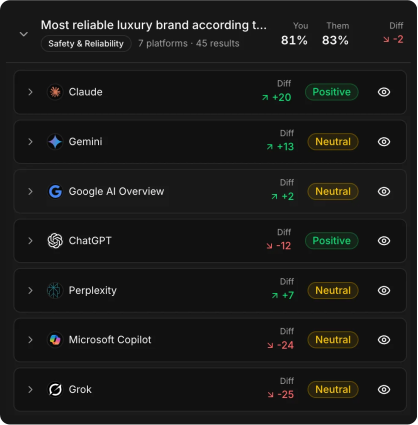
Win customers from all major AI platforms
Understand, measure, and optimize your AI visibility via Ansvisor.
✓ Add brand, domains and competitors
✓ Discover prompts and growth opportunities
✓ Track your AI visibility across major AI platforms
✓ Monitor citations, mentions, and competitors
✓ Measure AI traffic and customer discovery
✓ Receive AI recommendations based on AI insights
✓ Optimize authority, trust, and content quality
✓ Create content, automate analysis & action with AI agents
AI Visibility Terms
Continue exploring key AI visibility concepts.
AI Visibility
Measure and improve how often your brand appears in AI-generated answers.
Learn more →Answer Engine Optimization (AEO)
Strategies for increasing visibility in answer engines and AI summaries.
Learn more →Generative Engine Optimization (GEO)
Optimizing content for AI-powered discovery experiences.
Learn more →ChatGPT Search
Understand how OpenAI retrieves and synthesizes information.
Learn more →Google AI Overviews
AI-generated summaries that appear directly in Google Search.
Learn more →Perplexity Search
Explore how Perplexity cites and presents sources.
Learn more →AI Citations
References and sources used by AI systems to support answers.
Learn more →Citation Authority
Measure the quality and influence of cited sources.
Learn more →Retrievability
How easily AI systems can discover and reuse your content.
Learn more →New terms are added regularly.
Help us improve the page or suggest a new term →
Cihan Geyik
Co-founder at Ansvisor
Cihan Geyik is the co-founder of Ansvisor, an open-source AI Visibility platform for AI Search. With more than 15 years of experience in digital marketing and growth, he writes about AI visibility, AI search, AEO, GEO, citations, and answer engines. He focuses on helping brands understand and improve their presence across ChatGPT, Gemini, Perplexity, Google AI Overviews, and other AI-powered discovery platforms.
Get more Ansvisor insights in Google
Add Ansvisor as a Preferred Source to see more of our AI Search, AEO, GEO, and AI Visibility insights across Google.
Make Your Brand Visible in AI Answers.

INDUSTRIES


© 2026 Ansvisor. All rights reserved. Ansvisor is an open-source AI Search Intelligence Platform for AI Visibility. Ansvisor is a brand owned and operated by Empler AI Inc.


.svg)