


Bright Data
What is Bright Data?
Bright Data is a web data infrastructure platform that provides real-time access to public web information, search results, AI-generated answers, structured datasets, and large-scale data collection infrastructure.
Within AI search, Bright Data provides APIs and scraping tools that allow organizations to collect responses from major answer engines, extract citations and source metadata, monitor brand visibility, compare competitors, and build custom AI search analytics products.
Unlike many dedicated AI visibility platforms, Bright Data primarily operates at the data infrastructure layer. It provides the underlying search and answer-engine data that developers, agencies, analytics teams, and software platforms can use to build their own AI visibility measurement and optimization workflows.
What does Bright Data do for AI search?
Bright Data allows teams to query major AI search engines programmatically and retrieve the resulting answers and metadata in structured formats.
Organizations can use this data to investigate questions such as:
- Does an AI engine mention our brand?
- Which competitors are recommended?
- Which websites and URLs are cited?
- Which sources influence AI-generated answers?
- How does visibility differ between AI platforms?
- How do answers change by location or query?
- How does AI search visibility change over time?
Because Bright Data exposes this information through APIs and scraping infrastructure, teams can define their own prompts, metrics, storage, reporting, and monitoring methodology.
What are the key AI search features of Bright Data?
Bright Data combines answer-engine scraping, search APIs, web access infrastructure, datasets, and structured data delivery.
- LLM Scraper API: Collects responses from major AI-powered search and answer engines.
- AI Search Visibility Data: Provides the response and metadata required to monitor brand mentions, recommendations, and competitive positioning.
- Citation and Source Extraction: Returns cited sources, URLs, and other answer-level metadata.
- Answer Engine Search: Allows developers to submit prompts to supported AI platforms programmatically.
- Real-Time AI Tracking: Supports repeated collection of dynamic AI-generated search results.
- Competitive Insights: Enables teams to compare how brands and competitors appear across AI responses.
- SERP API: Provides structured traditional search results that can be combined with AI search data.
- Web Search API: Provides search results from multiple conventional search engines through a unified interface.
- Geo-Targeting: Allows search and web data collection to be localized across markets.
- Structured Outputs: Delivers data in formats such as JSON, HTML, and Markdown.
- Web Unlocking Infrastructure: Handles blocking, rate limits, proxies, and other technical barriers involved in public web data collection.
- AI & LLM Datasets: Provides structured datasets for model training, grounding, research, and AI applications.
- Web Archive: Provides large-scale archived web data for historical and retrieval use cases.
- Agentic Web Access: Gives AI agents real-time access to public web information.
Which AI platforms does Bright Data support?
Bright Data's current AI search scraping products support several major consumer-facing answer engines.
Its AI Scraper Playground and current product materials explicitly include:
- ChatGPT.
- Perplexity.
- Gemini.
- Grok.
- Microsoft Copilot.
- Google AI Mode.
Bright Data also provides dedicated LLM scraping capabilities for AI-generated search experiences and continues to expand coverage as new answer engines become relevant.
Platform coverage should be evaluated based on the specific Bright Data product or endpoint being used because LLM Scraper, SERP API, Web Search API, and other data products provide different types of results.
How does Bright Data collect AI search data?
Bright Data uses large-scale web data collection infrastructure to access consumer-facing AI search experiences and return the resulting information programmatically.
Its infrastructure handles challenges such as:
- IP blocking.
- Rate limiting.
- Geo restrictions.
- Session management.
- Dynamic page rendering.
- Response parsing.
This allows organizations to focus on analyzing AI search data instead of maintaining the underlying scraping infrastructure themselves.
Bright Data's LLM Scraper product returns both generated answers and structured metadata, allowing teams to store and analyze the results in their own systems.
What data does Bright Data return from AI search engines?
Bright Data can return AI-generated answer content together with structured metadata associated with the response.
Depending on the engine and product configuration, this can include:
- Generated answer text.
- Cited URLs.
- Source domains.
- Source metadata.
- Search results used by the answer engine.
- Answer-engine-specific fields.
- Query information.
- Response metadata.
Bright Data states that its LLM scraping product can return dozens of metadata fields, allowing developers to analyze more than the final answer text alone.
How can Bright Data be used for AI visibility tracking?
Bright Data can act as the collection layer behind a custom AI visibility monitoring system.
A typical workflow can include:
- Define a set of customer and market prompts.
- Run those prompts across multiple AI search engines.
- Collect generated answers and citations.
- Detect brand and competitor mentions.
- Calculate citation and mention rates.
- Compare performance across engines.
- Store historical results.
- Track changes over time.
Bright Data itself provides the underlying AI search data, while teams can decide how visibility metrics should be calculated and presented.
How can Bright Data be used for citation intelligence?
Citation intelligence requires understanding which domains and pages AI systems rely on when constructing answers.
Bright Data's structured answer-engine data can be used to identify these sources and build citation monitoring workflows.
Teams can investigate:
- Which owned pages receive citations.
- Which competitor pages are cited.
- Which third-party domains repeatedly influence answers.
- How source usage differs across AI engines.
- Which prompts generate citations for specific domains.
These findings can then support content optimization, digital PR, authority building, competitive analysis, and third-party distribution strategies.
How can Bright Data be used for competitor analysis?
Bright Data allows organizations to collect the same prompt across several AI search platforms and compare the brands appearing in the resulting answers.
Teams can use this data to calculate custom competitive metrics such as:
- Mention Rate.
- Share of Voice.
- Citation Rate.
- Recommendation frequency.
- Platform coverage.
- Source overlap.
- Competitive citation gaps.
Because the data is delivered programmatically, organizations can define their own competitor sets and scoring methodology.
How does Bright Data support real-time AI search monitoring?
AI-generated answers change frequently, so one-time checks provide limited information about visibility.
Bright Data's APIs can be called on recurring schedules to capture answers repeatedly and create historical datasets.
This allows teams to monitor:
- New brand mentions.
- Lost mentions.
- Changes in citations.
- Competitor gains.
- Changes in recommended products or companies.
- Platform-level visibility trends.
Historical monitoring can help reduce the risk of interpreting one unstable AI response as a permanent search result.
What is Bright Data LLM Scraper?
Bright Data LLM Scraper is a web scraping product specifically designed for collecting data from large language model and AI search interfaces.
It allows developers to query supported AI systems and retrieve their responses through Bright Data's infrastructure.
Bright Data currently highlights support for experiences including ChatGPT, Perplexity, Gemini, and Google AI Mode within its LLM Scraper offering.
The product is intended for use cases such as AI search visibility tracking, competitive intelligence, model research, and AI response monitoring.
What is Bright Data AI Scraper?
Bright Data AI Scraper provides prebuilt scraping interfaces for extracting structured data from AI and other dynamic web environments.
Its Answer Engines Search workflow allows users to submit questions to systems such as ChatGPT, Perplexity, Gemini, Grok, and Microsoft Copilot.
Developers can then integrate these requests into applications using APIs and code examples.
This can provide the retrieval layer for internal AI visibility tools, research systems, monitoring products, and competitive intelligence platforms.
What is Bright Data SERP API?
Bright Data SERP API provides structured access to conventional search engine result pages.
It handles proxy management, geo-targeting, unblocking, rendering, and result parsing while returning search information through an API.
Teams can combine SERP API data with AI search data to analyze relationships between:
- Traditional rankings.
- AI citations.
- Search features.
- Organic visibility.
- AI-generated answers.
This can be useful for organizations that want to treat traditional and AI search as connected discovery environments.
What is Bright Data Web Search API?
Bright Data Web Search API provides search results from multiple conventional search engines through a unified interface.
The API supports geographic targeting and can return results in formats including JSON, HTML, and Markdown.
Bright Data positions the product for use cases including AI agents, search platforms, business intelligence, and real-time web retrieval.
For AI search teams, this type of search data can also serve as an input when researching the sources and traditional search results surrounding AI-generated answers.
How does Bright Data support AI agents?
Bright Data provides web access infrastructure specifically designed for AI agents and autonomous systems.
Agents can use Bright Data to search, crawl, and retrieve information from the public web while the infrastructure handles access problems such as blocked requests and rate limits.
Bright Data can return cleaned Markdown and structured JSON to reduce unnecessary content before information is passed into a language model.
This makes the platform relevant not only to AI visibility monitoring but also to retrieval, grounding, research agents, and real-time AI applications.
What AI datasets does Bright Data provide?
Bright Data provides large collections of structured web datasets that can be used for AI model training, inference, grounding, evaluation, and agent workflows.
Datasets are available in structured formats such as:
- JSON.
- CSV.
- Parquet.
Bright Data also provides filtering, recurring dataset refreshes, documentation, and integration examples for AI applications.
These datasets are a different product category from AI search visibility tracking but share the same underlying objective of making public web data accessible to AI systems and analytics workflows.
How does Bright Data differ from AI visibility dashboards?
Dedicated AI visibility platforms typically combine data collection, metrics, dashboards, competitor benchmarking, recommendations, and workflows into a packaged product.
Bright Data focuses more heavily on the infrastructure underneath those systems.
Instead of requiring teams to use a specific dashboard, Bright Data provides:
- AI search responses.
- Source metadata.
- Citations.
- Search data.
- Geo-targeting.
- APIs.
- Web access infrastructure.
Organizations then decide how those outputs should be stored, scored, visualized, or incorporated into their own products.
This provides greater flexibility but also generally requires more engineering and analytics work than using a fully packaged AI visibility platform.
Can AI visibility platforms use Bright Data?
Yes. Bright Data can function as a data provider or infrastructure layer behind AI visibility and search intelligence products.
A platform can use Bright Data to collect AI answers and citations, then apply its own logic for:
- Prompt management.
- Brand detection.
- Competitor detection.
- Visibility scoring.
- Citation analysis.
- Reporting.
- Opportunity discovery.
This separation between data collection and intelligence allows companies to build differentiated AI search products without maintaining all of the scraping and web-access infrastructure internally.
How does Bright Data fit into AI SEO, AEO, and GEO?
Bright Data operates primarily as a data and infrastructure layer within AI SEO, Answer Engine Optimization (AEO), and Generative Engine Optimization (GEO).
Its products can supply the raw evidence required to measure how AI search systems respond to prompts, which sources they cite, and how brands and competitors appear.
This data can support workflows including:
- AI visibility monitoring.
- Citation intelligence.
- Competitive benchmarking.
- Prompt tracking.
- GEO experiments.
- AI search analytics.
- Search intelligence products.
- AI agent retrieval.
Bright Data therefore complements dedicated optimization and analytics products by providing much of the underlying web and answer-engine data those systems require.
How is Bright Data different from traditional SEO data providers?
Traditional SEO data providers primarily focus on keywords, rankings, SERPs, backlinks, search volumes, and other conventional search signals.
Bright Data provides traditional search infrastructure through products such as SERP API, but it also extends data collection into AI-generated answers and agentic web access.
This allows teams to investigate questions such as:
- What does ChatGPT say about our brand?
- Which sites does Perplexity cite?
- Which competitors appear in Gemini answers?
- Which sources influence Google AI Mode?
- How does AI visibility compare with Google rankings?
- How do AI search results vary across markets?
This makes Bright Data relevant to organizations building search intelligence across both traditional and AI-powered discovery channels.
Who is Bright Data for?
Bright Data is designed primarily for organizations that need large-scale, programmatic access to public web and search data.
Potential users include:
- Developers.
- AI Search and GEO teams.
- Search intelligence platforms.
- AI visibility software companies.
- SEO data platforms.
- Marketing analytics teams.
- Business intelligence teams.
- Agencies.
- AI agent developers.
- Machine learning teams.
- Enterprise data organizations.
The infrastructure-oriented approach can be particularly relevant when custom metrics, raw data access, large-scale collection, geographic coverage, or integration into existing analytics systems are important requirements.
What should teams consider when evaluating Bright Data?
Organizations evaluating Bright Data for AI search should first determine whether they want a ready-made AI visibility product or the infrastructure required to build their own monitoring system.
Important considerations include:
- Engineering resources.
- Required AI engine coverage.
- Prompt and request volume.
- Monitoring frequency.
- Geographic requirements.
- Structured metadata requirements.
- Data storage and BI infrastructure.
- Compliance and data governance requirements.
- Required traditional search data.
Bright Data may be particularly suitable for teams that need flexible, high-volume data collection and want to control their own measurement methodology.
Organizations that primarily want dashboards, recommendations, and turnkey AEO workflows may prefer to use Bright Data indirectly through a dedicated AI search intelligence platform.
Bright Data and the AI Search tools ecosystem
Bright Data occupies the infrastructure layer of the AI search tools ecosystem.
Its LLM Scraper, AI Scraper, SERP API, Web Search API, datasets, proxies, and agentic web access products provide the underlying public web and answer-engine data that can power AI visibility systems, search analytics products, agents, and custom intelligence workflows.
The broader ecosystem includes packaged AI visibility platforms, prompt analytics tools, citation intelligence products, content optimization systems, AI traffic analytics platforms, and traditional SEO products expanding into AI search.
Ansvisor maintains a broader directory of AI SEO, AEO, GEO, AI visibility, and AI search tools to help teams understand these different layers and evaluate platforms according to their specific requirements.
Official source
FAQ
What is Bright Data?

Bright Data is a web data infrastructure platform that provides APIs, scraping tools, datasets, and real-time web access for collecting search results, AI-generated answers, citations, sources, and other public web data.
Does Bright Data support AI search visibility tracking?
Yes. Bright Data explicitly supports AI Search Visibility use cases, including tracking brand mentions, recommendations, citations, and competitor positioning across AI-generated search results
Which AI search engines does Bright Data support?
Bright Data's current AI search products explicitly reference ChatGPT, Perplexity, Gemini, Google AI Mode, Grok, and Microsoft Copilot across its LLM Scraper and Answer Engines Search capabilities.
Does Bright Data provide a complete AI visibility dashboard?
Bright Data primarily provides the data collection and infrastructure layer. Organizations can use its APIs and structured results to build custom dashboards, metrics, citation intelligence, competitor monitoring, or AI visibility products.
Can Bright Data be used by AI agents?
Yes. Bright Data provides dedicated web access infrastructure for AI agents, including real-time crawling and search, structured JSON and Markdown output, and tools designed to handle blocked or rate-limited public web sources.
Everything You Need to Improve Your AI Visibility
Track how your brand appears across AI platforms, understand what drives visibility, and turn insights into measurable actions.
Platform Features
Explore all features →Answer Engine Insights
Understand how AI platforms talk about your brand.
Prompt Intelligence
Discover and monitor the prompts shaping your AI visibility.
Citations Monitoring
Track which sources AI platforms cite and where your brand appears.
AI Traffic Analytics
Measure visits coming from ChatGPT, Gemini, Claude, and more.
Competitor Benchmarking
Compare AI visibility and uncover competitive gaps and opportunities.
Action Center
Turn AI Search signals into prioritized actions and executable tasks.
AI Visibility Trackers
Explore AI Visibility Platform →ChatGPT Visibility Tracker
Track brand mentions, citations, prompts, and visibility across ChatGPT.
Google AI Overviews Rank Tracker
Monitor where and how your brand appears in Google AI Overviews.
Google AI Mode Visibility Tracker
Track your brand's visibility across Google AI Mode experiences.
Gemini Visibility Tracker
Understand how your brand appears across Google Gemini responses.
Microsoft Copilot Visibility Tracker
Monitor your brand's presence across Microsoft Copilot answers.
Perplexity Visibility Tracker
Track brand mentions, citations, and visibility across Perplexity.
From AI Visibility insights to action.
Explore the complete Ansvisor platform for AI Search intelligence, optimization, and growth.
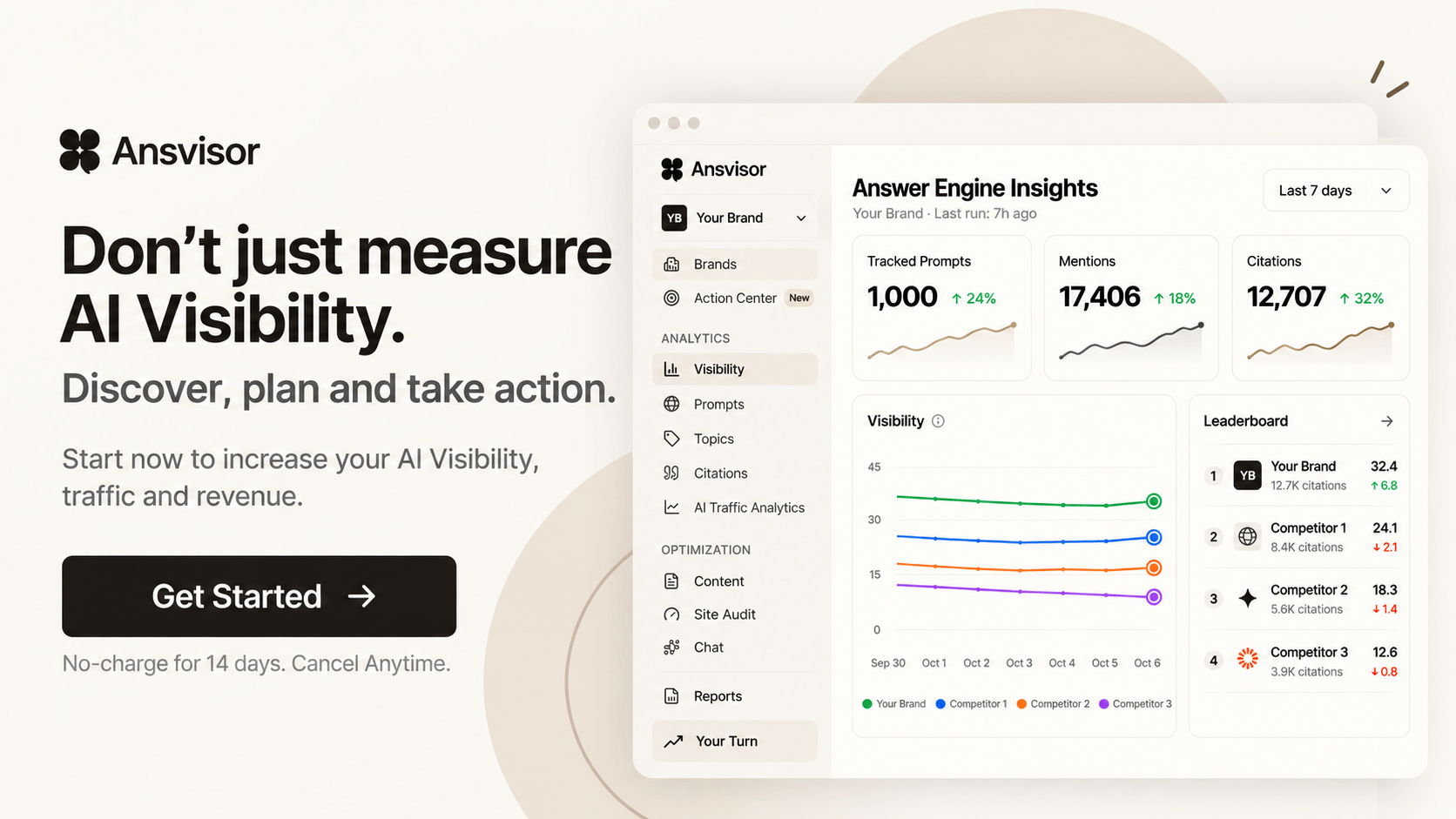
Win customers from all major AI platforms
Understand, measure, and optimize your AI visibility via Ansvisor.
✓ Add brand, domains and competitors
✓ Discover prompts and growth opportunities
✓ Track your AI visibility across major AI platforms
✓ Monitor citations, mentions, and competitors
✓ Measure AI traffic and customer discovery
✓ Receive AI recommendations based on AI insights
✓ Optimize authority, trust, and content quality
✓ Create content, automate analysis & action with AI agents
AI Visibility Terms
Continue exploring key AI visibility concepts.
AI Visibility
Measure and improve how often your brand appears in AI-generated answers.
Learn more →Answer Engine Optimization (AEO)
Strategies for increasing visibility in answer engines and AI summaries.
Learn more →Generative Engine Optimization (GEO)
Optimizing content for AI-powered discovery experiences.
Learn more →ChatGPT Search
Understand how OpenAI retrieves and synthesizes information.
Learn more →Google AI Overviews
AI-generated summaries that appear directly in Google Search.
Learn more →Perplexity Search
Explore how Perplexity cites and presents sources.
Learn more →AI Citations
References and sources used by AI systems to support answers.
Learn more →Citation Authority
Measure the quality and influence of cited sources.
Learn more →Retrievability
How easily AI systems can discover and reuse your content.
Learn more →New terms are added regularly.
Help us improve the page or suggest a new term →
Cihan Geyik
Co-founder at Ansvisor
Cihan Geyik is the co-founder of Ansvisor, an open-source AI Visibility platform for AI Search. With more than 15 years of experience in digital marketing and growth, he writes about AI visibility, AI search, AEO, GEO, citations, and answer engines. He focuses on helping brands understand and improve their presence across ChatGPT, Gemini, Perplexity, Google AI Overviews, and other AI-powered discovery platforms.
Get more Ansvisor insights in Google
Add Ansvisor as a Preferred Source to see more of our AI Search, AEO, GEO, and AI Visibility insights across Google.
Make Your Brand Visible in AI Answers.

INDUSTRIES


© 2026 Ansvisor. All rights reserved. Ansvisor is an open-source AI Search Intelligence Platform for AI Visibility. Ansvisor is a brand owned and operated by Empler AI Inc.


.svg)