


AI Search Optimization
Why AI Search Optimization matters
AI Search Optimization is the practice of improving how brands, products, services, and content are discovered, understood, cited, mentioned, and recommended across AI-powered search experiences.
Unlike traditional SEO, which primarily focuses on visibility within search engine results, rankings, impressions, clicks, and organic traffic, AI Search Optimization expands the optimization process to AI-generated answers and conversational discovery environments.
The goal is not simply to rank a webpage. It is to improve the likelihood that a brand and its information become part of the answers people receive when they ask questions, compare solutions, research products, evaluate alternatives, or seek recommendations through AI-powered platforms.
As platforms such as ChatGPT Search, Perplexity Search, Google AI Overviews, and Gemini increasingly influence discovery, organizations need strategies designed specifically for AI-powered search.
Benefits of AI Search Optimization can include:
- Improving AI Visibility across strategically relevant topics.
- Increasing opportunities to earn citations in AI-generated answers.
- Increasing brand and product mentions.
- Strengthening entity and source authority.
- Expanding discovery beyond traditional search results.
- Improving visibility for comparison and recommendation prompts.
- Closing visibility gaps against competitors.
- Influencing customer decisions earlier in the research journey.
- Increasing opportunities for AI-referred website traffic.
AI Search Optimization has emerged as an umbrella discipline that includes Answer Engine Optimization (AEO) and Generative Engine Optimization (GEO). These disciplines overlap significantly because each focuses on improving how information is discovered and represented within AI-generated experiences.
How AI Search Optimization works
AI search platforms do not operate exactly like traditional search engines. Depending on the platform and query, they can combine language models, retrieval systems, search indexes, ranking mechanisms, knowledge sources, and information extracted from the web to construct an answer.
This creates a discovery process that can be simplified as:
User Question → Retrieval → Source Selection → Answer Generation → Brand Mention or Citation
AI Search Optimization attempts to improve a brand's ability to participate in this process.
Successful optimization strategies commonly focus on:
- Content quality and usefulness.
- Entity recognition and consistency.
- Topical depth and expertise.
- Citation opportunities.
- Source and domain authority.
- Clear information architecture.
- Structured and machine-readable information.
- Content accessibility and crawlability.
- Third-party brand mentions and references.
- Fresh and accurate information.
Concepts such as Retrievability, Source Authority, and Citation Authority help explain why some sources are more discoverable or frequently referenced than others.
What is the relationship between AI Search Optimization, AEO, and GEO?
AI Search Optimization, AEO, and GEO describe closely related approaches to improving visibility within AI-powered discovery environments.
Answer Engine Optimization (AEO) focuses on improving how brands, content, products, and information appear within answer-oriented experiences. It can include visibility, mentions, citations, recommendations, prompt coverage, competitor performance, and other signals associated with AI-generated answers.
Generative Engine Optimization (GEO) commonly focuses on optimizing information for discovery, retrieval, citation, and representation by generative AI systems.
AI Search Optimization can be used as a broader umbrella for these practices:
AI Search Optimization → AEO + GEO + AI Visibility + Content + Authority + Measurement
The terminology continues to evolve, and organizations may use AEO, GEO, AI SEO, or AI Search Optimization differently. In practice, the disciplines share a common objective: increasing meaningful visibility across AI-powered search and answer experiences.
What influences AI Search Optimization?
No single optimization factor determines whether a brand will appear in an AI-generated answer. Performance can depend on a combination of content, technical, entity, authority, retrieval, and external signals.
Important areas can include:
- AI Content Optimization.
- Entity clarity and consistency.
- Source credibility.
- Topical authority.
- Structured data.
- Content freshness.
- Clear page structure.
- Internal linking.
- Original research and evidence.
- Third-party mentions and citations.
- Accessible and indexable content.
- Coverage of relevant questions and customer intents.
Unlike a strategy focused only on keyword matching, AI Search Optimization also considers whether information is easy for AI systems to retrieve, understand, contextualize, and use when constructing an answer.
Why are entities important for AI Search Optimization?
AI systems need to understand what a company, product, person, service, or concept represents before they can reliably connect that entity with relevant questions and topics.
Strong entity signals can help establish relationships between:
- A brand and its products.
- A company and its industry.
- A product and its use cases.
- A brand and relevant topics.
- A company and third-party sources that discuss it.
- A product and the alternatives or competitors associated with it.
Consistent brand information, clear product descriptions, structured information, authoritative references, and relevant third-party mentions can all contribute to stronger entity understanding.
Why is content important for AI Search Optimization?
Content provides much of the information AI search systems can retrieve, evaluate, summarize, and cite.
Effective AI Search Optimization therefore requires more than publishing large amounts of content. Pages should provide useful information that directly addresses relevant questions and can be understood without unnecessary ambiguity.
Useful content characteristics can include:
- Clear answers to specific questions.
- Accurate definitions.
- Original data and research.
- Statistics with identifiable sources.
- Expert insights.
- Examples and practical explanations.
- Comparison tables.
- Product and service information.
- Transparent methodology.
- Logical headings and page structure.
The objective is to create information that is useful to both people and the systems retrieving information to construct AI-generated answers.
What role do citations play in AI Search Optimization?
Citations provide an important connection between an AI-generated answer and the sources used or presented alongside that answer.
Citation visibility can help organizations understand whether their websites and individual pages are being used as sources, rather than only whether their brands are mentioned.
This distinction is important:
Brand Mention → Entity Visibility
Citation → Source Visibility
A brand can be mentioned without its website being cited, while a page can sometimes be cited even when the brand itself is not prominently discussed.
Monitoring both signals provides a more complete view of AI Search performance.
Why does third-party authority matter?
AI Search Optimization is not limited to content published on a company's own website.
AI-generated answers may reference publishers, review sites, industry resources, community discussions, research organizations, directories, and other third-party sources.
This means organizations can also evaluate:
- Which third-party domains are frequently cited for important prompts.
- Where competitors are mentioned but the brand is absent.
- Which publishers influence category recommendations.
- Which external sources establish authority around important topics.
- Where relevant brand mentions or citations could be strengthened.
AI Search Optimization can therefore extend beyond owned content into broader authority, digital PR, brand mention, and citation strategies.
How are prompts used in AI Search Optimization?
Prompts represent the questions, instructions, comparisons, and requests people use when interacting with AI-powered search systems.
A traditional SEO workflow often begins with:
Keyword → Search Results → Ranking → Click
An AI Search Optimization workflow can instead examine:
Prompt → AI Answer → Brand Visibility → Mention or Citation → Recommendation → Outcome
Relevant prompt groups can include:
- Informational questions.
- Category discovery prompts.
- Product recommendations.
- Best-tool or best-provider questions.
- Competitor comparisons.
- Alternative searches.
- Use-case questions.
- Problem-solving prompts.
- High-intent purchase or evaluation questions.
Tracking a representative portfolio of prompts helps organizations understand where their AI Search visibility is strong and where important gaps remain.
How is AI Search Optimization different from traditional SEO?
AI Search Optimization and SEO overlap significantly, but they measure and optimize different discovery experiences.
Traditional SEO commonly focuses on search results, ranking positions, organic impressions, clicks, and website traffic.
AI Search Optimization additionally considers whether a brand or source becomes part of the generated answer itself.
- SEO: keywords, rankings, SERPs, organic clicks, and traffic.
- AI Search Optimization: prompts, answers, mentions, citations, recommendations, AI Visibility, and AI-referred traffic.
These practices should not be treated as mutually exclusive. Strong technical SEO, useful content, authority, crawlability, and information architecture can also support AI Search visibility.
How to measure AI Search Optimization
AI Search Optimization should be measured across multiple signals rather than reduced to a single score.
Organizations commonly monitor:
- AI Visibility.
- Brand mentions.
- Citation frequency.
- Citation Rate.
- Share of Voice.
- Prompt coverage.
- Competitor performance.
- Platform coverage.
- Historical visibility changes.
- AI Referral Traffic.
- AI-referred landing pages.
- Conversions where identifiable.
Capabilities such as Prompt Monitoring, Citation Monitoring, and AI Search Analytics help organizations understand which optimization efforts correspond with changes in AI Search performance.
The measurement process can be summarized as:
Establish Baseline → Optimize → Track Changes → Compare → Identify Gaps → Improve Again
How do you identify AI Search Optimization opportunities?
Optimization opportunities can be identified by comparing customer demand with existing brand visibility, competitor performance, citation coverage, and available content.
Examples can include:
- High-value prompts where the brand does not appear.
- Topics where competitors have stronger AI Visibility.
- Prompts where competitors receive citations but the brand does not.
- Important questions not adequately addressed by existing content.
- Pages that receive citations but could cover additional related questions.
- Third-party sources that repeatedly influence relevant AI answers.
- AI platforms where the brand has weak coverage.
- High-visibility pages that generate limited AI-referred traffic.
This turns AI Search Optimization from a collection of isolated tactics into a prioritization process based on measurable gaps and opportunities.
How do you improve AI Search Optimization?
The appropriate optimization action depends on the reason a visibility gap exists. There is no single tactic that improves every prompt or platform.
Depending on the evidence, organizations may:
- Create content for strategically important uncovered topics.
- Expand existing pages to answer important related questions.
- Improve factual clarity and information structure.
- Add original research, evidence, examples, or statistics.
- Strengthen internal links between related topics.
- Improve structured and machine-readable information.
- Update outdated content.
- Strengthen entity signals.
- Close competitor citation gaps.
- Earn relevant third-party mentions and references.
- Improve pages already receiving AI citations or referral traffic.
Optimization should then be followed by repeated measurement to determine whether the targeted signals changed.
Measure → Find Gap → Prioritize → Optimize → Measure Again
What are the most important AI Search Optimization KPIs?
The appropriate KPIs depend on the organization's goals, but common measurements can include:
- AI Visibility percentage.
- Total brand mentions.
- Total citations.
- Citation Rate.
- Share of Voice.
- Prompt Coverage.
- Competitor visibility gaps.
- Platform coverage.
- AI-referred visits.
- Conversions from identifiable AI referral traffic.
KPIs become more useful when they are connected with specific topics, prompts, competitors, and actions rather than viewed as isolated dashboard metrics.
Can AI Search Optimization guarantee citations or recommendations?
No. Optimization cannot guarantee that a particular AI system will cite, mention, or recommend a brand for a specific prompt.
AI-generated answers can vary because of model changes, retrieval systems, prompt wording, location, language, available sources, competitor activity, and changes in web content.
AI Search Optimization should therefore be treated as an ongoing process of improving discoverability, authority, information quality, coverage, and measurable visibility rather than as a guarantee of a specific answer.
Common AI Search Optimization mistakes
Common mistakes include:
- Treating AI Search as traditional SEO with a different name.
- Focusing only on rankings.
- Tracking only one or two manually selected prompts.
- Ignoring citations and source authority.
- Ignoring brand mentions that occur without citations.
- Monitoring only a single AI platform.
- Creating content without evaluating existing content first.
- Publishing large amounts of low-value AI-generated content.
- Ignoring third-party sources and authority.
- Measuring only website traffic.
- Failing to benchmark competitors.
- Making changes without establishing a performance baseline.
Avoiding these mistakes helps organizations build a more complete optimization strategy across content, authority, retrieval, visibility, and measurement.
AI Search Optimization and continuous improvement
AI Search Optimization is not a one-time project. AI platforms, models, retrieval systems, cited sources, competitor content, and customer questions continually change.
A mature optimization program therefore creates a continuous cycle:
Prompts → Visibility → Citations → Competitors → Opportunities → Actions → Measurement
Platforms such as Ansvisor can help organizations monitor answer engines, analyze prompts and citations, benchmark competitors, identify visibility opportunities, measure AI-referred traffic, and connect detected signals with optimization actions.
As AI-powered search becomes a larger part of product discovery, research, comparison, and decision-making, AI Search Optimization provides a framework for understanding where a brand appears, why competitors may be more visible, which sources influence answers, and what organizations can improve next.
FAQ
What is AI Search Optimization?

AI Search Optimization is the practice of improving visibility, citations, and discoverability across AI-powered search platforms.
How is AI Search Optimization different from SEO?
SEO focuses primarily on rankings and traffic, while AI Search Optimization focuses on mentions, citations, recommendations, and AI-generated answers.
What factors influence AI Search Optimization?
Important factors include content quality, authority signals, citations, retrievability, and entity recognition.
How can organizations measure AI Search Optimization?
Organizations can monitor AI visibility, citations, mentions, Share of Voice, and prompt coverage.
Which tools help with AI Search Optimization?
AI Visibility tools like Ansvisor help organizations analyze visibility, citations, prompts, competitors, and optimization opportunities across answer engines.
Everything You Need to Improve Your AI Visibility
Track how your brand appears across AI platforms, understand what drives visibility, and turn insights into measurable actions.
Platform Features
Explore all features →Answer Engine Insights
Understand how AI platforms talk about your brand.
Prompt Intelligence
Discover and monitor the prompts shaping your AI visibility.
Citations Monitoring
Track which sources AI platforms cite and where your brand appears.
AI Traffic Analytics
Measure visits coming from ChatGPT, Gemini, Claude, and more.
Competitor Benchmarking
Compare AI visibility and uncover competitive gaps and opportunities.
Action Center
Turn AI Search signals into prioritized actions and executable tasks.
AI Visibility Trackers
Explore AI Visibility Platform →ChatGPT Visibility Tracker
Track brand mentions, citations, prompts, and visibility across ChatGPT.
Google AI Overviews Rank Tracker
Monitor where and how your brand appears in Google AI Overviews.
Google AI Mode Visibility Tracker
Track your brand's visibility across Google AI Mode experiences.
Gemini Visibility Tracker
Understand how your brand appears across Google Gemini responses.
Microsoft Copilot Visibility Tracker
Monitor your brand's presence across Microsoft Copilot answers.
Perplexity Visibility Tracker
Track brand mentions, citations, and visibility across Perplexity.
From AI Visibility insights to action.
Explore the complete Ansvisor platform for AI Search intelligence, optimization, and growth.
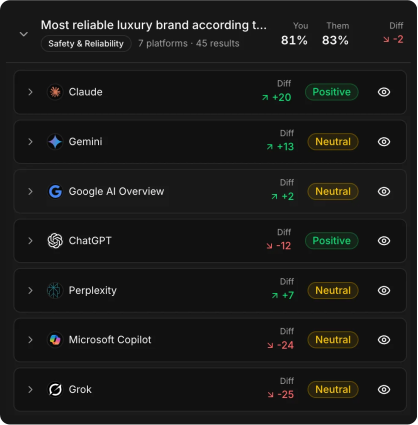
Win customers from all major AI platforms
Understand, measure, and optimize your AI visibility via Ansvisor.
✓ Add brand, domains and competitors
✓ Discover prompts and growth opportunities
✓ Track your AI visibility across major AI platforms
✓ Monitor citations, mentions, and competitors
✓ Measure AI traffic and customer discovery
✓ Receive AI recommendations based on AI insights
✓ Optimize authority, trust, and content quality
✓ Create content, automate analysis & action with AI agents
AI Visibility Terms
Continue exploring key AI visibility concepts.
AI Visibility
Measure and improve how often your brand appears in AI-generated answers.
Learn more →Answer Engine Optimization (AEO)
Strategies for increasing visibility in answer engines and AI summaries.
Learn more →Generative Engine Optimization (GEO)
Optimizing content for AI-powered discovery experiences.
Learn more →ChatGPT Search
Understand how OpenAI retrieves and synthesizes information.
Learn more →Google AI Overviews
AI-generated summaries that appear directly in Google Search.
Learn more →Perplexity Search
Explore how Perplexity cites and presents sources.
Learn more →AI Citations
References and sources used by AI systems to support answers.
Learn more →Citation Authority
Measure the quality and influence of cited sources.
Learn more →Retrievability
How easily AI systems can discover and reuse your content.
Learn more →New terms are added regularly.
Help us improve the page or suggest a new term →
Cihan Geyik
Co-founder at Ansvisor
Cihan Geyik is the co-founder of Ansvisor, an open-source AI Visibility platform for AI Search. With more than 15 years of experience in digital marketing and growth, he writes about AI visibility, AI search, AEO, GEO, citations, and answer engines. He focuses on helping brands understand and improve their presence across ChatGPT, Gemini, Perplexity, Google AI Overviews, and other AI-powered discovery platforms.
Make Your Brand Visible in AI Answers.

INDUSTRIES


© 2026 Ansvisor. All rights reserved. Ansvisor is an open-source AI Search Intelligence Platform for AI Visibility.


.svg)
