Why Foundation Models matter
Foundation Models are large-scale AI models trained on massive datasets that serve as the base layer for a wide range of AI applications. Rather than being built for a single task, foundation models learn general patterns, language, knowledge, and reasoning capabilities that can later be adapted for specific use cases.
Foundation models have become the core technology behind modern AI assistants, answer engines, search systems, and generative AI applications.
Benefits of foundation models include:
- Support multiple tasks.
- Enable natural language understanding.
- Power AI search experiences.
- Provide reasoning capabilities.
- Accelerate AI application development.
Most modern Answer Engines and AI search platforms rely on foundation models as their primary reasoning and generation layer.
How Foundation Models work
Foundation models are trained on large collections of text, code, images, and other forms of data.
- Pre-training on massive datasets.
- Learning semantic relationships.
- Building knowledge representations.
- Developing reasoning capabilities.
- Learning language patterns.
- Generalizing across tasks.
After pre-training, foundation models can be adapted using techniques such as Fine-Tuning, prompting, retrieval systems, or specialized training methods.
Examples of Foundation Models
Many leading AI systems are built on foundation models.
- GPT family models.
- Claude models.
- Gemini models.
- Llama models.
- Mistral models.
- DeepSeek models.
These models power search, assistants, coding tools, recommendation systems, and enterprise AI applications.
How Foundation Models affect AI search
Foundation models influence multiple aspects of AI-powered search experiences.
- Language understanding.
- Answer generation.
- Entity recognition.
- Recommendation quality.
- Reasoning performance.
- Information synthesis.
Technologies such as Retrieval-Augmented Generation (RAG), Embeddings, and Context Window are commonly combined with foundation models to improve factual accuracy and retrieval performance.
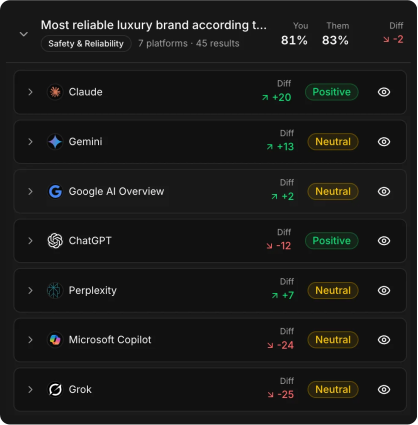
Platforms such as Ansvisor help organizations understand how foundation model-powered search systems retrieve, cite, and recommend content across different AI search platforms.
Common pitfalls
Common mistakes include:
- Assuming all foundation models behave similarly.
- Expecting models to have real-time knowledge.
- Ignoring retrieval systems.
- Relying only on model size.
- Treating foundation models as databases.
Foundation models provide the reasoning and language capabilities behind modern AI systems, but their effectiveness depends heavily on retrieval, data quality, context, and trust signals.








.svg)
