


LLMrefs
What is LLMrefs?
LLMrefs is an AI search analytics and visibility monitoring platform designed to help organizations understand how their brands appear across AI-powered search and answer engines.
The platform measures brand mentions, citations, Share of Voice, position, competitors, and other visibility signals across AI-generated responses.
One of LLMrefs' defining characteristics is its keyword-first approach. Instead of requiring marketers to manually create and manage large numbers of individual conversational prompts, teams can define important keywords and topics while LLMrefs expands them into prompt variations and related queries for monitoring.
LLMrefs operates within the growing AI search optimization ecosystem associated with AI SEO, Answer Engine Optimization (AEO), Generative Engine Optimization (GEO), and LLM SEO.
What does LLMrefs do?
LLMrefs monitors how brands perform when AI systems answer questions related to selected keywords and topics.
The platform generates and analyzes conversational prompt variations across multiple AI search engines, then aggregates the resulting brand mentions, citations, positions, and competitive data into structured reports.
Teams can use these reports to understand where their brand appears, which competitors receive stronger visibility, which sources are cited, and how AI search performance changes over time.
What are the key features of LLMrefs?
LLMrefs combines AI search monitoring, keyword intelligence, citation analysis, competitive benchmarking, and optimization tools within its platform.
- AI Search Visibility Tracking: Measures brand presence across AI-generated answers.
- Keyword-First Monitoring: Allows teams to start with important SEO keywords and topics rather than manually building every prompt.
- Automated Prompt Generation: Expands keywords and topics into conversational prompt variations for AI search monitoring.
- Share of Voice: Compares brand visibility with competitors across analyzed AI responses.
- Position Tracking: Measures where brands appear when multiple companies or products are mentioned within AI answers.
- Citation Tracking: Identifies sources referenced by AI search engines.
- Competitor Tracking: Benchmarks brands against competing organizations across relevant keywords and prompts.
- Query Fan-Out: Analyzes related searches and query variations associated with AI search behavior.
- Geo-Targeting: Supports AI search monitoring across multiple countries and languages.
- Alerts: Helps teams monitor meaningful changes in AI visibility.
- API Access: Allows AI search data to be integrated into external analytics, reporting, and workflow systems.
- AI SEO Tools: Provides additional utilities for AI crawlability, query fan-out, prompt research, content testing, Reddit research, and other AI search workflows.
Which AI platforms does LLMrefs track?
LLMrefs monitors brand visibility across a broad range of major AI search and answer engines.
Its current platform coverage includes:
- ChatGPT.
- Google AI Overviews.
- Google AI Mode.
- Gemini.
- Perplexity.
- Claude.
- Grok.
- Microsoft Copilot.
- Meta AI.
- DeepSeek.
LLMrefs also supports geographic targeting across more than 20 countries and multiple languages, allowing organizations to investigate how AI visibility differs between markets.
Multi-platform monitoring is important because similar questions can produce different brands, sources, citations, and recommendations depending on the AI system being used.
What is the keyword-first approach in LLMrefs?
LLMrefs approaches AI visibility monitoring differently from systems built primarily around manually configured prompt lists.
Users can begin with the keywords and topics that matter to their business. LLMrefs then handles the process of expanding those concepts into conversational prompts, variations, and related searches that can be tested across AI engines.
For example, a broad commercial topic can generate different question formats such as recommendations, comparisons, alternatives, and informational searches.
This approach is designed to make AI search monitoring more familiar to SEO teams while addressing the fact that users can express the same underlying intent through many different natural-language prompts.
How does LLMrefs generate and monitor AI prompts?
LLMrefs converts tracked keywords and topics into multiple conversational prompt templates rather than treating one manually written prompt as the complete representation of an AI search topic.
The system can expand a seed topic into question formats such as:
- Best product or service recommendations.
- Comparisons between alternatives.
- Alternative-product searches.
- Informational and how-to questions.
- Related fan-out queries.
These prompts are executed across supported AI search engines and analyzed for brands, competitors, citations, and visibility signals.
The resulting data is then aggregated at the keyword or topic level to provide a broader representation of AI search visibility.
How does LLMrefs measure AI visibility?
LLMrefs analyzes multiple AI-generated responses associated with tracked keywords and prompt variations to determine how brands perform across AI search.
Its reporting includes signals such as:
- Brand visibility.
- Share of Voice.
- Brand mentions.
- Average position.
- Citations.
- Competitor presence.
- AI search engine performance.
- Visibility trends over time.
Rather than treating one generated response as a stable search result, LLMrefs aggregates information across prompts and AI engines to create more comparable measurements.
How does LLMrefs handle non-deterministic AI responses?
AI search engines are non-deterministic, meaning that the same or similar prompt can produce different answers, brands, sources, and citations across repeated runs.
This creates a measurement challenge that does not exist in exactly the same form in traditional rank tracking.
LLMrefs addresses this by using multiple prompt variations, repeated observations, aggregation, normalization, and statistical sampling rather than relying on a single response as the definitive result for a topic.
The objective is to create visibility metrics that represent broader patterns across AI answers instead of overreacting to individual response variations.
How does citation tracking work in LLMrefs?
LLMrefs analyzes citations appearing within AI-generated responses to help teams understand which websites and sources influence important AI search topics.
Citation analysis can help organizations investigate:
- Which domains receive citations.
- Which competitors are supported by cited sources.
- Which sources repeatedly appear for important topics.
- Where citation gaps exist.
- Which content may be influencing AI recommendations.
These insights can support content strategy, competitive research, digital PR, authority building, and other AI search optimization activities.
How does LLMrefs analyze competitors?
LLMrefs compares brands across the same keywords, prompts, and AI search engines to provide competitive visibility benchmarks.
Teams can investigate Share of Voice, average position, citations, and other signals to understand which competitors receive greater exposure across AI-generated answers.
Because results are aggregated across multiple prompt variations, competitor analysis can provide a broader view of category visibility than manually comparing individual AI responses.
This can help teams identify topics where competitors consistently outperform their brand and investigate the content or source patterns associated with those differences.
What is Query Fan-Out in LLMrefs?
LLMrefs incorporates Query Fan-Out into its approach to AI search research and measurement.
Query fan-out occurs when an AI search system expands an initial user request into multiple related searches or subqueries before constructing its final answer.
Understanding these queries can reveal additional topics, entities, comparisons, and information needs that influence retrieval.
LLMrefs provides fan-out analysis as part of its broader AI search toolkit and also offers a Query Fan-Out Generator that allows marketers to investigate how an original question can expand into supporting searches.
What AI SEO tools does LLMrefs provide?
In addition to its core AI visibility platform, LLMrefs provides a collection of utilities designed for specific AI search research and optimization tasks.
These tools include:
- AI Crawlability Checker: Tests whether AI crawlers can access page content.
- Query Fan-Out Generator: Generates related searches that may be used during AI retrieval.
- ChatGPT Search Query Extractor: Helps investigate searches generated during ChatGPT Search activity.
- ChatGPT Prompts Database: Provides searchable prompt data based on AI chatbot conversations.
- AI Content Optimizer: Supports testing and comparing content for AI search.
- Reddit Threads Finder: Identifies relevant Reddit discussions around selected topics.
- LLMs.txt Generator: Generates an llms.txt file for websites.
These utilities extend the platform beyond monitoring by providing tools for investigating retrieval behavior, content accessibility, prompt demand, and third-party visibility opportunities.
What is the LLMrefs ChatGPT Prompts Database?
LLMrefs provides a searchable database designed to help marketers investigate questions people ask across AI chatbots.
The database contains millions of conversational examples from AI environments such as ChatGPT, Gemini, and Perplexity.
Prompt datasets can help teams understand how conversational search differs from traditional keyword search and identify questions, wording patterns, and customer intents that may be relevant to their market.
These insights can then inform keyword selection, prompt monitoring, content planning, and AI search optimization.
Does LLMrefs provide an API?
LLMrefs provides an AI SEO API that allows organizations to access platform data programmatically.
API access can be useful for teams that want to integrate AI visibility data with external reporting systems, dashboards, internal analytics platforms, or automated workflows.
This is particularly relevant to agencies and organizations managing AI search data across multiple brands, projects, or reporting environments.
Who is LLMrefs for?
LLMrefs is designed for organizations and professionals that want to understand how their brands perform across AI-generated search experiences.
Potential users include:
- SEO teams.
- AEO and GEO teams.
- Content marketing teams.
- Growth teams.
- Brand teams.
- Digital PR teams.
- Agencies.
- Enterprise marketing teams.
Its keyword-first workflow can be particularly relevant to SEO practitioners who want to extend existing keyword and topic strategies into AI search without manually maintaining large prompt lists.
How does LLMrefs fit into AI SEO, AEO, and GEO?
LLMrefs operates within the broader AI search optimization ecosystem associated with AI SEO, Answer Engine Optimization (AEO), Generative Engine Optimization (GEO), and LLM SEO.
These disciplines expand search optimization beyond traditional rankings by examining whether brands and content are mentioned, cited, compared, and recommended within AI-generated answers.
LLMrefs supports this process through keyword-based AI search tracking, automated prompt generation, Query Fan-Out, citations, competitor intelligence, Share of Voice, and AI search optimization utilities.
How is LLMrefs different from traditional SEO tools?
Traditional SEO platforms primarily measure keywords, rankings, backlinks, organic traffic, and conventional search engine results.
LLMrefs focuses on how brands perform within generated AI answers.
Instead of only asking where a webpage ranks for a keyword, teams can investigate questions such as:
- How often does AI mention our brand?
- Which competitors receive greater Share of Voice?
- Which websites are cited?
- How does visibility vary across AI engines?
- Which conversational prompts represent an important keyword?
- What fan-out queries may influence retrieval?
- How is our AI search visibility changing over time?
LLMrefs therefore extends familiar keyword and topic-based search analysis into AI-generated discovery environments.
What should teams consider when evaluating LLMrefs?
Organizations evaluating LLMrefs should consider whether its keyword-first methodology matches the way they want to measure AI search.
Teams that prefer to define and control every individual prompt may have different requirements from organizations that want a system to automatically expand keywords into multiple conversational searches.
Other considerations include required AI engine coverage, countries and languages, tracking frequency, citation analysis, competitor monitoring, API requirements, reporting workflows, and the number of projects or clients being managed.
Teams should also consider how an AI visibility platform addresses non-deterministic responses. AI answers can change between runs, so measurement methodology and sampling strategy can materially affect the resulting visibility metrics.
LLMrefs and the AI Search tools ecosystem
LLMrefs is one of several platforms developed specifically for measuring brand visibility across AI-generated search experiences.
Its keyword-first methodology, automated prompt expansion, statistical approach to AI response measurement, citation tracking, and collection of supporting AI SEO utilities distinguish its approach within the market.
The broader ecosystem includes AI visibility monitoring platforms, prompt analytics products, citation intelligence tools, AI traffic analytics systems, content optimization platforms, and traditional SEO products expanding into AI search.
Ansvisor maintains a broader directory of AI SEO, AEO, GEO, AI visibility, and AI search tools to help teams understand this evolving ecosystem and evaluate platforms based on their specific requirements.
Official source
FAQ
What is LLMrefs?

LLMrefs is an AI search analytics platform that tracks brand visibility, Share of Voice, position, citations, and competitors across AI search engines. It uses a keyword-first approach that automatically expands topics into conversational prompts for monitoring.
Which AI platforms does LLMrefs track?
LLMrefs currently lists ChatGPT, Google AI Overviews, Google AI Mode, Gemini, Perplexity, Claude, Grok, Microsoft Copilot, Meta AI, and DeepSeek among its supported AI search engines.
How is LLMrefs different from prompt-based AI visibility tools?
LLMrefs emphasizes a keyword-first methodology. Teams define important keywords and topics, while the platform generates prompt variations and fan-out queries and aggregates results across responses and engines rather than relying only on manually created prompt lists.
Does LLMrefs track AI citations and competitors?
Yes. LLMrefs analyzes citations, brand visibility, Share of Voice, average position, and competitor performance across monitored AI search responses.
Does LLMrefs provide AI search research tools and an API?
es. LLMrefs provides an AI SEO API alongside tools for Query Fan-Out, AI crawlability, ChatGPT prompts, ChatGPT search queries, content testing, Reddit research, and llms.txt generation.
Everything You Need to Improve Your AI Visibility
Track how your brand appears across AI platforms, understand what drives visibility, and turn insights into measurable actions.
Platform Features
Explore all features →Answer Engine Insights
Understand how AI platforms talk about your brand.
Prompt Intelligence
Discover and monitor the prompts shaping your AI visibility.
Citations Monitoring
Track which sources AI platforms cite and where your brand appears.
AI Traffic Analytics
Measure visits coming from ChatGPT, Gemini, Claude, and more.
Competitor Benchmarking
Compare AI visibility and uncover competitive gaps and opportunities.
Action Center
Turn AI Search signals into prioritized actions and executable tasks.
AI Visibility Trackers
Explore AI Visibility Platform →ChatGPT Visibility Tracker
Track brand mentions, citations, prompts, and visibility across ChatGPT.
Google AI Overviews Rank Tracker
Monitor where and how your brand appears in Google AI Overviews.
Google AI Mode Visibility Tracker
Track your brand's visibility across Google AI Mode experiences.
Gemini Visibility Tracker
Understand how your brand appears across Google Gemini responses.
Microsoft Copilot Visibility Tracker
Monitor your brand's presence across Microsoft Copilot answers.
Perplexity Visibility Tracker
Track brand mentions, citations, and visibility across Perplexity.
From AI Visibility insights to action.
Explore the complete Ansvisor platform for AI Search intelligence, optimization, and growth.
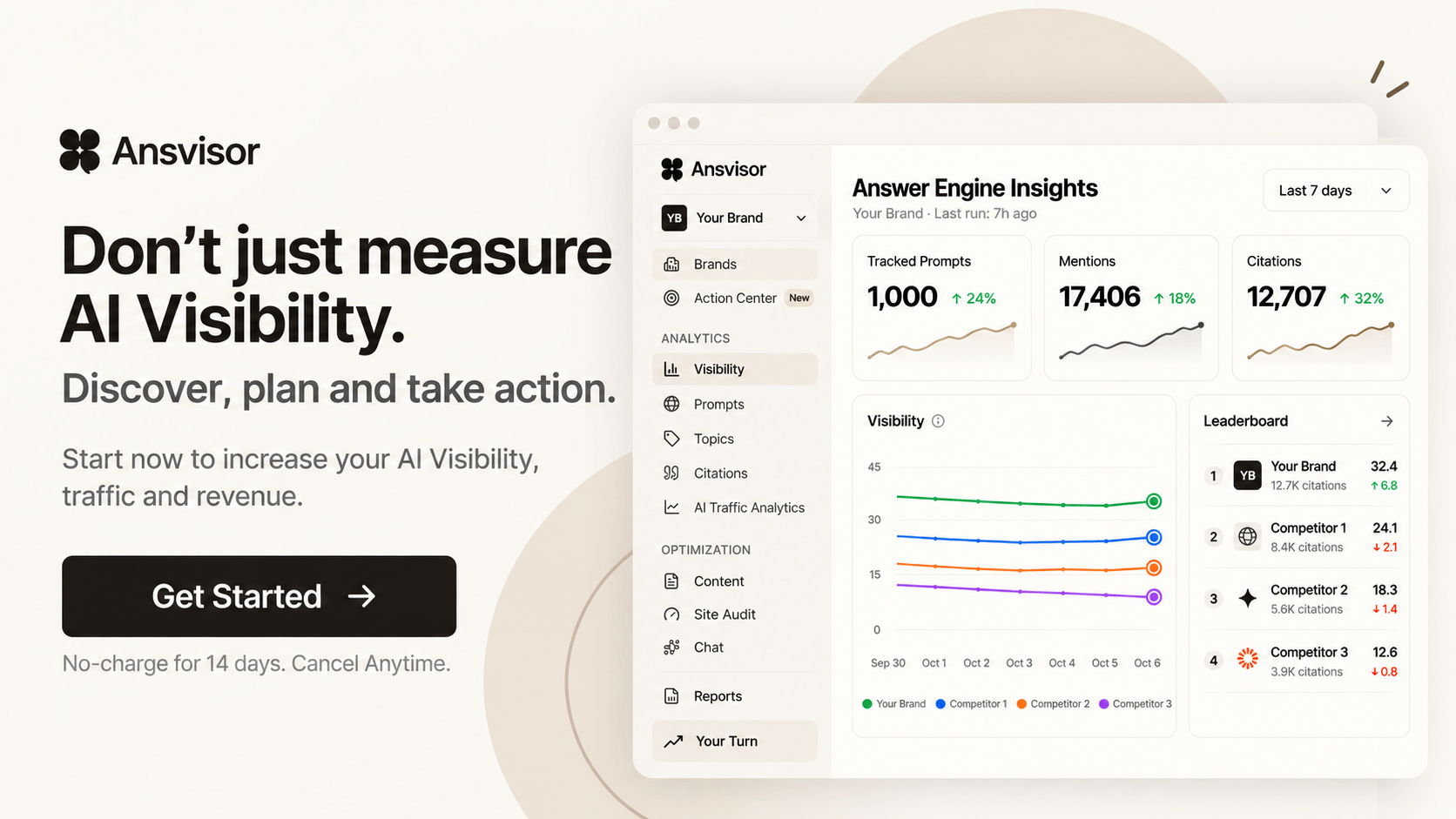
Win customers from all major AI platforms
Understand, measure, and optimize your AI visibility via Ansvisor.
✓ Add brand, domains and competitors
✓ Discover prompts and growth opportunities
✓ Track your AI visibility across major AI platforms
✓ Monitor citations, mentions, and competitors
✓ Measure AI traffic and customer discovery
✓ Receive AI recommendations based on AI insights
✓ Optimize authority, trust, and content quality
✓ Create content, automate analysis & action with AI agents
AI Visibility Terms
Continue exploring key AI visibility concepts.
AI Visibility
Measure and improve how often your brand appears in AI-generated answers.
Learn more →Answer Engine Optimization (AEO)
Strategies for increasing visibility in answer engines and AI summaries.
Learn more →Generative Engine Optimization (GEO)
Optimizing content for AI-powered discovery experiences.
Learn more →ChatGPT Search
Understand how OpenAI retrieves and synthesizes information.
Learn more →Google AI Overviews
AI-generated summaries that appear directly in Google Search.
Learn more →Perplexity Search
Explore how Perplexity cites and presents sources.
Learn more →AI Citations
References and sources used by AI systems to support answers.
Learn more →Citation Authority
Measure the quality and influence of cited sources.
Learn more →Retrievability
How easily AI systems can discover and reuse your content.
Learn more →New terms are added regularly.
Help us improve the page or suggest a new term →
Cihan Geyik
Co-founder at Ansvisor
Cihan Geyik is the co-founder of Ansvisor, an open-source AI Visibility platform for AI Search. With more than 15 years of experience in digital marketing and growth, he writes about AI visibility, AI search, AEO, GEO, citations, and answer engines. He focuses on helping brands understand and improve their presence across ChatGPT, Gemini, Perplexity, Google AI Overviews, and other AI-powered discovery platforms.
Get more Ansvisor insights in Google
Add Ansvisor as a Preferred Source to see more of our AI Search, AEO, GEO, and AI Visibility insights across Google.
Make Your Brand Visible in AI Answers.

INDUSTRIES


© 2026 Ansvisor. All rights reserved. Ansvisor is an open-source AI Search Intelligence Platform for AI Visibility. Ansvisor is a brand owned and operated by Empler AI Inc.


.svg)