

Google Analytics (GA4)
What is Google Analytics 4 (GA4)?
Google Analytics 4, commonly abbreviated as GA4, is Google's analytics platform for measuring user activity across websites and applications.
GA4 collects event-based behavioral data that organizations can use to understand how users discover their digital properties, which pages and screens they visit, how they engage, and whether they complete actions that matter to the business.
Within AI Search, GA4 is primarily useful for measuring what happens when AI-powered discovery results in an identifiable website visit.
It can help teams analyze traffic originating from AI platforms, identify the landing pages receiving those visitors, measure engagement and key events, and connect AI-driven acquisition with downstream business outcomes.
What does Google Analytics 4 do?
GA4 provides measurement and reporting across the customer journey using an event-based data model.
Organizations can use GA4 to analyze areas such as:
- Users.
- Sessions.
- Traffic acquisition.
- Landing pages.
- Page and screen views.
- Events.
- Engagement.
- Key events.
- Ecommerce activity.
- Revenue.
- User acquisition.
- Retention.
- Attribution.
These capabilities make GA4 useful for understanding the measurable business impact that occurs after users arrive from search engines, AI platforms, social networks, campaigns, referrals, and other acquisition sources.
Why is GA4 relevant to AI Search?
AI Search measurement extends beyond whether a brand appears inside an AI-generated answer.
Organizations also need to understand whether that visibility produces measurable website visits and whether those visitors generate meaningful business outcomes.
GA4 can provide this downstream measurement layer.
A broader AI Search measurement journey can be represented as:
Prompt → AI Answer → Brand Mention → Citation → Visit → Engagement → Key Event → Business Outcome
Dedicated AI visibility platforms primarily measure the earlier stages of this journey, while GA4 becomes particularly valuable once an identifiable visitor reaches the website.
Can GA4 track traffic from AI platforms?
Yes. GA4 can identify traffic sources when sufficient referral or campaign information reaches the website.
Google Analytics uses traffic-source dimensions to identify where users come from and how they arrived.
Relevant dimensions include:
- Source.
- Medium.
- Source / Medium.
- Session Source.
- Session Medium.
- Session Source / Medium.
- First User Source.
- First User Medium.
- Campaign.
- Default Channel Group.
When an AI platform sends an identifiable referrer, these dimensions can be used to isolate and analyze that traffic.
What is AI referral traffic in GA4?
AI referral traffic generally refers to website visits that can be associated with an AI-powered platform through referral or campaign information.
For example, a user may ask an AI assistant for a product recommendation, research a topic, receive an answer containing a source link, and then click that link to visit a website.
If the referral information is preserved, GA4 can record the acquisition source associated with that session.
Teams can then analyze what the visitor does after arriving.
Which AI platforms can appear in GA4 traffic data?
Traffic from AI platforms can potentially appear in GA4 when those platforms send users through links that preserve identifiable referral information.
Potential sources can include AI assistants and answer engines such as:
- ChatGPT.
- Perplexity.
- Claude.
- Gemini and Google-powered discovery experiences.
- Microsoft Copilot.
- Other AI-powered services that send identifiable referral information.
The exact source values and attribution behavior can vary by platform, interface, device, browser, redirect behavior, and implementation.
Organizations should therefore inspect their own GA4 traffic-source data rather than assume that every AI platform will always appear under a consistent source value.
How can AI traffic be identified in GA4?
One approach is to use GA4's Traffic acquisition reporting and analyze session-level source dimensions.
Teams can inspect dimensions such as Session source or Session source / medium and identify referral sources associated with AI platforms.
More advanced implementations can create custom explorations, comparisons, audiences, reporting logic, or external data models that group known AI referral sources into a dedicated AI Traffic category.
This allows organizations to compare AI-driven acquisition with channels such as Organic Search, Paid Search, Referral, Social, Email, and Direct.
What is the Traffic acquisition report in GA4?
The Traffic acquisition report is a standard GA4 report designed to show where website and application visitors are coming from.
It focuses on session acquisition and includes dimensions that can help teams understand the sources and mediums responsible for new and returning visitor sessions.
For AI Search analysis, this report can provide a starting point for identifying sessions that originate from recognizable AI referral sources.
What is the difference between User acquisition and Traffic acquisition?
GA4 distinguishes between how a user was originally acquired and how individual sessions were acquired.
User acquisition focuses on the source that first acquired a user.
Traffic acquisition focuses on the source associated with sessions, including subsequent visits.
For AI Search analysis, both can be useful.
Traffic acquisition can help identify sessions generated by AI platforms, while user acquisition can help investigate whether AI discovery originally introduced a user to the website.
What is Source in GA4?
Source identifies the specific platform, website, application, or online location that referred a user to a website or app.
Examples in conventional analytics can include search engines, social networks, referring websites, campaigns, or direct traffic.
For AI Search measurement, Source is particularly important because identifiable AI referral domains can provide evidence that a session originated from an AI-powered discovery experience.
What is Medium in GA4?
Medium describes the general method through which a user arrived.
Common examples include:
- organic.
- cpc.
- referral.
- social.
- email.
- none.
AI-originated visits may appear with a referral-related medium depending on how the traffic arrives and how GA4 classifies the source.
What is Session Source / Medium?
Session Source / Medium combines the source associated with a session and the method through which that traffic arrived.
This can be particularly useful for AI Search reporting because it allows analysts to inspect individual acquisition sources together with their traffic classification.
Teams can use this dimension when building reports that isolate known AI traffic sources.
Can GA4 automatically identify all AI traffic?
No. GA4 should not be treated as a complete measurement system for every visit influenced by AI Search.
GA4 can only attribute traffic according to the information available when a user reaches the website or application.
Some AI-influenced visits may not contain sufficient referral information.
For example, a user could discover a brand through an AI-generated answer and later:
- Type the domain directly into a browser.
- Search for the brand on Google.
- Use another device.
- Open a copied link.
- Return to the website later.
In these situations, the influence of the original AI interaction may not be visible in GA4 attribution.
Why can AI traffic appear as Direct in GA4?
GA4 uses Direct when it does not have sufficient information to identify a clearer traffic source.
Referral information can be unavailable for multiple reasons, including how a link is opened, redirect behavior, missing campaign information, browser behavior, privacy mechanisms, or other technical conditions.
An AI-influenced visitor may therefore appear as Direct even though an AI platform influenced the discovery journey.
This is one reason GA4 AI referral traffic should not be interpreted as the total business influence of AI Search.
What is dark AI traffic?
Dark AI traffic is an informal term used by marketers to describe website visits influenced by AI platforms that cannot be reliably identified as AI referrals in analytics.
For example, someone may discover a brand in ChatGPT, remember the brand name, and later visit the website directly.
GA4 records the measurable website journey according to available acquisition data, but it cannot reconstruct an earlier AI interaction that leaves no observable attribution signal.
Dark AI traffic therefore illustrates the difference between AI influence and directly measurable AI referrals.
Can GA4 measure zero-click AI visibility?
No. GA4 requires activity on a website or application to generate analytics events.
If a user sees a brand recommendation, description, product, citation, or other information inside an AI-generated answer but never visits the website, GA4 has no website session to measure.
This is known as zero-click visibility.
Dedicated AI visibility monitoring is required to measure brand presence inside AI answers independently of website traffic.
Can GA4 track AI brand mentions?
No. GA4 does not primarily monitor external AI-generated answers for brand mentions.
A brand can be mentioned thousands of times across AI platforms without those interactions generating website sessions.
GA4 becomes relevant when an AI interaction results in measurable activity on the organization's own website or application.
Can GA4 track AI citations?
GA4 does not directly monitor which pages or domains are cited inside external AI-generated answers.
Citation monitoring requires data from the AI answer itself.
However, GA4 can complement citation intelligence.
For example, an AI visibility platform can identify that a particular URL is frequently cited by AI engines, while GA4 can help determine whether that URL receives identifiable AI referral traffic and whether those visitors engage or convert.
How can GA4 connect AI citations with business outcomes?
Combining citation intelligence with GA4 creates a stronger measurement model.
An organization can analyze:
- Which URLs receive AI citations.
- Which cited URLs receive AI referral traffic.
- How many sessions those pages generate.
- How engaged those visitors are.
- Which key events they trigger.
- Whether they contribute to ecommerce or other business outcomes.
This helps distinguish AI visibility from AI visibility that produces measurable downstream value.
How can GA4 analyze AI landing pages?
Landing-page analysis can show which pages users first encounter when they arrive from identifiable AI sources.
Teams can use this information to investigate:
- Which pages receive the most AI referral traffic.
- Which topics attract AI-driven visitors.
- Which AI landing pages generate stronger engagement.
- Which pages contribute to key events.
- Which pages produce ecommerce activity.
- Whether pages gaining AI citations also gain measurable traffic.
This can be particularly valuable when AI citation data is mapped to corresponding website URLs.
How can GA4 measure AI traffic engagement?
GA4 provides behavioral metrics that can help teams evaluate the quality of identifiable AI referral traffic rather than focusing only on session volume.
Depending on the reporting configuration, useful signals can include:
- Engaged sessions.
- Engagement rate.
- Average engagement time.
- Events.
- Views.
- Key events.
These metrics can help determine whether AI-referred visitors meaningfully interact with the website after arriving.
What is an event in GA4?
GA4 uses an event-based measurement model.
An event represents an interaction or occurrence on a website or application.
Events can represent actions such as page views, clicks, form interactions, purchases, signups, downloads, or custom behaviors defined by the organization.
For AI Search analysis, events make it possible to understand what identifiable AI-referred users do after reaching the website.
What is a key event in GA4?
A key event is an event that measures an action considered particularly important to the success of a business.
Organizations can identify relevant events and mark them as key events in GA4.
Examples can include:
- Lead submissions.
- Account registrations.
- Trial starts.
- Purchases.
- Demo requests.
- Subscriptions.
- Other important business actions.
For AI Search, key events can help determine whether identifiable AI traffic contributes to meaningful outcomes rather than simply generating visits.
What is the difference between a GA4 key event and a conversion?
Google changed its Analytics terminology so that important behavioral events inside GA4 are referred to as key events.
A conversion is now used in the context of an important action used to measure advertising performance and optimize campaign bidding.
This distinction matters when discussing AI Search measurement because many organic AI outcomes are better described as key events unless they are also being used within advertising conversion workflows.
Can GA4 measure leads from AI Search?
Yes, when lead-generation activity is properly configured as events or key events.
For example, a B2B organization can investigate whether identifiable AI-referred users:
- Submit a lead form.
- Request a demo.
- Create an account.
- Register for a trial.
- Download a resource.
- Complete another configured lead action.
This can help B2B teams evaluate AI Search according to pipeline-related behavior rather than traffic alone.
Can GA4 measure ecommerce performance from AI traffic?
Yes. Organizations with ecommerce measurement implemented can analyze ecommerce activity associated with identifiable acquisition sources.
This can help teams investigate whether AI-referred users generate outcomes such as:
- Product views.
- Add-to-cart activity.
- Checkout activity.
- Purchases.
- Purchase revenue.
This makes GA4 particularly useful for connecting AI-powered product discovery with measurable commerce behavior.
Can GA4 measure revenue from AI Search?
GA4 can measure revenue-related activity when the relevant ecommerce, subscription, advertising, or other revenue data is properly implemented and available.
Teams can then segment or analyze identifiable AI acquisition sources and evaluate whether those users contribute to revenue.
However, revenue attributed to identifiable AI referrals should not automatically be interpreted as the complete revenue influenced by AI Search because some AI-assisted journeys may be attributed to another channel or appear as Direct.
Can GA4 measure SaaS signups from AI Search?
Yes. SaaS companies can configure relevant signup and product actions as events and key events.
A typical measurement sequence could include:
AI Referral → Landing Page → Signup → Activation → Upgrade
The extent to which GA4 can measure the full sequence depends on the organization's tracking implementation and whether important product and business events are available within its analytics architecture.
Can GA4 measure B2B outcomes from AI Search?
Yes, but B2B measurement often requires a broader data model than website analytics alone.
GA4 can measure identifiable AI referral sessions and website actions such as demo requests or lead submissions.
However, later outcomes such as qualified opportunities, sales conversations, contracts, and closed revenue may occur in CRM or other business systems.
For B2B organizations, GA4 data may therefore need to be combined with CRM and revenue data to understand the full business impact of AI Search.
How can GA4 support GEO measurement?
Generative Engine Optimization focuses on improving visibility within generative and AI-powered discovery environments.
GA4 can help measure the downstream impact when GEO improvements result in identifiable website traffic.
For example, an organization may use an AI visibility platform to observe improvements in:
- Brand mentions.
- AI citations.
- Prompt visibility.
- AI Share of Voice.
- Cited URL coverage.
GA4 can then help determine whether those improvements correspond with changes in:
- AI referral sessions.
- Landing-page engagement.
- Key events.
- Ecommerce activity.
- Revenue.
How can GA4 support AEO measurement?
Answer Engine Optimization focuses on improving how brands, products, services, and information appear in systems that generate direct answers.
Many AEO interactions may remain zero-click, making them invisible to conventional web analytics.
When an answer engine does send a measurable visitor to a website, GA4 can help analyze the resulting session and downstream behavior.
This makes GA4 a complementary measurement layer for AEO rather than a complete AEO visibility platform.
How can GA4 support AI SEO?
AI SEO combines established search optimization with the growing importance of AI-generated discovery.
GA4 can help teams compare traffic and outcomes across acquisition channels and evaluate how AI referrals fit alongside traditional organic search.
This can help answer questions such as:
- How much measurable traffic comes from AI platforms?
- How does AI traffic compare with organic search?
- Which landing pages attract AI visitors?
- Do AI visitors engage differently?
- Which channel generates more key events?
- Which acquisition sources contribute to revenue?
What is the difference between AI visibility and AI traffic?
AI visibility measures a brand's presence inside AI-generated answers.
It can include metrics such as:
- Brand mentions.
- Citations.
- Prompt coverage.
- Share of Voice.
- Recommendation frequency.
- Sentiment.
AI traffic measures website visits that result from AI-powered discovery and can be identified through analytics.
The two should not be treated as interchangeable.
A brand can gain substantial AI visibility without receiving a proportional number of clicks because many AI interactions are zero-click.
What is the difference between GA4 and an AI visibility platform?
GA4 and AI visibility platforms measure different stages of the AI discovery journey.
An AI visibility platform typically answers questions such as:
- Does ChatGPT mention our brand?
- Which prompts trigger our brand?
- Which URLs receive citations?
- Which competitors appear more often?
- What is our AI Share of Voice?
GA4 answers questions such as:
- Which identifiable sources send visitors?
- Which pages do those users enter through?
- What do visitors do after arriving?
- Do they trigger key events?
- Do they purchase or generate revenue?
The platforms are therefore complementary rather than substitutes.
Can AI visibility data be combined with GA4?
Yes. Combining AI visibility data with Google Analytics can create a more complete AI Search measurement and optimization framework.
Instead of analyzing AI visibility and website performance separately, teams can connect signals such as:
- Tracked prompts.
- Brand mentions.
- AI citations.
- Cited URLs.
- AI Share of Voice.
- AI referral sessions.
- Landing-page performance.
- Engagement.
- Key events.
- Revenue and other business outcomes.
This makes it possible to move beyond measuring whether a brand appears in AI-generated answers and begin understanding which AI Search opportunities are connected to meaningful user behavior.
How does Ansvisor use Google Analytics data?
Ansvisor can connect Google Analytics data with AI Search intelligence to help teams identify higher-value opportunities across prompts and content.
Instead of evaluating a prompt only by AI visibility, mentions, or citations, Ansvisor can use website performance signals from Google Analytics as additional context for understanding which topics, pages, and opportunities may matter more to the business.
This data can support more relevant prompt and content recommendations by connecting AI Search behavior with measurable website performance.
For example, the combined intelligence can help identify:
- Prompts related to pages that already generate meaningful engagement or business activity.
- Content with measurable website performance but limited AI visibility.
- Pages that may deserve stronger protection or optimization because they contribute to business outcomes.
- Topics where AI visibility opportunities align with existing user demand and website behavior.
- Content opportunities that can be prioritized using both AI Search and first-party analytics signals.
This creates a broader optimization loop:
AI Search Data + Google Analytics Data → Opportunities → Prompt and Content Recommendations → Actions → Measurement
The goal is not simply to generate more prompts or content. It is to use first-party performance data as additional evidence for deciding which AI Search opportunities deserve attention.
Can GA4 data be exported to BigQuery?
Yes. Google Analytics properties can export raw event data to BigQuery.
BigQuery allows organizations to query that event-level data and combine it with external datasets.
For AI Search teams, this can create opportunities to combine GA4 behavioral data with datasets such as:
- AI prompt monitoring data.
- AI visibility metrics.
- Citation data.
- Search Console data.
- CRM data.
- Revenue data.
- Product analytics data.
This can support custom AI Search attribution and business-impact models beyond standard GA4 reports.
How can GA4 and Google Search Console complement each other?
Google Search Console and GA4 measure different parts of the search journey.
Search Console provides information about Google Search performance, including queries, impressions, clicks, positions, and pages.
GA4 measures what users do after reaching the website.
When combined with AI visibility data, these systems can provide three different perspectives:
Search Console → Traditional Google Search demand and performance
AI Visibility Data → Brand presence inside AI-generated answers
GA4 → Website behavior and downstream outcomes
What are the limitations of GA4 for AI Search analytics?
GA4 is valuable for AI Search measurement, but it has important limitations.
- It cannot measure zero-click AI visibility.
- It does not directly monitor AI prompts.
- It does not directly collect external AI answers.
- It does not directly track brand mentions inside AI platforms.
- It does not directly monitor AI citations.
- Not every AI-influenced visit contains identifiable referral information.
- AI-assisted discovery may later be attributed to Direct, Organic Search, or another channel.
- Cross-device and delayed journeys can make attribution incomplete.
GA4 data should therefore be interpreted as observable website behavior rather than a complete representation of AI Search influence.
Is GA4 an AI visibility tool?
No. GA4 does not systematically monitor external AI prompts, brand mentions, citations, or AI Share of Voice. It primarily measures what users do after reaching a company's website or application.
AI Search Intelligence platforms such as Ansvisor complement GA4 by monitoring AI visibility and combining those insights with Google Analytics data to identify and prioritize prompt and content opportunities.
The two systems therefore measure different but connected parts of the AI discovery journey: AI Search Intelligence can help explain what happens inside AI-generated discovery, while GA4 helps measure what happens after identifiable users reach the website.
Is GA4 an AI Search tool?
GA4 was not created specifically for AI Search, but it has become an important component of the AI Search analytics stack.
As AI assistants and generative search experiences become acquisition channels, organizations can use GA4's existing traffic-source, behavioral, event, and business-outcome data to analyze their measurable impact.
It is therefore best understood as an analytics layer within the broader AI Search ecosystem rather than a dedicated GEO monitoring product.
Who should use GA4 for AI Search measurement?
GA4 can be useful to organizations that want to connect AI-powered discovery with measurable website outcomes.
Relevant users include:
- SEO teams.
- AEO and GEO practitioners.
- Growth teams.
- Content teams.
- Digital analysts.
- Marketing teams.
- Ecommerce businesses.
- SaaS companies.
- B2B organizations.
- Agencies.
Its value becomes stronger when GA4 data is analyzed together with dedicated AI visibility, citation, search, CRM, and business data.
Google Analytics 4 and the AI Search tools ecosystem
Google Analytics 4 occupies the first-party traffic, behavior, and business-outcome layer of the AI Search ecosystem.
It does not replace prompt monitoring, citation intelligence, AI Share of Voice measurement, or external AI answer tracking.
Instead, GA4 helps organizations understand what happens after AI-powered discovery generates an identifiable website visit.
A complete AI Search measurement stack can therefore connect:
AI Visibility → Citations → AI Traffic → User Behavior → Key Events → Business Outcomes
Combining these layers helps organizations move beyond asking only whether they appear in AI-generated answers and toward understanding whether that visibility contributes to measurable business value.
Platforms such as Ansvisor can connect Google Analytics data with AI Search intelligence to help identify and prioritize prompt and content opportunities based on both AI visibility and measurable website performance.
Ansvisor maintains a broader AI Visibility Glossary covering the platforms, analytics systems, technologies, metrics, and optimization concepts shaping AI Search, AEO, GEO, and AI visibility.
Official Sources
- Google Analytics — Traffic acquisition report
- Google Analytics — Traffic-source dimensions
- Google Analytics — Direct traffic
- Google Analytics — Key events
- Google Analytics — BigQuery Export
FAQ
What is Google Analytics 4 (GA4)?

Google Analytics 4 is Google's event-based web and app analytics platform for measuring acquisition, user behavior, engagement, key events, and other business outcomes across digital properties.
Can GA4 track traffic from ChatGPT and other AI platforms?
Yes, when identifiable referral or campaign information reaches the website. GA4 traffic-source dimensions such as Session source and Session source / medium can be used to analyze recognizable AI referral sources.
Can GA4 measure all traffic influenced by AI Search?
No. Some AI-influenced visits may lack identifiable referral information or occur later through Direct, Google Search, another device, or another channel. GA4 therefore measures observable attributed traffic, not every interaction influenced by AI Search.
Can GA4 measure AI Search conversions and revenue?
GA4 can connect identifiable acquisition sources with configured events, key events, ecommerce activity, and other measurable outcomes. This allows teams to evaluate the downstream value of identifiable AI referral traffic.
Is GA4 an AI visibility tool?
No. GA4 does not systematically monitor external AI prompts, brand mentions, citations, or AI Share of Voice. It primarily measures what users do after reaching a company's website or application. AI Search Intelligence platforms such as Ansvisor complement GA4 by monitoring AI visibility and combining those insights with Google Analytics data to identify and prioritize prompt and content opportunities.
Everything You Need to Improve Your AI Visibility
Track how your brand appears across AI platforms, understand what drives visibility, and turn insights into measurable actions.
Platform Features
Explore all features →Answer Engine Insights
Understand how AI platforms talk about your brand.
Prompt Intelligence
Discover and monitor the prompts shaping your AI visibility.
Citations Monitoring
Track which sources AI platforms cite and where your brand appears.
AI Traffic Analytics
Measure visits coming from ChatGPT, Gemini, Claude, and more.
Competitor Benchmarking
Compare AI visibility and uncover competitive gaps and opportunities.
Action Center
Turn AI Search signals into prioritized actions and executable tasks.
AI Visibility Trackers
Explore AI Visibility Platform →ChatGPT Visibility Tracker
Track brand mentions, citations, prompts, and visibility across ChatGPT.
Google AI Overviews Rank Tracker
Monitor where and how your brand appears in Google AI Overviews.
Google AI Mode Visibility Tracker
Track your brand's visibility across Google AI Mode experiences.
Gemini Visibility Tracker
Understand how your brand appears across Google Gemini responses.
Microsoft Copilot Visibility Tracker
Monitor your brand's presence across Microsoft Copilot answers.
Perplexity Visibility Tracker
Track brand mentions, citations, and visibility across Perplexity.
From AI Visibility insights to action.
Explore the complete Ansvisor platform for AI Search intelligence, optimization, and growth.
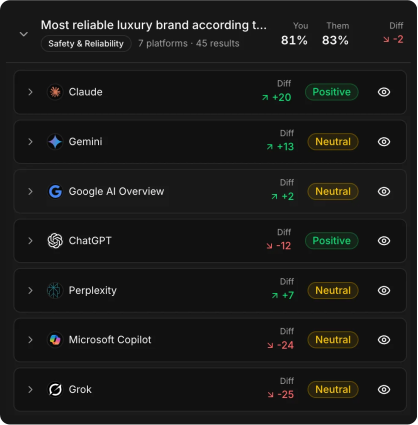
Win customers from all major AI platforms
Understand, measure, and optimize your AI visibility via Ansvisor.
✓ Add brand, domains and competitors
✓ Discover prompts and growth opportunities
✓ Track your AI visibility across major AI platforms
✓ Monitor citations, mentions, and competitors
✓ Measure AI traffic and customer discovery
✓ Receive AI recommendations based on AI insights
✓ Optimize authority, trust, and content quality
✓ Create content, automate analysis & action with AI agents
AI Visibility Terms
Continue exploring key AI visibility concepts.
AI Visibility
Measure and improve how often your brand appears in AI-generated answers.
Learn more →Answer Engine Optimization (AEO)
Strategies for increasing visibility in answer engines and AI summaries.
Learn more →Generative Engine Optimization (GEO)
Optimizing content for AI-powered discovery experiences.
Learn more →ChatGPT Search
Understand how OpenAI retrieves and synthesizes information.
Learn more →Google AI Overviews
AI-generated summaries that appear directly in Google Search.
Learn more →Perplexity Search
Explore how Perplexity cites and presents sources.
Learn more →AI Citations
References and sources used by AI systems to support answers.
Learn more →Citation Authority
Measure the quality and influence of cited sources.
Learn more →Retrievability
How easily AI systems can discover and reuse your content.
Learn more →New terms are added regularly.
Help us improve the page or suggest a new term →
Cihan Geyik
Co-founder at Ansvisor
Cihan Geyik is the co-founder of Ansvisor, an open-source AI Visibility platform for AI Search. With more than 15 years of experience in digital marketing and growth, he writes about AI visibility, AI search, AEO, GEO, citations, and answer engines. He focuses on helping brands understand and improve their presence across ChatGPT, Gemini, Perplexity, Google AI Overviews, and other AI-powered discovery platforms.
Get more Ansvisor insights in Google
Add Ansvisor as a Preferred Source to see more of our AI Search, AEO, GEO, and AI Visibility insights across Google.
Make Your Brand Visible in AI Answers.

INDUSTRIES


© 2026 Ansvisor. All rights reserved. Ansvisor is an open-source AI Search Intelligence Platform for AI Visibility. Ansvisor is a brand owned and operated by Empler AI Inc.


.svg)