Why Synthetic Answers matter
Synthetic Answers are responses generated by AI systems through the combination, interpretation, and synthesis of information from multiple sources rather than by reproducing content from a single document or webpage.
Unlike traditional search engines that primarily return lists of links, modern answer engines increasingly generate synthetic answers that summarize, combine, and contextualize information to satisfy user intent directly.
Benefits of synthetic answers include:
- Provide direct answers.
- Improve user experience.
- Reduce search effort.
- Combine multiple perspectives.
- Support complex questions.
Synthetic answers have become one of the defining characteristics of AI-powered search experiences.
How Synthetic Answers work
Modern AI systems generate synthetic answers through multiple stages.
- Interpret user intent.
- Retrieve relevant information.
- Evaluate source quality.
- Compare multiple sources.
- Synthesize information.
- Generate the final response.
Rather than copying content directly, AI systems identify patterns, facts, relationships, and concepts across multiple sources before generating a response.
Many modern answer engines use Retrieval-Augmented Generation (RAG), Query Fan-Out, and Grounding techniques to support synthetic answer generation.
What influences Synthetic Answers?
Several factors influence the quality and composition of synthetic answers.
The sources selected during retrieval significantly influence which brands, entities, and viewpoints appear in the final synthesized response.
How Synthetic Answers affect AI visibility
Synthetic answers fundamentally change how organizations achieve visibility in AI search.
Because synthetic answers often combine information from multiple sources, organizations no longer compete solely for rankings but also for inclusion within AI-generated narratives.
Strategies such as Answer Engine Optimization (AEO), AI Citation Optimization, and AI Content Optimization increasingly focus on improving inclusion within synthetic answers.
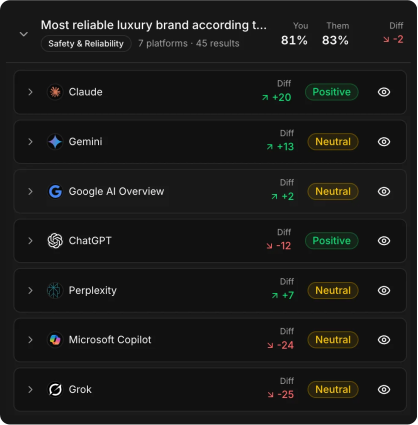
Platforms such as Ansvisor help organizations analyze synthetic answer behavior by monitoring prompts, citations, competitors, source attribution, recommendation frequency, and AI visibility performance across answer engines.
Common misconceptions
Common misconceptions about synthetic answers include:
- Synthetic answers copy a single source.
- AI-generated answers always include citations.
- Ranking first guarantees inclusion.
- All answer engines generate synthetic answers similarly.
- Website traffic accurately reflects synthetic answer visibility.
Synthetic answers represent one of the biggest shifts in information discovery because AI systems increasingly synthesize knowledge rather than simply returning lists of documents.








.svg)
