

Moz
What is Moz?
Moz is a search marketing platform that provides software, data, metrics, and educational resources for search engine optimization and increasingly for AI-powered search.
Moz became widely known for SEO capabilities such as keyword research, rank tracking, site crawling, link analysis, Domain Authority, Page Authority, and competitive research.
Its current Moz Pro platform has expanded into AI Search and Generative Engine Optimization (GEO) with capabilities for monitoring brand visibility in AI-generated responses, tracking prompts, analyzing competitors and citations, researching AI prompts, creating AI content briefs, and identifying Google AI Overviews.
What does Moz do?
Moz helps search and marketing teams understand how websites and brands perform across traditional search engines and newer AI-powered discovery environments.
Moz Pro includes capabilities such as:
- Keyword research.
- Keyword rank tracking.
- Site crawling and technical SEO.
- Link research.
- Competitive analysis.
- Domain Authority.
- Page Authority.
- Brand Authority.
- AI Visibility.
- AI prompt tracking.
- AI Prompt Suggestions.
- AI Content Briefs.
- Google AI Overviews analysis.
- AI-powered SEO insights.
This allows teams to evaluate search visibility across both conventional search results and generative AI experiences from the same broader SEO platform.
What is Moz AI Visibility?
AI Visibility is Moz Pro's AI Search monitoring capability.
It is designed to help teams understand how their brand appears within AI-generated search responses and identify opportunities to improve that visibility.
The tool allows users to define a brand, relevant brand terms, competitors, and topics before generating prompts to monitor.
Tracked results can then be used to analyze brand presence, competitors, response details, and cited sources across supported AI systems.
What can Moz AI Visibility track?
Moz AI Visibility can be used to monitor several aspects of a brand's presence in AI-generated answers.
Current workflows include:
- Tracked AI prompts.
- Brand mentions.
- Competitor visibility.
- Mention depth.
- Prompt-level responses.
- Cited pages and websites.
- Visibility trends.
- AI search opportunities.
This gives Moz users an AI Search measurement layer alongside the platform's traditional SEO data.
Which AI platforms does Moz track?
Moz Pro currently includes prompt tracking across three AI model environments on its AI Search and GEO plans:
- GPT.
- Gemini.
- Google AI Mode.
Moz's product documentation also describes AI Visibility as a system for measuring presence in ChatGPT and Gemini-generated responses.
Platform coverage can change as Moz continues expanding its AI Research toolkit, so users should review current plan and product documentation when comparing engine coverage.
How does Moz track prompts?
Moz allows users to generate and select prompts around topics that matter to their brand.
During AI Visibility setup, users define information such as:
- Brand name.
- Brand domain.
- Brand terms.
- Competitors.
- Topics.
Moz then generates relevant prompts that can be selected for ongoing tracking.
This approach gives teams a repeatable way to monitor the questions and use cases where they want their brand to appear in AI-generated answers.
What are Moz AI Prompt Suggestions?
AI Prompt Suggestions is Moz's prompt research capability for discovering conversational questions that may matter within AI-powered search.
Traditional keyword research begins with search queries and keyword demand.
AI prompt research expands this process toward conversational questions, recommendations, comparisons, and information needs that users may express through generative AI systems.
Prompt suggestions can therefore help teams determine which AI search conversations deserve monitoring or content investment.
What are Moz AI Content Briefs?
Moz Pro includes AI Content Briefs as part of its AI Search and GEO toolkit.
Content briefs help teams turn search and AI research into structured content planning.
They can support workflows where marketers identify an opportunity through keyword, prompt, competitor, or AI visibility data and then translate that opportunity into a content brief for optimization or new content creation.
This gives Moz an execution-oriented layer beyond visibility reporting alone.
Does Moz track citations in AI-generated answers?
Yes. Moz AI Visibility provides cited page information within tracked prompt responses.
Users can expand individual prompts to see which pages and websites were referenced within the corresponding AI-generated response.
Citation information can help answer questions such as:
- Which websites are influencing AI answers?
- Is our own content being cited?
- Which competitor pages receive citations?
- Which third-party sources influence a topic?
- Which content gaps may be limiting our AI visibility?
How can Moz be used for competitor analysis in AI Search?
Moz allows brands to define competitors as part of the AI Visibility setup and compare how different brands perform across monitored prompts.
Competitor analysis can help identify:
- Prompts where competitors appear but the brand does not.
- Topics where competitors have stronger visibility.
- Sources that support competitor visibility.
- Differences in brand mentions.
- Potential content and authority gaps.
This extends Moz's established SEO competitive research into AI-generated discovery.
What is mention depth in Moz?
Moz uses mention depth as one of the signals for understanding how a brand appears within AI responses.
A simple mention indicates that the brand appeared somewhere in the answer.
Mention depth adds context about how prominently or substantively the brand is represented within that response.
This can provide more useful information than a binary yes-or-no brand mention measurement.
Does Moz track Google AI Overviews?
Yes. Moz Pro includes AI Overviews by Keyword.
Within Keyword Explorer and SERP analysis workflows, users can identify whether Google displays an AI Overview for a keyword and inspect information associated with that result.
This can include the AI Overview content and the pages or URLs linked from the generated result.
AI Overview tracking helps SEO teams understand where generative results are appearing across their existing keyword strategy.
Why are Google AI Overviews important to Moz users?
Google AI Overviews introduce generated answers directly into traditional search results.
This means an SEO strategy increasingly needs to consider both conventional rankings and whether content appears within or supports generative search features.
Moz's AI Overview data allows teams to investigate:
- Which keywords trigger AI Overviews.
- Which websites receive links from AI Overviews.
- Whether their own content appears.
- Where competitors gain generative visibility.
- Which existing keywords may require a different content strategy.
What is Moz Brand Authority?
Brand Authority is a proprietary Moz metric designed to estimate the overall strength and salience of a brand.
It is expressed on a scale from 1 to 100 and is intended to provide marketers with a comparative measure of brand strength.
Brand Authority differs from Moz's Domain Authority because it focuses on brand strength rather than primarily evaluating the ranking potential of a domain based on link-related signals.
Why is Brand Authority relevant to AI Search?
Generative search systems do not rely only on traditional webpage rankings when forming answers and recommendations.
Brand recognition, web mentions, authority, consistency, and broader entity signals can all be relevant to how a brand is represented across the web.
Moz Brand Authority can therefore provide an additional signal when teams investigate why some brands consistently appear across both search and AI-generated discovery.
However, Brand Authority should not be interpreted as a direct measure of AI visibility or as proof that an AI platform will mention or cite a brand.
What is Moz Domain Authority?
Domain Authority, commonly abbreviated as DA, is one of Moz's best-known proprietary SEO metrics.
It uses a 1–100 scale to estimate how likely a domain is to rank in search engine results relative to other domains.
Domain Authority is based on Moz's link data and machine-learning methodology.
It is a comparative SEO metric rather than a metric used directly by Google or other search engines.
What is Moz Page Authority?
Page Authority is a Moz metric designed to estimate the ranking strength of an individual webpage.
Like Domain Authority, it is expressed on a 1–100 scale and uses Moz's link intelligence and machine-learning methodology.
Page Authority can be useful when comparing individual pages and evaluating link-based authority, but it should not be interpreted as a direct ranking factor used by Google.
What is MozBar?
MozBar is Moz's browser-based SEO toolbar.
It provides quick access to metrics while users browse websites and search results.
Depending on access level, MozBar can display metrics and information including:
- Domain Authority.
- Page Authority.
- Brand Authority.
- Spam Score.
- Ranking keywords.
- On-page SEO information.
MozBar is primarily an SEO research tool rather than an AI visibility tracker.
What is Keyword Explorer in Moz?
Keyword Explorer is Moz's keyword research environment.
It helps teams investigate search demand, keyword difficulty, ranking opportunities, related queries, and SERP information.
In the AI Search context, Keyword Explorer can also help users identify keywords where Google AI Overviews appear.
This helps connect existing SEO keyword strategies with newer generative search features.
How can Moz combine keyword research with AI prompt research?
Traditional keyword research and AI prompt research represent different but related forms of demand intelligence.
Keywords can show how users express demand through search engines, while prompts can reveal more conversational, comparative, or recommendation-oriented information needs.
Moz's combination of Keyword Explorer and AI Prompt Suggestions allows teams to work with both forms of search behavior.
A broader research workflow can therefore include:
Keywords → Topics → AI Prompts → Visibility → Content Opportunities
What is Link Explorer in Moz?
Link Explorer is Moz's backlink and link intelligence product.
It helps marketers understand:
- Inbound links.
- Linking domains.
- Domain Authority.
- Page Authority.
- Spam Score.
- Competitor link profiles.
Link intelligence remains relevant to traditional SEO and can also contribute to a broader understanding of online authority and source ecosystems around a brand.
How are links relevant to AI Search?
Links remain important to the broader web ecosystem because they help connect entities, pages, publications, sources, and topics.
However, earning backlinks should not be treated as a direct formula for earning AI citations.
AI systems can use different search providers, retrieval methods, ranking systems, source selection processes, and knowledge sources.
Moz's link intelligence is therefore best viewed as one part of a broader authority and discovery strategy rather than a standalone AI visibility metric.
Does Moz provide site crawling?
Yes. Moz Pro includes website crawling capabilities for identifying technical SEO issues that may affect search performance.
Site crawling can surface issues related to:
- Crawlability.
- Page errors.
- Redirects.
- Metadata.
- Duplicate content.
- Technical site structure.
Technical accessibility remains relevant as search expands into AI-powered discovery because pages still need to be accessible and understandable across the web ecosystem.
Can Moz improve AI crawler access?
Moz can help identify broader technical SEO and crawlability issues, but its primary crawler product should not be confused with dedicated AI crawler monitoring infrastructure.
Organizations that need to identify specific AI bots, analyze server logs, or allow and block individual AI crawlers may require additional crawler analytics or infrastructure tools.
AI crawler accessibility is also only one factor in AI visibility and does not guarantee that a page will be retrieved, mentioned, or cited.
How does Moz support GEO?
Moz increasingly supports Generative Engine Optimization through a combination of measurement, research, and content planning.
Relevant GEO capabilities include:
- AI Visibility tracking.
- Prompt tracking.
- AI Prompt Suggestions.
- Competitor visibility analysis.
- Cited source analysis.
- AI Content Briefs.
- Google AI Overviews analysis.
- Brand Authority.
- Traditional SEO research.
These capabilities allow teams to connect established search intelligence with emerging AI search workflows.
How does Moz support AEO?
Answer Engine Optimization focuses on improving how brands and information appear in systems that provide direct answers.
Moz can support AEO through prompt research, AI visibility monitoring, source analysis, content planning, keyword research, technical SEO, and AI Overview analysis.
This makes it possible to investigate both the questions users ask and how different search and answer systems respond.
How does Moz combine SEO and AI Search?
One of Moz's main advantages in the evolving search landscape is the ability to place AI Search data alongside established SEO workflows.
A team can use Moz to investigate:
- What keywords users search.
- Which pages rank.
- Which sites link to competitors.
- Which keywords trigger AI Overviews.
- Which AI prompts matter to the brand.
- Whether the brand appears in AI responses.
- Which sources AI systems reference.
This helps marketers avoid treating traditional search and AI-powered search as completely isolated disciplines.
Is Moz still primarily an SEO tool?
SEO remains a major part of Moz's platform and product history.
However, its current Moz Pro offering has expanded beyond conventional SEO by adding a dedicated AI Research and AI Visibility layer.
Moz now explicitly packages SEO and AI Search/GEO capabilities together in its higher subscription tiers.
It is therefore more accurate to describe current Moz Pro as an SEO and AI Search platform rather than only a traditional SEO tool.
How is Moz different from dedicated AI visibility platforms?
Dedicated AI visibility platforms are generally designed from the beginning around generative search measurement.
They may provide broader capabilities such as:
- Large-scale multi-engine prompt monitoring.
- AI Share of Voice.
- Advanced citation intelligence.
- Query fan-out analysis.
- AI referral analytics.
- AI crawler analytics.
- Action and opportunity engines.
Moz approaches AI search from an established SEO platform.
Its advantage is the ability to combine newer AI visibility and prompt data with mature keyword, link, authority, crawling, and ranking datasets.
The right choice therefore depends on whether a team primarily needs a specialized AI Search intelligence system or a broader SEO platform that is adding GEO capabilities.
How is Moz different from AI Search data APIs?
AI Search data APIs primarily provide raw or structured data that developers can use to create their own products, scoring systems, and dashboards.
Moz provides a packaged user interface and workflow for marketers.
This means teams can use Moz without building their own AI visibility analytics infrastructure.
Data-oriented organizations requiring large-scale raw AI response collection or custom metrics may have different requirements from typical Moz Pro users.
Who is Moz for?
Moz is designed for search marketers and organizations that need a combination of SEO research, monitoring, and increasingly AI Search intelligence.
Potential users include:
- SEO professionals.
- AI Search and GEO teams.
- Content marketers.
- Digital marketing agencies.
- Growth teams.
- In-house marketing teams.
- Consultants.
- Small and medium-sized businesses.
- Enterprise search teams.
It can be particularly useful for organizations that already rely on traditional SEO metrics and want to extend those workflows into AI-powered discovery.
What should teams consider when evaluating Moz for AI Search?
Teams evaluating Moz for AI Search should consider how much of their requirement is traditional SEO versus dedicated generative search intelligence.
Important considerations include:
- Required AI platform coverage.
- Number of prompts to track.
- Prompt tracking frequency.
- Citation intelligence requirements.
- Need for AI Overview data.
- Keyword and backlink research needs.
- Content brief requirements.
- Need for advanced GEO workflows.
- Existing use of Moz SEO metrics.
Organizations that need both mature SEO intelligence and a growing AI Search toolkit may value Moz's unified approach.
Moz and the AI Search tools ecosystem
Moz occupies a hybrid position within the AI Search ecosystem.
Its foundation remains a mature SEO platform with keyword, ranking, link, crawling, and authority data, while Moz Pro now adds AI Visibility, prompt research, AI Content Briefs, AI Overviews analysis, and GEO-oriented workflows.
This makes Moz part of a broader group of established SEO platforms expanding their products to cover the transition from traditional search results toward AI-generated answers and conversational discovery.
The wider ecosystem also includes dedicated AI visibility platforms, AI Search data APIs, citation intelligence tools, AI traffic analytics systems, crawler infrastructure, and content optimization platforms.
Ansvisor maintains a broader AI Visibility Glossary covering these platforms, technologies, metrics, and concepts across AI Search, AEO, GEO, and AI visibility.
Official Sources
FAQ
What is Moz?

Moz is an SEO and AI Search platform that combines keyword research, rankings, crawling, links, authority metrics, AI visibility tracking, prompt research, AI Overviews analysis, and GEO content workflows.
Does Moz track AI visibility?
Yes. Moz Pro's AI Visibility tool tracks brand presence across selected AI prompts and provides competitor, response, mention, and cited-source information.
Which AI platforms does Moz track?
Moz Pro's current pricing lists three tracked AI model environments: GPT, Gemini, and Google AI Mode. Platform coverage may vary as Moz expands its AI Research toolkit.
Does Moz track AI citations?
Yes. Within tracked prompt results, Moz allows users to expand responses and inspect the pages cited in those answers.
Does Moz support Generative Engine Optimization?
Yes. Moz Pro currently combines AI Visibility, AI Prompt Suggestions, AI Content Briefs, AI Overviews by Keyword, and traditional SEO tools as part of its AI Search and GEO offering.
Everything You Need to Improve Your AI Visibility
Track how your brand appears across AI platforms, understand what drives visibility, and turn insights into measurable actions.
Platform Features
Explore all features →Answer Engine Insights
Understand how AI platforms talk about your brand.
Prompt Intelligence
Discover and monitor the prompts shaping your AI visibility.
Citations Monitoring
Track which sources AI platforms cite and where your brand appears.
AI Traffic Analytics
Measure visits coming from ChatGPT, Gemini, Claude, and more.
Competitor Benchmarking
Compare AI visibility and uncover competitive gaps and opportunities.
Action Center
Turn AI Search signals into prioritized actions and executable tasks.
AI Visibility Trackers
Explore AI Visibility Platform →ChatGPT Visibility Tracker
Track brand mentions, citations, prompts, and visibility across ChatGPT.
Google AI Overviews Rank Tracker
Monitor where and how your brand appears in Google AI Overviews.
Google AI Mode Visibility Tracker
Track your brand's visibility across Google AI Mode experiences.
Gemini Visibility Tracker
Understand how your brand appears across Google Gemini responses.
Microsoft Copilot Visibility Tracker
Monitor your brand's presence across Microsoft Copilot answers.
Perplexity Visibility Tracker
Track brand mentions, citations, and visibility across Perplexity.
From AI Visibility insights to action.
Explore the complete Ansvisor platform for AI Search intelligence, optimization, and growth.
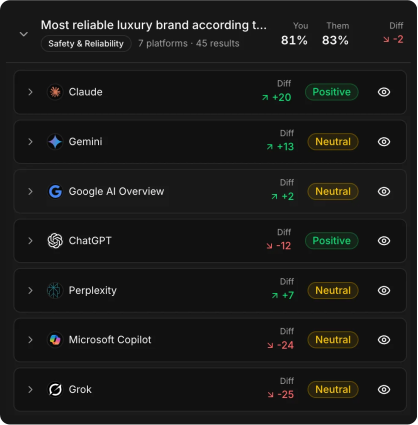
Win customers from all major AI platforms
Understand, measure, and optimize your AI visibility via Ansvisor.
✓ Add brand, domains and competitors
✓ Discover prompts and growth opportunities
✓ Track your AI visibility across major AI platforms
✓ Monitor citations, mentions, and competitors
✓ Measure AI traffic and customer discovery
✓ Receive AI recommendations based on AI insights
✓ Optimize authority, trust, and content quality
✓ Create content, automate analysis & action with AI agents
AI Visibility Terms
Continue exploring key AI visibility concepts.
AI Visibility
Measure and improve how often your brand appears in AI-generated answers.
Learn more →Answer Engine Optimization (AEO)
Strategies for increasing visibility in answer engines and AI summaries.
Learn more →Generative Engine Optimization (GEO)
Optimizing content for AI-powered discovery experiences.
Learn more →ChatGPT Search
Understand how OpenAI retrieves and synthesizes information.
Learn more →Google AI Overviews
AI-generated summaries that appear directly in Google Search.
Learn more →Perplexity Search
Explore how Perplexity cites and presents sources.
Learn more →AI Citations
References and sources used by AI systems to support answers.
Learn more →Citation Authority
Measure the quality and influence of cited sources.
Learn more →Retrievability
How easily AI systems can discover and reuse your content.
Learn more →New terms are added regularly.
Help us improve the page or suggest a new term →
Cihan Geyik
Co-founder at Ansvisor
Cihan Geyik is the co-founder of Ansvisor, an open-source AI Visibility platform for AI Search. With more than 15 years of experience in digital marketing and growth, he writes about AI visibility, AI search, AEO, GEO, citations, and answer engines. He focuses on helping brands understand and improve their presence across ChatGPT, Gemini, Perplexity, Google AI Overviews, and other AI-powered discovery platforms.
Get more Ansvisor insights in Google
Add Ansvisor as a Preferred Source to see more of our AI Search, AEO, GEO, and AI Visibility insights across Google.
Make Your Brand Visible in AI Answers.

INDUSTRIES


© 2026 Ansvisor. All rights reserved. Ansvisor is an open-source AI Search Intelligence Platform for AI Visibility. Ansvisor is a brand owned and operated by Empler AI Inc.


.svg)