Why Zero-Shot Learning matters
Zero-Shot Learning is a machine learning capability that allows AI systems to solve tasks, understand concepts, or generate responses without receiving task-specific training examples. Instead, the model relies on its existing knowledge and its ability to generalize across concepts and contexts.
Zero-shot learning has become one of the defining characteristics of modern foundation models and large language models, enabling them to perform a wide variety of tasks without explicit retraining.
Benefits of zero-shot learning include:
- Reduce training requirements.
- Improve task flexibility.
- Enable generalization.
- Support conversational AI.
- Power scalable AI systems.
This capability allows AI systems to adapt quickly to new problems and domains without requiring labeled datasets for every possible task.
How Zero-Shot Learning works
Zero-shot learning relies on a model's ability to generalize from previously learned patterns.
- Train on large datasets.
- Learn semantic relationships.
- Build conceptual representations.
- Interpret unseen tasks.
- Apply existing knowledge.
- Generate predictions or responses.
For example, a language model trained on broad internet data may successfully answer questions about a niche topic without ever receiving task-specific examples for that exact domain.
Modern large language models achieve zero-shot capabilities through large-scale pretraining, embeddings, and contextual reasoning.
What technologies enable Zero-Shot Learning?
Zero-shot learning relies on several AI technologies.
Modern foundation models often combine zero-shot learning with few-shot prompting, retrieval augmentation, and reasoning techniques.
How Zero-Shot Learning affects AI visibility
Zero-shot learning influences how AI systems understand brands, entities, and content that were not explicitly included during training.
Because AI systems can generalize to previously unseen topics and entities, organizations increasingly compete not only for direct mentions but also for semantic associations and contextual relevance.
Strategies such as Answer Engine Optimization (AEO), LLM Optimization, and AI Content Optimization often seek to improve how AI systems generalize and retrieve information about brands and topics.
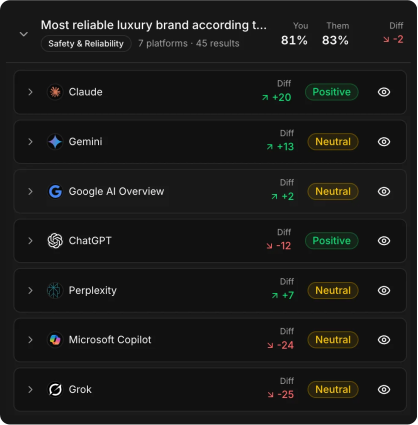
Platforms such as Ansvisor help organizations analyze how AI systems interpret prompts, entities, topics, citations, competitors, and semantic relationships across answer engines and AI search ecosystems.
Common misconceptions
Common misconceptions about zero-shot learning include:
- Zero-shot learning requires no training.
- Zero-shot performance is always accurate.
- Zero-shot learning eliminates hallucinations.
- All AI models have strong zero-shot capabilities.
- Zero-shot learning replaces retrieval systems.
As AI systems evolve, zero-shot learning remains a foundational capability because it enables models to generalize knowledge, understand unseen tasks, and operate effectively across a wide range of domains without explicit task-specific training.








.svg)
