


Competitive Intelligence for AI Search
Competitive Intelligence for AI Search is the process of analyzing how competing brands appear across AI-generated answers and using those differences to understand market visibility, strengths, weaknesses, and opportunities.
Instead of focusing only on traditional search rankings, AI Search Competitive Intelligence compares signals such as brand visibility, mentions, recommendations, citations, Share of Voice, prompt coverage, source influence, and performance across AI answer engines.
The goal is not simply to determine whether a competitor appears in an AI answer. It is to understand where competitors appear, why they may be gaining visibility, which sources support that visibility, and where opportunities exist for another brand to improve its position.
How does AI Search Competitive Intelligence work?
AI Search Competitive Intelligence typically begins by identifying strategically relevant competitors and monitoring the same set of prompts across the brand and those competitors.
AI-generated answers can then be analyzed to determine which brands appear, how frequently they appear, how prominently they are represented, which sources are cited, and how performance changes across prompts and platforms.
Repeating this process over time creates a competitive intelligence layer for AI-powered discovery.
What does AI Search Competitive Intelligence measure?
Competitive intelligence can combine multiple signals because no single metric fully describes how brands compete inside AI-generated answers.
Common measurements include:
- AI Visibility.
- Brand mentions.
- Competitor mentions.
- AI rankings and answer prominence.
- Recommendations.
- Share of Voice.
- Citations.
- Citation Rate.
- Cited domains and URLs.
- Prompt-level performance.
- Platform-level performance.
- Sentiment and representation.
- Historical gains and losses.
These signals help organizations understand not only who is visible, but how competitors earn and maintain that visibility.
Why is competitive intelligence important in AI Search?
AI-generated answers increasingly influence how people discover products, compare companies, evaluate alternatives, and build consideration sets.
In these environments, brands are often presented together. An AI system may recommend several companies, compare their capabilities, or cite sources that favor particular competitors.
Competitive intelligence helps organizations understand how they are represented within this new discovery environment instead of analyzing their own visibility in isolation.
What questions can AI competitor intelligence answer?
A structured competitive intelligence program can help answer questions such as:
- Which competitors appear most frequently in AI answers?
- Which competitors have greater AI Visibility?
- Where does our brand outperform competitors?
- Which prompts are dominated by competing brands?
- Which competitors have higher Share of Voice?
- Which competitor pages are frequently cited?
- Which third-party sources support competitor visibility?
- Which topics are competitors associated with?
- Where are competitors gaining or losing visibility?
- Which competitive gaps represent opportunities?
How is AI competitor analysis different from traditional competitor analysis?
Traditional search competitor analysis often focuses on keyword rankings, backlinks, organic traffic, content coverage, and domain authority.
AI Search introduces additional layers because generated answers can mention, compare, recommend, and cite brands without following a conventional search results structure.
AI Search → Prompt → Generated Answer → Brands + Mentions + Citations + Sources
The two forms of competitive analysis are complementary. Traditional search intelligence helps explain web visibility, while AI Search Competitive Intelligence focuses on how brands are represented inside AI-powered discovery experiences.
Can AI Search competitors differ from SEO competitors?
Yes.
A brand's strongest competitors in AI-generated answers may not be identical to the domains competing with it in conventional organic search.
AI answers can introduce:
- Direct product competitors.
- Emerging companies.
- Adjacent solutions.
- Marketplaces.
- Review platforms.
- Publishers.
- Community recommendations.
This means AI Search Competitive Intelligence can reveal a competitive landscape that is not obvious from keyword rankings alone.
What is competitor AI Visibility?
Competitor AI Visibility measures how consistently competing brands appear across a monitored set of AI-generated answers.
Visibility can be evaluated across prompts, topics, platforms, regions, languages, and time periods depending on the measurement system.
Comparing visibility helps identify brands that repeatedly enter AI-generated consideration sets.
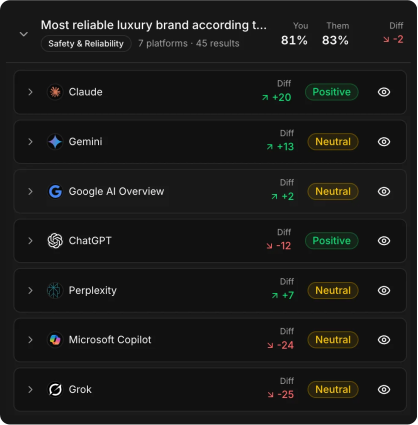
Ansvisor's AI Competitor Tracking & Benchmarking compares visibility, mentions, citations, Share of Voice, prompts, and answer-level performance across tracked competitors.
What is competitor Share of Voice in AI Search?
AI Share of Voice compares how frequently a brand appears relative to competitors across a defined monitoring dataset.
For example, if several brands are tracked across the same high-value prompts, Share of Voice can help reveal which brands receive the greatest presence within those monitored answers.
Share of Voice should always be interpreted within the prompt set, competitors, platforms, locations, and methodology being measured.
What is prompt-level competitor analysis?
Prompt-level competitor analysis compares brands for individual questions rather than relying only on an overall visibility score.
This is important because a competitor can perform strongly for one customer intent while being nearly invisible for another.
For example, a brand might lead for:
- General category questions.
- Informational prompts.
While a competitor leads for:
- Best-product recommendations.
- Alternative searches.
- Product comparisons.
- High-intent buying questions.
Prompt-level analysis exposes these differences and makes competitor intelligence more actionable.
What is an AI competitor visibility gap?
An AI competitor visibility gap occurs when a competing brand appears across strategically important AI answers while another brand does not.
For example, a competitor may consistently appear for high-intent recommendation prompts while your brand appears only for broader informational questions.
That difference can indicate a potential opportunity to investigate content, authority, positioning, citations, or third-party presence.
What is a competitor strength in AI Search?
A competitor strength is an area where another brand consistently performs better across monitored AI Search signals.
Examples can include:
- Higher visibility for an important topic.
- More frequent recommendations.
- Stronger citation coverage.
- Greater Share of Voice.
- More visibility across high-intent prompts.
- Better performance on a particular AI platform.
Identifying a competitor strength does not automatically explain why the advantage exists. Further analysis is needed to understand the sources, content, positioning, and context behind it.
What is a competitive advantage in AI Search?
Competitive analysis should also identify where your own brand performs better.
A brand may have stronger visibility for certain topics, more citations from authoritative sources, greater prompt coverage, or better representation on a particular AI platform.
These strengths can help teams understand which existing strategies are working and where they may be able to expand their advantage.
How do AI mentions contribute to competitor intelligence?
Brand mentions reveal which companies are entering AI-generated answers.
Tracking mentions across competitors can show which brands are most frequently associated with a category, product type, problem, or customer need.
However, mention frequency should not be treated as identical to recommendation strength.
Answer context is necessary to understand how each competitor is actually being represented.
Why is answer-level competitor analysis important?
Aggregate metrics can show that one competitor is more visible than another, but they do not always explain why.
Inspecting individual AI answers can reveal:
- How competitors are described.
- Whether they are recommended.
- Which features are associated with them.
- Which strengths or weaknesses are mentioned.
- Which sources support the answer.
- How your own brand is positioned alongside them.
This qualitative layer can explain differences that aggregate visibility metrics cannot show on their own.
How do citations contribute to AI competitor intelligence?
Citations can reveal which sources influence how AI systems construct answers about competing brands.
Instead of only asking which competitor appears, teams can investigate which domains and URLs support that competitor's visibility.
These sources can include:
- Competitor websites.
- Editorial publications.
- Industry reports.
- Review platforms.
- Forums and communities.
- Video platforms.
- Marketplaces.
- Independent blogs.
Ansvisor's AI Citation Monitoring separates own-domain, competitor, and third-party citations so teams can investigate the sources influencing AI Search visibility.
What is a competitor citation gap?
A competitor citation gap exists when a source, domain, or URL contributes to competitor visibility but does not provide similar citation coverage for your brand.
These gaps can reveal potential opportunities across:
- Content creation.
- Existing-page optimization.
- Digital PR.
- Editorial coverage.
- Review platforms.
- Communities and forums.
- Partnerships.
- Third-party authority building.
A citation gap does not guarantee that appearing on the same source will produce an AI citation, but it provides evidence about the information environment already influencing monitored answers.
Why are third-party sources important in AI competitive intelligence?
AI visibility is not determined only by what a company publishes on its own website.
AI systems can reference independent publishers, reviews, communities, research, videos, forums, and other external sources when constructing answers.
If competitors repeatedly appear in influential third-party sources, those sources can become an important part of competitive analysis.
Can competitor citations reveal content opportunities?
Yes.
Frequently cited competitor pages can reveal topics, formats, evidence, and information structures that appear useful within AI-generated answers.
Teams can inspect these sources to understand:
- Which topics receive citation coverage.
- Which questions the content answers.
- What evidence is included.
- How information is structured.
- Which content formats are repeatedly cited.
This analysis can inform original content strategy without simply copying competitor content.
What is source-level competitive intelligence?
Source-level competitive intelligence focuses on the domains and URLs behind AI-generated answers.
It asks not only which brands are visible, but which information sources are helping shape that visibility.
This can reveal whether a market is influenced primarily by:
- Brand-owned content.
- Large editorial publishers.
- Review platforms.
- Industry communities.
- Forums.
- Video content.
- Research publications.
Understanding the source landscape provides another layer of intelligence beyond direct brand comparisons.
What is platform-level competitor intelligence?
Platform-level competitor intelligence compares how brands perform across different AI Search and answer engines.
The same competitor does not necessarily have the same visibility everywhere. A brand may perform strongly on one platform and have much weaker visibility on another.
Comparing performance by platform helps identify where competitive strengths and weaknesses are concentrated.
Why can competitor performance differ across AI platforms?
AI platforms can use different models, retrieval systems, data sources, interfaces, freshness mechanisms, and answer-generation processes.
As a result, the same prompt can generate different:
- Brands.
- Recommendations.
- Rankings.
- Citations.
- Sources.
- Comparisons.
Competitive intelligence should therefore avoid assuming that performance on one AI platform represents performance across the entire AI Search ecosystem.
Why is historical competitor tracking important?
Competitive intelligence becomes more valuable when changes can be observed over time.
Historical monitoring can reveal:
- Competitors gaining visibility.
- Competitors losing Share of Voice.
- New competitors entering AI answers.
- Changes in citation patterns.
- New third-party sources influencing answers.
- Changes after product launches or content updates.
This helps distinguish persistent competitive shifts from isolated answer variation.
Can new competitors emerge through AI Search?
Yes.
AI-generated answers can reveal brands that were not previously considered direct competitors.
If another company repeatedly appears for the same high-value customer questions, it may be competing for attention and consideration even if traditional market analysis did not identify it as a primary competitor.
AI Search can therefore act as a discovery layer for emerging competitive threats and adjacent alternatives.
What is competitive prompt coverage?
Competitive prompt coverage compares how broadly different brands appear across a monitored set of strategically relevant questions.
For example, one brand may appear across 80% of monitored category prompts while another appears across only 30%.
The exact percentage is meaningful only within the defined prompt portfolio, but it can reveal whether one competitor has broader representation across the customer journey.
Can competitive intelligence identify high-value AI Search opportunities?
Yes.
One of the most useful applications of competitor intelligence is identifying areas where competitive differences create actionable opportunities.
Examples include:
- High-value prompts where competitors appear but your brand does not.
- Topics where competitor Share of Voice is increasing.
- Competitor citations your brand has not earned.
- Third-party sources influencing competitor recommendations.
- Platforms where competitors have stronger visibility.
- Customer questions not adequately addressed by your existing content.
- Areas where your brand already has a competitive advantage worth expanding.
What should brands do with AI competitor intelligence?
Competitive data becomes valuable when it informs decisions rather than simply producing another dashboard.
Depending on the evidence, competitive insights can lead to actions such as:
- Creating content around uncovered customer questions.
- Improving pages with weak AI visibility.
- Strengthening product and entity information.
- Addressing missing comparison topics.
- Building relationships with relevant third-party sources.
- Improving citation coverage.
- Strengthening presence in influential communities.
- Protecting topics where the brand already leads.
Is competitor visibility enough to explain why a brand wins?
No.
Visibility shows what is happening, but it does not automatically explain why.
A competitor may appear more frequently because of stronger content, better third-party coverage, more relevant documentation, authoritative citations, stronger brand associations, or other factors.
Competitive Intelligence should therefore connect visibility metrics with answer-level evidence and source-level analysis.
Does more competitor visibility mean a competitor has more market share?
No.
AI Visibility measures representation within a defined AI Search monitoring environment. It does not directly measure revenue, customer count, total market share, or overall brand awareness.
AI Search metrics should be treated as a distinct discovery and visibility layer.
Does more competitor citations mean a competitor is more authoritative?
Not necessarily.
Citation frequency can show that a competitor or source is repeatedly referenced within monitored AI answers, but authority is broader than citation count alone.
Citation context, source quality, relevance, prompt coverage, content usefulness, and other factors should also be considered.
What are the limitations of AI Search Competitive Intelligence?
AI competitor analysis provides useful evidence, but it has important limitations.
- AI-generated answers can vary between repeated runs.
- Tracked prompts represent a selected measurement portfolio.
- Private user conversations are generally not observable.
- Different platforms can represent the same competitor differently.
- Visibility metrics can use different methodologies.
- A mention does not necessarily mean a recommendation.
- A citation does not guarantee a website visit.
- AI visibility does not directly equal market share or revenue.
- Competitor performance can change after model or retrieval updates.
Competitive intelligence is therefore most useful when multiple signals and historical trends are analyzed together.
Who should use AI Search Competitive Intelligence?
Competitive Intelligence for AI Search can support teams responsible for market positioning, discovery, brand visibility, customer acquisition, and growth.
Typical users include:
- Founders and executives.
- Brand and PR teams.
- SEO, AEO, and GEO teams.
- Growth teams.
- Content teams.
- Competitive intelligence teams.
- Product marketing teams.
- Agencies.
- B2B companies.
- Ecommerce companies.
How does Ansvisor approach AI Search Competitive Intelligence?
Ansvisor's AI Search Intelligence Platform connects AI Search behavior with search and business data to help organizations understand where they stand, where opportunities exist, and what actions should come next.
Competitive intelligence is part of this broader model. Teams can compare their brand with tracked competitors across visibility, mentions, citations, Share of Voice, prompts, platforms, and individual AI answers.
Ansvisor's AI Competitor Tracking & Benchmarking provides the dedicated competitor analysis layer, while AI Citation Monitoring helps explain the domains and URLs influencing competitor visibility.
This moves competitive analysis beyond observing which brand has a higher score. The objective is to understand the evidence behind competitive differences and turn those differences into decisions that can improve AI Search performance.
From competitor tracking to AI Search Intelligence
Competitor tracking answers:
How does our brand perform compared with competitors?
Competitive Intelligence goes further:
Where are competitors winning, what evidence supports their visibility, where are the gaps, and which opportunities should we act on?
This broader approach makes competitive analysis part of an ongoing AI Search intelligence process rather than a static comparison report.
Explore AI Search Competitive Intelligence with Ansvisor
Explore the Ansvisor capabilities most directly connected with competitor intelligence, benchmarking, and citation analysis.
FAQ
What is Competitive Intelligence for AI Search?

Competitive Intelligence for AI Search is the process of comparing how brands appear across AI-generated answers using signals such as visibility, mentions, citations, Share of Voice, prompts, sources, and historical performance.
How is AI Search Competitive Intelligence different from traditional competitor analysis?
Traditional competitor analysis often focuses on keyword rankings, backlinks, traffic, and content. AI Search Competitive Intelligence adds answer-level signals such as brand mentions, recommendations, citations, source influence, prompt coverage, and Share of Voice across AI-generated responses.
What competitor metrics should brands track in AI Search?
Useful metrics include AI Visibility, mentions, citations, Citation Rate, Share of Voice, prompt coverage, answer prominence, platform performance, cited domains and URLs, and historical gains or losses. No single metric provides a complete view of competitive performance.
What is an AI competitor citation gap?
An AI competitor citation gap occurs when a domain or URL contributes to a competitor's visibility in monitored AI answers but does not provide similar citation coverage for your brand. These gaps can reveal content, PR, community, review, partnership, and authority-building opportunities.
How does Ansvisor help with AI Search Competitive Intelligence?
Ansvisor compares brands across AI Visibility, mentions, citations, Share of Voice, prompts, platforms, and individual AI answers. Its competitor benchmarking and citation intelligence capabilities help teams move from identifying competitive differences to discovering opportunities and prioritizing actions.
Win customers from all major AI platforms
Understand, measure, and optimize your AI visibility via Ansvisor.
✓ Add brand, domains and competitors
✓ Discover prompts and growth opportunities
✓ Track your AI visibility across major AI platforms
✓ Monitor citations, mentions, and competitors
✓ Measure AI traffic and customer discovery
✓ Receive AI recommendations based on AI insights
✓ Optimize authority, trust, and content quality
✓ Create content, automate analysis & action with AI agents
AI Visibility Terms
Continue exploring key AI visibility concepts.
AI Visibility
Measure and improve how often your brand appears in AI-generated answers.
Learn more →Answer Engine Optimization (AEO)
Strategies for increasing visibility in answer engines and AI summaries.
Learn more →Generative Engine Optimization (GEO)
Optimizing content for AI-powered discovery experiences.
Learn more →ChatGPT Search
Understand how OpenAI retrieves and synthesizes information.
Learn more →Google AI Overviews
AI-generated summaries that appear directly in Google Search.
Learn more →Perplexity Search
Explore how Perplexity cites and presents sources.
Learn more →AI Citations
References and sources used by AI systems to support answers.
Learn more →Citation Authority
Measure the quality and influence of cited sources.
Learn more →Retrievability
How easily AI systems can discover and reuse your content.
Learn more →New terms are added regularly.
Help us improve the page or suggest a new term →
Cihan Geyik
Co-founder at Ansvisor
Cihan Geyik is the co-founder of Ansvisor, an open-source AI Visibility platform for AI Search. With more than 15 years of experience in digital marketing and growth, he writes about AI visibility, AI search, AEO, GEO, citations, and answer engines. He focuses on helping brands understand and improve their presence across ChatGPT, Gemini, Perplexity, Google AI Overviews, and other AI-powered discovery platforms.
Make Your Brand Visible in AI Answers.

INDUSTRIES


© 2026 Ansvisor. All rights reserved. Ansvisor is an open-source AI Search Intelligence Platform for AI Visibility.


.svg)
