An LLM Rank Tracker is a tool that measures how a brand,
product, website, or competitor appears across answers generated by large
language models and AI Search platforms. Instead of tracking only a URL's
numerical position in a traditional search engine results page, an LLM rank
tracker analyzes signals such as prompt-level visibility, brand mentions,
citations, answer prominence, competitors, cited sources, and changes over time.
LLM rank tracking helps teams understand whether their brand is present when
people ask AI systems commercially or informationally important questions.
It creates a repeatable measurement layer for evaluating visibility across
AI-generated answers.
Prompt → AI Answer → Brand Visibility → Mentions → Citations → Competitors → Historical Change
How Does an LLM Rank Tracker Work?
An LLM rank tracker starts with a defined set of prompts or topics. These
prompts represent questions that potential customers, researchers, buyers,
or other users may ask AI systems.
The tracker repeatedly analyzes responses to those prompts and records
relevant signals. Teams can use
AI prompt tracking and volumes
to build and monitor prompt sets around topics that matter to their business.
Depending on the measurement methodology, LLM rank tracking can evaluate:
- whether the tracked brand appears in an answer;
- which competitors appear in the same answer;
- how prominently the brand is presented;
- whether the brand's website or another source is cited;
- which domains and URLs are used as sources;
- which prompts generate brand visibility;
- how results differ between AI platforms; and
- how these signals change over time.
What Does an LLM Rank Tracker Measure?
| Signal |
What It Measures |
| Prompt Visibility |
Whether the brand appears for a specific tracked prompt. |
| Brand Mentions |
Whether the LLM explicitly mentions the brand, product, or entity. |
| Citations |
Whether a website, page, or domain is cited as a source in the AI-generated answer. |
| Answer Prominence |
How prominently the brand appears within the generated response. |
| Competitor Visibility |
Which competing brands appear for the same prompts and topics. |
| Source Visibility |
Which domains and URLs are repeatedly used to support AI-generated answers. |
| Historical Data |
How visibility, mentions, citations, and competitor presence change across repeated measurements. |
LLM Rank Tracking vs. Traditional SEO Rank Tracking
Traditional rank tracking typically follows a relatively direct model:
a keyword is searched, a search results page is returned, and a website's
organic position is recorded.
Traditional rank tracking: Keyword → Search Result → URL Position
LLM rank tracking: Prompt → Generated Answer → Brand Mention → Citation → Competitor Presence → Answer Context
AI-generated answers do not always produce a conventional list of ten ranked
URLs. A brand can be mentioned without being cited, cited without receiving
prominent brand exposure, or excluded while a competitor appears instead.
This makes LLM ranking a multidimensional measurement problem rather than
simply another version of traditional position tracking.
What Is LLM Rank Tracking Data?
LLM rank tracking data is the historical dataset created by
repeatedly measuring AI-generated answers for a consistent set of prompts.
It can include brand presence, mentions, citations, competitors, source URLs,
answer context, platform, prompt, and measurement date.
Historical data is particularly important because AI-generated answers can
change. A single answer provides a snapshot. Repeated measurements help reveal
whether visibility changes represent a broader pattern or an isolated result.
Teams can combine this data with broader
Answer Engine Insights
to investigate how prompts, answers, sources, and competitors contribute to
AI Search performance.
LLM Visibility Tracking
LLM visibility tracking measures whether and how frequently
a brand appears across a monitored set of AI-generated answers. Ranking data
can be one component of this measurement, but visibility tracking is broader
than a conventional position metric.
Useful visibility signals can include prompt coverage, mention frequency,
citation presence, competitor Share of Voice, answer prominence, and historical
changes. Together, these signals help show where a brand is visible, where it
is absent, and where competitors have stronger representation.
LLM Mentions and Citations Are Different Signals
A brand mention and a citation should not be treated as the same measurement.
An LLM may mention a company without linking to or citing its website.
Conversely, a page from a domain may be cited without the brand receiving
prominent exposure in the answer.
AI citation monitoring
helps teams analyze cited domains and URLs separately from brand mentions.
This distinction makes it possible to evaluate both entity visibility and
source visibility.
Brand Mention → Entity Visibility
Citation → Source Visibility
LLM Rank Tracking → Measures these signals in the context of prompts, answers, competitors, and time.
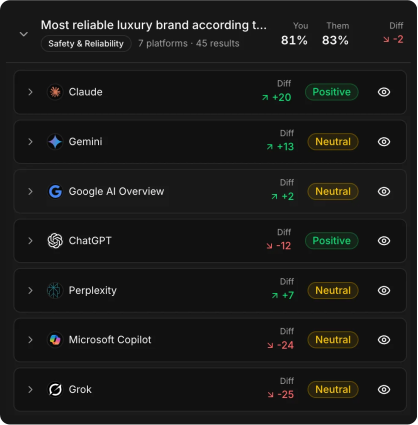
Tracking Rankings Across Different LLMs
Visibility can differ significantly between AI systems because platforms can
use different models, retrieval systems, search indexes, sources, interfaces,
and answer-generation processes. A brand that appears for a prompt on one
platform may not appear for the same or similar prompt elsewhere.
Platform-specific measurement can therefore provide a clearer picture than
combining every AI answer into a single undifferentiated metric.
ChatGPT Rank and Visibility Tracking
Teams can use a
ChatGPT Visibility Tracker
to monitor prompts, brand presence, citations, competitors, and changes in
ChatGPT answers.
Gemini Rank and Visibility Tracking
A
Gemini Visibility Tracker
can be used to analyze how a brand appears across relevant Gemini-generated
answers and compare visibility with competing brands.
Google AI Overviews Rank Tracking
For Google's AI-generated search experiences, a
Google AI Overviews Rank Tracker
can monitor whether a website or brand appears in AI Overviews, which URLs
are cited, which competitors are visible, and how results change for important queries.
Google AI Mode Visibility Tracking
Teams can separately
track Google AI Mode visibility
to understand brand presence across Google's conversational AI Search experience.
Claude Visibility Tracking
A
Claude AI Visibility Tracker
measures how a brand, competitors, and relevant sources appear across monitored Claude prompts.
Microsoft Copilot Visibility Tracking
A
Microsoft Copilot Visibility Tracker
can provide a platform-specific view of brand visibility and citations across tracked Copilot answers.
Perplexity Visibility Tracking
Teams can use a
Perplexity Visibility Tracker
to measure brand presence, citations, competitors, and source visibility across relevant Perplexity answers.
How LLM Rank Tracking Supports LLM SEO
LLM SEO focuses on improving how brands and their content are represented,
discovered, mentioned, and cited within AI-generated answers. Rank tracking
provides the measurement layer needed to evaluate those efforts.
For example, teams can identify prompts where competitors appear but their
own brand is absent, analyze which sources are repeatedly cited, improve
relevant content, strengthen external authority signals, and then measure
whether visibility changes after those actions.
Track Prompts → Measure LLM Visibility → Find Gaps → Take Action → Measure Change
What Makes an LLM Rank Tracker Useful?
An LLM rank tracking tool becomes more useful when it connects raw answer
data to the questions teams need to answer:
- Which commercially important prompts mention our brand?
- Where are competitors visible but we are absent?
- Which pages and domains are being cited?
- Which topics have weak brand coverage?
- How does visibility differ between AI platforms?
- Are mentions and citations increasing or declining?
- Which changes are worth acting on?
This moves LLM rank tracking beyond a static reporting dashboard and toward
a broader AI Search intelligence workflow.
Limitations of LLM Rank Tracking
LLM rank tracking should be interpreted differently from deterministic
traditional rank tracking. Generated answers can vary between runs, models,
locations, interfaces, and retrieval conditions. A monitored prompt set also
represents only a defined sample of the much larger universe of questions
users may ask.
Private user conversations generally cannot be observed directly by external
rank tracking tools. For this reason, LLM rank tracking should be treated as
structured measurement based on a controlled prompt portfolio rather than a
complete record of every AI interaction involving a brand.
A mention or citation also does not automatically mean that a user visited
the website, preferred the brand, or converted. Visibility, citations,
traffic, and business outcomes should be evaluated as related but distinct signals.
LLM Rank Tracking and AI Search Intelligence
LLM rank tracking is most valuable when it becomes part of a broader
intelligence process rather than an isolated ranking metric.
Using an
AI Search Intelligence Platform,
teams can connect prompts, AI-generated answers, visibility, mentions,
citations, competitors, and historical performance to understand where
opportunities exist and what to improve next.
LLM Rank Tracking Data → Visibility Gaps → Opportunities → Actions → Measurement








.svg)
