GeoGenie is a full-stack Generative Engine Optimization platform for monitoring, understanding, and improving how brands appear across AI-powered search and answer engines.
The platform combines prompt research, AI visibility monitoring, competitor analysis, citation intelligence, technical website analysis, content briefs, publisher opportunities, and AI crawler analytics.
GeoGenie organizes these capabilities into a connected product suite rather than treating AI visibility as a single dashboard.
Its current platform includes:
The broader workflow can be represented as:
Research → Prompt Discovery → Monitoring → Citation Analysis → Actions → Technical Optimization → Validation
Traditional SEO primarily focuses on search rankings, impressions, clicks, and organic traffic.
AI Search introduces a different discovery journey.
A customer can ask an AI system a question and receive a generated answer containing brands, products, comparisons, recommendations, and citations.
The journey can therefore become:
Prompt → AI Answer → Brand Mention → Citation → Recommendation → Website Visit
GeoGenie is designed to measure and optimize several stages of this journey.
Yes.
AI visibility monitoring is a central GeoGenie capability.
MonitoringGenie tracks whether brands appear across monitored prompts and measures visibility, competitive presence, and citation activity across supported AI engines.
GeoGenie then extends beyond measurement through citation analysis, content briefs, technical auditing, publisher opportunities, and bot-level analytics.
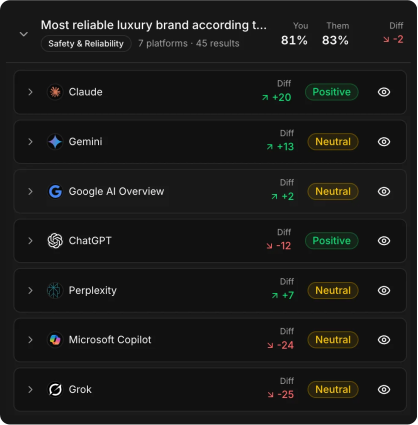
GeoGenie's current documentation and product pages list monitoring across:
Coverage can be analyzed separately by engine rather than being collapsed into a single aggregate score.
Yes.
ChatGPT is one of GeoGenie's core monitored AI environments.
Users can analyze prompt-level brand visibility, competitor presence, citations, and changes over time within ChatGPT responses.
Yes.
Gemini is included in GeoGenie's current AI platform coverage.
Teams can compare visibility and citation performance in Gemini with performance across other supported AI engines.
Yes.
Perplexity is supported within GeoGenie's current monitoring environment.
Its source-oriented answer format can also make it particularly useful for citation analysis.
Yes.
Claude is included in GeoGenie's current AI Search monitoring coverage.
Yes.
Google AI Overviews is one of the AI Search environments explicitly listed in GeoGenie's current monitoring documentation.
Yes.
Microsoft Copilot is included in GeoGenie's current supported engine set.
ContextGenie is GeoGenie's research layer.
It maps the personas, topics, contexts, and competitors associated with a brand before prompt monitoring begins.
Its purpose is to help teams understand:
This research becomes the foundation for prompt generation and monitoring.
AI Search users can express the same commercial need in many different ways.
A monitoring program based only on conventional SEO keywords can therefore miss important conversational queries.
ContextGenie is designed to map the broader buyer and category context before selecting prompts.
PromptsGenie is GeoGenie's prompt discovery and generation layer.
It generates prompts intended to represent different stages of the buying journey and different levels of commercial intent.
GeoGenie separates these into two broad prompt types:
Coverage prompts are broader category-level prompts.
They are designed to show whether AI systems generally recognize and surface a brand within an important category.
These prompts provide a wider view of category presence.
Depth prompts are more specific, commercial-intent questions where AI systems may provide concrete brand or product recommendations.
They are intended to reveal visibility at later stages of the buyer journey.
For example:
Coverage Prompt → "running shoes"
Depth Prompt → "best lightweight running shoes for marathon training under $150"
Broad prompts can show whether a brand is known within a category.
Commercial prompts can show whether the brand appears when users are closer to a decision.
Using both can provide a more balanced monitoring portfolio.
Not necessarily.
PromptsGenie predicts and generates realistic prompts based on personas, topics, contexts, and buying stages.
These prompts should not automatically be interpreted as complete logs of private real-world user conversations.
The distinction is:
Predicted Prompt Set ≠ Complete Real-World Prompt Demand
MonitoringGenie is GeoGenie's AI visibility tracking layer.
It repeatedly runs tracked prompts across supported AI systems and measures how the brand performs.
Its three core metrics are:
Visibility % measures how often the tracked brand appears in AI-generated answers for the monitored prompts.
A higher Visibility % means the brand appears more consistently across the selected prompt set.
Visibility % is a presence metric.
It does not automatically indicate that the brand is recommended or positively described.
Share of Voice % compares the tracked brand's AI mentions with competitor mentions across the monitored environment.
It is designed to show whether a brand is gaining or losing relative presence against competitors.
Share of Voice should be interpreted within the selected prompt portfolio, competitor set, and supported AI engines rather than as a universal measure of the entire AI Search ecosystem.
Citation Rate % measures how often the tracked brand's own domain is cited as a source within monitored AI-generated answers.
This is different from a simple brand mention.
The distinction is:
Brand Mention → AI references the brand
Citation → AI references the brand's content as a source
A brand can be well known to AI systems without its own website being used as a primary source.
For example:
High Visibility + Low Citation Rate
can indicate that third-party sources are shaping the brand's AI Search presence.
This creates a different optimization problem from low visibility.
Yes.
MonitoringGenie allows teams to inspect visibility at both topic and prompt level.
For each prompt, users can review the actual AI answer, associated citations, and historical performance.
Aggregate visibility can hide important differences between customer questions.
A brand can perform strongly for informational prompts but poorly for high-intent commercial questions.
Prompt-level analysis helps identify exactly where those gaps exist.
Yes.
MonitoringGenie charts historical changes so teams can see whether visibility, Share of Voice, or citation performance is improving or declining.
GeoGenie also supports different monitoring cadences depending on team requirements.
Yes.
GeoGenie's current MonitoringGenie materials describe email and Slack alerts when Visibility or Share of Voice changes beyond configured thresholds.
Yes.
Competitor identification begins within ContextGenie and then flows through the rest of the platform.
GeoGenie treats AI Search competitors differently from a conventional fixed competitor list.
ContextGenie identifies brands that appear in AI answers across the same personas, topics, and contexts as the tracked brand.
This can include:
AI systems assemble answers using training data, retrieval systems, citations, and other information sources.
This means a brand that is not a major traditional competitor can still dominate specific AI-generated answers.
AI Search competitor analysis can therefore expose a different competitive landscape from conventional market or SEO analysis.
CitationsGenie is GeoGenie's citation intelligence layer.
It analyzes the citation supply chain behind monitored AI-generated answers.
The goal is to understand:
The Citation Supply Chain describes the network of sources AI systems use when constructing answers.
Instead of assuming that owned website content is the only factor influencing visibility, GeoGenie analyzes the broader source ecosystem.
This ecosystem can include:
A brand can improve its own website and still remain absent from AI-generated answers if external sources dominate the topic.
Citation analysis helps determine whether the appropriate action belongs on:
A citation gap occurs when important AI-generated answers rely on competitor or third-party sources while the tracked brand's own content is absent.
The correct response can vary.
Possible actions include:
ActionsGenie is GeoGenie's action and content-brief layer.
It turns citation and visibility gaps identified elsewhere in the platform into GEO-oriented content briefs.
The goal is to move from:
"We are losing this prompt"
to:
"Here is the content or source action we should take"
GeoGenie's current product materials describe briefs that can include:
The exact output depends on the underlying visibility and citation gap.
No.
GeoGenie explicitly distinguishes between:
This is important because not every AI visibility problem can be solved by publishing another page on the brand's own website.
Yes.
GeoGenie currently describes a built-in Publisher Network that can be used to execute certain off-site placements identified through citation analysis.
This moves part of the workflow from recommendation toward execution.
Publisher placement should still be evaluated for editorial quality, relevance, disclosure requirements, and platform policies.
SiteGenie is GeoGenie's technical website-audit layer.
It focuses on whether a website is structured and accessible in ways that support AI-powered discovery.
Current focus areas include:
Structured data can make important entities, attributes, and relationships easier for machines to interpret.
This can support machine understanding of:
Structured data does not guarantee that an AI system will retrieve or cite a page.
No.
Crawlability is only one stage of the discovery process.
A broader chain is:
Crawlable → Processed → Retrieved → Selected → Cited → Recommended
Success at an earlier stage does not guarantee success at a later stage.
Agent Analytics is GeoGenie's AI bot and crawler analysis layer.
It is designed to analyze AI-related HTTP activity at the infrastructure level rather than relying only on JavaScript analytics.
This is relevant because many crawlers do not execute the JavaScript required by conventional analytics platforms such as GA4.
GeoGenie's current documentation describes AI bot activity categorized around purposes such as:
It can also help teams investigate which AI-related crawlers access specific website content.
GeoGenie supports infrastructure-level log forwarding integrations.
Its current documentation references integrations including:
Additional CDN and infrastructure workflows can be supported depending on configuration.
Many AI crawlers request pages directly from web infrastructure without executing JavaScript.
This means traditional browser-based analytics may not record those visits.
Server and CDN logs can provide direct evidence that an HTTP request occurred.
No.
Crawler activity and visible citation activity are different events.
A crawler can request a page without that page later appearing in an AI-generated answer.
The distinction is:
AI Crawl ≠ AI Citation
Yes.
GeoGenie's documentation includes a GeoGenie MCP integration for connecting its data and workflows with compatible AI assistants and agent systems.
This can provide another interface for accessing GeoGenie information beyond the main dashboard.
The Model Context Protocol can provide structured access to application context and actions for compatible AI systems.
Within GeoGenie, MCP can help external AI assistants work with GEO-related data and workflows exposed by the platform.
Exact available tools and permissions depend on the current GeoGenie MCP implementation.
Yes.
MonitoringGenie currently supports alerts based on significant visibility or Share of Voice changes.
This can help teams identify material changes without manually checking every prompt.
Yes.
Current MonitoringGenie materials describe daily, weekly, or monthly monitoring cadence options at the topic level.
Yes.
Prompts can be grouped into topic folders.
GeoGenie can then display average performance across those prompts while still allowing users to drill down to individual questions.
Large prompt portfolios can be difficult to interpret one prompt at a time.
Topic grouping allows teams to understand where broader sections of their category are performing strongly or weakly.
No.
GeoGenie's measurement model deliberately separates:
CitationsGenie and Agent Analytics then add deeper source and crawler context around those metrics.
Not automatically.
AI Search attribution remains difficult because many discovery journeys do not preserve an identifiable referral.
A user can discover a brand through an AI answer and later visit through:
The distinction is:
AI Influence ≠ Identifiable AI Referral
Yes.
Although GeoGenie primarily uses the term Generative Engine Optimization, its platform also supports the broader objectives associated with Answer Engine Optimization.
These include:
Yes.
Generative Engine Optimization is GeoGenie's central product category.
Its full workflow is explicitly designed around moving from AI Search research and measurement toward optimization.
A simplified workflow is:
Research → Track → Analyze → Identify Gap → Create Action → Optimize → Monitor Again
No.
AI Search creates an additional discovery environment rather than removing conventional search.
Traditional SEO remains relevant for crawlability, content quality, search demand, technical performance, and organic acquisition.
A broader strategy can include:
SEO + AEO + GEO
Traditional rank tracking measures where a webpage appears in conventional search results for a keyword.
GeoGenie measures how a brand appears inside generated AI responses.
The measurement model changes from:
Keyword → Ranking Position
to:
Prompt → Generated Answer → Mention + Competitor + Citation Analysis
Google Search Console provides first-party Google Search performance and technical information for verified websites.
GeoGenie monitors brand visibility and citations across multiple AI-powered answer environments.
The distinction can be summarized as:
Google Search Console → Google Search Performance
GeoGenie → Cross-Platform AI Search Visibility & GEO
Google Analytics primarily measures what happens after users reach a connected website or application.
GeoGenie primarily analyzes what happens upstream inside AI-generated discovery environments and at the crawler infrastructure layer.
The broader relationship is:
GeoGenie → AI Discovery & AI Bot Activity
Web Analytics → On-Site User Behavior
GeoGenie is designed to extend beyond monitoring.
Its platform connects:
Its broader model is:
Measure → Understand Why → Take Action → Validate
GeoGenie and Visby both combine AI visibility monitoring with action-oriented GEO workflows.
GeoGenie places particularly strong emphasis on persona and context research, generated prompt sets, citation supply-chain analysis, off-site publisher opportunities, and infrastructure-level AI bot analytics.
Visby emphasizes visibility monitoring, prioritized GEO tasks, content generation, reporting integrations, and reputation data.
The platforms therefore overlap while organizing the workflow differently.
Both products operate in AI Visibility and GEO.
GetCito combines AI monitoring software with optional managed GEO services.
GeoGenie structures its workflow as a connected product suite covering research, prompts, monitoring, citations, actions, technical analysis, publisher execution, and bot analytics.
Elmo emphasizes open-source, self-hostable AI visibility monitoring and optimization.
GeoGenie currently presents itself as a commercial full-stack GEO platform with an integrated research, monitoring, action, publisher, and crawler-intelligence workflow.
Organizations prioritizing open-source deployment may therefore evaluate the products differently from organizations prioritizing managed execution.
GeoGenie and Ansvisor both move beyond basic AI visibility monitoring, but they emphasize different operating models.
GeoGenie organizes its platform around a seven-product GEO suite covering research, prompt prediction, monitoring, citation supply chains, content actions, technical readiness, and agent analytics.
Ansvisor is an AI Search Intelligence platform that connects AI behavior with search and business data and organizes the workflow around Analytics → Opportunities → Actions.
Ansvisor also provides an open-source, cloud-ready and self-hostable deployment model.
GeoGenie can provide detailed GEO research, AI visibility monitoring, citation analysis, content briefs, technical auditing, and publisher execution.
Ansvisor can add a broader AI Search Intelligence layer connecting AI behavior with search demand, business metrics, Prompt Discovery, Citation Intelligence, competitor and source opportunities, and prioritized actions.
A combined conceptual model is:
AI Search Data + Search Data + Business Data → Analytics → Opportunities → Actions → GEO Execution → Validation
GeoGenie's research, prompt, visibility, citation, and agent data form the analytics layer.
Citation and visibility gaps become opportunities.
ActionsGenie, SiteGenie, and the Publisher Network can then turn some of those opportunities into content, technical, or off-site actions.
The mapping can be represented as:
Analytics → Visibility & Citation Gap → Action Brief → Technical or Content Action → Measurement
Important considerations include:
GeoGenie can be relevant to organizations that want an integrated GEO workflow rather than a standalone AI visibility dashboard.
Potential users include:
GeoGenie occupies a broad position within the AI Search ecosystem because it connects research, measurement, diagnosis, execution, and technical validation.
ContextGenie maps personas, topics, and competitors.
PromptsGenie turns that context into Coverage and Depth prompt sets.
MonitoringGenie measures Visibility %, Share of Voice %, and Citation Rate %.
CitationsGenie explains which domains and URLs influence AI-generated answers.
ActionsGenie turns gaps into content and distribution briefs.
SiteGenie evaluates structured data and AI crawlability.
Agent Analytics adds infrastructure-level evidence of AI crawler activity.
The overall workflow can therefore be represented as:
Context → Prompts → Visibility → Citations → Opportunities → Actions → Technical Validation
Using Ansvisor, organizations can extend this model with an AI Search Intelligence layer that connects AI behavior with search data, business signals, Prompt Discovery, Citation Intelligence, opportunities, actions, and measurable outcomes.
The broader operating model becomes:
AI Search Data + Search Data + Business Data → Analytics → Opportunities → Actions → Validation → Learning
Ansvisor maintains a broader AI Visibility Glossary covering GeoGenie and the platforms, tools, metrics, technologies, data sources, protocols, and optimization concepts shaping AI Search, AEO, GEO, and generative discovery.
GeoGenie:
https://geogenie.ai/
GeoGenie is a full-stack Generative Engine Optimization platform that connects AI Search research, prompt generation, visibility monitoring, citation analysis, GEO content briefs, technical website analysis, publisher opportunities and AI bot analytics.
GeoGenie's current materials list ChatGPT, Gemini, Perplexity, Claude, Google AI Overviews and Microsoft Copilot. Visibility can be analyzed separately by engine, prompt, topic and competitor.
GeoGenie centers monitoring around three metrics: Visibility %, showing how often the brand appears; Share of Voice %, comparing the brand against competitors; and Citation Rate %, showing how often the brand's own domain is cited.
PromptsGenie generates Coverage and higher-intent Depth prompts based on personas and buyer context. MonitoringGenie then runs those prompts across supported AI engines and measures brand visibility, competitor presence and citation performance.
No. CitationsGenie analyzes the citation supply chain, ActionsGenie generates GEO-oriented briefs, SiteGenie audits technical AI readiness, and Agent Analytics analyzes AI crawler activity. This makes GeoGenie broader than a monitoring-only dashboard.
Understand, measure, and optimize your AI visibility via Ansvisor.
✓ Add brand, domains and competitors
✓ Discover prompts and growth opportunities
✓ Track your AI visibility across major AI platforms
✓ Monitor citations, mentions, and competitors
✓ Measure AI traffic and customer discovery
✓ Receive AI recommendations based on AI insights
✓ Optimize authority, trust, and content quality
✓ Create content, automate analysis & action with AI agents
Continue exploring key AI visibility concepts.
Measure and improve how often your brand appears in AI-generated answers.
Learn more →Strategies for increasing visibility in answer engines and AI summaries.
Learn more →Optimizing content for AI-powered discovery experiences.
Learn more →Understand how OpenAI retrieves and synthesizes information.
Learn more →AI-generated summaries that appear directly in Google Search.
Learn more →Explore how Perplexity cites and presents sources.
Learn more →References and sources used by AI systems to support answers.
Learn more →Measure the quality and influence of cited sources.
Learn more →How easily AI systems can discover and reuse your content.
Learn more →New terms are added regularly.
Help us improve the page or suggest a new term →
Co-founder at Ansvisor
Cihan Geyik is the co-founder of Ansvisor, an open-source AI Visibility platform for AI Search. With more than 15 years of experience in digital marketing and growth, he writes about AI visibility, AI search, AEO, GEO, citations, and answer engines. He focuses on helping brands understand and improve their presence across ChatGPT, Gemini, Perplexity, Google AI Overviews, and other AI-powered discovery platforms.
© 2026 Ansvisor. All rights reserved. Ansvisor is an open-source AI Search Intelligence Platform for AI Visibility.