Why Large Language Models matter
Large Language Models (LLMs) are advanced AI systems trained on massive amounts of text and other data to understand, generate, summarize, reason about, and interact using human language. They serve as the foundation of modern AI assistants, answer engines, search experiences, and generative AI applications.
LLMs have fundamentally changed how people discover information by enabling conversational search, synthesized answers, and natural language interactions instead of traditional keyword-based interfaces.
Benefits of LLMs include:
- Enable conversational search.
- Generate natural language answers.
- Support reasoning tasks.
- Improve information discovery.
- Power AI assistants.
Most modern AI platforms, including ChatGPT Search, Gemini Search, and Perplexity Search, rely on LLMs as their primary reasoning and answer generation engines.
How Large Language Models work
LLMs learn patterns, relationships, and representations from enormous datasets during pre-training.
- Process billions of documents.
- Learn language structures.
- Build semantic understanding.
- Identify entity relationships.
- Develop reasoning capabilities.
- Generate contextual responses.
Modern LLMs are typically built using transformer architectures and rely heavily on technologies such as Embeddings, attention mechanisms, and large-scale neural networks.
After training, LLMs may be improved using techniques such as Fine-Tuning, Human Feedback, and retrieval-based systems.
How LLMs power AI search
Large language models have become the core intelligence layer behind AI-powered search experiences.
- Query understanding.
- Intent interpretation.
- Knowledge Retrieval.
- Answer synthesis.
- Recommendation generation.
- Conversational interactions.
Most modern AI search systems combine LLMs with retrieval systems rather than relying solely on the knowledge learned during training.
Technologies such as Retrieval-Augmented Generation (RAG), Grounding, and Hybrid Search help LLMs generate more accurate and reliable answers.
Examples of Large Language Models
Several organizations have developed influential LLMs.
- GPT models.
- Claude models.
- Gemini models.
- Llama models.
- Mistral models.
- DeepSeek models.
These models power search engines, coding assistants, enterprise AI systems, research tools, and conversational agents.
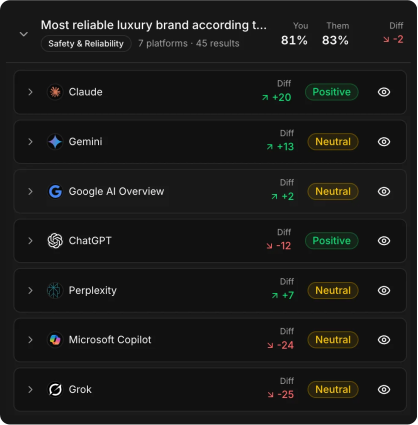
Platforms such as Ansvisor help organizations understand how LLM-powered search systems retrieve, cite, recommend, and represent brands by analyzing prompts, citations, competitors, and visibility patterns across multiple answer engines.
Common misconceptions
Common misconceptions about LLMs include:
- LLMs are databases.
- LLMs always provide factual answers.
- LLMs have real-time knowledge.
- Larger models never hallucinate.
- LLMs understand information exactly like humans.
Large language models provide the reasoning and language capabilities behind modern AI systems, but their performance depends heavily on retrieval quality, grounding, trusted sources, and continuous optimization.








.svg)
