


Gauge
What is Gauge?
Gauge is an AI visibility and Generative Engine Optimization (GEO) platform designed to help organizations understand, measure, and improve how their brands appear across AI-powered search and answer engines.
The platform combines prompt tracking, brand visibility analytics, citation analysis, competitor intelligence, AI traffic measurement, crawler monitoring, content creation, action recommendations, and integrations with search, analytics, advertising, and publishing systems.
Gauge is designed around a broader workflow than monitoring alone. Its product structure focuses on tracking AI search performance, understanding why visibility gaps exist, and then helping teams execute actions intended to improve brand presence.
What does Gauge do?
Gauge runs relevant prompts across major AI search platforms and analyzes the resulting responses for brand mentions, competitor presence, citations, source usage, and other visibility signals.
Teams can use this data to understand where their brand appears, where competitors perform better, which sources influence AI answers, and which content or distribution gaps may be limiting visibility.
Gauge also connects AI visibility data with organic search, website analytics, product usage, advertising, and content publishing workflows so teams can move from analysis toward execution.
What are the key features of Gauge?
Gauge combines AI search monitoring, analysis, optimization, and execution within one platform.
- Prompt Tracking: Monitors how AI systems respond to selected prompts over time.
- Brand Coverage: Measures how frequently a brand appears across AI-generated answers.
- Competitor Analysis: Compares brand visibility with competitors across monitored prompts and platforms.
- Citation Analysis: Identifies the domains and pages AI systems rely on when generating answers.
- Citation Rate: Measures how frequently a brand's website is used as a source within AI-generated responses.
- Mention Rate: Measures how frequently a brand name appears in answers when its website is being cited.
- Gap Analysis: Identifies prompts and topics where competitors receive visibility while the tracked brand does not.
- Action Center: Provides recommended actions based on AI visibility, competitive, citation, and content data.
- Ask Gauge: Provides an AI assistant that can analyze AI search, organic search, traffic, and other connected marketing data.
- Content Engine: Creates content based on AI visibility gaps, search data, and competitive intelligence.
- AI Traffic Analytics: Connects AI visibility with referral traffic and website-performance data.
- AI Crawler Monitoring: Tracks AI crawler activity through infrastructure integrations such as Cloudflare and Vercel.
- ChatGPT Ad Tracking: Extends monitoring into paid visibility and advertising activity within AI search.
- API and Data Export: Makes Gauge data available to external systems, dashboards, and BI workflows.
- Slack and MCP Access: Allows teams to interact with Gauge data through conversational and agent-compatible workflows.
Which AI platforms does Gauge track?
Gauge monitors brand visibility across major consumer-facing AI search and answer experiences.
Its current platform materials reference support for:
- ChatGPT.
- Claude.
- Gemini.
- Perplexity.
- Microsoft Copilot.
- Google AI Mode.
- Google AI Overviews.
- Grok.
Gauge emphasizes collecting data from real user-facing AI search experiences rather than relying exclusively on generic model APIs.
This distinction matters because the consumer interface of an AI platform can use different retrieval systems, browsing behavior, source selection, or product logic from the underlying API.
How does prompt tracking work in Gauge?
Prompts represent questions and searches that potential customers may submit to AI systems while researching products, services, categories, or business problems.
Gauge runs tracked prompts across selected AI platforms on a recurring basis and analyzes the resulting answers.
Prompt-level analysis can include:
- Brand mentions.
- Competitor mentions.
- Website citations.
- Source usage.
- Visibility gaps.
- Model-level differences.
- Performance trends over time.
Gauge states that prompts on its primary monitoring plans are run daily, allowing teams to observe changes in AI search visibility over time.
How does Gauge measure AI visibility?
Gauge uses several signals to describe how brands perform across monitored AI-generated answers.
Core measurements include:
- Brand Coverage.
- Brand mentions.
- Citation Rate.
- Mention Rate.
- Competitor visibility.
- Prompt-level coverage.
- Model-level performance.
- Share of Voice-style competitive comparisons.
Gauge distinguishes between citations and mentions because an AI system can use a website as an information source without explicitly naming the brand in the final answer.
This distinction can help teams identify situations where their content influences AI-generated answers but does not receive corresponding brand recognition.
How does citation analysis work in Gauge?
Gauge analyzes the sources used by AI search systems when answering monitored prompts.
Teams can investigate:
- Which owned pages receive AI citations.
- Which competitor pages are used as sources.
- Which third-party domains influence important answers.
- Which sources repeatedly appear across high-value prompts.
- Where competitors have stronger citation coverage.
- Where the brand is cited but not explicitly mentioned.
These insights can support content strategy, digital PR, partnerships, authority building, and competitor research.
What is the difference between Citation Rate and Mention Rate in Gauge?
Gauge treats citation and brand mention behavior as separate signals.
Citation Rate measures how frequently the tracked website is used as a source across monitored AI-generated responses.
Mention Rate measures how frequently the brand itself appears within the generated answer.
The distinction is useful because AI systems may retrieve and use information from a website without naming the organization responsible for that information.
A brand with strong citation performance but weak mention performance may therefore be influencing AI answers without receiving corresponding brand visibility.
How does Gauge analyze competitors?
Gauge benchmarks competing brands across the same monitored AI prompts and platforms.
Teams can compare:
- Brand Coverage.
- Mentions.
- Citations.
- Prompt performance.
- Source presence.
- Platform-level visibility.
Competitive Gap Analysis can reveal prompts where a competitor appears but the tracked brand is absent.
These gaps can then be investigated to determine whether the competitor has stronger content, more relevant third-party coverage, stronger citations, or better alignment with the user's underlying intent.
What is Ask Gauge?
Ask Gauge is the platform's AI-assisted analysis interface.
It is designed to let marketers ask natural-language questions about their AI search data and connected marketing datasets rather than manually moving between dashboards.
Gauge can combine data from sources such as AI visibility monitoring, Google Search Console, Google Analytics 4, product analytics, and advertising systems.
Teams can use Ask Gauge to investigate questions such as:
- Why is a competitor gaining AI visibility?
- Which prompts represent the largest gaps?
- Which sources are shaping important answers?
- Which content opportunities should be prioritized?
- How does AI visibility relate to organic search or traffic performance?
What is the Gauge Content Engine?
Gauge includes a content engine designed to turn AI search and search-performance data into content workflows.
The system can use AI visibility gaps, competitor information, search data, and other connected signals to generate content intended to improve both AI search and traditional search performance.
Gauge can also send approved content to connected publishing systems.
Current publishing integrations include environments such as:
- Webflow.
- Framer.
- Sanity.
- GitHub.
This creates a workflow that connects visibility measurement with content execution rather than stopping at analytics.
How does Gauge connect AI visibility with search and analytics data?
Gauge integrates AI search intelligence with broader marketing and performance datasets.
Current integrations include:
- Google Analytics 4.
- Google Search Console.
- Google Ads.
- DataForSEO.
- PostHog.
These connections allow teams to analyze AI visibility alongside organic search, traffic, product usage, and campaign-performance data.
Combining these signals can help organizations prioritize opportunities based on potential business impact rather than evaluating AI visibility as an isolated metric.
How does Gauge measure AI referral traffic?
Gauge integrates with Google Analytics 4 to analyze website traffic originating from AI platforms.
This allows teams to connect monitored AI visibility with visits to owned digital properties.
Potential analysis can include:
- AI referral traffic.
- Landing pages.
- Traffic trends.
- Relationship between citations and visits.
- Relationship between visibility changes and traffic changes.
This provides additional context for determining whether AI-generated discovery contributes to measurable website activity.
How does Gauge monitor AI crawlers?
Gauge supports AI crawler monitoring through website infrastructure integrations.
Current integrations include platforms such as:
- Cloudflare.
- Vercel.
Crawler monitoring helps teams understand when AI systems access their websites and which content attracts crawler activity.
This technical layer can provide context around whether important pages are being discovered before those pages appear as citations within AI-generated answers.
How does Gauge turn AI visibility data into actions?
Gauge is designed around a workflow that connects measurement with execution.
The platform can identify potential actions based on AI search visibility, citation patterns, competitors, search performance, and content gaps.
Potential actions can include:
- Creating content for uncovered prompts.
- Improving existing pages.
- Addressing competitor visibility gaps.
- Targeting influential third-party sources.
- Improving citation performance.
- Strengthening brand mention rates.
- Prioritizing topics with stronger search demand.
Gauge's Content Engine can then help generate and publish approved content intended to address selected opportunities.
What integrations does Gauge support?
Gauge connects with multiple analytics, search, publishing, infrastructure, advertising, and agent environments.
Current integration examples include:
- Google Analytics 4.
- Google Search Console.
- Google Ads.
- DataForSEO.
- PostHog.
- Webflow.
- Framer.
- Sanity.
- GitHub.
- Cloudflare.
- Vercel.
- OpenAI Ads.
- Meta Ads.
- Slack.
- MCP-compatible clients.
Gauge can also export data into external data and business-intelligence workflows.
What is Agent Led Growth in Gauge?
Gauge has expanded beyond conventional AI search monitoring into what it calls Agent Led Growth.
This capability focuses on situations where coding agents such as Claude Code, Codex, and Cursor decide which software tools, APIs, or packages to recommend and install during development workflows.
Gauge can run agents inside real software environments and analyze their decision-making process, including searches, tool calls, documentation usage, and final product selection.
For developer-focused companies, this provides another form of AI visibility: understanding whether autonomous agents recognize, recommend, and successfully integrate their products.
Who is Gauge for?
Gauge is designed for organizations that want to monitor and improve their presence across AI-generated discovery experiences.
Potential users include:
- SEO and AI Search teams.
- AEO and GEO teams.
- Content marketing teams.
- Growth teams.
- Developer marketing teams.
- Brand teams.
- Agencies.
- B2B and SaaS companies.
- Developer-tool companies.
- Enterprise marketing organizations.
Its integration and content-execution capabilities can be particularly useful for teams that want to connect AI visibility monitoring with search, traffic, product, and publishing workflows.
How does Gauge fit into AI SEO, AEO, and GEO?
Gauge operates within the broader AI search optimization ecosystem associated with AI SEO, Answer Engine Optimization (AEO), and Generative Engine Optimization (GEO).
These disciplines expand search optimization beyond traditional rankings by examining how brands are mentioned, cited, retrieved, compared, and recommended within AI-generated answers.
Gauge supports this process through prompt monitoring, competitor analysis, citations, traffic analytics, crawler monitoring, search integrations, action recommendations, and content execution.
Its approach is designed to connect AI search measurement with the work required to improve future performance.
How is Gauge different from traditional SEO tools?
Traditional SEO platforms primarily analyze keywords, rankings, backlinks, organic traffic, and technical search performance.
Gauge focuses on the additional discovery layer created by AI-generated answers.
Teams can investigate questions such as:
- Does AI mention our brand?
- Is our website being used as a source?
- Which competitors receive greater AI visibility?
- Which prompts create the largest gaps?
- Which sources influence AI-generated answers?
- Does our content influence AI answers without generating brand mentions?
- Does AI visibility generate measurable website traffic?
- Which content should we create or update next?
Gauge therefore complements traditional SEO analytics with an AI search measurement and execution layer.
What should teams consider when evaluating Gauge?
Organizations evaluating Gauge should consider their required AI platform coverage, number of prompts, content-production needs, competitor monitoring requirements, analytics integrations, crawler monitoring, publishing workflows, and budget.
Teams should also consider Gauge's methodology for collecting AI search data. The platform emphasizes real user-facing AI experiences rather than relying exclusively on standard model APIs.
This can make Gauge particularly relevant to organizations that want monitoring designed to resemble the actual AI search interfaces encountered by end users.
Organizations should also evaluate whether they need a monitoring-only product or a broader workflow that combines analysis, recommendations, content creation, publishing, and performance measurement.
Gauge and the AI Search tools ecosystem
Gauge is one of several platforms developed specifically for measuring and improving visibility across AI-generated search experiences.
Its approach combines prompt and citation monitoring with AI-assisted analysis, search and analytics integrations, crawler monitoring, content generation, publishing workflows, and an emerging Agent Led Growth product for developer-focused companies.
The broader ecosystem includes dedicated AI visibility platforms, citation intelligence tools, prompt analytics products, AI traffic systems, content optimization platforms, and established SEO products expanding into AI search.
Ansvisor maintains a broader directory of AI SEO, AEO, GEO, AI visibility, and AI search tools to help teams understand this evolving ecosystem and evaluate platforms based on their specific requirements.
Official source
FAQ
What is Gauge?

Gauge is an AI search visibility and GEO platform that helps organizations track prompts, brand coverage, citations, competitors, AI traffic, crawler activity, and optimization opportunities across major AI search experiences.
Which AI platforms does Gauge track?
Gauge currently references monitoring across ChatGPT, Claude, Gemini, Perplexity, Microsoft Copilot, Google AI Mode, Google AI Overviews, and Grok.
What is the difference between Citation Rate and Mention Rate in Gauge?
Citation Rate measures how often Gauge detects a website being used as an AI source, while Mention Rate measures how often the associated brand appears within the generated answer. This helps identify cases where content influences an answer without receiving explicit brand recognition.
Does Gauge connect AI visibility with traffic and search data?
Yes. Gauge integrates with systems including GA4, Google Search Console, Google Ads, DataForSEO, and PostHog so teams can analyze AI visibility alongside search, traffic, advertising, and product data.
Does Gauge create and publish content?
Yes. Gauge's content engine can generate content based on AI visibility and search data, while publishing integrations currently include Webflow, Framer, Sanity, and GitHub.
Everything You Need to Improve Your AI Visibility
Track how your brand appears across AI platforms, understand what drives visibility, and turn insights into measurable actions.
Platform Features
Explore all features →Answer Engine Insights
Understand how AI platforms talk about your brand.
Prompt Intelligence
Discover and monitor the prompts shaping your AI visibility.
Citations Monitoring
Track which sources AI platforms cite and where your brand appears.
AI Traffic Analytics
Measure visits coming from ChatGPT, Gemini, Claude, and more.
Competitor Benchmarking
Compare AI visibility and uncover competitive gaps and opportunities.
Action Center
Turn AI Search signals into prioritized actions and executable tasks.
AI Visibility Trackers
Explore AI Visibility Platform →ChatGPT Visibility Tracker
Track brand mentions, citations, prompts, and visibility across ChatGPT.
Google AI Overviews Rank Tracker
Monitor where and how your brand appears in Google AI Overviews.
Google AI Mode Visibility Tracker
Track your brand's visibility across Google AI Mode experiences.
Gemini Visibility Tracker
Understand how your brand appears across Google Gemini responses.
Microsoft Copilot Visibility Tracker
Monitor your brand's presence across Microsoft Copilot answers.
Perplexity Visibility Tracker
Track brand mentions, citations, and visibility across Perplexity.
From AI Visibility insights to action.
Explore the complete Ansvisor platform for AI Search intelligence, optimization, and growth.
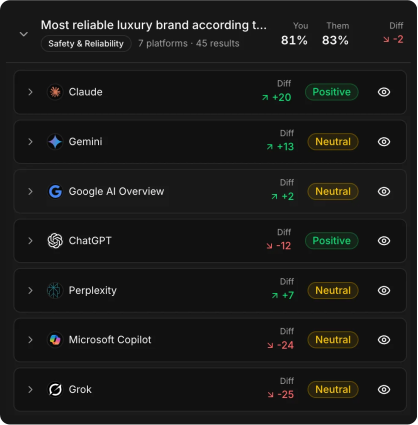
Win customers from all major AI platforms
Understand, measure, and optimize your AI visibility via Ansvisor.
✓ Add brand, domains and competitors
✓ Discover prompts and growth opportunities
✓ Track your AI visibility across major AI platforms
✓ Monitor citations, mentions, and competitors
✓ Measure AI traffic and customer discovery
✓ Receive AI recommendations based on AI insights
✓ Optimize authority, trust, and content quality
✓ Create content, automate analysis & action with AI agents
AI Visibility Terms
Continue exploring key AI visibility concepts.
AI Visibility
Measure and improve how often your brand appears in AI-generated answers.
Learn more →Answer Engine Optimization (AEO)
Strategies for increasing visibility in answer engines and AI summaries.
Learn more →Generative Engine Optimization (GEO)
Optimizing content for AI-powered discovery experiences.
Learn more →ChatGPT Search
Understand how OpenAI retrieves and synthesizes information.
Learn more →Google AI Overviews
AI-generated summaries that appear directly in Google Search.
Learn more →Perplexity Search
Explore how Perplexity cites and presents sources.
Learn more →AI Citations
References and sources used by AI systems to support answers.
Learn more →Citation Authority
Measure the quality and influence of cited sources.
Learn more →Retrievability
How easily AI systems can discover and reuse your content.
Learn more →New terms are added regularly.
Help us improve the page or suggest a new term →
Cihan Geyik
Co-founder at Ansvisor
Cihan Geyik is the co-founder of Ansvisor, an open-source AI Visibility platform for AI Search. With more than 15 years of experience in digital marketing and growth, he writes about AI visibility, AI search, AEO, GEO, citations, and answer engines. He focuses on helping brands understand and improve their presence across ChatGPT, Gemini, Perplexity, Google AI Overviews, and other AI-powered discovery platforms.
Get more Ansvisor insights in Google
Add Ansvisor as a Preferred Source to see more of our AI Search, AEO, GEO, and AI Visibility insights across Google.
Make Your Brand Visible in AI Answers.

INDUSTRIES


© 2026 Ansvisor. All rights reserved. Ansvisor is an open-source AI Search Intelligence Platform for AI Visibility. Ansvisor is a brand owned and operated by Empler AI Inc.


.svg)