Why Retrieval Layers matter
A Retrieval Layer is the component of an AI system responsible for finding, ranking, filtering, and delivering relevant information before answer generation occurs. It acts as the bridge between user queries and the information sources that large language models use to generate responses.
Modern AI search engines and answer systems increasingly rely on retrieval layers because language models alone cannot provide accurate, current, or domain-specific information consistently.
Benefits of retrieval layers include:
- Improve answer accuracy.
- Reduce hallucinations.
- Enable real-time information access.
- Support domain knowledge.
- Increase answer transparency.
Retrieval layers have become one of the foundational architectural components of AI search and retrieval systems.
How a Retrieval Layer works
A retrieval layer typically performs several operations before answer generation.
- Interpret the user query.
- Expand search intent.
- Retrieve candidate sources.
- Rank retrieved information.
- Filter irrelevant results.
- Deliver context to the model.
The retrieved information is then passed to the language model, which synthesizes the final answer using both retrieved content and model reasoning capabilities.
The effectiveness of the retrieval layer often determines the overall quality of the AI system.
What technologies power Retrieval Layers?
Modern retrieval layers combine several AI technologies.
Advanced retrieval layers often incorporate reranking systems, embeddings, vector search, grounding mechanisms, and multi-step retrieval pipelines.
How Retrieval Layers affect AI visibility
Retrieval layers directly determine which brands, entities, and sources are surfaced by AI systems.
Organizations with authoritative, well-structured, and retrievable information are more likely to be selected by retrieval systems and incorporated into AI-generated answers.
Strategies such as AI Content Optimization, Answer Engine Optimization (AEO), and LLM Optimization often focus on improving performance within retrieval layers.
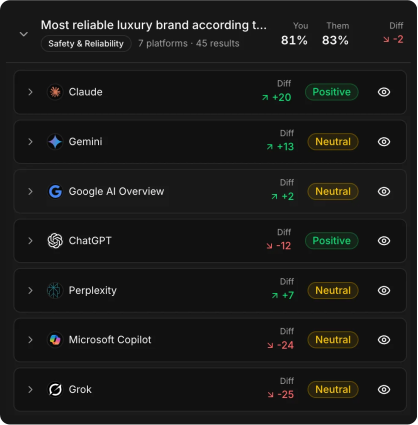
Platforms such as Ansvisor help organizations analyze how retrieval layers discover, rank, retrieve, cite, and synthesize information by monitoring prompts, citations, competitors, retrieval patterns, and AI visibility performance across multiple answer engines.
Common misconceptions
Common misconceptions about retrieval layers include:
- Language models retrieve information by themselves.
- Retrieval layers only perform keyword searches.
- More retrieved documents always improve answers.
- All AI platforms use identical retrieval architectures.
- Retrieval quality matters less than model size.
As AI search systems evolve, retrieval layers increasingly determine what information users see, which sources are cited, and which brands become visible within AI-generated experiences.








.svg)
