


Answer Engines
Why Answer Engines matter
Answer Engines are systems designed to provide direct answers, explanations, summaries, comparisons, and recommendations in response to user questions. Modern answer engines often combine large language models, information retrieval systems, search indexes, knowledge sources, and external web content to generate conversational responses.
Unlike traditional search experiences that primarily return a list of links, answer engines can synthesize information from multiple sources and present the result directly inside the interface.
This changes the discovery journey:
Traditional Search → Query → Search Results → Website → Information
Answer Engine → Prompt → Retrieval → Generated Answer → Mention, Citation, or Recommendation
As users increasingly interact with AI-generated search and discovery experiences, answer engines are changing how people research topics, discover brands, compare products, evaluate services, and make decisions.
Understanding answer engines can help organizations:
- Understand changing search and discovery behavior.
- Identify new channels where customers discover brands.
- Improve AI Visibility strategies.
- Measure brand presence inside AI-generated answers.
- Understand which sources influence AI responses.
- Track citations and recommendations.
- Compare visibility with competitors.
- Adapt content strategies to conversational search.
- Identify questions and prompts that influence customer decisions.
The emergence of answer engines has contributed to disciplines such as Answer Engine Optimization (AEO), Generative Engine Optimization (GEO), and AI Search Optimization. These approaches focus on improving how brands, products, websites, and information are discovered and represented across AI-powered search experiences.
What is an Answer Engine?
An Answer Engine is a search or information system that attempts to answer a user's question directly rather than requiring the user to navigate through a traditional list of search results.
Depending on the platform and query, an answer engine may:
- Generate a direct factual answer.
- Summarize information from multiple sources.
- Recommend products, companies, or services.
- Compare alternatives.
- Explain a complex topic.
- Provide step-by-step instructions.
- Display citations or source links.
- Continue the interaction through follow-up questions.
Modern AI-powered answer engines extend this model by using large language models to interpret natural-language questions and generate conversational responses.
This means users can search using complete questions and complex requests rather than relying only on short keyword queries.
What is the difference between an Answer Engine and a Search Engine?
Traditional search engines and answer engines both help users discover information, but the user experience and information-delivery process can be different.
A traditional search engine commonly provides ranked search results that direct users to websites where they can find the information they need.
An answer engine can retrieve information and synthesize it directly into an answer.
A simplified comparison looks like this:
- Search Engine: Query → Ranked Results → Website Visit.
- Answer Engine: Prompt → Retrieval → Generated Answer → Sources, Mentions, or Recommendations.
The distinction is not always absolute. Modern search engines increasingly include AI-generated answers, while many AI assistants can search the web and provide source links.
As a result, search engines and answer engines are increasingly overlapping rather than existing as completely separate categories.
Which platforms are Answer Engines?
Several major AI and search platforms provide answer-engine experiences. Depending on the product and feature being used, these can include:
- ChatGPT Search.
- Perplexity Search.
- Google AI Overviews.
- Google AI Mode.
- Gemini.
- Claude.
- Microsoft Copilot.
- Grok.
These platforms do not necessarily use the same retrieval methods, search indexes, models, source-selection processes, citation mechanisms, or answer-generation systems.
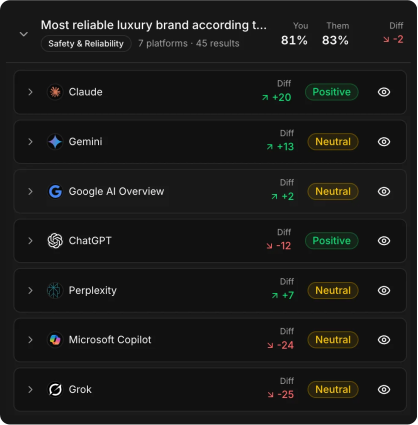
Consequently, the same question can produce different brands, recommendations, sources, citations, and explanations across different answer engines.
Same Prompt → Different Answer Engines → Different Answers, Sources, and Brands
How Answer Engines work
The exact architecture differs between platforms, but modern answer engines can combine several technologies and information sources to generate responses.
These can include:
- Large language models.
- Information retrieval systems.
- Search indexes.
- Web search systems.
- Knowledge bases.
- Structured data.
- External websites and documents.
- Ranking and source-selection systems.
- Citation mechanisms.
- Conversational interfaces.
A simplified answer-generation process can look like:
User Prompt → Query Understanding → Retrieval → Source Selection → Synthesis → Generated Answer
The process can be more complex than this. A platform may rewrite or expand the original question, perform multiple searches, retrieve different documents, rank candidate sources, and combine information before generating the final response.
Technologies and concepts such as Retrieval-Augmented Generation (RAG), Query Fan-Out, and semantic retrieval help explain how some answer engines find and use external information.
What is retrieval in an Answer Engine?
Retrieval is the process of finding information that may be relevant to a user's question before or during answer generation.
Depending on the system, retrieved information can come from:
- Search engine indexes.
- Web pages.
- Knowledge bases.
- Structured databases.
- Documents.
- Product information.
- Other connected information sources.
Retrieval is important because an answer engine does not necessarily rely only on information encoded within the underlying language model.
When external retrieval is used, the system can incorporate newer or more query-specific information into the generated response.
For brands and publishers, this makes Retrievability an important concept: information must be discoverable and accessible before it can potentially influence a retrieval-based answer.
What is Query Fan-Out in Answer Engines?
A complex user question may contain several underlying information needs. Some AI-powered search systems can decompose, rewrite, or expand that question into related searches or subqueries.
This process is commonly discussed as Query Fan-Out.
A simplified example is:
Original Prompt → Related Queries → Retrieved Sources → Synthesized Answer
This matters because a brand may not only need to be relevant to the exact words used in the original prompt. Its content may also need to address related concepts, questions, comparisons, entities, and subtopics explored during retrieval.
How do Answer Engines select sources?
There is no single universal source-selection process shared by every answer engine. Different platforms can use different search systems, indexes, ranking mechanisms, retrieval pipelines, and models.
Potential considerations can include:
- Relevance to the question.
- Topical context.
- Information quality.
- Source authority.
- Freshness.
- Accessibility.
- Structured information.
- Entity relationships.
- The specific retrieval system being used.
Source selection can also vary between prompts and between repeated generations. A domain cited for one question may not be cited for a closely related question.
This is why monitoring a representative set of prompts over time is generally more informative than relying on a single manual test.
What are citations in Answer Engines?
Some answer engines provide citations, references, or source links alongside AI-generated answers.
An AI Citation connects part of the answer experience with an external source such as a website, article, product page, research document, or other resource.
Citations are particularly important for organizations because they provide a measurable source-level signal.
There is an important distinction between a brand mention and a citation:
Mention → The brand appears in the answer.
Citation → A source or URL is referenced by the answer engine.
A brand can therefore be mentioned without its website being cited. Likewise, a website can be cited as a source without the brand becoming a prominent part of the answer.
Why do Answer Engines mention brands?
Answer engines can mention brands when those brands are relevant to the topic, category, comparison, recommendation, or question being answered.
Brand visibility can be influenced by information found across both owned and third-party sources.
Relevant sources may include:
- Company websites.
- Product pages.
- Industry publications.
- Review platforms.
- Comparison articles.
- News coverage.
- Research and reports.
- Directories.
- Community discussions.
- Other authoritative third-party websites.
This means visibility within answer engines is not solely an owned-content problem. The broader information environment around a brand can also matter.
How do Answer Engines change brand discovery?
Traditional organic discovery often depends on a user seeing a search result, clicking it, and visiting the website.
Answer engines can introduce brands before a website visit occurs.
For example, a user might ask:
- What are the best tools for a particular problem?
- Which companies provide a particular service?
- What are the alternatives to a specific product?
- Which product is better for a particular use case?
- What should I consider before making a purchase?
The answer engine may mention or recommend several brands directly in its response. The user can therefore discover, compare, or evaluate a company without initially visiting that company's website.
This creates a discovery journey such as:
Customer Question → AI Answer → Brand Discovery → Evaluation → Website Visit or Later Action
What is Answer Engine Optimization?
Answer Engine Optimization (AEO) is the practice of improving how brands, websites, products, services, and information are discovered and represented across answer-engine experiences.
AEO can involve improving:
- AI Visibility.
- Prompt coverage.
- Brand mentions.
- Citation visibility.
- Source authority.
- Content quality and structure.
- Entity understanding.
- Competitive visibility.
- Third-party authority.
The goal is not to manipulate an answer engine into producing a guaranteed response. Instead, AEO focuses on strengthening the signals, information, authority, and content that can contribute to visibility within answer-oriented discovery.
How is AEO different from traditional SEO?
SEO and AEO overlap, but they focus on different parts of the search and discovery experience.
Traditional SEO commonly measures:
- Keywords.
- Ranking positions.
- Search impressions.
- Organic CTR.
- Organic clicks.
- Organic traffic.
AEO can additionally measure:
- Prompts.
- AI Visibility.
- Brand mentions.
- AI citations.
- Prompt Coverage.
- Share of Voice.
- Competitor visibility.
- AI Referral Traffic.
A simplified distinction is:
SEO → How does a page perform in search results?
AEO → How does a brand or source perform inside generated answers?
The two practices can support each other. Strong content, technical accessibility, authority, internal linking, and clear information architecture can be useful for both traditional search and AI-powered discovery.
How to measure performance in Answer Engines
Answer-engine performance should generally be measured across multiple signals rather than through a single metric.
Organizations commonly monitor:
- AI Mentions.
- AI Citations.
- AI Share of Voice.
- AI Visibility.
- Prompt Coverage.
- Citation Rate.
- Recommendation frequency.
- Competitor visibility.
- Platform coverage.
- Historical visibility changes.
- AI Referral Traffic where identifiable.
Metrics and capabilities from AI Search Analytics, AI Benchmarking, and AI Visibility Monitoring can help organizations understand how their performance changes across answer engines.
Why are prompts important for measuring Answer Engines?
Prompts are a fundamental measurement unit because users interact with answer engines through questions, instructions, comparisons, and conversational requests.
A representative prompt portfolio can include:
- Informational questions.
- Category discovery prompts.
- Product and service recommendations.
- Best-product questions.
- Alternative searches.
- Competitor comparisons.
- Use-case questions.
- Problem-solving questions.
- High-intent commercial prompts.
For each prompt, organizations can analyze which brands appear, which sources are cited, which competitors are visible, and how those results change over time.
This creates a measurement model such as:
Prompt → Answer → Brand Presence → Citation → Competitor Comparison → Historical Change
How do you measure AI Visibility across Answer Engines?
AI Visibility Monitoring tracks how consistently a brand appears across a defined portfolio of AI-generated answers.
Organizations can evaluate visibility by:
- Prompt.
- Topic.
- Platform.
- Product or service.
- Market.
- Competitor.
- Time period.
Multi-platform measurement is important because strong visibility in one answer engine does not necessarily mean strong visibility in another.
The same brand may have strong coverage in ChatGPT Search but weaker coverage in Google AI Overviews, Gemini, Perplexity, or another answer engine.
How do you compare competitors across Answer Engines?
Competitor benchmarking helps organizations understand whether visibility changes are specific to their brand or part of a broader category shift.
Teams can compare:
- AI Visibility.
- Brand mentions.
- Share of Voice.
- Prompt Coverage.
- Citations.
- Citation Rate.
- Recommendation presence.
- Platform coverage.
- Historical gains and losses.
Competitive analysis can reveal prompts where competitors consistently appear, sources supporting competing brands, and topics where a company has an opportunity to improve its presence.
Can Answer Engine visibility generate website traffic?
Yes. Some answer engines provide links or citations that can send visitors to external websites.
This traffic can be measured as AI Referral Traffic when the referral source can be identified through analytics.
However, AI Visibility and AI Referral Traffic are not the same thing.
AI Visibility ≠ Citation ≠ Website Visit ≠ Conversion
A user may discover or evaluate a brand inside an answer engine without clicking through to its website. A citation may also appear without generating a click.
For this reason, answer-engine performance should not be evaluated solely through website traffic.
How can brands improve visibility in Answer Engines?
There is no universal tactic that guarantees visibility across every answer engine. Different platforms use different models, retrieval systems, sources, and ranking processes.
Organizations can instead focus on improving the broader signals that make their information useful, discoverable, and authoritative.
Potential areas include:
- Publishing clear and useful information.
- Answering strategically relevant customer questions.
- Improving topical depth.
- Strengthening entity clarity.
- Making important content accessible to retrieval systems.
- Providing original evidence, research, and data.
- Maintaining accurate and current information.
- Strengthening internal links between related topics.
- Improving citation-worthy content.
- Building relevant third-party authority and brand mentions.
- Monitoring competitors and citation gaps.
These activities can form part of a broader Answer Engine Optimization (AEO) strategy.
What are the limitations of Answer Engine measurement?
Answer engines are dynamic systems, so measurement should be interpreted with appropriate context.
Potential limitations include:
- Generated answers can vary between repeated runs.
- Models and retrieval systems can change.
- Source selection can change over time.
- Results can differ by platform.
- Results may vary by location and language.
- A tracked prompt set does not represent every private user conversation.
- A brand mention does not necessarily represent a recommendation.
- A citation does not necessarily generate a website visit.
- Not every AI-influenced customer journey can be directly attributed.
Consistent methodology and historical measurement make answer-engine data more useful than isolated manual checks.
Common Answer Engine optimization mistakes
Common mistakes include:
- Treating answer engines exactly like traditional search engines.
- Focusing only on rankings.
- Measuring only website traffic.
- Ignoring citations and source visibility.
- Confusing brand mentions with citations.
- Tracking only one AI platform.
- Testing only a small number of arbitrary prompts.
- Ignoring competitor performance.
- Ignoring third-party sources.
- Creating content without understanding actual visibility gaps.
- Assuming one optimization tactic works across every answer engine.
A stronger approach combines prompt monitoring, visibility measurement, citation analysis, competitor intelligence, content optimization, authority development, and historical tracking.
Answer Engines and AI Search Intelligence
Answer engines create a new layer of search and discovery data. Organizations can now analyze not only whether a webpage ranks, but also whether a brand appears inside generated answers, which sources influence those answers, which competitors receive visibility, and which prompts create opportunities.
Platforms such as Ansvisor help organizations monitor answer engines, analyze prompts, mentions and citations, benchmark competitors, measure AI-referred traffic, and identify opportunities to improve AI Visibility.
This creates a broader intelligence cycle:
Prompts → AI Answers → Visibility → Mentions → Citations → Competitors → Opportunities → Actions
As answer engines continue to evolve, understanding this discovery layer can help organizations determine where their brands appear, why competitors may be more visible, which sources influence AI-generated answers, and what they can improve next.
FAQ
What are Answer Engines?

Answer Engines are AI-powered systems that generate answers and recommendations instead of returning lists of search results.
How are Answer Engines different from search engines?
Traditional search engines return links, while answer engines generate direct responses using AI and retrieval systems.
Which platforms are considered Answer Engines?
Examples include ChatGPT Search, Perplexity Search, Google AI Overviews, Google AI Mode, Gemini, Claude, Copilot, and Grok.
Why do Answer Engines matter?
They increasingly influence how users research, compare, and make purchasing decisions.
Which tools help analyze Answer Engines?
AI Visibility Platforms like Ansvisor help organizations monitor visibility, citations, competitors, prompts, and performance across answer engines.
Everything You Need to Improve Your AI Visibility
Track how your brand appears across AI platforms, understand what drives visibility, and turn insights into measurable actions.
Platform Features
Explore all features →Answer Engine Insights
Understand how AI platforms talk about your brand.
Prompt Intelligence
Discover and monitor the prompts shaping your AI visibility.
Citations Monitoring
Track which sources AI platforms cite and where your brand appears.
AI Traffic Analytics
Measure visits coming from ChatGPT, Gemini, Claude, and more.
Competitor Benchmarking
Compare AI visibility and uncover competitive gaps and opportunities.
Action Center
Turn AI Search signals into prioritized actions and executable tasks.
AI Visibility Trackers
Explore AI Visibility Platform →ChatGPT Visibility Tracker
Track brand mentions, citations, prompts, and visibility across ChatGPT.
Google AI Overviews Rank Tracker
Monitor where and how your brand appears in Google AI Overviews.
Google AI Mode Visibility Tracker
Track your brand's visibility across Google AI Mode experiences.
Gemini Visibility Tracker
Understand how your brand appears across Google Gemini responses.
Microsoft Copilot Visibility Tracker
Monitor your brand's presence across Microsoft Copilot answers.
Perplexity Visibility Tracker
Track brand mentions, citations, and visibility across Perplexity.
From AI Visibility insights to action.
Explore the complete Ansvisor platform for AI Search intelligence, optimization, and growth.
Win customers from all major AI platforms
Understand, measure, and optimize your AI visibility via Ansvisor.
✓ Add brand, domains and competitors
✓ Discover prompts and growth opportunities
✓ Track your AI visibility across major AI platforms
✓ Monitor citations, mentions, and competitors
✓ Measure AI traffic and customer discovery
✓ Receive AI recommendations based on AI insights
✓ Optimize authority, trust, and content quality
✓ Create content, automate analysis & action with AI agents
AI Visibility Terms
Continue exploring key AI visibility concepts.
AI Visibility
Measure and improve how often your brand appears in AI-generated answers.
Learn more →Answer Engine Optimization (AEO)
Strategies for increasing visibility in answer engines and AI summaries.
Learn more →Generative Engine Optimization (GEO)
Optimizing content for AI-powered discovery experiences.
Learn more →ChatGPT Search
Understand how OpenAI retrieves and synthesizes information.
Learn more →Google AI Overviews
AI-generated summaries that appear directly in Google Search.
Learn more →Perplexity Search
Explore how Perplexity cites and presents sources.
Learn more →AI Citations
References and sources used by AI systems to support answers.
Learn more →Citation Authority
Measure the quality and influence of cited sources.
Learn more →Retrievability
How easily AI systems can discover and reuse your content.
Learn more →New terms are added regularly.
Help us improve the page or suggest a new term →
Cihan Geyik
Co-founder at Ansvisor
Cihan Geyik is the co-founder of Ansvisor, an open-source AI Visibility platform for AI Search. With more than 15 years of experience in digital marketing and growth, he writes about AI visibility, AI search, AEO, GEO, citations, and answer engines. He focuses on helping brands understand and improve their presence across ChatGPT, Gemini, Perplexity, Google AI Overviews, and other AI-powered discovery platforms.
Make Your Brand Visible in AI Answers.

INDUSTRIES


© 2026 Ansvisor. All rights reserved. Ansvisor is an open-source AI Search Intelligence Platform for AI Visibility.


.svg)
