Why Context Window matters
A Context Window is the amount of information an AI model can process and consider during a single interaction. It defines how much text, data, instructions, and retrieved information a model can access while generating an answer.
In AI-powered search systems, context windows determine how much information can be retrieved, analyzed, and synthesized before producing a response. Larger context windows allow models to process more information, but they do not automatically guarantee better answers.
Benefits of larger context windows include:
- Analyze longer documents.
- Process more retrieved sources.
- Maintain conversational memory.
- Support complex reasoning.
- Improve multi-step tasks.
Context windows have become a critical component of modern Answer Engines and AI-powered search experiences.
How Context Windows work
AI models process information using tokens rather than words. A context window defines the maximum number of tokens available during inference.
- User prompts.
- System instructions.
- Conversation history.
- Retrieved documents.
- Tool outputs.
- Generated responses.
All of these inputs compete for limited context space. When the limit is exceeded, models may truncate, compress, or ignore portions of the available information.
How Context Windows affect AI search
Context size influences several aspects of AI-generated answers.
- Retrieval capacity.
- Answer completeness.
- Citation quality.
- Reasoning performance.
- Conversation continuity.
- Multi-document analysis.
Technologies such as Retrieval-Augmented Generation (RAG), Content Retrieval, and Query Fan-Out often rely on effective context management to maximize answer quality.
How organizations optimize for Context Windows
Organizations commonly improve context utilization by:
- Structuring information clearly.
- Reducing redundant content.
- Creating focused documents.
- Using semantic chunking.
- Prioritizing authoritative sources.
- Optimizing retrieval pipelines.
Strategies such as AI Content Optimization, Retrievability, and semantic content organization help improve how information fits within model context windows.
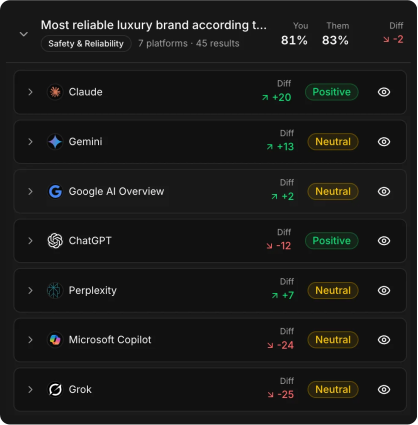
Platforms such as Ansvisor help organizations identify which content structures, citations, and authority signals are most likely to be retrieved and included within AI-generated answers.
Common pitfalls
Common mistakes include:
- Assuming larger context windows always produce better answers.
- Providing excessive irrelevant information.
- Ignoring retrieval quality.
- Creating overly long documents.
- Treating context windows as permanent memory.
Context windows define how much information AI systems can process at once, but answer quality ultimately depends on retrieval, relevance, structure, and the quality of the underlying information.








.svg)
