


Prompt Monitoring
Prompt Monitoring is the process of continuously tracking prompts and the AI-generated answers associated with them across AI-powered search and answer platforms. It helps organizations measure how their brands, products, competitors, sources, and content appear for strategically important questions over time.
Instead of tracking only traditional search queries and rankings, Prompt Monitoring observes conversational questions and the answers generated by platforms such as ChatGPT, Google AI Overviews, Google AI Mode, Gemini, Claude, Perplexity, and Microsoft Copilot.
Prompt Monitoring can connect each monitored prompt with signals such as AI Visibility, AI Mentions, AI Citations, competitor visibility, recommendations, sources, and AI Share of Voice.
Why Does Prompt Monitoring Matter?
AI-powered discovery is increasingly conversational. Users can ask detailed questions about products, categories, problems, alternatives, comparisons, and recommendations rather than entering only short search queries.
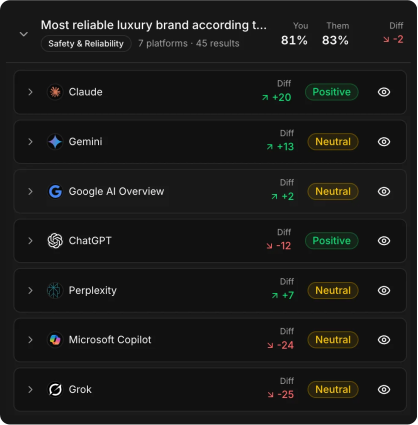
This creates a measurement challenge. A brand may perform well for one prompt but be absent from another closely related question. It may appear on ChatGPT but not on another platform, or receive a mention without receiving a citation.
Prompt Monitoring helps make these differences observable.
Organizations can use it to:
- Measure AI Search visibility across important prompts.
- Track when and where brands are mentioned.
- Monitor citations and cited sources.
- Compare visibility with competitors.
- Identify prompts where the brand is absent.
- Detect visibility gains and losses.
- Compare performance across AI platforms.
- Discover new topics, competitors, and opportunities.
- Measure changes after optimization work.
What Does Prompt Monitoring Track?
Prompt Monitoring can capture multiple signals from each monitored prompt and generated answer.
| Signal | What It Helps Measure |
|---|---|
| Prompt | The question, request, or conversational query being monitored. |
| Brand Visibility | Whether and how prominently the brand appears in the generated answer. |
| AI Mentions | Whether the brand, product, or entity is referenced. |
| AI Citations | Which domains, webpages, and URLs are referenced as sources. |
| Competitors | Which competing brands appear for the same prompts. |
| Recommendations | Which brands or products are recommended or included in relevant answers. |
| Sources | Which external domains and pages are surfaced by AI platforms. |
| Share of Voice | The brand's relative visibility compared with competitors. |
| Historical Changes | How answers and visibility signals change over time. |
Depending on the available data, monitoring can also be segmented by platform, topic, country, language, customer journey stage, intent, product category, and time period.
How Does Prompt Monitoring Work?
A Prompt Monitoring workflow begins with identifying questions that represent important customer needs, topics, use cases, and commercial intents.
Those prompts are then evaluated repeatedly across relevant AI platforms. Generated answers can be analyzed to extract brands, competitors, citations, sources, recommendations, and other visibility signals.
A typical workflow can include:
- Define important topics and customer intents.
- Create or discover representative prompts.
- Group prompts into meaningful topics or categories.
- Evaluate prompts across relevant AI platforms.
- Collect generated answers.
- Identify brands, products, competitors, and other entities.
- Extract citations and source domains.
- Measure visibility and competitive signals.
- Store results historically.
- Detect meaningful changes and opportunities.
Technologies such as Natural Language Processing (NLP), Entity Recognition, and Prompt Analytics can help transform AI-generated responses into structured data that can be analyzed over time.
What Is an AI Prompt?
An AI prompt is an instruction, question, or input provided to an AI system. In AI Search, prompts often represent the questions users ask while researching topics, discovering products, comparing alternatives, or making decisions.
Examples of prompt types include:
- Informational questions.
- Product or service recommendations.
- Brand comparisons.
- Alternative searches.
- Problem-based questions.
- Use-case questions.
- Category research.
- High-intent commercial questions.
Because users can express the same intent in many different ways, a useful monitoring strategy usually tracks a portfolio of representative prompts rather than relying on one question.
Prompt Monitoring vs Keyword Tracking
Prompt Monitoring and traditional keyword rank tracking both measure discovery, but they observe different environments.
| Keyword Tracking | Prompt Monitoring |
|---|---|
| Tracks search queries. | Tracks conversational questions and instructions. |
| Primarily measures search result positions. | Measures presence inside AI-generated answers. |
| Usually focuses on URLs and rankings. | Can track brands, products, citations, sources, competitors, and recommendations. |
| Measures traditional search visibility. | Measures AI-powered discovery and answer visibility. |
| Results are often represented as ranked listings. | Results can be conversational, synthesized, and variable. |
Prompt Monitoring does not replace keyword tracking. Organizations can use both to understand visibility across traditional search and AI-powered discovery.
Prompt Monitoring vs Prompt Tracking
Prompt Monitoring and Prompt Tracking are often used to describe closely related activities.
Prompt Tracking can refer to recording the performance or output of specific prompts, while Prompt Monitoring generally implies repeated observation over time to detect changes in answers, mentions, citations, competitors, and visibility.
Prompt Monitoring → Observe Prompt Results Continuously Over Time
In practice, the terms can overlap, particularly within AI Visibility and AI Search Intelligence platforms.
Prompt Monitoring vs AI Search Monitoring
Prompt Monitoring focuses specifically on a defined set of questions and the answers generated for them.
AI Search Monitoring is a broader concept that can include prompts as well as visibility changes, mentions, citations, competitors, sources, rankings, AI traffic, and other signals across the wider AI Search environment.
AI Search Monitoring → Broader AI Search Performance Observation
Prompt Monitoring vs Prompt Analytics
Prompt Monitoring provides the recurring collection and observation layer. Prompt Analytics focuses on analyzing the resulting data to understand patterns, performance, competitors, visibility gaps, and changes.
Prompt Analytics → Analyze & Understand
The two capabilities work together: monitoring creates historical prompt-level data, while analytics turns that data into insights.
What Is Prompt Coverage?
Prompt Coverage measures how broadly a brand appears across a defined portfolio of relevant prompts.
A brand may have strong visibility for a few questions but remain absent from many other prompts related to the same category.
Monitoring Prompt Coverage helps distinguish concentrated visibility from broader topic-level presence.
Coverage can be analyzed across:
- Topics.
- Products.
- Customer problems.
- Use cases.
- Commercial intents.
- Customer journey stages.
- AI platforms.
- Countries and languages.
What Are Prompt Volumes?
Prompt Volume data can help estimate the relative demand or importance associated with topics, questions, and prompt patterns.
Volume can provide useful prioritization context, but it should not be interpreted as a direct equivalent of traditional keyword search volume unless the underlying methodology supports that comparison.
Teams can combine volume signals with visibility, competitive gaps, business relevance, and intent to prioritize the prompts that deserve greater attention.
Ansvisor's Prompt Monitoring & Volumes connects prompt-level monitoring with demand signals to help teams understand both performance and opportunity.
How Does Prompt Monitoring Measure AI Visibility?
Prompt Monitoring provides the observation layer behind many AI Visibility metrics.
By repeatedly evaluating the same or comparable prompt portfolio, organizations can measure whether their visibility is expanding, declining, or shifting.
Prompt-level signals can include:
- Whether the brand appears.
- How prominently it appears.
- Whether it is recommended.
- Whether its website is cited.
- Which competitors appear alongside it.
- Which sources support the answer.
- How results differ across AI platforms.
These observations can contribute to broader measurements such as AI Visibility Score and AI Share of Voice.
How Does Prompt Monitoring Track AI Mentions?
AI Mentions show whether a brand, product, organization, or other entity appears within an AI-generated answer.
Monitoring mentions across a prompt portfolio can reveal:
- Which prompts generate brand mentions.
- Which topics have weak mention coverage.
- Whether mention frequency changes over time.
- Which platforms mention the brand most frequently.
- Which competitors receive mentions when the brand does not.
This helps transform individual AI mentions into a measurable historical signal.
How Does Prompt Monitoring Track AI Citations?
AI Citations identify the sources, domains, webpages, and URLs referenced by AI systems within or alongside generated answers.
At the prompt level, citation monitoring can reveal:
- Whether the brand's domain receives a citation.
- Which owned pages are cited.
- Which competitor pages receive citations.
- Which third-party sources repeatedly appear.
- Where citation gaps exist.
- How citation patterns change over time.
Combining prompt and citation data makes it possible to understand not only which sources appear, but the questions and intents associated with those citations.
How Does Prompt Monitoring Help Analyze Competitors?
Prompt Monitoring creates a shared environment for comparing brands against competitors for the same questions.
AI Competitor Analysis can use prompt-level data to identify:
- Competitors appearing when the brand is absent.
- Competitors receiving more recommendations.
- Competitors with stronger citation coverage.
- Topics where competitors have broader visibility.
- New competitors emerging in AI-generated answers.
- Changes in relative visibility over time.
This can reveal competitors that may not be obvious from traditional search rankings alone.
How Does Prompt Monitoring Support AI Share of Voice?
AI Share of Voice compares a brand's presence with competitors across a defined AI Search environment.
Prompt Monitoring supplies the underlying observations needed to calculate or analyze relative visibility across a representative prompt portfolio.
This provides competitive context that a raw mention count cannot provide on its own.
Why Should Prompts Be Grouped by Topic and Intent?
A large list of unstructured prompts can produce data without making the results easier to interpret.
Grouping prompts into topics, intents, products, use cases, or customer journey stages helps teams understand where visibility is strong and where meaningful gaps exist.
For example, prompts could be grouped into:
- Awareness and educational prompts.
- Problem and solution prompts.
- Category discovery prompts.
- Comparison prompts.
- Alternative prompts.
- Recommendation prompts.
- Purchase-oriented prompts.
This creates a more useful measurement model than treating every prompt as an isolated observation.
How Often Should Prompts Be Monitored?
There is no universal monitoring frequency that is appropriate for every prompt.
Monitoring frequency can depend on the importance of the topic, how quickly the market changes, platform volatility, available resources, and the purpose of the measurement.
High-priority commercial or competitive prompts may justify more frequent observation, while stable informational topics may require less frequent monitoring.
Consistency is particularly important when the goal is to compare performance over time.
Why Can Prompt Results Change Over Time?
AI-generated answers are not necessarily static. The same or similar prompt can produce different results at different times.
Changes can be associated with:
- Model updates.
- Retrieval changes.
- New or updated web content.
- Changes in cited sources.
- Platform updates.
- Prompt wording and context.
- Location or language.
- Changes in the competitive landscape.
Historical monitoring helps teams distinguish isolated observations from broader trends.
Why Do Prompt Results Differ Across AI Platforms?
Different AI platforms can produce different answers for similar prompts because they may use different models, retrieval systems, search indexes, sources, interfaces, and answer-generation processes.
A brand that appears prominently on one platform may have limited visibility on another.
Cross-platform Prompt Monitoring can therefore reveal platform-specific gaps that would remain hidden if measurement focused on only one answer engine.
How to Build a Prompt Monitoring Strategy
An effective Prompt Monitoring strategy begins with business relevance rather than simply generating the largest possible number of prompts.
- Define the topics and business areas that matter.
- Identify important customer questions and intents.
- Create representative prompts for each area.
- Include informational and commercial prompt types.
- Group prompts into meaningful topics or journeys.
- Select the AI platforms relevant to the audience.
- Establish a consistent monitoring cadence.
- Measure mentions, citations, competitors, and visibility.
- Analyze historical changes.
- Turn important gaps into actions.
Prompt Generator can help expand topic areas into relevant prompts, while Prompt Monitoring provides the recurring measurement layer for evaluating those prompts.
How Does Query Fan-Out Relate to Prompt Monitoring?
A user's original question may represent only one part of the information needed to produce a useful answer. AI-powered search systems can explore related questions, concepts, entities, and subtopics while resolving an information need.
Query Fan-Out analysis can help teams understand these related search paths and identify additional topics or questions that may deserve monitoring.
This can expand Prompt Monitoring beyond a static list of obvious questions and reveal a broader information landscape around a topic.
How Does Prompt Monitoring Connect to AI Search Analytics?
AI Search Analytics analyzes performance across AI-powered search and answer experiences.
Prompt Monitoring provides much of the recurring prompt-level data required for this analysis.
When prompt data is connected with visibility, citations, sources, competitors, AI Share of Voice, and historical performance, teams can move from individual answers to a more structured understanding of AI Search performance.
How Can Prompt Monitoring Identify Opportunities?
Prompt Monitoring becomes particularly valuable when gaps in the data can be translated into opportunities.
Examples include:
- A high-priority prompt where the brand is absent.
- A competitor receiving repeated recommendations.
- A competitor page receiving citations while the brand's content is not cited.
- A topic with weak Prompt Coverage.
- A platform where visibility is substantially lower.
- A newly emerging competitor.
- A previously strong prompt losing visibility.
- A source repeatedly influencing answers in an important category.
The next step is to investigate why the gap exists and determine whether it points to a content, authority, source, technical, competitive, or distribution opportunity.
What Are the Limitations of Prompt Monitoring?
Prompt Monitoring creates useful visibility data, but it should not be treated as a complete representation of every interaction happening across AI platforms.
- Private user prompts are generally not observable.
- A monitored prompt set represents only a sample of possible questions.
- Generated answers can vary between repeated observations.
- Different AI platforms behave differently.
- Prompt wording can affect the generated answer.
- Visibility does not necessarily result in a website visit.
- Prompt volume estimates may have methodological limitations.
- Platform and model updates can change results.
For these reasons, Prompt Monitoring is most useful when results are analyzed as patterns and trends across a representative prompt portfolio rather than as deterministic rankings.
Common Prompt Monitoring Mistakes
Common mistakes include:
- Treating Prompt Monitoring as traditional keyword rank tracking.
- Monitoring only one AI platform.
- Tracking too few prompts to represent a topic.
- Generating thousands of prompts without prioritization.
- Ignoring prompt intent and topic grouping.
- Focusing on prompt volume without considering business relevance.
- Measuring mentions while ignoring citations and competitors.
- Looking only at current results without historical context.
- Assuming one generated answer represents stable performance.
- Measuring visibility without turning findings into actions.
From Prompt Monitoring to Action
The goal of Prompt Monitoring is not simply to collect more AI-generated answers. Its value comes from identifying meaningful changes and determining what to do next.
For example, monitoring may show that a brand has lost visibility across several high-priority comparison prompts while a competitor has gained both mentions and citations. Teams can then investigate the competitor pages, cited sources, content gaps, authority signals, and other evidence associated with the change.
This connects Prompt Monitoring with Answer Engine Insights, AI Competitor Analysis, AI Search Analytics, and ongoing optimization.
Ansvisor's Prompt Monitoring & Volumes helps organizations monitor prompts across AI platforms, topics, competitors, countries, and languages while analyzing mentions, citations, recommendations, visibility, and demand signals.
Through the Ansvisor AI Search Intelligence Platform, prompt-level signals can be connected with broader AI Visibility data and translated into opportunities and actions that teams can prioritize and measure over time.
FAQ
What is Prompt Monitoring?

Prompt Monitoring is the continuous tracking of important prompts and their AI-generated answers across AI-powered search and answer platforms. It helps organizations measure brand visibility, mentions, citations, competitors, recommendations, sources, and how these signals change over time.
Why is Prompt Monitoring important?
Prompt Monitoring helps organizations understand how their brand is represented when users ask AI systems relevant questions. It can reveal visibility gaps, competitor gains, citation opportunities, recommendation trends, and changes in AI Search performance that may not be visible through traditional search analytics.
What does Prompt Monitoring track?
Prompt Monitoring can track brand visibility, AI Mentions, AI Citations, competitors, recommendations, cited sources, Prompt Coverage, Share of Voice, historical changes, and, where available, prompt volume or demand signals. Results can also be analyzed by platform, topic, country, language, and intent.
How is Prompt Monitoring different from keyword rank tracking?
Keyword rank tracking primarily measures where webpages rank for search queries. Prompt Monitoring measures what appears inside AI-generated answers, including brands, products, citations, sources, competitors, and recommendations. The two are complementary and measure different discovery environments.
Which tools help with Prompt Monitoring?
AI Search Intelligence platforms such as Ansvisor can monitor prompts across multiple AI platforms and connect them with mentions, citations, competitors, recommendations, Prompt Coverage, Share of Voice, historical visibility, and prompt volume signals.
Everything You Need to Improve Your AI Visibility
Track how your brand appears across AI platforms, understand what drives visibility, and turn insights into measurable actions.
Platform Features
Explore all features →Answer Engine Insights
Understand how AI platforms talk about your brand.
Prompt Intelligence
Discover and monitor the prompts shaping your AI visibility.
Citations Monitoring
Track which sources AI platforms cite and where your brand appears.
AI Traffic Analytics
Measure visits coming from ChatGPT, Gemini, Claude, and more.
Competitor Benchmarking
Compare AI visibility and uncover competitive gaps and opportunities.
Action Center
Turn AI Search signals into prioritized actions and executable tasks.
AI Visibility Trackers
Explore AI Visibility Platform →ChatGPT Visibility Tracker
Track brand mentions, citations, prompts, and visibility across ChatGPT.
Google AI Overviews Rank Tracker
Monitor where and how your brand appears in Google AI Overviews.
Google AI Mode Visibility Tracker
Track your brand's visibility across Google AI Mode experiences.
Gemini Visibility Tracker
Understand how your brand appears across Google Gemini responses.
Microsoft Copilot Visibility Tracker
Monitor your brand's presence across Microsoft Copilot answers.
Perplexity Visibility Tracker
Track brand mentions, citations, and visibility across Perplexity.
From AI Visibility insights to action.
Explore the complete Ansvisor platform for AI Search intelligence, optimization, and growth.
Win customers from all major AI platforms
Understand, measure, and optimize your AI visibility via Ansvisor.
✓ Add brand, domains and competitors
✓ Discover prompts and growth opportunities
✓ Track your AI visibility across major AI platforms
✓ Monitor citations, mentions, and competitors
✓ Measure AI traffic and customer discovery
✓ Receive AI recommendations based on AI insights
✓ Optimize authority, trust, and content quality
✓ Create content, automate analysis & action with AI agents
AI Visibility Terms
Continue exploring key AI visibility concepts.
AI Visibility
Measure and improve how often your brand appears in AI-generated answers.
Learn more →Answer Engine Optimization (AEO)
Strategies for increasing visibility in answer engines and AI summaries.
Learn more →Generative Engine Optimization (GEO)
Optimizing content for AI-powered discovery experiences.
Learn more →ChatGPT Search
Understand how OpenAI retrieves and synthesizes information.
Learn more →Google AI Overviews
AI-generated summaries that appear directly in Google Search.
Learn more →Perplexity Search
Explore how Perplexity cites and presents sources.
Learn more →AI Citations
References and sources used by AI systems to support answers.
Learn more →Citation Authority
Measure the quality and influence of cited sources.
Learn more →Retrievability
How easily AI systems can discover and reuse your content.
Learn more →New terms are added regularly.
Help us improve the page or suggest a new term →
Cihan Geyik
Co-founder at Ansvisor
Cihan Geyik is the co-founder of Ansvisor, an open-source AI Visibility platform for AI Search. With more than 15 years of experience in digital marketing and growth, he writes about AI visibility, AI search, AEO, GEO, citations, and answer engines. He focuses on helping brands understand and improve their presence across ChatGPT, Gemini, Perplexity, Google AI Overviews, and other AI-powered discovery platforms.
Make Your Brand Visible in AI Answers.

INDUSTRIES


© 2026 Ansvisor. All rights reserved. Ansvisor is an open-source AI Search Intelligence Platform for AI Visibility.


.svg)
