



AI Mentions
AI Mentions are instances where a brand, product, organization, person, or other entity appears within an AI-generated answer. They measure whether AI systems surface a brand when responding to relevant questions, recommendations, comparisons, and other prompts.
Unlike traditional search rankings, AI Mentions represent direct presence inside generated answers. A brand may be mentioned even when its website is not cited, making mentions an important component of AI Visibility.
Why Do AI Mentions Matter?
AI-powered search and answer platforms increasingly help users discover products, compare companies, research categories, evaluate alternatives, and make decisions. In these experiences, appearing directly in the generated answer can place a brand inside the user's consideration process.
Platforms such as ChatGPT Search, Perplexity Search, Google AI Overviews, Gemini, Claude, Google AI Mode, and Microsoft Copilot can surface brands without requiring users to navigate a traditional list of search results.
Monitoring AI Mentions can help organizations:
- Measure brand presence across AI-generated answers.
- Understand which prompts and topics trigger brand mentions.
- Identify non-branded discovery opportunities.
- Compare mention frequency with competitors.
- Measure visibility across different AI platforms.
- Detect gains or losses in brand presence over time.
- Understand where a brand enters AI-assisted customer journeys.
How Do AI Mentions Work?
AI systems generate answers based on their models, available context, retrieval processes, and—in some experiences—information retrieved from external sources. During this process, brands and entities can appear directly in the generated response.
A mention does not necessarily require a citation. An AI system may name a brand while citing another source, provide no visible citation, or reference the brand's own website separately.
AI Mentions can appear in many types of answers, including:
- Product and service recommendations.
- Best-tool or best-product lists.
- Brand and competitor comparisons.
- Alternative recommendations.
- Educational answers.
- Industry overviews.
- Buying guides.
- Problem-solving responses.
- Category explanations.
- Summaries and research-oriented answers.
What Counts as an AI Mention?
At its simplest, an AI Mention occurs when an identifiable brand, product, organization, or entity is named within an AI-generated response.
However, not every mention has the same meaning or potential value. The context in which the entity appears can be important.
Common types of AI Mentions include:
- Recommendation mentions: the brand is recommended as a potential solution.
- Comparison mentions: the brand appears alongside competitors.
- Informational mentions: the brand appears as part of an explanation or overview.
- Alternative mentions: the brand is presented as an alternative to another company or product.
- List mentions: the brand appears within a list of products, tools, companies, or resources.
- Example mentions: the brand is used as an example within a broader answer.
This is why mention frequency alone does not provide the complete picture. Mention context, prompt intent, competitors, prominence, citations, and historical performance can provide additional information about the value of a mention.
AI Mentions vs AI Citations
AI Mentions and AI Citations measure different forms of presence within AI-generated answers.
| AI Mentions | AI Citations |
|---|---|
| Measure whether a brand or entity appears. | Measure whether a source, domain, or URL is referenced. |
| Focus on entity presence. | Focus on source attribution. |
| Can occur without a citation. | Can occur without a prominent brand mention. |
| Can indicate brand recognition or inclusion. | Can indicate that content is being used or referenced as a source. |
| Useful for measuring brand-level visibility. | Useful for measuring source and content visibility. |
A brand can therefore receive many mentions while receiving relatively few citations to its own website. The opposite can also occur: a domain or page may be cited even when the brand itself is not prominently discussed.
Citation → A Source Is Referenced
Monitoring both provides a more complete picture of AI Search visibility.
AI Mentions vs Brand Mentions
Brand mentions are a broad concept covering references to a brand across websites, social media, news, communities, reviews, search results, and other digital channels.
AI Mentions focus specifically on references that appear inside AI-generated answers and AI-powered search experiences.
AI Mentions → References Inside AI-Generated Answers
AI Mentions can therefore be viewed as a specialized form of brand mention measurement for AI-powered discovery.
AI Mentions vs AI Visibility
AI Mentions are one component of AI Visibility, but the two concepts are not identical.
Mentions answer a relatively focused question: Does the brand appear in the generated answer?
AI Visibility is broader and can incorporate mentions alongside citations, recommendations, prompt coverage, Share of Voice, competitors, answer prominence, platform coverage, and historical performance.
AI Visibility → Overall Presence & Performance
How to Measure AI Mentions
AI Mention measurement typically begins with a representative portfolio of prompts related to the topics, products, problems, categories, and customer intents that matter to the organization.
Those prompts can then be monitored across relevant AI platforms to determine whether the brand appears and how that presence changes over time.
Common AI Mention metrics include:
- Mention frequency.
- Prompt coverage.
- Mention rate.
- Platform coverage.
- Competitor mention frequency.
- Recommendation frequency.
- Share of Voice.
- Topic-level mention coverage.
- Historical mention trends.
What Is AI Mention Frequency?
AI Mention Frequency measures how often a brand or entity appears across a defined set of monitored AI-generated answers.
For example, a team may monitor a portfolio of prompts repeatedly and count the number of answers in which its brand appears.
Frequency should be interpreted in context. A high number of mentions across irrelevant prompts may be less valuable than consistent mentions across a smaller set of strategically important commercial or category-level questions.
What Is AI Mention Rate?
AI Mention Rate expresses brand mentions relative to the number of monitored answers or observations.
A simplified representation is:
For example, if a brand appears in 30 out of 100 monitored answers under the same measurement framework, its observed mention rate would be 30%.
This does not create a universal benchmark. Mention rates depend on the prompt portfolio, competitors, platforms, observation frequency, industry, and methodology.
Why Does Prompt Coverage Matter for AI Mentions?
Mention measurement is only as useful as the prompts being monitored.
Tracking only branded prompts can create an incomplete picture because users may discover companies through non-branded questions such as:
- Which tools solve a particular problem?
- What are the best products in a category?
- Which companies provide a specific service?
- What are the alternatives to a competitor?
- Which solution is best for a particular use case?
A representative prompt portfolio helps measure whether a brand is being surfaced during category discovery and consideration—not only when users already know the brand name.
Prompt Monitoring can provide the recurring observation layer needed to analyze these patterns over time.
How Do AI Mentions Relate to Share of Voice?
Mention counts provide an absolute view of brand presence. Competitive measurement adds another layer.
AI Share of Voice compares a brand's observed presence with the presence of relevant competitors across a defined monitoring framework.
This distinction matters because a brand's mentions can increase while its competitive Share of Voice decreases if competitors are gaining mentions faster.
AI Share of Voice → How Brand Presence Compares With Competitors
How Do Competitor Mentions Help Measure Performance?
Competitor mentions provide context for understanding whether brand presence is strong or weak within relevant AI-generated answers.
Competitor analysis can reveal:
- Prompts where competitors appear but the brand does not.
- Competitors with higher mention frequency.
- Topics dominated by particular competitors.
- Competitors that are frequently recommended.
- Platform-specific differences in competitive presence.
- Changes in competitive visibility over time.
This can help teams move from simply counting mentions to understanding the competitive context surrounding them.
Does Every AI Mention Have the Same Value?
No. A brand mention should be interpreted together with the prompt and answer context.
For example, being listed as one of many companies in a broad informational answer is different from being directly recommended in response to a high-intent buying question.
Factors that can affect the significance of a mention include:
- Prompt intent.
- Mention prominence.
- Recommendation context.
- Competitors appearing in the same answer.
- Whether the brand receives a citation.
- The topic's relevance to the business.
- The AI platform where the mention appears.
- Whether the mention is consistently observed over time.
This is why AI Mention analysis should go beyond a simple total count.
Can AI Mentions Be Positive or Negative?
A mention does not automatically indicate positive brand visibility.
AI-generated answers can mention a brand positively, neutrally, comparatively, or critically depending on the prompt and available information.
Teams may therefore analyze the context surrounding important mentions in addition to counting their frequency.
This is especially relevant for prompts involving comparisons, limitations, alternatives, reviews, reputation, or purchasing decisions.
Why Do AI Mentions Differ Across Platforms?
A brand may appear frequently on one AI platform and rarely on another.
Differences can result from factors such as:
- Different underlying models.
- Different retrieval mechanisms.
- Different available sources.
- Different citation and search systems.
- Prompt interpretation.
- Language and location.
- Model or platform updates.
Multi-platform monitoring can help determine whether a mention gap is specific to one AI experience or appears across the broader AI Search environment.
How Do You Track AI Mentions Over Time?
AI-generated answers can change, so one-time checks provide only a snapshot. Historical monitoring helps teams distinguish recurring visibility patterns from individual answer variations.
Historical AI Mention analysis can reveal:
- New brand mentions.
- Lost mentions.
- Changes in mention frequency.
- Changes in prompt coverage.
- Competitor gains and losses.
- Platform-specific trends.
- Changes in recommendation frequency.
- Changes following content or optimization initiatives.
Consistency is important. Major changes to the prompt portfolio, competitors, platforms, or measurement methodology can affect historical comparisons.
What Influences AI Mentions?
There is no single factor that determines whether an AI system will mention a brand. AI-generated answers can depend on models, retrieval systems, available sources, prompt context, and platform behavior.
Observable factors that may be relevant to brand discoverability include:
- Topical relevance.
- Clear information about the brand and its products.
- Entity Authority.
- Source Authority.
- Third-party brand references.
- Content quality and depth.
- Retrievability.
- Coverage of relevant questions and use cases.
- Availability of useful, current, and accessible information.
These factors should not be interpreted as a guaranteed formula for generating mentions. AI systems and retrieval environments can behave differently across platforms and prompts.
How to Improve AI Mentions
Improving AI Mentions begins by identifying where the brand is absent or underrepresented across strategically important prompts.
Potential areas of improvement include:
- Publish authoritative content around relevant topics and customer questions.
- Strengthen clear associations between the brand and its products, categories, and use cases.
- Improve coverage of high-value non-branded prompts.
- Create useful comparison and alternative content where appropriate.
- Improve content structure and retrievability.
- Build credible third-party references and brand mentions.
- Analyze prompts where competitors are mentioned but the brand is absent.
- Identify citation and source gaps.
- Monitor whether optimization efforts produce sustained visibility changes.
The goal should not be to maximize raw mention counts. It should be to improve relevant brand presence across the topics, prompts, and customer journeys that matter to the organization.
How Do AI Mentions Connect to AI Search Analytics?
AI Mentions are one of the underlying signals used in AI Search Analytics.
When mentions are combined with prompts, citations, competitors, Share of Voice, sources, platforms, and historical data, teams can move beyond counting brand appearances and begin diagnosing visibility performance.
This makes mentions useful both as an individual metric and as part of a broader AI Search measurement framework.
What Are the Limitations of AI Mention Tracking?
AI Mention tracking provides useful visibility data, but it has limitations.
- AI-generated answers can vary between repeated observations.
- A monitored prompt set represents only a sample of potential user interactions.
- Private user conversations are generally not observable.
- A mention does not automatically mean a recommendation.
- A mention does not necessarily result in website traffic.
- Different platforms can produce different brand mentions.
- Raw mention counts do not capture every aspect of answer context.
Mention data should therefore be interpreted alongside prompt intent, competitors, citations, platform coverage, historical performance, and other AI Visibility signals.
Common AI Mention Tracking Mistakes
Common mistakes include:
- Measuring only citations and ignoring uncited mentions.
- Treating every mention as equally valuable.
- Tracking only branded prompts.
- Ignoring competitor mentions.
- Tracking only one AI platform.
- Using an unrepresentative prompt portfolio.
- Focusing only on website traffic.
- Ignoring mention context.
- Making conclusions from isolated AI-generated answers.
- Changing the monitoring methodology too frequently.
From AI Mentions to Action
AI Mentions become more useful when teams can connect changes in brand presence with the prompts, competitors, sources, citations, and topics behind those changes.
For example, analysis may reveal that competitors are consistently mentioned for an important category of non-branded prompts while the brand is absent. Teams can then investigate the content, source, authority, and competitive gaps associated with that pattern.
Ansvisor brings AI Mentions together with prompts, citations, competitors, Share of Voice, sources, AI traffic, and historical visibility through its AI Search Intelligence Platform, helping teams understand where brands appear, where they are missing, and which opportunities deserve attention.
FAQ
What are AI Mentions?

AI Mentions are instances where a brand, product, organization, or entity appears within an AI-generated answer. They can occur in recommendations, comparisons, lists, explanations, buying guides, and other AI-powered search experiences, with or without a citation to the brand's website.
How are AI Mentions different from AI Citations?
AI Mentions measure whether a brand or entity appears within an AI-generated answer, while AI Citations measure whether a source, domain, or webpage is referenced. A brand can be mentioned without its website being cited, and a website can be cited without the brand receiving a prominent mention.
How do you measure AI Mentions?
AI Mentions can be measured using mention frequency, mention rate, prompt coverage, platform coverage, recommendation frequency, competitor mentions, Share of Voice, and historical trends across a representative set of AI Search prompts.
Why do AI Mentions matter for AI Visibility?
AI Mentions show whether a brand is being surfaced when users ask AI systems about relevant products, categories, problems, comparisons, and recommendations. They are an important component of AI Visibility alongside citations, Share of Voice, prompt coverage, competitors, and platform coverage.
Which tools can track AI Mentions?
AI Search Intelligence platforms such as Ansvisor can track brand and competitor mentions across prompts and AI platforms while connecting them with citations, Share of Voice, sources, AI Visibility, and historical performance.
Everything You Need to Improve Your AI Visibility
Track how your brand appears across AI platforms, understand what drives visibility, and turn insights into measurable actions.
Platform Features
Explore all features →Answer Engine Insights
Understand how AI platforms talk about your brand.
Prompt Intelligence
Discover and monitor the prompts shaping your AI visibility.
Citations Monitoring
Track which sources AI platforms cite and where your brand appears.
AI Traffic Analytics
Measure visits coming from ChatGPT, Gemini, Claude, and more.
Competitor Benchmarking
Compare AI visibility and uncover competitive gaps and opportunities.
Action Center
Turn AI Search signals into prioritized actions and executable tasks.
AI Visibility Trackers
Explore AI Visibility Platform →ChatGPT Visibility Tracker
Track brand mentions, citations, prompts, and visibility across ChatGPT.
Google AI Overviews Rank Tracker
Monitor where and how your brand appears in Google AI Overviews.
Google AI Mode Visibility Tracker
Track your brand's visibility across Google AI Mode experiences.
Gemini Visibility Tracker
Understand how your brand appears across Google Gemini responses.
Microsoft Copilot Visibility Tracker
Monitor your brand's presence across Microsoft Copilot answers.
Perplexity Visibility Tracker
Track brand mentions, citations, and visibility across Perplexity.
From AI Visibility insights to action.
Explore the complete Ansvisor platform for AI Search intelligence, optimization, and growth.
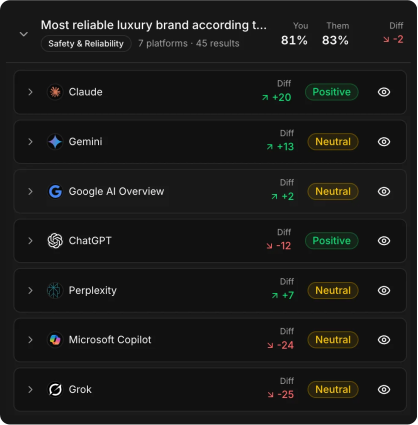
Win customers from all major AI platforms
Understand, measure, and optimize your AI visibility via Ansvisor.
✓ Add brand, domains and competitors
✓ Discover prompts and growth opportunities
✓ Track your AI visibility across major AI platforms
✓ Monitor citations, mentions, and competitors
✓ Measure AI traffic and customer discovery
✓ Receive AI recommendations based on AI insights
✓ Optimize authority, trust, and content quality
✓ Create content, automate analysis & action with AI agents
AI Visibility Terms
Continue exploring key AI visibility concepts.
AI Visibility
Measure and improve how often your brand appears in AI-generated answers.
Learn more →Answer Engine Optimization (AEO)
Strategies for increasing visibility in answer engines and AI summaries.
Learn more →Generative Engine Optimization (GEO)
Optimizing content for AI-powered discovery experiences.
Learn more →ChatGPT Search
Understand how OpenAI retrieves and synthesizes information.
Learn more →Google AI Overviews
AI-generated summaries that appear directly in Google Search.
Learn more →Perplexity Search
Explore how Perplexity cites and presents sources.
Learn more →AI Citations
References and sources used by AI systems to support answers.
Learn more →Citation Authority
Measure the quality and influence of cited sources.
Learn more →Retrievability
How easily AI systems can discover and reuse your content.
Learn more →New terms are added regularly.
Help us improve the page or suggest a new term →
Cihan Geyik
Co-founder at Ansvisor
Cihan Geyik is the co-founder of Ansvisor, an open-source AI Visibility platform for AI Search. With more than 15 years of experience in digital marketing and growth, he writes about AI visibility, AI search, AEO, GEO, citations, and answer engines. He focuses on helping brands understand and improve their presence across ChatGPT, Gemini, Perplexity, Google AI Overviews, and other AI-powered discovery platforms.
Make Your Brand Visible in AI Answers.

INDUSTRIES


© 2026 Ansvisor. All rights reserved. Ansvisor is an open-source AI Search Intelligence Platform for AI Visibility.


.svg)
