


Conductor
What is Conductor?
Conductor is an enterprise Answer Engine Optimization (AEO) and SEO platform designed to help organizations improve their visibility across AI answer engines and traditional search.
The platform combines AI search visibility tracking, traditional SEO intelligence, content creation and optimization, technical website monitoring, AI crawler analysis, competitive intelligence, traffic and conversion measurement, and enterprise reporting.
Conductor's AI search capabilities are built into a broader search intelligence ecosystem rather than operating as a standalone AI visibility tracker. This allows organizations to analyze how their brands perform across AI-generated answers while connecting those signals with website performance, content, technical health, and business outcomes.
What does Conductor do?
Conductor helps organizations understand how their brands and content perform across both AI-powered answer engines and traditional search.
Its AI Search Performance capabilities analyze AI-generated responses for brand mentions, citations, sentiment, competitors, topics, audience personas, search intent, and other visibility signals.
Teams can then connect those insights with content workflows, technical monitoring, AI crawler behavior, website analytics, conversions, and traditional SEO data.
This creates an end-to-end workflow that moves from measuring AI visibility to identifying opportunities, optimizing content, monitoring technical accessibility, and evaluating business impact.
What are the key AI search features of Conductor?
Conductor provides AI search capabilities across its Intelligence, Creator, Monitoring, analytics, agent, and developer products.
- AI Search Performance: Measures how brands and content appear across AI-generated search experiences.
- AI Mention Tracking: Identifies where brands appear within AI-generated responses.
- AI Citation Tracking: Tracks when owned websites and other sources are cited within AI answers.
- Sentiment Analysis: Evaluates how AI systems characterize a brand and connects sentiment with supporting sources.
- Competitive Market Share: Benchmarks brand visibility against competitors across important topics.
- Share of Voice: Measures the brand's relative presence across AI-generated responses compared with competitors.
- Topic-Level Analysis: Groups AI search performance around strategically important subjects rather than relying only on individual prompts.
- Prompt-Level Analysis: Allows teams to inspect individual questions and their resulting AI responses.
- Audience Personas: Models important customer segments and evaluates AI search visibility within those audiences.
- Search Intent Analysis: Classifies AI prompts according to customer journey and intent.
- AI Traffic Analytics: Connects AI referral traffic with website engagement.
- Conversion Measurement: Connects AI search visibility and referral traffic with downstream conversions.
- AI Bot Monitoring: Tracks how AI crawlers interact with website content.
- Content Creation and Optimization: Connects AI visibility opportunities directly with Conductor Creator.
- Technical Site Monitoring: Continuously monitors website health and issues that may affect search and AI visibility.
- LLM Apps: Makes Conductor intelligence available inside AI tools such as ChatGPT, Claude, and Copilot.
- Agents: Provides content and technical agents designed to automate AEO workflows.
- MCP and Developer Tools: Allows organizations to connect Conductor intelligence with external AI and enterprise workflows.
Which AI platforms does Conductor track?
Conductor tracks brand and content visibility across major AI-powered search and answer engines.
Current platform materials reference coverage across AI experiences including:
- ChatGPT.
- Gemini.
- Microsoft Copilot.
- Claude.
- Perplexity.
- Google AI search experiences.
Coverage can vary depending on the specific Conductor report, market, and product configuration.
Monitoring multiple AI platforms is important because the same question can produce different brands, sources, citations, sentiment, and recommendations depending on the answer engine being used.
What is Conductor AI Search Performance?
AI Search Performance is Conductor's reporting environment for understanding how brands and content perform within AI-generated search experiences.
The report allows organizations to monitor topics that matter to their business and analyze the prompts, mentions, citations, competitors, sentiment, and other signals associated with those topics.
Rather than reducing AI search performance to a single visibility score, Conductor provides multiple dimensions that help teams investigate why a brand appears, where competitors are stronger, and which opportunities may deserve action.
Teams can move from these insights directly into content creation and optimization workflows within the broader Conductor platform.
How does Conductor track AI mentions and citations?
Conductor distinguishes between brand mentions and website citations when measuring AI search performance.
A mention indicates that an AI-generated response references the brand, while a citation indicates that the AI system references a website or page as a source.
Analyzing both signals can help teams understand:
- Which prompts mention the brand.
- Which pages receive AI citations.
- Where brands appear without receiving citations.
- Which competitors receive stronger mention or citation coverage.
- Which topics generate the greatest visibility.
- Which content opportunities could improve future visibility.
This distinction is important because a brand can influence an AI answer without its own website being directly cited.
How does Conductor measure AI Share of Voice?
Conductor uses AI Share of Voice to compare how frequently a brand appears within AI-generated responses relative to competing brands.
The platform evaluates market share across strategically important topics and separates different dimensions of AI visibility.
Teams can use this information to identify categories where their brand leads, where competitors dominate, and where additional content or authority may be required.
Topic-level competitive analysis can provide a broader view than evaluating individual prompts independently.
How does Conductor analyze audience personas?
Conductor uses Audience Personas to represent important customer segments within AI search analysis.
A persona can represent a specific buyer type, role, customer segment, or other strategically important audience.
Conductor uses these personas to generate representative prompts intended to reflect the questions and context associated with those audiences.
This allows teams to analyze whether AI visibility differs between customer groups rather than treating every searcher as having the same needs and context.
For example, a brand may have strong AI visibility for general informational questions while being less visible for prompts associated with a specific enterprise buyer persona.
How does Conductor analyze search intent in AI search?
Conductor classifies AI search behavior according to the underlying intent behind a prompt.
Search intent can be organized around customer journey stages such as:
- Education.
- Comparison.
- Purchase.
This helps teams understand not only which questions generate visibility, but why users may be asking those questions.
Combining persona and intent information can help organizations prioritize AI search opportunities associated with strategically important audiences and stages of the customer journey.
How does Conductor generate prompts for AI search monitoring?
Conductor combines its historical search intelligence with synthetic prompt generation to build AI search monitoring around customer behavior.
The platform draws on more than a decade of search and keyword data while generating prompts designed to represent specific buyer personas and search intents.
This approach connects established search demand intelligence with the longer, more conversational questions users increasingly ask AI systems.
Teams can also customize tracking around the topics and prompts that matter most to their organization.
How does Conductor collect AI search data?
Conductor emphasizes an API-first approach to collecting AI search data wherever official interfaces are available.
The company positions this approach around data stability, accuracy, compliance, and repeatability for enterprise measurement.
This is particularly relevant for organizations using AI visibility information for high-stakes reporting because generated responses and the interfaces surrounding AI platforms can change frequently.
Data collection methodology should therefore be considered alongside platform coverage, prompt methodology, refresh frequency, and reporting capabilities when evaluating an AI visibility platform.
How does Conductor analyze sentiment in AI search?
Conductor analyzes the sentiment associated with brand appearances within AI-generated responses.
The platform goes beyond identifying whether sentiment is positive or negative by connecting sentiment analysis with the sources cited within the corresponding AI answers.
This can help teams investigate why an AI system represents a brand in a particular way and which external sources may be influencing that narrative.
Sentiment and source analysis can therefore be relevant to brand, communications, reputation, digital PR, SEO, and AEO teams.
How does Conductor analyze competitors in AI search?
Conductor benchmarks brand performance against competitors across AI-generated search experiences.
Competitive analysis can include:
- Brand mentions.
- Citations.
- Share of Voice.
- Market share.
- Topics.
- Prompts.
- Sentiment.
- Customer personas.
- Search intent.
Teams can use this information to identify topics where competitors receive greater visibility and determine which content or authority opportunities could help close those gaps.
How does Conductor connect AI visibility with traffic and conversions?
Conductor connects AI search visibility with website analytics so teams can evaluate whether visibility contributes to measurable business outcomes.
Its AI Traffic and Conversion Insights combine AI referral traffic with website engagement and conversion information.
This can help organizations investigate:
- How much traffic arrives from AI platforms.
- Which landing pages receive AI referrals.
- How AI visitors engage with the website.
- Whether AI visitors convert.
- How AI search contributes to business outcomes.
Connecting visibility with downstream performance can help teams move beyond measuring mentions and citations alone.
How does Conductor monitor AI crawlers?
Conductor Monitoring helps organizations understand how AI bots interact with their websites.
AI bot crawling reports provide information about whether AI systems are accessing important content and which areas of a website may have discovery or technical issues.
This can help teams investigate questions such as:
- Are AI bots crawling important pages?
- Which content receives crawler activity?
- Are technical issues preventing AI access?
- Are recently published pages discoverable?
- Could website changes create AI visibility problems?
Conductor combines this information with always-on technical website monitoring and real-time alerts.
How does Conductor connect AI visibility with content creation?
Conductor integrates AI Search Performance with Conductor Creator, its content creation and optimization environment.
When teams identify an AI visibility opportunity, they can move from analysis into content optimization or creation workflows without treating measurement and execution as separate processes.
Potential workflows can include:
- Identifying topics with weak AI visibility.
- Finding competitive content gaps.
- Improving existing pages.
- Creating new content around customer needs.
- Optimizing content for both traditional and AI search.
This creates a workflow that connects AI search intelligence with content execution.
What is Conductor Creator?
Conductor Creator is the platform's AI-powered content creation and optimization environment.
It is designed to help enterprise teams generate, optimize, and scale content that can perform across both traditional search engines and AI-generated discovery experiences.
Creator works alongside Conductor Intelligence and Monitoring so content decisions can be informed by search performance, AI visibility, competitive intelligence, and technical website information.
What is Conductor Monitoring?
Conductor Monitoring is the platform's always-on technical website monitoring layer.
It continuously monitors website health and can alert teams when technical changes create problems that may affect visibility, user experience, or business performance.
For AI search workflows, Monitoring also provides visibility into AI bot crawling behavior.
This helps organizations connect technical site health with the ability of traditional search engines and AI systems to discover and access content.
What are Conductor LLM Apps?
Conductor provides native LLM applications designed to bring its search and AEO intelligence into AI tools teams already use.
Current integrations include environments such as:
- ChatGPT.
- Claude.
- Microsoft Copilot.
Instead of requiring users to switch between an AI assistant and the Conductor platform, LLM Apps allow teams to access Conductor intelligence within conversational workflows.
This can help content, SEO, and marketing teams use grounded search data while working inside their preferred AI environments.
What are Conductor Agents?
Conductor provides turnkey agents designed to automate parts of enterprise AEO workflows.
Its agent capabilities include Content Agents and Technical Agents.
These systems are designed to help teams automate repetitive search optimization tasks while using Conductor's underlying intelligence and website data.
The agent layer extends the platform from reporting and recommendations toward automated execution across content and technical workflows.
Does Conductor provide MCP access?
Yes. Conductor provides a Model Context Protocol server that allows external AI systems to work with Conductor's search and AI visibility intelligence.
The MCP architecture is designed around grounded data supplied through Conductor's APIs so teams can distinguish between information originating from Conductor's datasets and reasoning generated by the connected AI model.
Conductor's MCP can also incorporate customer journey context such as personas, search intent, and geographic information.
This can be useful for organizations building custom AI applications or using AI assistants as an interface for enterprise search intelligence.
How does Conductor connect AI search with traditional SEO?
A defining characteristic of Conductor is that AI search intelligence operates alongside traditional SEO data rather than as an isolated monitoring system.
Teams can analyze AI visibility alongside information such as:
- Keyword performance.
- Search rankings.
- Organic traffic.
- Competitor performance.
- Content performance.
- Technical website health.
- Website analytics.
This allows organizations to build a hybrid search strategy that considers traditional search engines and AI answer engines as connected parts of digital discovery.
Who is Conductor for?
Conductor is primarily designed for enterprise organizations and larger marketing teams managing search visibility across multiple channels, markets, websites, and stakeholders.
Potential users include:
- Enterprise SEO teams.
- AEO and GEO teams.
- Content teams.
- Digital marketing teams.
- Brand and communications teams.
- Growth teams.
- Technical SEO teams.
- Digital experience teams.
- Agencies.
- Global marketing organizations.
Its unified SEO and AEO architecture can be particularly relevant to organizations that want AI search measurement to operate within an established enterprise search program.
How does Conductor fit into AI SEO, AEO, and GEO?
Conductor positions its AI search capabilities primarily around Answer Engine Optimization (AEO).
AEO, AI SEO, and Generative Engine Optimization (GEO) describe overlapping approaches to improving how brands and content appear within AI-powered discovery experiences.
Conductor supports these workflows through AI visibility monitoring, mentions, citations, sentiment, competitors, personas, intent, content optimization, technical monitoring, AI crawler analytics, traffic measurement, and automation.
Its broader SEO capabilities also allow teams to coordinate AI search optimization with traditional organic search strategies.
How is Conductor different from traditional SEO tools?
Traditional SEO tools primarily focus on keywords, rankings, technical performance, traffic, and conventional search engine results.
Conductor combines those established SEO workflows with an additional intelligence layer for AI-generated search.
Teams can therefore investigate questions such as:
- Does AI mention our brand?
- Which pages receive AI citations?
- Which competitors have greater AI Share of Voice?
- How does AI describe our brand?
- Which sources influence brand sentiment?
- How does visibility differ by persona and intent?
- Are AI crawlers accessing important content?
- Does AI visibility generate traffic and conversions?
- What content should we create or optimize next?
This makes Conductor a combined SEO and AEO platform rather than a standalone AI visibility tracker.
What should teams consider when evaluating Conductor?
Organizations evaluating Conductor should consider whether they need a standalone AI visibility tracker or a broader enterprise platform combining AEO, SEO, content, technical monitoring, analytics, and automation.
Important evaluation factors can include:
- AI platform coverage.
- Prompt and topic tracking requirements.
- Audience persona and intent analysis.
- Competitive intelligence.
- Traditional SEO requirements.
- Content creation workflows.
- Technical monitoring.
- AI crawler analysis.
- Traffic and conversion measurement.
- Enterprise reporting.
- Developer and MCP requirements.
Because Conductor is positioned primarily for enterprise organizations, teams should also evaluate implementation requirements, organizational scale, integrations, governance, and pricing relative to more specialized AI visibility platforms.
Conductor and the AI Search tools ecosystem
Conductor represents the expansion of an established enterprise SEO platform into the AI search and AEO category.
Its approach combines AI visibility intelligence with traditional search data, content creation, technical monitoring, AI crawler analytics, traffic and conversion measurement, LLM applications, and agents.
The broader ecosystem includes dedicated AI visibility platforms, prompt monitoring systems, citation intelligence products, AI traffic analytics tools, content optimization platforms, and other established SEO platforms expanding into AI search.
Ansvisor maintains a broader directory of AI SEO, AEO, GEO, AI visibility, and AI search tools to help teams understand this evolving ecosystem and evaluate platforms based on their specific requirements.
Official source
FAQ
What is Conductor?

Conductor is an enterprise AEO and SEO platform that helps organizations measure and improve visibility across AI answer engines and traditional search. It combines AI search intelligence with content creation, technical monitoring, analytics, and enterprise search data.
Which AI platforms does Conductor track?
Conductor's current AI search materials reference platforms including ChatGPT, Gemini, Microsoft Copilot, Claude, Perplexity, and Google AI search experiences. Coverage can vary across individual products and reports.
Does Conductor track AI mentions and citations?
Yes. Conductor's AI Search Performance tracks brand mentions and website citations and allows teams to analyze them across topics and prompts to identify visibility and content opportunities.
Does Conductor track AI traffic and conversions?
es. Conductor connects AI referral traffic with website engagement and conversion metrics so teams can evaluate AI search performance against business outcomes rather than relying only on visibility metrics.
Does Conductor provide MCP and AI agent capabilities?
Yes. Conductor provides an MCP server for bringing grounded Conductor data into external AI workflows and also offers LLM Apps, Content Agents, and Technical Agents for AI-assisted and automated AEO workflows.
Everything You Need to Improve Your AI Visibility
Track how your brand appears across AI platforms, understand what drives visibility, and turn insights into measurable actions.
Platform Features
Explore all features →Answer Engine Insights
Understand how AI platforms talk about your brand.
Prompt Intelligence
Discover and monitor the prompts shaping your AI visibility.
Citations Monitoring
Track which sources AI platforms cite and where your brand appears.
AI Traffic Analytics
Measure visits coming from ChatGPT, Gemini, Claude, and more.
Competitor Benchmarking
Compare AI visibility and uncover competitive gaps and opportunities.
Action Center
Turn AI Search signals into prioritized actions and executable tasks.
AI Visibility Trackers
Explore AI Visibility Platform →ChatGPT Visibility Tracker
Track brand mentions, citations, prompts, and visibility across ChatGPT.
Google AI Overviews Rank Tracker
Monitor where and how your brand appears in Google AI Overviews.
Google AI Mode Visibility Tracker
Track your brand's visibility across Google AI Mode experiences.
Gemini Visibility Tracker
Understand how your brand appears across Google Gemini responses.
Microsoft Copilot Visibility Tracker
Monitor your brand's presence across Microsoft Copilot answers.
Perplexity Visibility Tracker
Track brand mentions, citations, and visibility across Perplexity.
From AI Visibility insights to action.
Explore the complete Ansvisor platform for AI Search intelligence, optimization, and growth.
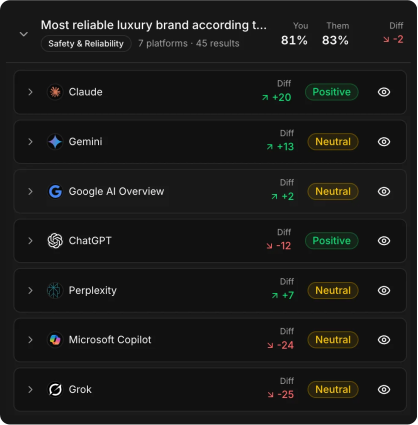
Win customers from all major AI platforms
Understand, measure, and optimize your AI visibility via Ansvisor.
✓ Add brand, domains and competitors
✓ Discover prompts and growth opportunities
✓ Track your AI visibility across major AI platforms
✓ Monitor citations, mentions, and competitors
✓ Measure AI traffic and customer discovery
✓ Receive AI recommendations based on AI insights
✓ Optimize authority, trust, and content quality
✓ Create content, automate analysis & action with AI agents
AI Visibility Terms
Continue exploring key AI visibility concepts.
AI Visibility
Measure and improve how often your brand appears in AI-generated answers.
Learn more →Answer Engine Optimization (AEO)
Strategies for increasing visibility in answer engines and AI summaries.
Learn more →Generative Engine Optimization (GEO)
Optimizing content for AI-powered discovery experiences.
Learn more →ChatGPT Search
Understand how OpenAI retrieves and synthesizes information.
Learn more →Google AI Overviews
AI-generated summaries that appear directly in Google Search.
Learn more →Perplexity Search
Explore how Perplexity cites and presents sources.
Learn more →AI Citations
References and sources used by AI systems to support answers.
Learn more →Citation Authority
Measure the quality and influence of cited sources.
Learn more →Retrievability
How easily AI systems can discover and reuse your content.
Learn more →New terms are added regularly.
Help us improve the page or suggest a new term →
Cihan Geyik
Co-founder at Ansvisor
Cihan Geyik is the co-founder of Ansvisor, an open-source AI Visibility platform for AI Search. With more than 15 years of experience in digital marketing and growth, he writes about AI visibility, AI search, AEO, GEO, citations, and answer engines. He focuses on helping brands understand and improve their presence across ChatGPT, Gemini, Perplexity, Google AI Overviews, and other AI-powered discovery platforms.
Get more Ansvisor insights in Google
Add Ansvisor as a Preferred Source to see more of our AI Search, AEO, GEO, and AI Visibility insights across Google.
Make Your Brand Visible in AI Answers.

INDUSTRIES


© 2026 Ansvisor. All rights reserved. Ansvisor is an open-source AI Search Intelligence Platform for AI Visibility. Ansvisor is a brand owned and operated by Empler AI Inc.


.svg)