


Answer Engine Optimization (AEO) is the practice of optimizing a brand's content, website, and authority signals to increase its visibility in AI-generated answers and answer engines. AEO helps information become easier for systems such as Google AI Overviews, ChatGPT, Gemini, Perplexity, and other AI search experiences to discover, understand, retrieve, cite, and recommend.
AEO stands for Answer Engine Optimization. Unlike traditional SEO, which has historically focused heavily on rankings and organic clicks, AEO also considers whether a brand, website, product, or source is mentioned, cited, or recommended directly inside AI-generated answers.
What Is Answer Engine Optimization (AEO)?
Answer Engine Optimization is a digital visibility strategy focused on improving how content and brands appear inside answers generated by search engines, AI assistants, and other answer-based discovery platforms.
Traditional search often presents users with a list of links. Answer engines can instead synthesize information from multiple sources and present a direct response. This changes the visibility opportunity: a brand may influence the user's research and decision-making process before the user ever visits its website.
AEO therefore extends beyond conventional rankings. It considers whether AI systems can correctly understand a brand, retrieve its information, associate it with relevant topics, cite its content, and include it when generating answers or recommendations.
These experiences span multiple answer engines, including AI-powered search experiences and conversational assistants.
What Does AEO Stand For?
AEO stands for Answer Engine Optimization. The term describes the process of making information easier for answer engines to discover, understand, retrieve, trust, and use when responding to user questions.
In marketing, AEO is increasingly used to describe strategies designed to improve visibility across AI-generated answers rather than focusing exclusively on traditional search engine result pages.
The objective is not simply to rank a webpage. It is to increase the likelihood that a brand's information, expertise, products, services, or content becomes part of the answer itself.
Why Answer Engine Optimization Matters
Search behavior is becoming more conversational. Users increasingly ask detailed questions, compare alternatives, research products, evaluate vendors, and seek recommendations through AI-powered search experiences.
This creates a new layer of discovery between traditional search results and a company's website. A brand can be visible, cited, compared, or recommended during this process — or it can be absent while competitors shape the answer.
Increase AI Visibility
Improve the likelihood that your brand appears across relevant AI-generated answers.
Earn More Citations
Create useful and authoritative information that answer engines can reference as a source.
Strengthen Brand Authority
Build stronger associations between your brand, expertise, products, and important topics.
Expand Discovery
Reach users across conversational and long-tail journeys beyond traditional search listings.
How Answer Engine Optimization Works
Answer engines can combine information from search indexes, websites, structured data, knowledge sources, retrieval systems, and other available information to generate responses.
The exact mechanisms vary by platform. There is therefore no single universal AEO ranking factor or optimization formula. Instead, AEO focuses on strengthening the signals that can make a source easier to discover, interpret, retrieve, trust, and reference.
- Content clarity: Make important information direct, specific, and easy to interpret.
- Topic coverage: Build meaningful depth around the questions and subjects important to your audience.
- Entity understanding: Make relationships between your brand, products, people, topics, and expertise clear.
- Source authority: Strengthen trust through credible content, references, mentions, and third-party validation.
- Technical accessibility: Ensure important content can be crawled, indexed, and retrieved where applicable.
- Structured information: Organize content so both users and machines can understand its meaning and context.
AEO vs SEO: What's the Difference?
AEO and SEO overlap significantly, but they are not identical. SEO traditionally focuses on improving visibility in search engine results, while AEO expands optimization toward direct answers generated by AI-powered and answer-based systems.
| Area | SEO | AEO |
|---|---|---|
| Primary visibility | Search results and organic rankings | AI-generated and direct answers |
| Common outcome | Ranking and organic click | Mention, citation, recommendation, or AI referral |
| Query behavior | Keywords and search queries | Prompts, questions, conversations, and search queries |
| Measurement | Rankings, impressions, clicks, organic traffic | AI visibility, mentions, citations, Share of Voice, prompt coverage, AI traffic |
AEO does not replace SEO. Strong technical foundations, useful content, authority, internal linking, and discoverability remain important. AEO adds another optimization and measurement layer for environments where the answer itself can become the search experience.
AEO vs GEO: What's the Difference?
Answer Engine Optimization (AEO) focuses broadly on improving visibility within direct and AI-generated answers. Generative Engine Optimization (GEO) is commonly used for optimization aimed specifically at generative AI search and answer experiences.
In practice, the two disciplines overlap heavily. Both can involve improving content clarity, authority, citations, entity signals, retrieval, and visibility across AI-powered discovery experiences.
Rather than treating AEO and GEO as completely separate disciplines, many teams use them as complementary approaches within a broader AI Search strategy.
Key AEO Visibility Signals
No single set of signals determines visibility across every answer engine. Different systems use different models, indexes, retrieval methods, sources, and ranking processes.
However, several areas are commonly important when building an Answer Engine Optimization strategy:
Content Quality & Clarity
Clear, useful, accurate, and well-structured information is easier to interpret and retrieve.
Topical Authority
Depth and consistency around a subject can strengthen the relationship between a brand and that topic.
Entity Signals
Clear information about brands, products, authors, organizations, and their relationships improves context.
Source Authority
Trusted references, external mentions, citations, and authoritative sources can strengthen credibility.
Structured Information
Logical page structures and appropriate structured data can make information easier to understand.
Freshness & Accuracy
Keeping important information accurate and current helps maintain the usefulness of a source.
Internal Linking
Strong internal relationships help communicate topical structure and connect supporting information.
Brand Mentions & Citations
Understanding where a brand and its content are mentioned or cited reveals important authority signals.
How to Optimize for Answer Engines
Effective AEO combines content, technical foundations, authority, measurement, and continuous improvement. The objective is to make your brand and information easier to discover and use when an answer engine responds to relevant questions.
Understand the Questions Your Audience Asks
Identify the prompts, conversational searches, comparisons, problems, and decision-stage questions relevant to your products and expertise.
Create Clear, Answerable Content
Provide direct answers while supporting them with useful context, evidence, definitions, examples, and deeper information.
Build Topical and Entity Authority
Develop connected content around important topics and make your expertise, products, organization, and relationships easy to understand.
Strengthen Citations and External Authority
Understand which sources influence AI-generated answers and build legitimate authority through useful content, mentions, partnerships, and relevant third-party coverage.
Measure AI Visibility
Monitor mentions, citations, prompts, competitors, Share of Voice, platform coverage, and AI-referred traffic instead of relying only on traditional rankings.
Improve Continuously
Use visibility gaps, competitor performance, citation patterns, and changing user demand to prioritize the next optimization opportunities.
For a deeper implementation framework, see our guide to optimizing content for Answer Engine Optimization.
How to Measure Answer Engine Optimization
AEO measurement requires looking beyond traditional keyword rankings. A brand may gain meaningful visibility inside an AI-generated answer even when the interaction does not produce a conventional search click.
Teams can therefore combine AI visibility metrics with traditional search and analytics data to understand how frequently a brand appears, how it compares with competitors, which sources influence its visibility, and whether AI platforms generate website visits.
Together, these metrics provide a broader picture of AI visibility than rankings alone.
Examples of Answer Engines and AI Search Platforms
Answer Engine Optimization can apply across multiple search and AI experiences. Visibility is not necessarily consistent between platforms because each system can use different data sources, retrieval methods, models, and response-generation processes.
- Google AI Overviews: AI-generated summaries displayed for eligible Google searches.
- Google AI Mode: Google's conversational AI-powered search experience.
- ChatGPT: Conversational AI experiences that can support research, discovery, comparison, and web search.
- Google Gemini: Google's AI assistant and generative AI ecosystem.
- Perplexity: An AI-powered answer and search experience with source citations.
- Microsoft Copilot: Microsoft's AI assistant ecosystem across search and other products.
- Claude: Anthropic's AI assistant used for research, analysis, and conversational discovery.
Because visibility can differ across these environments, AEO measurement should consider multiple platforms rather than assuming performance on one answer engine represents the entire AI search ecosystem.
Common AEO Mistakes
Answer Engine Optimization is still evolving, which can lead teams to apply traditional search assumptions too narrowly or optimize for individual tactics without understanding the broader visibility picture.
- Treating AEO as traditional SEO: Rankings remain useful, but AI answers introduce mentions, citations, recommendations, and other visibility outcomes.
- Optimizing for only one platform: Brand visibility can vary significantly between different answer engines.
- Ignoring citations: Understanding which sources influence AI answers can reveal important authority and content opportunities.
- Publishing shallow content: Creating pages solely to target questions without adding useful information can weaken rather than strengthen a content strategy.
- Ignoring brand authority: AEO is not only an on-page content exercise. Brand understanding, third-party references, expertise, and authority also matter.
- Measuring only traffic: AI-generated answers can influence discovery and decisions even when they do not immediately generate a website visit.
- Failing to monitor competitors: Competitor mentions and citations can reveal where other brands are earning visibility that your brand is missing.
How Ansvisor Helps With Answer Engine Optimization
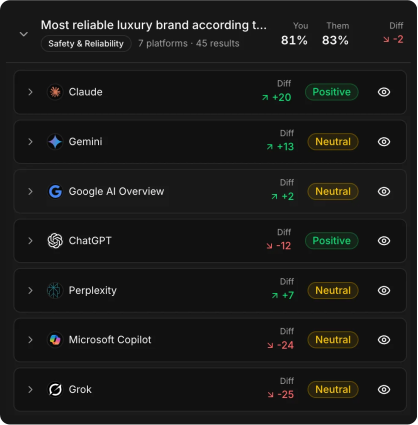
Ansvisor helps teams understand and improve how their brands appear across AI search and answer engines by connecting AI visibility, prompt intelligence, mentions, citations, competitors, AI-referred traffic, and actionable opportunities in one platform.
Instead of looking at AEO as a single ranking metric, teams can analyze where they appear, where competitors outperform them, which sources influence AI answers, which prompts matter, and what actions can improve visibility over time.





.svg)
