Why Multimodal AI matters
Multimodal AI refers to artificial intelligence systems that can process, understand, and generate multiple forms of information, including text, images, audio, video, documents, and structured data. Unlike traditional AI models that work with a single data type, multimodal systems combine information from different modalities to improve understanding and reasoning.
As AI applications become increasingly sophisticated, multimodal capabilities are transforming how users search, communicate, create content, and interact with AI systems.
Benefits of multimodal AI include:
- Improve contextual understanding.
- Support richer interactions.
- Enable cross-modal reasoning.
- Improve answer quality.
- Create more natural user experiences.
Many modern AI systems now support multimodal inputs and outputs, allowing users to communicate using combinations of text, images, voice, and documents.
How Multimodal AI works
Multimodal AI systems combine information from different data types into shared representations.
- Process text.
- Analyze images.
- Interpret audio.
- Understand video.
- Process documents.
- Combine multiple signals.
Modern multimodal models use techniques such as shared embeddings, cross-attention mechanisms, and transformer architectures to understand relationships between different types of information.
Concepts such as Embeddings, Foundation Models, and Large Language Models (LLMs) play a central role in multimodal systems.
What can Multimodal AI do?
Multimodal AI enables a wide range of capabilities.
- Image understanding.
- Visual question answering.
- Document analysis.
- Speech recognition.
- Video understanding.
- Cross-modal reasoning.
For example, a multimodal AI system may analyze a chart, understand accompanying text, process a spoken question, and generate a combined answer.
How Multimodal AI affects AI search
Multimodal AI is expanding the scope of search beyond traditional text-based queries.
- Visual search.
- Document search.
- Conversational search.
- Knowledge retrieval.
- Answer generation.
- Recommendation systems.
Modern Answer Engines increasingly combine multiple information types when retrieving and generating responses.
Concepts such as Knowledge Retrieval, Grounding, and Model Context Window become even more important in multimodal environments.
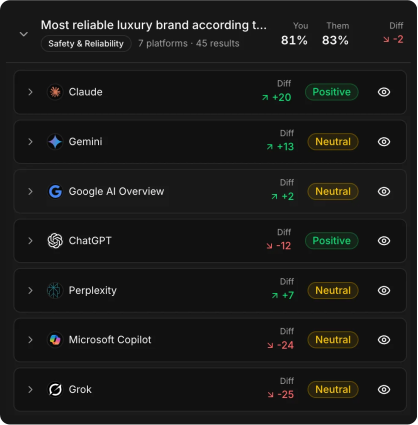
Platforms such as Ansvisor help organizations understand how brands, content, citations, and entities appear across evolving AI search experiences, including multimodal discovery and answer generation systems.
Common misconceptions
Common misconceptions about multimodal AI include:
- Multimodal AI only means image generation.
- All AI models are multimodal.
- Multimodal systems always outperform specialized models.
- Adding more modalities guarantees better results.
- Multimodal AI eliminates hallucinations.
Multimodal AI represents a major shift toward more human-like information processing, allowing AI systems to reason across multiple forms of information rather than relying on text alone.








.svg)
