


AI Visibility Metrics
AI Visibility Metrics are measurements used to understand how frequently, prominently, and effectively a brand, product, website, or other entity appears across AI-generated answers and AI-powered discovery experiences.
They extend visibility measurement beyond traditional search rankings. Instead of asking only where a webpage ranks, AI Visibility Metrics examine whether a brand is mentioned, recommended, cited, associated with relevant topics, visible across important prompts, competitive within its category, and capable of generating identifiable AI referral traffic.
Common AI Visibility Metrics include AI Visibility Rate, AI Visibility Score, AI Mentions, Citation Rate, AI Citations, Share of Voice, Prompt Coverage, Prompt-Level Visibility, competitor visibility, AI Referral Traffic, and historical visibility change.
What are AI Visibility Metrics?
AI Visibility Metrics quantify different aspects of a brand's presence within AI-generated answers.
They help organizations move from subjective questions such as "Are we visible in AI Search?" toward measurable questions such as:
- How often does our brand appear?
- Which prompts generate brand visibility?
- How often are our pages cited?
- Which competitors appear more frequently?
- What is our Share of Voice?
- Which topics have weak visibility?
- Which AI platforms send referral traffic?
- Is our visibility improving over time?
Together, these measurements form the quantitative layer of AI Search performance analysis.
Why do AI Visibility Metrics matter?
AI-powered search and answer experiences do not behave exactly like conventional search engine results.
A generated answer can mention several brands, recommend one company over another, cite multiple sources, summarize information without generating a click, or present different results for variations of the same question.
Traditional ranking metrics alone cannot describe all of these behaviors.
AI Visibility → Does the brand appear, how is it represented, what is cited, and how does it compare?
AI Visibility Metrics provide additional measurements for this new discovery environment while remaining complementary to traditional SEO analytics.
What are the most important AI Visibility Metrics?
The right metrics depend on the organization's objectives, but a comprehensive measurement framework commonly includes the following signals.
| Metric | What It Measures |
|---|---|
| AI Visibility Rate | The percentage of monitored prompts where the brand is visible. |
| AI Visibility Score | A composite measure of AI visibility based on a platform's defined methodology. |
| AI Mentions | How frequently the brand appears in monitored AI-generated answers. |
| AI Citations | When the brand's domain or pages appear as sources in AI answers. |
| Citation Rate | How frequently citation coverage occurs within a defined monitoring dataset. |
| Share of Voice | Brand presence relative to monitored competitors. |
| Prompt Coverage | How broadly the brand appears across strategically relevant prompts. |
| Prompt-Level Visibility | Performance for individual questions or prompts. |
| Competitor Visibility | How the brand performs relative to competing entities. |
| AI Referral Traffic | Identifiable website visits referred by AI-powered platforms. |
| Historical Visibility Change | How visibility and related metrics change over time. |
What is AI Visibility Rate?
AI Visibility Rate measures the proportion of monitored prompts in which a brand appears.
A simple version of the calculation is:
For example, if a brand appears in 60 of 100 tracked prompts, its visibility rate within that monitored prompt set would be 60%.
This does not mean the brand has 60% visibility across every AI conversation. The metric describes performance within the defined monitoring dataset.
What is an AI Visibility Score?
An AI Visibility Score is usually a composite metric designed to summarize different visibility signals into a single score.
Depending on the measurement methodology, the score may incorporate factors such as:
- Brand presence.
- Prompt coverage.
- Answer prominence.
- Mentions.
- Citations.
- Competitor performance.
- Platform coverage.
There is no universal industry formula for an AI Visibility Score. Different platforms can use different inputs, weighting systems, prompt sets, and calculation methods.
For this reason, an AI Visibility Score is usually most useful for monitoring consistent changes within the same methodology rather than comparing unrelated scores from different platforms.
What is the difference between AI Visibility Rate and AI Visibility Score?
AI Visibility Rate can be a relatively direct measurement of how many monitored prompts contain the brand.
AI Visibility Score is typically a broader calculated metric that may combine multiple signals.
Visibility Score → Composite measurement based on a defined methodology
Understanding this distinction is important when comparing dashboards, tools, reports, or historical performance.
What are AI Mentions?
AI Mentions measure instances where a brand, product, company, or other tracked entity appears within AI-generated answers.
Mentions can help measure brand presence across informational, comparison, recommendation, category, and purchase-oriented questions.
However, not every mention has the same meaning. A brand can be recommended, compared, referenced neutrally, or mentioned in another context.
Strong AI visibility analysis therefore considers answer context in addition to raw mention counts.
What are AI Citations?
AI Citations occur when a source, domain, or URL is referenced or presented as supporting information within an AI-generated answer.
Citation metrics help answer questions that mention metrics cannot answer on their own:
- Is the brand merely mentioned or is its website used as a source?
- Which pages receive citations?
- Which competitors receive citations?
- Which third-party domains influence the answer?
- Which sources repeatedly appear for important prompts?
Citations provide an important source-level layer of AI visibility measurement, but citation counts should not be interpreted as equivalent to traffic or conversions.
What is Citation Rate?
Citation Rate measures how frequently a brand, website, or source earns citations within a defined set of monitored AI answers.
It can help distinguish between two different types of visibility:
Citation Visibility → The website or content appears as a source
A brand can have a high mention rate but a lower citation rate, or strong citation coverage without being the most frequently mentioned competitor.
Why should mentions and citations be measured separately?
Mentions and citations represent different signals.
A mention indicates that the brand became part of the generated answer. A citation indicates that a source or URL was referenced as supporting information.
Keeping them separate makes it possible to identify situations such as:
- The brand is mentioned but its website is rarely cited.
- The website is cited but the brand receives weak recommendation visibility.
- Competitors receive citations from sources your brand does not appear on.
- Third-party sources influence brand visibility more than owned content.
These differences can lead to very different optimization opportunities.
What is AI Share of Voice?
AI Share of Voice measures a brand's presence relative to competing brands within a defined AI Search monitoring dataset.
Depending on the methodology, Share of Voice may be based on mentions, visibility, answer prominence, or a combination of signals.
It is especially useful for understanding whether improvements in absolute visibility are also translating into stronger competitive positioning.
Share of Voice should always be interpreted in the context of the prompts, competitors, platforms, countries, languages, and time period being monitored.
What is Prompt Coverage?
Prompt Coverage measures how broadly a brand appears across a strategically relevant portfolio of questions.
Instead of looking only at total mentions, Prompt Coverage asks whether the brand is visible across the different questions customers may ask during discovery, research, comparison, and decision-making.
For example, a brand may have strong coverage for broad informational prompts but weak visibility for:
- Best-product prompts.
- Alternative searches.
- Competitor comparisons.
- Use-case questions.
- High-intent purchase questions.
This makes prompt coverage useful for identifying visibility gaps that aggregate metrics can hide.
What is Prompt-Level Visibility?
Prompt-Level Visibility measures brand performance for individual tracked questions.
Each prompt can be analyzed for:
- Brand presence.
- Competitor presence.
- Mentions.
- Citations.
- Answer context.
- Platform differences.
- Historical changes.
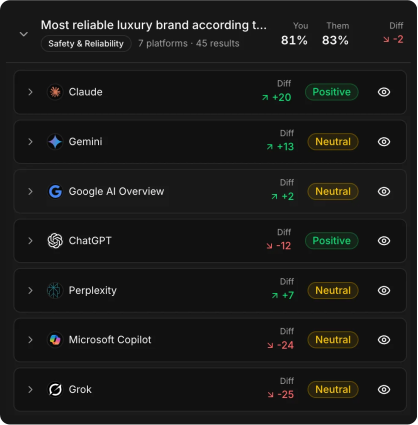
Ansvisor's AI Prompt Tracking & Analytics connects prompt-level visibility with demand, trends, citations, competitors, and performance changes so teams can understand which questions matter most.
Why does prompt selection matter for AI Visibility Metrics?
AI visibility measurements depend heavily on the prompts included in the monitoring dataset.
A brand could appear highly visible if the tracked set contains mostly branded questions, while appearing much weaker across non-branded category, comparison, and recommendation prompts.
A balanced measurement framework should therefore consider different topics and stages of customer intent.
This is also why visibility percentages from two different datasets should not automatically be compared as equivalent measurements.
What are competitor AI Visibility Metrics?
Competitor AI Visibility Metrics compare a brand's performance with other companies appearing across the same monitored AI answers.
Useful competitor metrics can include:
- Competitor Visibility Rate.
- Competitor Share of Voice.
- Competitor mentions.
- Competitor citations.
- Competitive Prompt Coverage.
- Platform-level visibility differences.
- Historical gains and losses.
Competitive metrics provide context. A brand's visibility may increase while a competitor grows even faster, or absolute visibility may remain stable while competitive Share of Voice improves.
What is answer prominence?
Answer prominence describes how visibly or strongly a brand is represented within an AI-generated response.
Simply appearing somewhere in a long answer can be different from being presented as a primary recommendation, leading option, or prominent comparison choice.
Some AI visibility methodologies therefore consider factors beyond binary presence when measuring performance.
Because answer formats vary substantially across platforms, prominence metrics should be interpreted according to the methodology used to calculate them.
What is AI Ranking as a visibility metric?
AI Ranking attempts to describe the relative position or prominence of brands within generated answers.
Unlike traditional search rankings, AI answers do not always provide a stable numbered list. A brand can appear in a paragraph, comparison table, recommendation list, cited source, or summary.
For this reason, AI Ranking is usually most useful when combined with visibility, mentions, citations, and answer context rather than treated as a direct equivalent of a conventional SERP position.
What is AI Referral Traffic?
AI Referral Traffic measures identifiable website visits that arrive from AI-powered search, answer, and discovery platforms.
It adds a downstream performance layer to AI visibility measurement.
Referral metrics can help teams understand:
- Which AI platforms send visitors.
- Which pages receive AI-referred traffic.
- How AI referral traffic changes over time.
- Which landing pages attract AI visitors.
- How AI-referred visitors engage after arriving.
AI Traffic Analytics can connect AI-referred visits with traffic sources, landing pages, trends, and downstream website behavior.
What is AI-Referred Traffic?
AI-Referred Traffic generally describes website visits that can be attributed to an AI-powered platform through identifiable referral information.
The terms AI Referral Traffic and AI-Referred Traffic are commonly used for closely related measurements of this traffic layer.
These metrics are useful because they help connect AI discovery with measurable website activity.
However, they do not capture every journey influenced by an AI-generated answer.
Is AI Referral Traffic the same as AI Visibility?
No.
AI Visibility measures presence within AI-generated answers. AI Referral Traffic measures identifiable visits arriving from AI platforms.
Someone can discover a brand, learn about a product, or include a company in their consideration set without clicking a citation or referral link.
Referral traffic is therefore an important AI Search metric, but it should not be treated as the complete measurement of AI influence.
Can AI Visibility Metrics be connected to conversions?
When AI-referred visits are identifiable, analytics systems can measure what those visitors do after reaching the website.
Depending on the organization's analytics setup, downstream metrics may include:
- Engaged sessions.
- Key events.
- Sign-ups.
- Lead generation.
- Purchases.
- Revenue.
These are business outcome metrics rather than direct AI Visibility Metrics, but connecting the two can help teams understand the commercial value of identifiable AI referral traffic.
How are AI Visibility Metrics different from SEO metrics?
SEO metrics and AI Visibility Metrics measure related but different discovery environments.
| Traditional SEO Metrics | AI Visibility Metrics |
|---|---|
| Keyword rankings | Prompt-Level Visibility |
| Search impressions | AI Visibility |
| Organic clicks | AI Referral Traffic |
| CTR | Mentions and Citation Rate |
| Ranking URLs | Cited URLs and sources |
| SERP competitors | AI answer competitors |
These measurement systems should be used together rather than treated as replacements for one another.
What are AI Visibility KPIs?
AI Visibility Metrics describe measurable signals. AI Visibility KPIs are the specific performance indicators an organization chooses to prioritize against defined goals.
KPI → What performance outcome are we trying to improve?
Example AI Visibility KPIs can include:
- Increase Visibility Rate for high-value prompts.
- Increase Citation Rate.
- Expand non-branded Prompt Coverage.
- Increase AI Share of Voice.
- Reduce competitor visibility gaps.
- Increase visibility across strategic topics.
- Grow AI Referral Traffic.
Ansvisor's AI Search KPIs & Actions connects measurable signals with KPIs, opportunities, evidence, and actions so teams can move from monitoring performance to improving it.
What is a good AI Visibility Score?
There is no universal AI Visibility Score that defines strong performance across every company, industry, platform, and measurement system.
A score depends on factors such as:
- The prompts included in the dataset.
- The competitors being monitored.
- The AI platforms measured.
- Geography and language.
- Brand and non-brand query mix.
- The scoring methodology.
- The category's competitive environment.
A more useful approach is to establish a consistent baseline and measure changes against historical performance, strategic objectives, and relevant competitors.
How often should AI Visibility Metrics be tracked?
AI Visibility Metrics should be monitored over time rather than measured through occasional one-off tests.
AI-generated answers can change because of:
- Model updates.
- Retrieval changes.
- New web content.
- Competitor activity.
- Changing source availability.
- Prompt variation.
- Platform updates.
Historical measurement helps distinguish short-term answer variability from sustained visibility changes.
Why are historical AI Visibility Metrics important?
A single visibility measurement provides a snapshot. Historical metrics reveal direction.
Tracking changes over time can show:
- Whether overall visibility is growing.
- Which topics are improving.
- Where citations are being gained or lost.
- Whether competitors are gaining Share of Voice.
- Which prompts have changed.
- Whether optimization efforts correspond with sustained improvements.
Trend data is especially important in AI Search because individual generated answers can vary.
Can one metric measure total AI Search performance?
No single metric fully represents AI Search performance.
For example:
- Visibility shows presence but not necessarily source authority.
- Mentions show representation but not necessarily citations.
- Citations show sourcing but not necessarily recommendation strength.
- Share of Voice shows competitive presence but not market share.
- Referral traffic shows identifiable visits but not zero-click influence.
How do you measure AI Search visibility correctly?
A useful measurement framework begins with a representative prompt set, tracks answers consistently, separates different visibility signals, compares performance with relevant competitors, and monitors changes over time.
Teams should also document which platforms, countries, languages, prompts, and competitors are included so that changes can be interpreted consistently.
For a broader measurement framework, see how to measure AI Search visibility across prompts, mentions, citations, Share of Voice, competitors, and AI traffic.
What are the limitations of AI Visibility Metrics?
AI Visibility Metrics provide useful intelligence, but they have important limitations.
- AI answers can vary between repeated generations.
- Tracked prompts represent a selected dataset rather than every private conversation.
- Different platforms may produce different answers for similar prompts.
- Visibility scores can use different methodologies.
- A mention does not necessarily indicate a recommendation.
- A citation does not guarantee a click.
- AI Referral Traffic does not capture every AI-influenced journey.
- Share of Voice does not represent total market share.
These limitations make methodology, historical consistency, and multi-metric analysis especially important.
How do you turn AI Visibility Metrics into actions?
Measurement becomes more valuable when a metric can be connected to a specific opportunity.
For example:
- Low Prompt Coverage can reveal missing content opportunities.
- Strong mentions but weak citations can reveal citation opportunities.
- Low Share of Voice can reveal competitive gaps.
- Strong citations but low AI referral traffic can reveal landing-page or conversion opportunities.
- Weak platform coverage can reveal distribution gaps.
- Declining visibility can trigger investigation into prompts, sources, and competitors.
This approach prevents AI visibility measurement from becoming a collection of dashboard numbers without a clear next step.
AI Visibility Metrics and AI Search Intelligence
AI Visibility Metrics describe what is happening across AI-generated discovery. AI Search Intelligence connects those measurements with context, opportunities, business data, and actions.
An AI Search Intelligence Platform can combine prompts, AI answers, mentions, citations, competitors, search data, AI traffic, and other signals to help teams understand where performance is changing and what should be prioritized next.
This creates a broader measurement system in which AI Visibility Metrics are not the final output. They become inputs for decisions about content, citations, competitive positioning, authority, distribution, and growth.
From AI Visibility Metrics to measurable growth
The value of AI Visibility Metrics increases when organizations can connect visibility with the broader customer journey.
Not every AI journey follows this exact path, and many AI interactions can influence decisions without generating an identifiable referral. But measuring these signals together provides a more complete view of how a brand is performing as AI-powered discovery becomes a larger part of search and customer research.
FAQ
What are AI Visibility Metrics?

AI Visibility Metrics measure how a brand performs across AI-generated answers. Common metrics include AI Visibility Rate, mentions, citations, Citation Rate, Share of Voice, Prompt Coverage, Prompt-Level Visibility, competitor visibility, AI Referral Traffic, and historical visibility trends.
How do you measure AI visibility?
AI visibility can be measured by monitoring a consistent set of relevant prompts across AI platforms and analyzing brand presence, mentions, citations, competitors, Share of Voice, prompt coverage, answer context, and changes over time.
What are the most important AI Visibility Metrics?
Important metrics include AI Visibility Rate, AI Visibility Score, AI Mentions, AI Citations, Citation Rate, Share of Voice, Prompt Coverage, competitor visibility, AI Referral Traffic, and historical performance. The appropriate combination depends on the objective being measured.
What is a good AI Visibility Score?
There is no universal good AI Visibility Score because scoring methodologies, prompt sets, platforms, competitors, markets, and weighting systems vary. It is generally more useful to compare performance consistently against historical results, competitors, and defined objectives.
What is the difference between AI Visibility Metrics and SEO metrics?
SEO metrics typically measure keyword rankings, impressions, clicks, CTR, and organic traffic. AI Visibility Metrics measure performance inside AI-generated answers through prompts, mentions, citations, Share of Voice, competitor visibility, answer prominence, and AI-referred traffic. The two measurement systems are complementary rather than replacements for one another.
Win customers from all major AI platforms
Understand, measure, and optimize your AI visibility via Ansvisor.
✓ Add brand, domains and competitors
✓ Discover prompts and growth opportunities
✓ Track your AI visibility across major AI platforms
✓ Monitor citations, mentions, and competitors
✓ Measure AI traffic and customer discovery
✓ Receive AI recommendations based on AI insights
✓ Optimize authority, trust, and content quality
✓ Create content, automate analysis & action with AI agents
AI Visibility Terms
Continue exploring key AI visibility concepts.
AI Visibility
Measure and improve how often your brand appears in AI-generated answers.
Learn more →Answer Engine Optimization (AEO)
Strategies for increasing visibility in answer engines and AI summaries.
Learn more →Generative Engine Optimization (GEO)
Optimizing content for AI-powered discovery experiences.
Learn more →ChatGPT Search
Understand how OpenAI retrieves and synthesizes information.
Learn more →Google AI Overviews
AI-generated summaries that appear directly in Google Search.
Learn more →Perplexity Search
Explore how Perplexity cites and presents sources.
Learn more →AI Citations
References and sources used by AI systems to support answers.
Learn more →Citation Authority
Measure the quality and influence of cited sources.
Learn more →Retrievability
How easily AI systems can discover and reuse your content.
Learn more →New terms are added regularly.
Help us improve the page or suggest a new term →
Cihan Geyik
Co-founder at Ansvisor
Cihan Geyik is the co-founder of Ansvisor, an open-source AI Visibility platform for AI Search. With more than 15 years of experience in digital marketing and growth, he writes about AI visibility, AI search, AEO, GEO, citations, and answer engines. He focuses on helping brands understand and improve their presence across ChatGPT, Gemini, Perplexity, Google AI Overviews, and other AI-powered discovery platforms.
Make Your Brand Visible in AI Answers.

INDUSTRIES


© 2026 Ansvisor. All rights reserved. Ansvisor is an open-source AI Search Intelligence Platform for AI Visibility.


.svg)
