


AI Search Monitoring
AI Search Monitoring is the continuous observation of prompts, AI-generated answers, brand visibility, mentions, citations, competitors, sources, rankings, and other signals to detect meaningful changes across AI-powered search and answer environments.
Rather than measuring only a brand's current visibility, AI Search Monitoring watches the broader AI Search environment for changes that may require attention. These changes can include a brand disappearing from an important answer, a new competitor gaining visibility, a citation being gained or lost, or a different source beginning to appear across a group of relevant prompts.
The purpose of AI Search Monitoring is therefore not simply to collect more AI-generated answers. It is to create a repeatable observation system that helps teams identify what changed, where it changed, and whether the change deserves investigation or action.
How does AI Search Monitoring work?
AI Search Monitoring starts by defining the topics, prompts, competitors, platforms, and signals that matter to a business. Those signals are then observed repeatedly so current results can be compared with previous observations.
A typical monitoring workflow includes:
- Define strategically important topics and customer intents.
- Build a representative set of prompts.
- Select relevant AI Search platforms.
- Observe generated answers on a recurring basis.
- Capture mentions, citations, competitors, rankings, and sources.
- Compare new observations with historical data.
- Detect meaningful gains, losses, and changes.
- Investigate the evidence behind important changes.
- Prioritize opportunities or corrective actions.
Ansvisor's AI Prompt Tracking & Analytics connects monitored prompts with visibility, demand, citations, competitors, and historical performance.
What can you monitor in AI Search?
AI Search Monitoring can include multiple signals because changes in AI visibility rarely occur in isolation.
| Signal | What Can Be Monitored |
|---|---|
| Prompts | Changes in answers for strategically important customer questions. |
| Brand Visibility | Whether and how consistently the brand appears. |
| Mentions | New, recurring, increasing, or disappearing brand mentions. |
| Citations | Owned, competitor, and third-party citation gains and losses. |
| Competitors | New competitors and changes in relative visibility. |
| Share of Voice | Changes in relative brand presence within a monitored dataset. |
| Sources | New, recurring, or disappearing domains and URLs used in answers. |
| Rankings & Prominence | Changes in where and how prominently a brand appears. |
| AI Referral Traffic | Changes in identifiable website visits from AI-powered platforms. |
The objective is not necessarily to monitor every possible signal. A useful monitoring program prioritizes the signals connected to the organization's customers, markets, products, competitors, and business objectives.
Why is continuous AI Search Monitoring important?
AI-generated answers are dynamic. The brands, sources, citations, and recommendations appearing for the same or similar questions can change over time.
A one-time manual search provides only a snapshot.
Repeated Monitoring → Change Intelligence
Continuous monitoring creates historical context. This makes it possible to distinguish an isolated observation from a recurring change that may affect visibility, competitive position, source coverage, or customer discovery.
What is prompt monitoring in AI Search?
Prompt monitoring is the repeated observation of strategically selected questions across AI-powered search and answer platforms.
Prompts act as measurement points. They can represent different topics and customer intents, including:
- Informational questions.
- Product or service recommendations.
- Best-product queries.
- Alternative searches.
- Competitor comparisons.
- Use-case questions.
- Technical questions.
- High-intent commercial questions.
Monitoring the same or comparable prompt portfolio over time makes it possible to observe how answers, brands, citations, and competitors change.
How do you monitor brand mentions in AI answers?
Brand mention monitoring identifies when a company, product, service, or other tracked entity appears within generated answers.
Teams can monitor:
- New brand mentions.
- Lost brand mentions.
- Prompts generating mentions.
- Topics associated with the brand.
- Platforms where mentions occur.
- Competitors appearing alongside the brand.
- Changes in mention frequency.
Monitoring should also preserve answer context. A mention does not necessarily mean the brand is being recommended.
How do you monitor AI citations?
AI citation monitoring observes the domains and URLs referenced within generated answers and tracks how those sources change over time.
This can reveal:
- New citations to owned content.
- Lost citations.
- Competitor citation gains.
- New third-party sources.
- Changes in Citation Rate.
- Changes in the URLs cited for important prompts.
Citation monitoring becomes particularly useful when changes are connected back to the prompts and topics where they occurred.
How do you monitor competitors in AI Search?
Competitor monitoring observes how competing brands appear across the same AI Search environment.
It can detect:
- A new competitor appearing for an important prompt.
- A competitor gaining Share of Voice.
- A competitor receiving new citations.
- A competitor becoming more prominent in recommendations.
- A competitor expanding into additional prompt clusters.
- A competitor gaining visibility on additional AI platforms.
This provides context for a brand's own performance. Stable visibility may appear positive until monitoring shows that competitors are gaining substantially faster.
What is AI source monitoring?
AI source monitoring observes which domains and URLs appear as sources across generated answers and how that source ecosystem changes.
Sources can include:
- Brand websites.
- Competitor websites.
- Industry publications.
- News websites.
- Review platforms.
- Forums and communities.
- Research resources.
- Documentation.
- Comparison websites.
A new source repeatedly appearing across relevant prompts may be worth investigating. Similarly, the disappearance of a previously common source can signal a change in the observable citation environment.
How do you monitor AI rankings and answer prominence?
AI ranking monitoring observes where and how prominently brands appear within generated answers.
Unlike traditional search results, AI-generated answers do not always contain a stable ordered list of links. A brand might appear:
- First in a recommendation list.
- Inside a comparison table.
- Within a paragraph.
- As one of several alternatives.
- Only as a cited source.
Monitoring answer prominence therefore requires more context than simply recording a conventional numeric ranking.
What changes should AI Search Monitoring detect?
A monitoring system becomes useful when it can distinguish important changes from the normal flow of collected data.
Examples of changes worth investigating include:
- A brand disappearing from a high-value prompt.
- A brand beginning to appear for a previously uncovered prompt.
- A new competitor entering an important answer set.
- A meaningful increase or decline in Share of Voice.
- An owned citation being gained or lost.
- A competitor gaining citations across multiple prompts.
- A new third-party source repeatedly appearing.
- A change in answer prominence.
- A major difference in visibility on one AI platform.
- A sustained change across an entire topic or prompt cluster.
What is change detection in AI Search?
Change detection compares a new observation with previous observations to identify what has changed.
The significance of a change can depend on several factors, including its size, duration, affected prompts, topic importance, competitor activity, and potential business impact.
For example, losing one mention in a low-priority prompt may be normal variation. Losing visibility across an entire high-value commercial prompt cluster may deserve immediate investigation.
What are AI Search alerts?
AI Search alerts are notifications triggered when monitored signals meet defined change conditions or thresholds.
Potential alerts can include:
- Significant visibility loss.
- Important citation loss.
- A new competitor appearing.
- A major Share of Voice change.
- A high-priority prompt changing significantly.
- A new source repeatedly appearing.
- A meaningful platform-level visibility change.
Alerting should be selective. Generating a notification for every variation can create noise and make important changes harder to identify.
How do you monitor AI Search across multiple platforms?
Multi-platform monitoring observes comparable prompts and signals across the AI-powered environments relevant to a brand's audience.
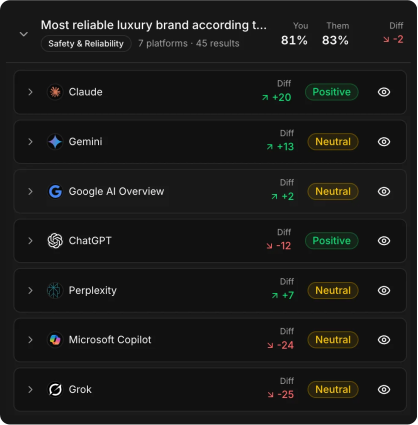
Depending on the monitoring scope, this can include platforms such as ChatGPT, Gemini, Claude, Perplexity, Microsoft Copilot, Google AI Overviews, and Google AI Mode.
Cross-platform monitoring matters because different systems can return different brands, citations, sources, recommendations, and answer structures for similar questions.
Monitoring these differences can reveal whether a visibility change is isolated to one platform or appears more broadly across the AI Search ecosystem.
Why is historical AI Search Monitoring important?
Historical monitoring provides the baseline required for meaningful change detection.
Without historical data, a team can see the current state but may not know whether that state represents an improvement, decline, recurring pattern, or temporary variation.
Historical monitoring can help answer questions such as:
- When did visibility begin changing?
- Which prompts were affected first?
- Did competitors change at the same time?
- Were citations gained or lost?
- Did the source mix change?
- Was the change temporary or sustained?
- Was one platform affected or several?
This makes monitoring more useful for diagnosis rather than simply reporting the latest state.
AI Search Monitoring vs AI Visibility Tracking
AI Search Monitoring and AI Visibility Tracking overlap, but their primary purposes are different.
| AI Visibility Tracking | AI Search Monitoring |
|---|---|
| Measures brand visibility | Observes the broader AI Search environment |
| Focuses on structured visibility measurement | Focuses on continuous observation and change detection |
| Measures performance over time | Identifies changes that may require attention |
| Visibility-centric | Includes visibility, prompts, citations, sources, competitors, and other signals |
| Answers “How is our visibility changing?” | Answers “What is changing across our AI Search environment?” |
The two practices are complementary. Visibility tracking provides structured performance measurement, while monitoring adds broader observation and change detection around that measurement.
Monitoring → Detect Meaningful Change
AI Search Monitoring vs AI Rank Tracking
AI Rank Tracking has a narrower scope. It focuses on where or how prominently a brand appears within generated answers for monitored prompts.
AI Search Monitoring can include ranking changes, but also observes mentions, citations, sources, competitors, Share of Voice, prompt coverage, and other signals.
A ranking change may therefore be one event detected within a broader AI Search Monitoring system.
How is AI Search Monitoring different from SEO monitoring?
SEO monitoring commonly observes signals such as traditional rankings, organic traffic, crawling, indexing, backlinks, and search performance.
AI Search Monitoring adds a different observation layer centered on generated answers.
| Traditional SEO Monitoring | AI Search Monitoring |
|---|---|
| Keywords | Prompts and conversational questions |
| SERP rankings | Brand presence and answer prominence |
| Organic competitors | Competitors appearing in AI-generated answers |
| Backlinks | AI citations and cited sources |
| Search traffic | AI Referral Traffic and AI-influenced discovery signals |
| Search result changes | Generated answer and source changes |
AI Search Monitoring does not replace SEO monitoring. It adds visibility into another discovery environment where customers can research brands, compare products, evaluate alternatives, and find information.
Can AI Search Monitoring observe every user query?
No.
AI Search Monitoring generally observes a defined portfolio of prompts rather than every private conversation occurring across AI platforms.
A monitored prompt set should therefore be treated as a measurement framework, not a complete record of all AI Search activity.
The usefulness of monitoring depends partly on how well the selected prompts represent important topics, customer questions, search demand, products, and business objectives.
How accurate is AI Search Monitoring?
AI Search Monitoring can identify useful patterns and changes, but generated answers are not always deterministic.
Results can vary because of:
- Model updates.
- Prompt wording.
- Answer variation.
- Retrieval differences.
- Platform-specific behavior.
- Location and language.
- Source freshness.
- Changes to available web content.
This is why monitoring should focus on repeated observations, consistent methodology, historical patterns, and meaningful changes rather than treating every individual answer variation as a major event.
How often should AI Search be monitored?
Monitoring frequency depends on business priorities, the importance of tracked prompts, the number of platforms, market volatility, and the cost of collecting AI-generated answers.
High-value commercial prompts or fast-moving categories may justify more frequent monitoring, while lower-priority topics may require less frequent observation.
The goal is to collect data consistently enough to identify meaningful changes without creating unnecessary noise or excessive measurement costs.
What are the limitations of AI Search Monitoring?
AI Search Monitoring provides useful observational intelligence, but it has limitations that should be considered when interpreting results.
- Generated answers can vary between repeated runs.
- Tracked prompts represent a selected measurement set.
- Private user conversations are generally not observable.
- Different platforms can produce different results.
- Not every detected change is strategically meaningful.
- A mention does not necessarily mean a recommendation.
- A citation does not necessarily generate traffic.
- Observed changes do not always reveal their underlying cause.
Monitoring should therefore be treated as a signal and investigation layer rather than a system that automatically explains every change.
How do you turn AI Search Monitoring into action?
Monitoring creates value when important changes lead to investigation, prioritization, and measurable action.
For example:
- Lost visibility can trigger investigation into affected prompts and competitors.
- A new competitor can reveal an emerging competitive threat.
- A citation loss can trigger source and content analysis.
- A recurring third-party source can reveal a distribution opportunity.
- Low coverage across a high-value prompt cluster can reveal a content opportunity.
- A platform-specific decline can trigger deeper platform analysis.
- A sustained Share of Voice change can influence prioritization.
Ansvisor's AI Search KPIs & Actions connects detected signals with evidence, measurable KPIs, opportunities, and prioritized actions.
This helps prevent monitoring from becoming a passive reporting exercise. The objective is to determine which changes matter and what should happen next.
AI Search Monitoring and AI Search Intelligence
AI Search Monitoring answers:
What is changing across our AI Search environment?
AI Search Intelligence extends that observation by connecting changes with prompts, visibility, citations, competitors, search data, business data, opportunities, and actions.
An AI Search Intelligence Platform can provide the broader layer needed to move from continuous observation to prioritization and execution.
In this model, monitoring is not the final objective. It is the continuous signal layer that helps teams detect meaningful changes, understand where attention is required, and connect AI Search data with measurable business decisions.
FAQ
What is AI Search Monitoring?

AI Search Monitoring is the continuous observation of prompts, AI-generated answers, brand visibility, mentions, citations, competitors, sources, rankings, and other signals to detect meaningful changes across AI-powered search environments.
What can you monitor in AI Search?
Teams can monitor prompts, brand visibility, mentions, citations, competitors, Share of Voice, cited domains and URLs, answer prominence, platform coverage, historical changes, and AI Referral Traffic.
What is the difference between AI Search Monitoring and AI Visibility Tracking?
AI Visibility Tracking primarily measures how a brand's visibility changes over time. AI Search Monitoring has a broader observation role, detecting changes across prompts, answers, mentions, citations, competitors, sources, visibility, and other AI Search signals.
What are AI Search alerts?
AI Search alerts are notifications triggered by meaningful changes in monitored signals, such as significant visibility loss, citation loss, a new competitor, a major Share of Voice change, or an important change affecting a high-value prompt.
Does AI Search Monitoring replace SEO monitoring?
No. SEO monitoring measures signals such as traditional rankings, organic traffic, crawling, indexing, and backlinks. AI Search Monitoring adds an additional layer for prompts, generated answers, mentions, citations, competitors, and sources across AI-powered discovery environments.
Win customers from all major AI platforms
Understand, measure, and optimize your AI visibility via Ansvisor.
✓ Add brand, domains and competitors
✓ Discover prompts and growth opportunities
✓ Track your AI visibility across major AI platforms
✓ Monitor citations, mentions, and competitors
✓ Measure AI traffic and customer discovery
✓ Receive AI recommendations based on AI insights
✓ Optimize authority, trust, and content quality
✓ Create content, automate analysis & action with AI agents
AI Visibility Terms
Continue exploring key AI visibility concepts.
AI Visibility
Measure and improve how often your brand appears in AI-generated answers.
Learn more →Answer Engine Optimization (AEO)
Strategies for increasing visibility in answer engines and AI summaries.
Learn more →Generative Engine Optimization (GEO)
Optimizing content for AI-powered discovery experiences.
Learn more →ChatGPT Search
Understand how OpenAI retrieves and synthesizes information.
Learn more →Google AI Overviews
AI-generated summaries that appear directly in Google Search.
Learn more →Perplexity Search
Explore how Perplexity cites and presents sources.
Learn more →AI Citations
References and sources used by AI systems to support answers.
Learn more →Citation Authority
Measure the quality and influence of cited sources.
Learn more →Retrievability
How easily AI systems can discover and reuse your content.
Learn more →New terms are added regularly.
Help us improve the page or suggest a new term →
Cihan Geyik
Co-founder at Ansvisor
Cihan Geyik is the co-founder of Ansvisor, an open-source AI Visibility platform for AI Search. With more than 15 years of experience in digital marketing and growth, he writes about AI visibility, AI search, AEO, GEO, citations, and answer engines. He focuses on helping brands understand and improve their presence across ChatGPT, Gemini, Perplexity, Google AI Overviews, and other AI-powered discovery platforms.
Make Your Brand Visible in AI Answers.

INDUSTRIES


© 2026 Ansvisor. All rights reserved. Ansvisor is an open-source AI Search Intelligence Platform for AI Visibility.


.svg)
