Why LLM Optimization matters
LLM Optimization is the practice of improving how large language models (LLMs) retrieve, understand, cite, and recommend information. Rather than optimizing for traditional search rankings, LLM optimization focuses on increasing visibility within AI-generated answers, recommendations, and conversational search experiences.
As platforms powered by Large Language Models (LLMs) increasingly influence how users discover products, brands, and information, organizations must optimize for retrieval, authority, and AI understanding.
Benefits of LLM optimization include:
- Increase AI visibility.
- Improve citation frequency.
- Strengthen entity authority.
- Increase recommendations.
- Improve competitive positioning.
LLM optimization represents a shift from optimizing webpages for rankings toward optimizing entities and information for AI understanding.
How LLM Optimization works
LLM optimization focuses on improving signals that influence AI retrieval and generation systems.
- Content quality.
- Entity authority.
- Source authority.
- Knowledge coverage.
- Structured information.
- Citation opportunities.
Because modern AI systems increasingly rely on retrieval architectures, optimization efforts focus on improving discoverability and retrievability rather than manipulating model outputs directly.
Technologies such as Retrieval-Augmented Generation (RAG), Grounding, and Knowledge Retrieval strongly influence how LLMs access and use information.
What influences LLM Optimization?
Several factors affect visibility within LLM-powered search experiences.
Organizations that establish strong authority and produce retrievable, trustworthy information are more likely to appear in AI-generated answers.
How LLM Optimization differs from traditional SEO
LLM optimization and traditional SEO optimize for different systems and objectives.
- SEO optimizes rankings.
- LLM optimization improves retrieval.
- SEO prioritizes clicks.
- LLM optimization prioritizes citations and recommendations.
- SEO focuses on webpages.
- LLM optimization focuses on entities and knowledge.
Strategies such as Answer Engine Optimization (AEO), Generative Engine Optimization (GEO), and AI Content Optimization are often considered subsets of broader LLM optimization efforts.
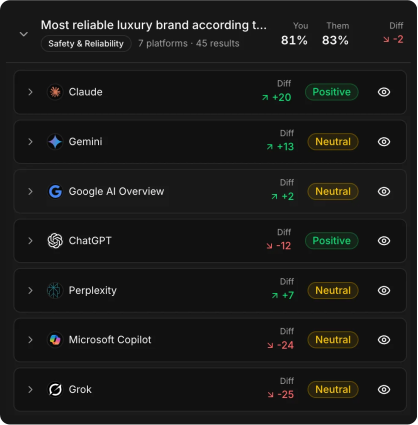
Platforms such as Ansvisor help organizations optimize for LLM-powered search by analyzing prompts, citations, competitors, answer engines, entity authority, and AI visibility opportunities across multiple AI ecosystems.
Common misconceptions
Common misconceptions about LLM optimization include:
- LLM optimization replaces SEO.
- Prompt engineering improves brand visibility.
- Keywords alone influence LLMs.
- LLMs only use training data.
- AI visibility can be optimized on a single platform.
Effective LLM optimization requires improving authority, retrieval, knowledge coverage, and trust signals across multiple AI ecosystems rather than optimizing for a single ranking algorithm.








.svg)
