


Cloudflare
What is Cloudflare?
Cloudflare is a global web infrastructure, security, performance, and connectivity platform used to protect and deliver websites, applications, and APIs.
Within AI search and generative discovery, Cloudflare provides infrastructure for understanding and controlling how AI crawlers, AI assistants, search bots, and agentic systems access website content.
Its primary product for this area is AI Crawl Control, formerly known as AI Audit. AI Crawl Control gives website owners visibility into AI crawler activity and tools for deciding which AI services can access their content.
What is Cloudflare AI Crawl Control?
Cloudflare AI Crawl Control is a website-level control and analytics layer for AI crawlers.
It helps site owners understand which AI services are accessing their content, how often those systems crawl the site, which pages they request, whether they follow robots.txt directives, and whether access should be allowed, blocked, or monetized.
Unlike AI visibility platforms that focus primarily on prompts, mentions, citations, or Share of Voice, Cloudflare operates closer to the infrastructure layer. It monitors the interaction between AI systems and the website itself.
What does Cloudflare AI Crawl Control do?
AI Crawl Control observes requests made by AI crawlers and provides tools for monitoring and managing those requests.
Teams can use the product to understand:
- Which AI crawlers access the website.
- How frequently they crawl.
- Which pages they request.
- Which requests succeed or fail.
- Whether robots.txt directives are being followed.
- Which AI services send referral traffic.
- Which crawlers should be allowed or blocked.
Because Cloudflare sits between users, bots, and the origin server, it can observe and enforce these policies at the network layer.
What are the key AI search features of Cloudflare?
Cloudflare provides several capabilities relevant to AI discovery, crawler governance, and AI search infrastructure.
- AI Crawl Control: Monitors and manages how AI crawlers access website content.
- AI Crawler Analytics: Shows crawler request volume, trends, paths, operators, hostnames, and response status codes.
- Allow and Block Controls: Lets site owners allow or block individual AI crawlers.
- robots.txt Monitoring: Tracks crawler behavior against robots.txt directives and helps identify violations.
- Managed robots.txt: Helps organizations centrally manage crawler directives through Cloudflare.
- Bot Detection: Uses Cloudflare's bot intelligence to identify known AI crawlers and assistants.
- WAF Integration: Allows organizations to enforce AI crawler policies through Web Application Firewall rules.
- AI Referral Analytics: Tracks referral traffic arriving from AI platforms on supported plans.
- Pay Per Crawl: Provides an experimental model for charging selected AI crawlers for content access.
- AI Labyrinth: Provides mechanisms for dealing with unwanted or non-compliant AI crawling behavior.
- GraphQL Analytics API: Makes AI crawler analytics available programmatically for custom reporting and monitoring.
- Licensing Signals: Supports response headers and policy mechanisms that can communicate licensing or usage terms to crawlers.
Which AI crawlers does Cloudflare recognize?
Cloudflare maintains a bot reference that includes crawlers and assistants from major AI providers.
Current examples include:
- GPTBot.
- ChatGPT-User.
- OAI-SearchBot.
- ClaudeBot.
- Claude-SearchBot.
- Claude-User.
- PerplexityBot.
- Perplexity-User.
- Google-CloudVertexBot.
- Meta-ExternalAgent.
- Meta-ExternalFetcher.
- Applebot.
- Amazonbot.
- MistralAI-User.
- CCBot.
- Bytespider.
- DuckAssistBot.
Cloudflare also tracks conventional search crawlers such as Googlebot and Bingbot within its broader bot-management systems.
The exact bot list changes over time as AI providers introduce new crawlers, assistants, and search products.
How does Cloudflare detect AI crawlers?
Cloudflare can identify AI crawler activity using several levels of detection.
On basic plans, AI Crawl Control can detect well-known crawlers using their declared user-agent strings.
Enterprise customers using Bot Management can access more advanced detection based on Cloudflare's bot-identification systems rather than relying only on user-agent text.
This distinction matters because user agents can be spoofed, while behavioral and network-level bot detection can provide more reliable classification.
How does Cloudflare monitor AI crawler activity?
AI Crawl Control provides analytics across Overview, Crawlers, Directives, and Metrics views.
Teams can analyze:
- Total request volume.
- Allowed requests.
- Unsuccessful requests.
- Most active AI crawlers.
- Most frequently crawled pages.
- Response status codes.
- Traffic by hostname.
- Traffic by path.
- Traffic by crawler operator.
- Referral traffic from AI services.
These signals help teams understand how AI systems interact with website content before that content appears within generated answers.
How does Cloudflare manage AI crawler access?
Cloudflare allows website owners to control individual AI crawlers at the network layer.
Teams can create policies that:
- Allow selected AI crawlers.
- Block selected AI crawlers.
- Apply different rules to different paths.
- Combine AI Crawl Control with WAF rules.
- Apply bot-management policies according to crawler behavior.
This gives organizations more direct enforcement capability than relying exclusively on robots.txt.
robots.txt communicates preferences to crawlers, while Cloudflare's network controls can actively block requests when required.
How does Cloudflare use robots.txt for AI crawlers?
robots.txt remains one of the primary mechanisms for communicating crawler-access preferences.
Cloudflare's Directives view helps organizations inspect how AI crawlers interact with robots.txt files across their domains.
Teams can use this information to:
- Confirm that robots.txt is available.
- Review which crawlers access restricted paths.
- Identify crawlers that ignore directives.
- Monitor crawler request patterns.
- Assess whether the site is configured appropriately for AI agents.
Cloudflare can also manage robots.txt centrally and apply enforcement rules when crawler behavior does not match the organization's policy.
What is the difference between robots.txt and Cloudflare AI Crawl Control?
robots.txt is primarily an instruction mechanism. It tells compliant crawlers which areas of a website they should or should not access.
AI Crawl Control adds observation and enforcement.
With Cloudflare, organizations can see whether a crawler actually follows robots.txt and can block requests through network-level controls when necessary.
This creates a stronger governance model than relying on crawler cooperation alone.
How does Cloudflare classify AI bot behavior?
Cloudflare distinguishes between different types of AI bot activity because not every AI crawler serves the same purpose.
Current classifications include behaviors such as:
- Search: Crawlers that index or retrieve content for AI-powered search and answer experiences.
- Agent: Automated systems acting on behalf of a user in real time.
- Training: Crawlers collecting content for model training or related dataset creation.
Separating these categories allows website owners to create more nuanced policies.
For example, an organization may allow AI search crawlers that can generate discovery and referral traffic while blocking crawlers primarily associated with model training.
How can Cloudflare affect AI search visibility?
Cloudflare does not directly determine whether a brand appears in ChatGPT, Gemini, Perplexity, or another AI-generated answer.
However, it can influence the technical accessibility layer required for AI retrieval.
If a website blocks relevant AI search crawlers, those systems may have less direct access to its content. Conversely, allowing appropriate crawlers can make content accessible for search and retrieval use cases.
Cloudflare can therefore help teams answer questions such as:
- Can AI search crawlers access our content?
- Are important pages returning successful responses?
- Are we unintentionally blocking AI discovery?
- Are unwanted training crawlers accessing our site?
- Which pages attract the most AI crawler activity?
These signals complement prompt, citation, and AI visibility analytics provided by other tools.
How does Cloudflare track AI referral traffic?
Cloudflare can identify referral traffic arriving from known AI platform domains on supported plans.
Examples of AI referral sources can include:
- ChatGPT.
- Claude.
- Perplexity.
- Google.
- Microsoft.
- Meta.
- DuckDuckGo.
- Apple.
- Amazon.
Referral analytics help organizations distinguish AI crawler activity from real human visitors arriving through AI-powered discovery.
This is important because a crawler request does not represent a user visit, while referral traffic can indicate measurable downstream discovery.
What is Pay Per Crawl in Cloudflare?
Pay Per Crawl is an experimental Cloudflare capability that allows website owners to charge selected AI crawlers for accessing content.
Site owners can define crawl pricing and apply different rules to specific content or URL patterns.
Cloudflare can then mediate access between the crawler and the website based on those pricing rules.
The feature is currently available in beta and represents a potential economic model for compensating publishers whose content is used by AI systems.
How does dynamic Pay Per Crawl pricing work?
Cloudflare supports more advanced Pay Per Crawl configurations where pricing can vary according to the requested content.
A website can use origin response headers or Cloudflare Workers to determine a crawl price dynamically.
This can allow publishers to:
- Charge different prices for different sections.
- Provide some content without charge.
- Price premium content differently.
- Apply crawler-specific access strategies.
This creates more granular control than applying one universal price to every crawler request.
What is Cloudflare AI Labyrinth?
AI Labyrinth is part of Cloudflare's broader approach to unwanted or non-compliant AI crawler behavior.
It is intended to help protect websites from AI bots that do not follow recommended access guidelines.
AI Labyrinth complements AI Crawl Control by providing another mechanism for dealing with automated systems that website owners do not want freely crawling their content.
How does Cloudflare work with WAF for AI crawler management?
Cloudflare AI Crawl Control integrates with the Web Application Firewall to enforce crawler-access policies.
WAF custom rules can be used to block or control AI crawler requests before they reach the origin server.
This allows organizations to create detailed policies based on:
- Crawler identity.
- Request path.
- Bot classification.
- Hostname.
- Other request characteristics.
For organizations with complex websites, this can provide more precise AI access governance than a single global allow-or-block switch.
Does Cloudflare provide an API for AI crawler analytics?
Yes. AI Crawl Control analytics can be accessed through Cloudflare's GraphQL Analytics API.
Organizations can use the API to:
- Build custom AI crawler dashboards.
- Export AI traffic data.
- Integrate crawler analytics with internal monitoring systems.
- Analyze specific paths or hostnames.
- Track known AI user agents.
- Analyze AI referral traffic.
This is useful for enterprise teams that want AI crawler behavior integrated into broader observability, analytics, or security systems.
How can AI visibility platforms use Cloudflare data?
AI visibility platforms can use Cloudflare as a website-level data source for understanding AI crawler activity.
Cloudflare data can complement answer-level AI visibility data with signals such as:
- Which AI crawlers visited a page.
- When they visited.
- How frequently they visited.
- Whether the request succeeded.
- Which paths attracted crawler activity.
- Whether AI referral traffic followed.
Combining these signals with prompts, citations, mentions, and traffic analytics can create a broader view of the AI discovery journey.
A simplified sequence can be represented as:
Crawl → Retrieval → Citation → AI Answer → Referral → Conversion
Cloudflare provides particularly strong visibility into the crawl and access stages of that sequence.
How does Cloudflare support AI search technical optimization?
Cloudflare can help teams identify technical barriers affecting AI access.
Potential issues include:
- AI search crawlers being unintentionally blocked.
- Important pages returning unsuccessful status codes.
- robots.txt rules conflicting with AI search objectives.
- WAF rules blocking legitimate AI search crawlers.
- Outdated or duplicate pages being accessed instead of canonical content.
Cloudflare can also redirect verified AI training crawlers toward canonical URLs in certain configurations, helping reduce duplicate or deprecated-page crawling.
How is Cloudflare different from AI visibility monitoring tools?
AI visibility platforms typically analyze generated answers, prompts, citations, competitors, sentiment, and Share of Voice.
Cloudflare focuses primarily on the infrastructure interaction that happens before those answers are generated.
Instead of asking only:
- Does ChatGPT mention our brand?
- Which page received a citation?
Cloudflare helps answer:
- Did OpenAI's crawler access the page?
- Was the request allowed or blocked?
- Which AI services are crawling our website?
- Are they respecting our robots.txt directives?
- Which content receives the most AI crawler activity?
- Which AI services send referral traffic?
Cloudflare therefore complements AI visibility platforms rather than replacing them.
How does Cloudflare fit into AI SEO, AEO, and GEO?
Cloudflare operates primarily within the technical accessibility and crawler-governance layer of AI SEO, Answer Engine Optimization (AEO), and Generative Engine Optimization (GEO).
A strong AI search strategy requires content to be accessible to the relevant systems before it can be retrieved, cited, or recommended.
Cloudflare supports this layer through:
- AI crawler monitoring.
- Crawler allow and block controls.
- robots.txt management.
- WAF enforcement.
- Bot classification.
- AI referral analytics.
- Programmatic crawler data.
These capabilities can be combined with prompt monitoring, citation intelligence, content optimization, and traffic analytics from other tools to provide a more complete AI search workflow.
Who is Cloudflare AI Crawl Control for?
Cloudflare AI Crawl Control is relevant to organizations that need visibility and control over how AI systems access website content.
Potential users include:
- SEO and AI Search teams.
- AEO and GEO teams.
- Technical SEO teams.
- Web infrastructure teams.
- Security teams.
- Publishers.
- Media organizations.
- Developer teams.
- Enterprise websites.
- AI visibility platforms integrating crawler analytics.
It can be particularly valuable for organizations that need to balance AI discoverability with content protection, licensing, security, and infrastructure governance.
What should teams consider when evaluating Cloudflare for AI search?
Organizations evaluating Cloudflare should first define which types of AI access they want to encourage and which they want to restrict.
Important considerations include:
- Which AI search crawlers should be allowed.
- Which training crawlers should be blocked.
- Whether AI agents should have real-time access.
- robots.txt strategy.
- WAF configuration.
- Bot detection requirements.
- AI crawler analytics retention.
- Referral traffic measurement.
- Content licensing or monetization requirements.
Teams should also understand that allowing a crawler does not guarantee a citation or brand mention. Crawler accessibility is only one part of a broader AI search visibility strategy.
Cloudflare and the AI Search tools ecosystem
Cloudflare occupies the infrastructure and crawler-governance layer of the AI search ecosystem.
Its AI Crawl Control product provides website owners with visibility into crawler behavior, tools for enforcing access policies, robots.txt monitoring, AI referral analytics, and emerging content monetization mechanisms.
The broader AI search ecosystem also includes prompt-monitoring platforms, citation intelligence tools, AI visibility analytics products, traffic analytics systems, content optimization platforms, and data providers.
Ansvisor maintains a broader directory of AI SEO, AEO, GEO, AI visibility, and AI search tools to help teams understand these different layers and evaluate platforms according to their specific requirements.
Official source
FAQ
What is Cloudflare AI Crawl Control?

Cloudflare AI Crawl Control is a website-level analytics and control product that shows which AI crawlers access a site, how they interact with content, whether they follow robots.txt directives, and whether their access should be allowed or blocked.
Which AI crawlers can Cloudflare identify?
Cloudflare's current bot reference includes crawlers and assistants from OpenAI, Anthropic, Perplexity, Google, Microsoft, Meta, Apple, Amazon, Mistral, ByteDance, Common Crawl, and other providers.
Can Cloudflare block individual AI crawlers?
Yes. AI Crawl Control provides crawler-level allow and block controls, while Cloudflare WAF can be used to create more granular enforcement rules based on paths and other request characteristics.
Does Cloudflare track AI referral traffic?
Yes. AI Crawl Control can report referrals from known AI service domains on supported plans, helping teams distinguish human AI referral traffic from automated crawler requests.
Does Cloudflare provide AI crawler analytics through an API?
Yes. AI Crawl Control analytics are available through Cloudflare's GraphQL Analytics API, allowing organizations to build custom dashboards, exports, and internal monitoring systems.
Everything You Need to Improve Your AI Visibility
Track how your brand appears across AI platforms, understand what drives visibility, and turn insights into measurable actions.
Platform Features
Explore all features →Answer Engine Insights
Understand how AI platforms talk about your brand.
Prompt Intelligence
Discover and monitor the prompts shaping your AI visibility.
Citations Monitoring
Track which sources AI platforms cite and where your brand appears.
AI Traffic Analytics
Measure visits coming from ChatGPT, Gemini, Claude, and more.
Competitor Benchmarking
Compare AI visibility and uncover competitive gaps and opportunities.
Action Center
Turn AI Search signals into prioritized actions and executable tasks.
AI Visibility Trackers
Explore AI Visibility Platform →ChatGPT Visibility Tracker
Track brand mentions, citations, prompts, and visibility across ChatGPT.
Google AI Overviews Rank Tracker
Monitor where and how your brand appears in Google AI Overviews.
Google AI Mode Visibility Tracker
Track your brand's visibility across Google AI Mode experiences.
Gemini Visibility Tracker
Understand how your brand appears across Google Gemini responses.
Microsoft Copilot Visibility Tracker
Monitor your brand's presence across Microsoft Copilot answers.
Perplexity Visibility Tracker
Track brand mentions, citations, and visibility across Perplexity.
From AI Visibility insights to action.
Explore the complete Ansvisor platform for AI Search intelligence, optimization, and growth.
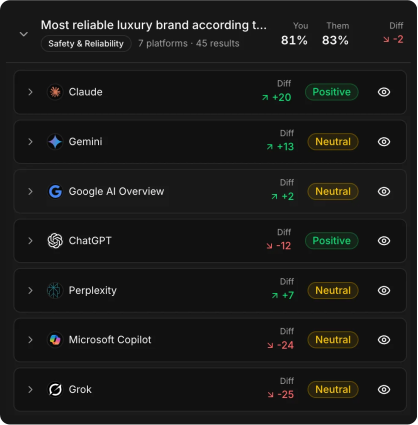
Win customers from all major AI platforms
Understand, measure, and optimize your AI visibility via Ansvisor.
✓ Add brand, domains and competitors
✓ Discover prompts and growth opportunities
✓ Track your AI visibility across major AI platforms
✓ Monitor citations, mentions, and competitors
✓ Measure AI traffic and customer discovery
✓ Receive AI recommendations based on AI insights
✓ Optimize authority, trust, and content quality
✓ Create content, automate analysis & action with AI agents
AI Visibility Terms
Continue exploring key AI visibility concepts.
AI Visibility
Measure and improve how often your brand appears in AI-generated answers.
Learn more →Answer Engine Optimization (AEO)
Strategies for increasing visibility in answer engines and AI summaries.
Learn more →Generative Engine Optimization (GEO)
Optimizing content for AI-powered discovery experiences.
Learn more →ChatGPT Search
Understand how OpenAI retrieves and synthesizes information.
Learn more →Google AI Overviews
AI-generated summaries that appear directly in Google Search.
Learn more →Perplexity Search
Explore how Perplexity cites and presents sources.
Learn more →AI Citations
References and sources used by AI systems to support answers.
Learn more →Citation Authority
Measure the quality and influence of cited sources.
Learn more →Retrievability
How easily AI systems can discover and reuse your content.
Learn more →New terms are added regularly.
Help us improve the page or suggest a new term →
Cihan Geyik
Co-founder at Ansvisor
Cihan Geyik is the co-founder of Ansvisor, an open-source AI Visibility platform for AI Search. With more than 15 years of experience in digital marketing and growth, he writes about AI visibility, AI search, AEO, GEO, citations, and answer engines. He focuses on helping brands understand and improve their presence across ChatGPT, Gemini, Perplexity, Google AI Overviews, and other AI-powered discovery platforms.
Get more Ansvisor insights in Google
Add Ansvisor as a Preferred Source to see more of our AI Search, AEO, GEO, and AI Visibility insights across Google.
Make Your Brand Visible in AI Answers.

INDUSTRIES


© 2026 Ansvisor. All rights reserved. Ansvisor is an open-source AI Search Intelligence Platform for AI Visibility. Ansvisor is a brand owned and operated by Empler AI Inc.


.svg)