

Airops
What is AirOps?
AirOps is an AI search and content engineering platform designed to help marketing teams measure, improve, and scale visibility across traditional search and AI-powered answer engines.
The platform combines AI search visibility monitoring, prompt intelligence, citation analysis, competitor tracking, page-level performance data, opportunity discovery, content workflows, knowledge bases, brand context, and publishing integrations.
AirOps is designed around a connected workflow that moves from understanding where a brand appears in AI search to identifying the highest-value opportunities and executing content or off-site actions intended to improve future visibility.
What does AirOps do?
AirOps monitors how brands and content perform across AI-generated search experiences and connects those insights with SEO and website analytics.
Teams can use the platform to understand which prompts mention their brand, which pages receive citations, which competitors have stronger visibility, which third-party sources influence AI answers, and which owned pages should be created, refreshed, or optimized.
These insights can then flow directly into AirOps workflows, Grids, Power Agents, and content-production systems so teams can act on opportunities without separating measurement from execution.
What are the key features of AirOps?
AirOps combines AI search intelligence with content engineering and workflow automation.
- AI Search Insights: Measures how brands perform across AI-generated search experiences.
- Prompt Tracking: Monitors strategically important questions across supported AI platforms.
- Mention Rate: Measures how frequently a brand appears within monitored AI responses.
- Citation Rate: Measures how frequently owned content is cited as a source.
- Share of Voice: Compares brand presence with competing organizations.
- Average Position: Helps teams understand where brands appear within AI-generated answers.
- Sentiment Analysis: Adds context around how AI systems describe a brand.
- Citation Intelligence: Identifies domains and URLs referenced across AI responses.
- Pages: Combines AI visibility, SEO performance, and website analytics at the page level.
- Page360: Provides a unified view of content performance across AI search, traditional search, and on-site engagement.
- Opportunities: Identifies content creation, content refresh, outreach, and community opportunities.
- Community Intelligence: Analyzes Reddit and other community content influencing AI-generated answers.
- Workflow Studio: Turns repeatable research, creation, optimization, and refresh strategies into automated workflows.
- Power Agents: Provides reusable agentic workflows for common content operations.
- Grid: Provides a collaborative environment for managing content and workflow execution at scale.
- Brand Kits: Stores brand voice, tone, rules, and guidelines for content workflows.
- Knowledge Bases: Grounds workflows in proprietary company information and connected data.
- MCP: Makes AirOps data and workflows accessible from compatible AI assistants.
Which AI platforms does AirOps track?
AirOps monitors brand performance across major AI search and answer engines.
Its current AI Search Analytics documentation lists:
- ChatGPT.
- Gemini.
- Perplexity.
- Google AI Mode.
- Google AI Overviews.
Other current AirOps product materials also reference Claude as part of its broader AI search visibility coverage.
Exact engine availability can vary by plan and product workflow, so organizations should evaluate the platform coverage available within their specific subscription.
How does prompt tracking work in AirOps?
Prompts represent questions and queries that customers may use when researching products, services, categories, or business problems through AI systems.
AirOps monitors tracked prompts daily across connected AI search platforms and analyzes the resulting answers.
Prompt-level metrics include:
- Prompt Volume.
- Mention Rate.
- Citation Rate.
- Brand visibility.
- Competitor visibility.
- Platform-level performance.
- Answer history.
Prompts can also be grouped into topics, tagged, segmented by region, and classified as brand-related or category-related.
This allows teams to move between high-level topic performance and the individual questions responsible for AI visibility.
What is Prompt Volume in AirOps?
AirOps provides Prompt Volume as a relative measure of demand associated with monitored AI search questions.
Prompt Volume is displayed using levels such as Very Low, Low, Medium, High, and Very High.
The signal combines AI search data with traditional search-volume information to help teams distinguish between prompts with different levels of potential audience interest.
This can help organizations prioritize opportunities instead of treating every monitored question as equally important.
How does AirOps measure AI visibility?
AirOps analyzes monitored AI-generated responses using several complementary visibility metrics.
These include:
- Mention Rate.
- Citation Rate.
- Share of Voice.
- Average Position.
- Sentiment.
- Prompt-level visibility.
- Topic-level visibility.
- Platform-level visibility.
Performance can be segmented by dimensions such as platform, topic, region, persona, prompt type, domain type, and page type.
This provides a more detailed picture than a single visibility score because teams can investigate where visibility comes from and where specific gaps exist.
How does citation tracking work in AirOps?
AirOps records the domains and individual URLs cited across monitored AI-generated responses.
The Citations view helps teams understand:
- Which owned pages receive citations.
- Which competitor pages influence AI answers.
- Which third-party sources appear frequently.
- Whether a cited page actually references the tracked brand.
- Which competitors are mentioned within cited pages.
- Which domain and page types influence AI responses.
This is particularly important for AI search because visibility can depend on information distributed across the broader web rather than only content published on a brand's own domain.
How does AirOps identify off-site AI search opportunities?
AirOps extends AI search optimization beyond owned websites through its citation and Outreach Opportunity analysis.
The platform can identify third-party domains that are frequently cited for prompts where the tracked brand is underrepresented.
These sources may represent opportunities for:
- Digital PR.
- Partnerships.
- Editorial outreach.
- Guest contributions.
- Brand mentions.
- Community participation.
AirOps can also identify pages that mention competitors but do not mention the tracked brand, helping teams prioritize specific off-site visibility gaps.
How does AirOps analyze Reddit and community content?
AirOps includes a Community view for understanding how Reddit and other community-driven content contributes to AI-generated answers.
Teams can analyze which subreddits and discussions are cited and determine where community content influences important AI search topics.
Community opportunities can then be incorporated into the broader optimization roadmap alongside owned content and outreach opportunities.
This reflects the growing importance of third-party discussions and user-generated content within AI retrieval and citation behavior.
What are Opportunities in AirOps?
Opportunities is AirOps' prioritization layer for turning search and AI visibility data into actions.
AirOps currently organizes opportunities into categories including:
- Creation Opportunities: New content that could capture additional visibility.
- Refresh Opportunities: Existing content that may need updating or optimization.
- Outreach Opportunities: External sources where stronger citations or mentions may improve visibility.
- Community Opportunities: Relevant conversations on Reddit and other platforms where participation may strengthen brand presence.
This structure helps teams move from identifying visibility gaps to determining the type of action most appropriate for each gap.
What is Page360 in AirOps?
Page360 is AirOps' unified page-level performance view.
It combines signals from multiple search and analytics environments so teams can understand the complete performance of an individual page.
Page-level data can include:
- AI citations.
- AI visibility.
- Google Search Console performance.
- Google Analytics data.
- Prompt performance.
- Content opportunities.
This helps teams identify pages that perform strongly in traditional search but poorly in AI search, pages losing both search and AI visibility, and pages with proven AI citation potential that may deserve additional investment.
How does AirOps prioritize pages?
AirOps allows teams to combine AI search, SEO, and website analytics signals to create custom prioritization strategies.
For example, teams can identify:
- Pages with declining Google clicks but existing AI citations.
- Pages with strong organic performance but no AI citations.
- High-traffic pages with declining AI citation performance.
- Topics where competitors receive citations but the brand has no relevant page.
These combinations can help teams prioritize work based on multiple forms of evidence rather than relying on traffic, rankings, or AI visibility independently.
What is Workflow Studio in AirOps?
Workflow Studio is AirOps' automation environment for turning content strategies into repeatable processes.
Teams can build workflows for activities such as:
- Research.
- Content creation.
- Content refresh.
- Optimization.
- Enrichment.
- Internal linking.
- Publishing.
Workflows can combine AI models, external data sources, proprietary knowledge, brand rules, and human review checkpoints.
They can also be scheduled for recurring execution, allowing repeatable content operations to run with less manual coordination.
What are Power Agents in AirOps?
Power Agents are reusable agentic workflows designed for common content and marketing tasks.
Instead of building every workflow from scratch, teams can use existing Power Agents and customize them according to their strategy, data, brand requirements, and publishing environment.
This provides an execution layer for turning AI search insights into repeatable actions at scale.
How does AirOps maintain brand and content quality?
AirOps combines automation with structured brand context and human review.
Brand Kits allow organizations to define voice, tone, style, and content rules.
Knowledge Bases can provide workflows with proprietary information such as product documentation, internal research, existing content, and other company data.
Human Review checkpoints can then be inserted into workflows so subject-matter experts or editors can review outputs before publication.
This approach is intended to scale content operations without removing human editorial control.
How does AirOps connect AI search with SEO and website analytics?
AirOps combines AI search performance with traditional search and website analytics rather than treating them as independent channels.
Its Pages and Page360 environments can connect AI citation data with sources such as Google Search Console and Google Analytics.
Teams can therefore investigate relationships between:
- AI citations.
- AI mentions.
- Organic search performance.
- Website traffic.
- On-site engagement.
- Content changes.
This helps organizations prioritize content according to its broader search and business performance.
How does AirOps measure the impact of content changes?
AirOps is designed to create a feedback loop between optimization actions and subsequent visibility outcomes.
When teams refresh existing content, create new pages, or make other changes, they can continue monitoring the associated pages and prompts to understand how AI visibility changes over time.
This can help teams determine which types of content updates consistently improve citations, mentions, traditional search performance, or on-site engagement.
The resulting evidence can then inform future prioritization and workflow design.
Does AirOps support MCP?
Yes. AirOps provides a Model Context Protocol connection that allows compatible AI assistants to access AirOps data and workflows.
MCP can be used to ask questions about:
- AI visibility.
- Mention Rate.
- Share of Voice.
- Competitors.
- Citations.
- Platform performance.
- Pages losing visibility.
- High-volume prompt opportunities.
Users can also initiate actions such as creating reports or preparing action Grids from compatible MCP environments.
Who is AirOps for?
AirOps is designed primarily for marketing and content organizations that need to improve visibility across both traditional and AI search.
Potential users include:
- SEO teams.
- AEO and GEO teams.
- Content marketing teams.
- Growth teams.
- Digital PR teams.
- Brand teams.
- Content operations teams.
- Agencies.
- Enterprise marketing organizations.
Its workflow and automation capabilities can be particularly relevant to teams managing large content inventories or recurring optimization programs.
How does AirOps fit into AI SEO, AEO, and GEO?
AirOps operates across traditional SEO and the emerging AI search optimization ecosystem associated with AI SEO, Answer Engine Optimization (AEO), and Generative Engine Optimization (GEO).
The platform measures prompts, mentions, citations, competitors, sources, and pages, then connects those insights with content creation, refresh, outreach, community, and workflow automation.
This creates a closed-loop approach where AI search intelligence is used to prioritize actions, those actions are executed through content workflows, and subsequent performance can be measured over time.
How is AirOps different from traditional SEO tools?
Traditional SEO platforms primarily analyze keywords, rankings, backlinks, technical performance, and organic search traffic.
AirOps adds AI-generated answers and content execution to this search workflow.
Teams can investigate questions such as:
- Does AI mention our brand?
- Which pages receive AI citations?
- Which competitors appear instead of us?
- Which third-party domains influence important answers?
- Which Reddit discussions are being cited?
- Which pages should we refresh?
- Which new pages should we create?
- Which external sources should we engage with?
- Did our optimization improve AI visibility?
AirOps therefore combines AI search measurement with a broader content engineering and execution layer.
What should teams consider when evaluating AirOps?
Organizations evaluating AirOps should consider whether they need AI visibility monitoring alone or a broader platform for turning search intelligence into content and off-site actions.
Important considerations include:
- Required AI platform coverage.
- Number of tracked prompts and pages.
- Content-production volume.
- SEO and analytics integrations.
- Content refresh requirements.
- Off-site and community optimization needs.
- Workflow automation requirements.
- Brand governance and human review.
- CMS and publishing integrations.
- Multi-region and persona monitoring.
Teams should also evaluate whether AirOps' combination of Insights and Actions fits their operating model. Organizations that only require visibility reporting may have different requirements from teams looking to automate large-scale content operations.
AirOps and the AI Search tools ecosystem
AirOps is one of the platforms expanding AI search optimization from measurement into execution.
Its approach combines AI search visibility, prompt and citation intelligence, page-level performance, off-site opportunities, community analysis, content workflows, proprietary knowledge, and publishing automation.
The broader ecosystem includes dedicated AI visibility platforms, citation intelligence tools, prompt analytics systems, content optimization products, AI traffic analytics platforms, and traditional SEO products expanding into AI search.
Ansvisor maintains a broader directory of AI SEO, AEO, GEO, AI visibility, and AI search tools to help teams understand this evolving ecosystem and evaluate platforms based on their specific requirements.
Official source
FAQ
What is AirOps?

AirOps is an AI search and content engineering platform that combines AI visibility, prompts, citations, competitors, SEO and analytics data with workflows for creating, refreshing, optimizing, and publishing content.
Which AI platforms does AirOps track?
AirOps' current Analytics documentation lists ChatGPT, Gemini, Perplexity, Google AI Mode, and Google AI Overviews. Broader current product materials also reference Claude as part of its AI visibility coverage.
Does AirOps track prompts and citations?
Yes. AirOps tracks prompts daily and measures signals including Mention Rate and Citation Rate. Its Citations view identifies the specific domains and URLs referenced across monitored AI answers.
Does AirOps identify content and off-site opportunities?
Yes. AirOps categorizes opportunities into new content creation, existing content refreshes, outreach, and community opportunities, including influential third-party sources and Reddit discussions.
Does AirOps support MCP?
Yes. Its MCP connection allows compatible AI clients to query AI visibility, competitors, citations and page opportunities and initiate workflows such as reports and action Grids.
Everything You Need to Improve Your AI Visibility
Track how your brand appears across AI platforms, understand what drives visibility, and turn insights into measurable actions.
Platform Features
Explore all features →Answer Engine Insights
Understand how AI platforms talk about your brand.
Prompt Intelligence
Discover and monitor the prompts shaping your AI visibility.
Citations Monitoring
Track which sources AI platforms cite and where your brand appears.
AI Traffic Analytics
Measure visits coming from ChatGPT, Gemini, Claude, and more.
Competitor Benchmarking
Compare AI visibility and uncover competitive gaps and opportunities.
Action Center
Turn AI Search signals into prioritized actions and executable tasks.
AI Visibility Trackers
Explore AI Visibility Platform →ChatGPT Visibility Tracker
Track brand mentions, citations, prompts, and visibility across ChatGPT.
Google AI Overviews Rank Tracker
Monitor where and how your brand appears in Google AI Overviews.
Google AI Mode Visibility Tracker
Track your brand's visibility across Google AI Mode experiences.
Gemini Visibility Tracker
Understand how your brand appears across Google Gemini responses.
Microsoft Copilot Visibility Tracker
Monitor your brand's presence across Microsoft Copilot answers.
Perplexity Visibility Tracker
Track brand mentions, citations, and visibility across Perplexity.
From AI Visibility insights to action.
Explore the complete Ansvisor platform for AI Search intelligence, optimization, and growth.
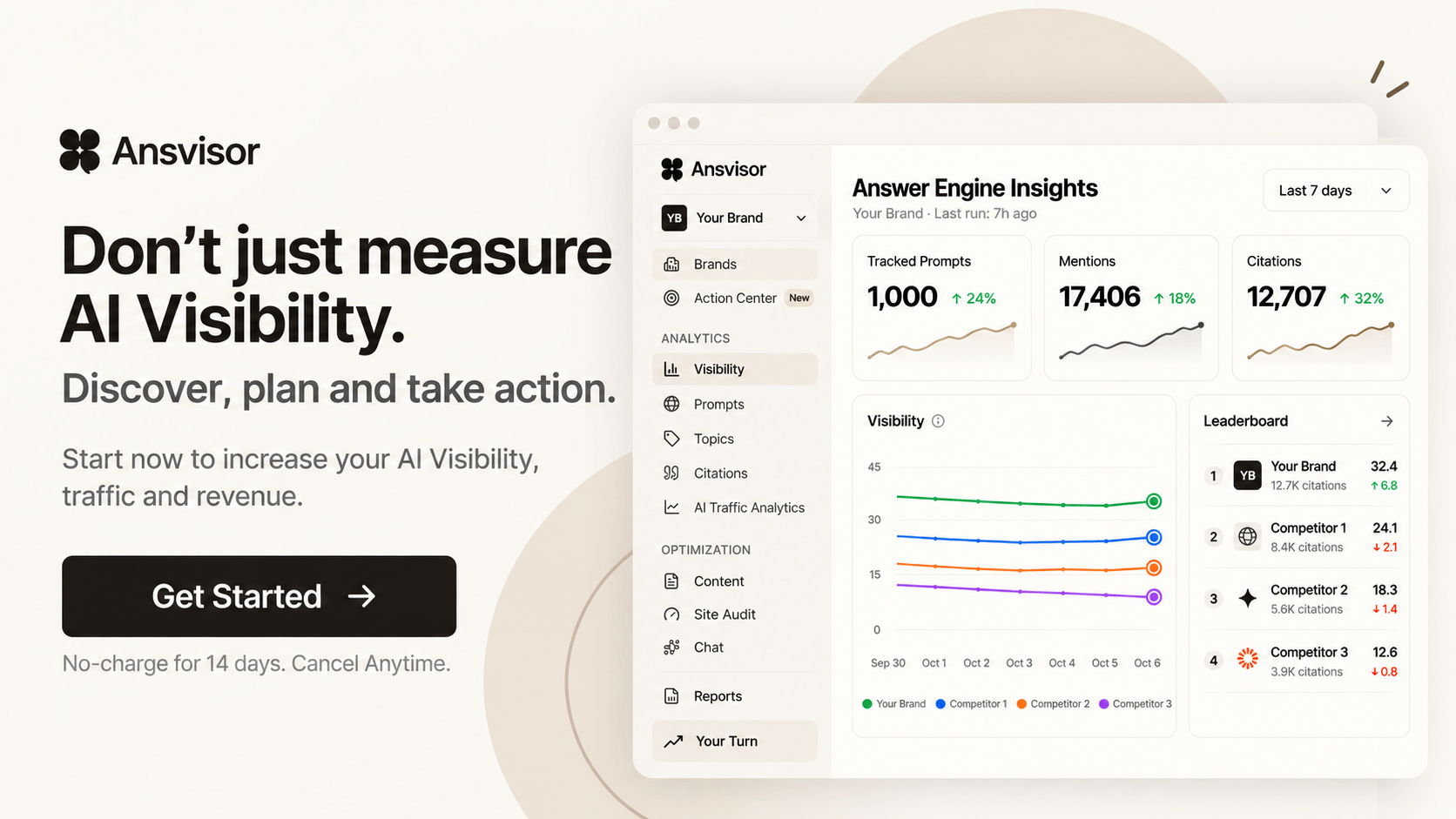
Win customers from all major AI platforms
Understand, measure, and optimize your AI visibility via Ansvisor.
✓ Add brand, domains and competitors
✓ Discover prompts and growth opportunities
✓ Track your AI visibility across major AI platforms
✓ Monitor citations, mentions, and competitors
✓ Measure AI traffic and customer discovery
✓ Receive AI recommendations based on AI insights
✓ Optimize authority, trust, and content quality
✓ Create content, automate analysis & action with AI agents
AI Visibility Terms
Continue exploring key AI visibility concepts.
AI Visibility
Measure and improve how often your brand appears in AI-generated answers.
Learn more →Answer Engine Optimization (AEO)
Strategies for increasing visibility in answer engines and AI summaries.
Learn more →Generative Engine Optimization (GEO)
Optimizing content for AI-powered discovery experiences.
Learn more →ChatGPT Search
Understand how OpenAI retrieves and synthesizes information.
Learn more →Google AI Overviews
AI-generated summaries that appear directly in Google Search.
Learn more →Perplexity Search
Explore how Perplexity cites and presents sources.
Learn more →AI Citations
References and sources used by AI systems to support answers.
Learn more →Citation Authority
Measure the quality and influence of cited sources.
Learn more →Retrievability
How easily AI systems can discover and reuse your content.
Learn more →New terms are added regularly.
Help us improve the page or suggest a new term →
Cihan Geyik
Co-founder at Ansvisor
Cihan Geyik is the co-founder of Ansvisor, an open-source AI Visibility platform for AI Search. With more than 15 years of experience in digital marketing and growth, he writes about AI visibility, AI search, AEO, GEO, citations, and answer engines. He focuses on helping brands understand and improve their presence across ChatGPT, Gemini, Perplexity, Google AI Overviews, and other AI-powered discovery platforms.
Get more Ansvisor insights in Google
Add Ansvisor as a Preferred Source to see more of our AI Search, AEO, GEO, and AI Visibility insights across Google.
Make Your Brand Visible in AI Answers.

INDUSTRIES


© 2026 Ansvisor. All rights reserved. Ansvisor is an open-source AI Search Intelligence Platform for AI Visibility. Ansvisor is a brand owned and operated by Empler AI Inc.


.svg)