Why Platform Coverage matters
Platform Coverage measures how broadly a brand, entity, product, or topic appears across multiple AI search and answer platforms. It helps organizations understand their visibility footprint across the rapidly growing ecosystem of conversational search and AI-powered discovery platforms.
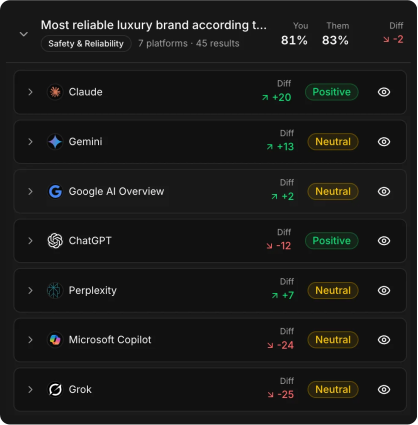
As users increasingly distribute their searches across ChatGPT, Google AI Overviews, Perplexity, Claude, Gemini, Microsoft Copilot, Grok, and other answer engines, platform coverage has become a critical metric for measuring AI visibility.
Benefits of measuring platform coverage include:
- Measure cross-platform visibility.
- Identify discovery gaps.
- Benchmark competitors.
- Reduce platform dependency.
- Optimize AI search strategies.
Organizations with strong platform coverage are more likely to be discovered regardless of which AI platform users choose.
How Platform Coverage is measured
Platform coverage is typically measured by analyzing visibility across multiple answer engines.
- Number of platforms covered.
- Platform visibility rates.
- Platform-specific mentions.
- Platform-specific citations.
- Recommendation coverage.
- Cross-platform share of voice.
For example, a brand that consistently appears across ChatGPT, Perplexity, Gemini, and Microsoft Copilot would generally have stronger platform coverage than a brand visible on only one platform.
What influences Platform Coverage?
Several factors influence cross-platform visibility.
Because every answer engine uses different retrieval, ranking, and synthesis methods, organizations often experience significant variations in visibility across platforms.
How Platform Coverage affects AI visibility
Platform coverage provides a broader perspective on AI search performance.
Strong platform coverage reduces dependence on any single answer engine and increases the likelihood of appearing throughout the customer journey.
Strategies such as Answer Engine Optimization (AEO), Generative Engine Optimization (GEO), and LLM Optimization often aim to improve platform coverage across multiple AI ecosystems.
Platforms such as Ansvisor help organizations measure platform coverage across ChatGPT, Claude, Gemini, Perplexity, Google AI Overviews, Google AI Mode, Microsoft Copilot, Grok, and other answer engines to identify visibility gaps and optimization opportunities.
Common misconceptions
Common misconceptions about platform coverage include:
- Visibility on one AI platform is sufficient.
- All answer engines behave similarly.
- Platform coverage equals market share.
- SEO rankings determine all AI visibility.
- Platform visibility remains stable over time.
As AI search ecosystems continue to diversify, platform coverage has become an essential metric for understanding how broadly brands are represented across the emerging answer economy.








.svg)
