Why Embeddings matter
Embeddings are numerical vector representations that encode the semantic meaning of text, images, audio, or other data. Instead of treating information as exact keywords, AI systems use embeddings to understand relationships, context, and similarity between concepts.
Embeddings have become a foundational technology for modern AI systems, powering search, recommendations, retrieval, clustering, and language understanding.
Benefits of embeddings include:
- Enable semantic search.
- Improve information retrieval.
- Support recommendations.
- Identify related concepts.
- Improve AI understanding.
Without embeddings, modern Answer Engines and AI-powered search experiences would struggle to understand meaning beyond exact keyword matches.
How Embeddings work
Embedding models convert information into numerical vectors within high-dimensional space.
- Words become vectors.
- Sentences become vectors.
- Documents become vectors.
- Images become vectors.
- Entities become vectors.
Items with similar meanings produce vectors that are positioned close to one another in the embedding space, allowing AI systems to identify semantic relationships rather than relying on exact matches.
For example, the concepts "AI visibility", "answer engine optimization", and "generative engine optimization" may appear close together within an embedding model despite having different wording.
How Embeddings affect AI search
Embeddings play a critical role in modern AI-powered search systems.
Most answer engines use embeddings to identify relevant information before generating responses and citations.
How organizations optimize for Embeddings
Organizations can improve embedding performance by:
- Using clear semantic language.
- Building topical authority.
- Creating structured content.
- Strengthening entity relationships.
- Improving content organization.
- Maintaining content quality.
Strategies such as AI Content Optimization, Content Authority, and Retrievability can improve how content is represented and retrieved through embedding-based systems.
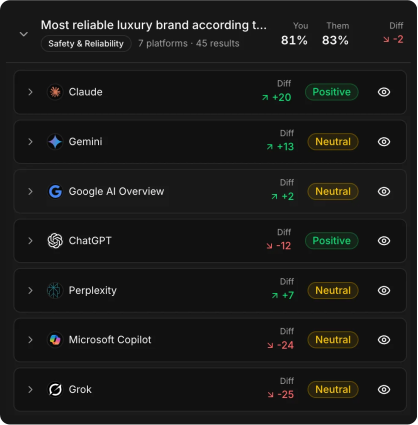
Platforms such as Ansvisor help organizations understand which content, entities, and authority signals are most likely to be retrieved and surfaced by embedding-driven AI search systems.
Common pitfalls
Common mistakes include:
- Optimizing only for exact keywords.
- Ignoring semantic relationships.
- Publishing poorly structured content.
- Building weak topical authority.
- Assuming embeddings replace authority signals.
Embeddings enable AI systems to understand meaning, but successful retrieval and visibility still depend on authority, trust, freshness, and high-quality information.








.svg)
