


Brand Visibility
What Is Brand Visibility?
Brand Visibility refers to how discoverable, recognizable, and prominent a brand is across the channels and environments where customers search for information, evaluate options, and make decisions.
Traditionally, brand visibility has included presence across search engines, websites, media, social platforms, marketplaces, and other digital channels. As discovery expands into AI-powered search, brand visibility also includes whether a brand is mentioned, cited, compared, or recommended within AI-generated answers.
Strong brand visibility does not simply mean appearing frequently. It means being present in relevant contexts where potential customers are researching topics, comparing solutions, evaluating products, or looking for recommendations.
What Does Brand Visibility Mean?
Brand visibility means the extent to which people can discover and encounter a brand across relevant digital touchpoints. It reflects both the frequency and prominence of a brand's presence throughout the customer discovery journey.
A brand may be visible through organic search results, third-party publications, industry websites, social platforms, product comparisons, AI-generated answers, citations, recommendations, and other sources that influence how customers discover information.
In AI-powered search environments, brand visibility extends beyond traditional rankings. A brand may gain visibility when an AI system mentions it, cites its website, includes it in a comparison, recommends its product, or uses information associated with the brand when generating an answer.
Why Brand Visibility Matters
Brand visibility influences whether potential customers encounter a brand during research and decision-making. If a brand is consistently present across relevant discovery environments, customers have more opportunities to recognize, evaluate, and engage with it.
As search behavior expands across traditional search engines and AI-powered experiences, measuring visibility across multiple channels provides a broader understanding of market presence.
Benefits of measuring brand visibility include:
- Understand where and how customers discover the brand.
- Measure market presence across relevant channels.
- Identify visibility gaps around important topics and customer questions.
- Compare brand presence with competitors.
- Understand which sources and platforms influence discovery.
- Evaluate the impact of content, search, authority, and optimization efforts.
- Identify opportunities to increase mentions, citations, and recommendations.
Brand visibility becomes especially important when customers can complete significant parts of their research without visiting a company's website. Search results, AI-generated answers, comparison pages, third-party sources, and recommendations can all influence consideration before a direct website visit occurs.
Brand Visibility vs Brand Awareness
Brand visibility and brand awareness are closely related, but they describe different aspects of a brand's market presence.
Brand visibility describes how frequently and prominently a brand appears across the channels, sources, and environments where customers discover information.
Brand awareness describes how familiar an audience is with the brand and whether people recognize or remember it.
Visibility can contribute to awareness because repeated exposure gives potential customers more opportunities to encounter a brand. However, a visible brand is not automatically a well-known brand, and a well-known brand may still have visibility gaps across specific topics, platforms, or customer journeys.
For measurement purposes, brand visibility therefore focuses primarily on observable presence, while brand awareness often requires additional indicators such as surveys, branded search demand, direct traffic, recall, or other audience research.
Traditional Brand Visibility vs AI Brand Visibility
Traditional digital brand visibility is commonly measured through signals such as search rankings, search impressions, media coverage, website traffic, backlinks, social presence, marketplace visibility, and branded search demand.
AI Brand Visibility focuses specifically on how a brand appears within AI-powered search and answer experiences. Instead of measuring only whether a webpage ranks, organizations can evaluate whether the brand itself becomes part of generated answers and recommendations.
Common AI Brand Visibility signals include:
- Whether the brand appears for relevant prompts.
- How frequently the brand is mentioned in AI-generated answers.
- Whether owned webpages are cited as sources.
- How prominently the brand appears compared with competitors.
- Whether the brand is included in recommendations and comparisons.
- Which third-party sources influence brand visibility.
- How visibility differs across AI platforms, topics, regions, and languages.
- Whether AI-generated discovery leads to website visits and conversions.
Traditional and AI Brand Visibility should not be treated as completely separate disciplines. Search authority, useful content, entity clarity, trusted third-party references, technical accessibility, and overall brand authority can influence visibility across both traditional and AI-powered discovery environments.
What Influences Brand Visibility?
Brand visibility is shaped by multiple signals across owned websites, search engines, third-party sources, media, AI platforms, and other digital ecosystems.
Important factors can include:
- Brand Authority: The overall credibility and recognition associated with a brand.
- Brand Entities: How clearly search and AI systems can understand the brand and its relationships with products, people, topics, and organizations.
- Brand Mentions: References to the brand across owned and third-party sources.
- AI Citations: Whether AI-generated answers use owned webpages or other relevant sources as supporting references.
- Content quality: The usefulness, clarity, accuracy, and relevance of information associated with the brand.
- Topic authority: The depth and breadth of credible information around strategically important subjects.
- Source credibility: The authority and trustworthiness of the sources that discuss or reference the brand.
- Technical accessibility: Whether search engines, crawlers, and retrieval systems can discover and access important information.
- Third-party presence: Brand coverage across publications, communities, directories, comparison sites, and other external sources.
- Competitive positioning: How frequently and prominently the brand appears relative to competing brands.
No single signal determines brand visibility. Strong visibility generally develops from a combination of useful owned content, clear entity information, trusted external references, technical accessibility, and consistent presence around relevant topics.
How Is Brand Visibility Measured?
Brand visibility can be measured using different signals depending on the channels being analyzed. There is no single metric that captures every form of visibility.
Traditional measurement may include search impressions, keyword rankings, branded search demand, website traffic, media mentions, backlinks, referral traffic, and social visibility.
For AI-powered search, organizations can measure signals such as:
- AI Visibility Score.
- AI Share of Voice.
- Prompt Visibility.
- Prompt Coverage.
- Brand Mention frequency.
- AI Citation frequency.
- Recommendation frequency.
- Competitor visibility.
- Platform coverage.
- Source and citation coverage.
- AI-referred website traffic.
- Engagement and conversions from AI-referred visitors.
Combining multiple visibility signals provides a more complete picture than relying on a single metric. For example, a brand may have high mention frequency but relatively few citations, or strong visibility on one AI platform but limited coverage on another.
Key Brand Visibility Metrics
The most useful brand visibility metrics depend on what an organization is trying to understand. A practical measurement framework can combine presence, prominence, source attribution, competitive performance, and business impact.
- Visibility: Whether the brand appears for relevant searches, prompts, topics, or customer questions.
- Mention frequency: How often the brand is referenced.
- Citation frequency: How often owned or relevant brand sources are cited.
- Share of Voice: The brand's relative visibility compared with competitors.
- Prompt Coverage: The percentage of strategically relevant prompts where the brand appears.
- Platform Coverage: How consistently the brand appears across different AI search platforms.
- Recommendation frequency: How often the brand is recommended when users ask for products, services, companies, or solutions.
- Competitive visibility: Where competitors appear more or less frequently for the same topics and prompts.
- Traffic: Visits generated from search, AI platforms, citations, and other discovery sources.
- Business outcomes: Engagement, leads, signups, purchases, or other conversions associated with discovery channels.
These metrics become more useful when tracked over time. A single visibility measurement provides a snapshot, while historical monitoring can reveal whether brand presence is expanding, declining, or shifting across topics and platforms.
How to Improve Brand Visibility
Improving brand visibility requires increasing the brand's presence across the places customers use to discover, research, compare, and evaluate information.
Organizations can improve brand visibility by:
- Building topical authority around strategically important subjects.
- Publishing useful content that answers real customer questions.
- Improving technical search accessibility.
- Strengthening internal linking and content relationships.
- Making brand, product, and entity information clear and consistent.
- Earning relevant third-party mentions and references.
- Increasing citation opportunities.
- Building relationships with authoritative industry sources.
- Monitoring competitor visibility and identifying gaps.
- Expanding presence across the platforms customers use for discovery.
- Measuring changes and prioritizing opportunities based on performance data.
The objective is not simply to maximize the number of times a brand appears. Visibility should be built around relevant topics, customer needs, and discovery environments that can contribute to meaningful business outcomes.
How to Improve Brand Visibility in AI Search
Improving AI Brand Visibility requires understanding which prompts, topics, sources, and competitors shape generated answers across AI-powered search platforms.
A practical AI visibility workflow can include:
- Identify the prompts and questions that matter to customers.
- Measure whether the brand appears for those prompts.
- Analyze which competitors are mentioned or recommended instead.
- Identify the domains and webpages AI systems cite.
- Find content, topic, citation, and authority gaps.
- Create or improve content around meaningful customer needs.
- Strengthen relevant third-party references and brand mentions.
- Improve entity clarity and technical accessibility.
- Track visibility changes across multiple AI platforms.
- Connect visibility improvements with AI-referred traffic and business outcomes.
Strategies such as Answer Engine Optimization (AEO), Generative Engine Optimization (GEO), and AI Search Optimization can support these efforts by improving how information is discovered, retrieved, understood, cited, and used across AI-powered search experiences.
Brand Visibility Across AI Platforms
Brand visibility can vary significantly between AI platforms because different systems may use different models, retrieval methods, search indexes, source ecosystems, and answer-generation processes.
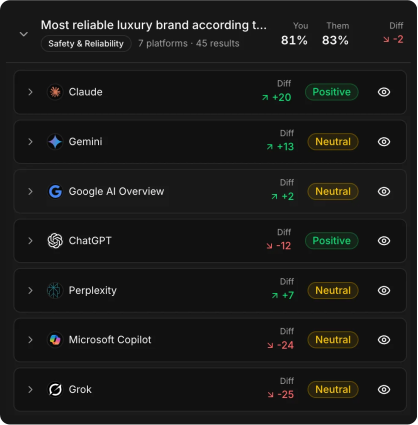
A brand that appears frequently in ChatGPT may not have the same level of visibility in Google AI Overviews, Gemini, Claude, Perplexity, Microsoft Copilot, or other AI-powered search experiences.
This makes platform-level measurement important. Instead of assuming that one visibility score represents the entire AI search ecosystem, organizations can compare:
- Visibility by AI platform.
- Visibility by topic or prompt group.
- Brand mentions by platform.
- Citations and cited sources by platform.
- Competitor Share of Voice by platform.
- Regional and language differences.
- Changes in visibility over time.
Comparing these dimensions helps teams understand where a brand is already strong and where additional content, authority, citation, or optimization opportunities may exist.
Common Brand Visibility Mistakes
Brand visibility can be misunderstood when teams rely on a narrow set of metrics or assume that visibility works the same way across every discovery channel.
Common mistakes include:
- Measuring only website traffic.
- Equating brand visibility with brand awareness.
- Focusing only on traditional search rankings.
- Ignoring AI-generated answers and zero-click discovery.
- Tracking only one AI platform.
- Combining mentions and citations into a single metric.
- Measuring visibility without comparing competitors.
- Ignoring the third-party sources influencing brand discovery.
- Looking only at total visibility instead of topic-level and prompt-level performance.
- Increasing visibility without connecting it to meaningful business outcomes.
A more complete approach combines traditional search and digital discovery data with AI visibility signals to understand where a brand appears, why it appears, how it compares with competitors, and which opportunities are worth prioritizing.
Ansvisor helps organizations measure AI Brand Visibility across prompts, mentions, citations, competitors, Share of Voice, AI platforms, and AI-referred traffic. Teams can use these signals to identify visibility gaps, discover opportunities, prioritize actions, and measure how their presence changes over time through the AI Search Intelligence Platform.
FAQ
What is Brand Visibility?

Brand Visibility measures how discoverable, recognizable, and prominent a brand is across search, AI-generated answers, digital platforms, and other customer discovery channels.
Why is Brand Visibility important?
Strong brand visibility increases the likelihood that customers discover, recognize, consider, and engage with a brand. In AI search, visibility can also influence whether a brand is mentioned, cited, compared, or recommended in generated answers.
How is Brand Visibility measured?
Brand visibility can be measured using signals such as search visibility, brand mentions, citations, Share of Voice, prompt coverage, platform coverage, recommendation frequency, website traffic, and AI Visibility Score.
How can brands improve Brand Visibility?
Brands can improve visibility by strengthening topical authority, publishing useful content, improving search and AI discoverability, building credible third-party mentions, earning citations, strengthening entity signals, and monitoring competitors.
Which tools help measure Brand Visibility?
Platforms like Ansvisor help organizations measure AI brand visibility across prompts, mentions, citations, competitors, Share of Voice, AI platforms, and AI-referred traffic.
Everything You Need to Improve Your AI Visibility
Track how your brand appears across AI platforms, understand what drives visibility, and turn insights into measurable actions.
Platform Features
Explore all features →Answer Engine Insights
Understand how AI platforms talk about your brand.
Prompt Intelligence
Discover and monitor the prompts shaping your AI visibility.
Citations Monitoring
Track which sources AI platforms cite and where your brand appears.
AI Traffic Analytics
Measure visits coming from ChatGPT, Gemini, Claude, and more.
Competitor Benchmarking
Compare AI visibility and uncover competitive gaps and opportunities.
Action Center
Turn AI Search signals into prioritized actions and executable tasks.
AI Visibility Trackers
Explore AI Visibility Platform →ChatGPT Visibility Tracker
Track brand mentions, citations, prompts, and visibility across ChatGPT.
Google AI Overviews Rank Tracker
Monitor where and how your brand appears in Google AI Overviews.
Google AI Mode Visibility Tracker
Track your brand's visibility across Google AI Mode experiences.
Gemini Visibility Tracker
Understand how your brand appears across Google Gemini responses.
Microsoft Copilot Visibility Tracker
Monitor your brand's presence across Microsoft Copilot answers.
Perplexity Visibility Tracker
Track brand mentions, citations, and visibility across Perplexity.
From AI Visibility insights to action.
Explore the complete Ansvisor platform for AI Search intelligence, optimization, and growth.
Win customers from all major AI platforms
Understand, measure, and optimize your AI visibility via Ansvisor.
✓ Add brand, domains and competitors
✓ Discover prompts and growth opportunities
✓ Track your AI visibility across major AI platforms
✓ Monitor citations, mentions, and competitors
✓ Measure AI traffic and customer discovery
✓ Receive AI recommendations based on AI insights
✓ Optimize authority, trust, and content quality
✓ Create content, automate analysis & action with AI agents
AI Visibility Terms
Continue exploring key AI visibility concepts.
AI Visibility
Measure and improve how often your brand appears in AI-generated answers.
Learn more →Answer Engine Optimization (AEO)
Strategies for increasing visibility in answer engines and AI summaries.
Learn more →Generative Engine Optimization (GEO)
Optimizing content for AI-powered discovery experiences.
Learn more →ChatGPT Search
Understand how OpenAI retrieves and synthesizes information.
Learn more →Google AI Overviews
AI-generated summaries that appear directly in Google Search.
Learn more →Perplexity Search
Explore how Perplexity cites and presents sources.
Learn more →AI Citations
References and sources used by AI systems to support answers.
Learn more →Citation Authority
Measure the quality and influence of cited sources.
Learn more →Retrievability
How easily AI systems can discover and reuse your content.
Learn more →New terms are added regularly.
Help us improve the page or suggest a new term →
Cihan Geyik
Co-founder at Ansvisor
Cihan Geyik is the co-founder of Ansvisor, an open-source AI Visibility platform for AI Search. With more than 15 years of experience in digital marketing and growth, he writes about AI visibility, AI search, AEO, GEO, citations, and answer engines. He focuses on helping brands understand and improve their presence across ChatGPT, Gemini, Perplexity, Google AI Overviews, and other AI-powered discovery platforms.
Make Your Brand Visible in AI Answers.

INDUSTRIES


© 2026 Ansvisor. All rights reserved. Ansvisor is an open-source AI Search Intelligence Platform for AI Visibility.


.svg)
