

Ansvisor
What is Ansvisor?
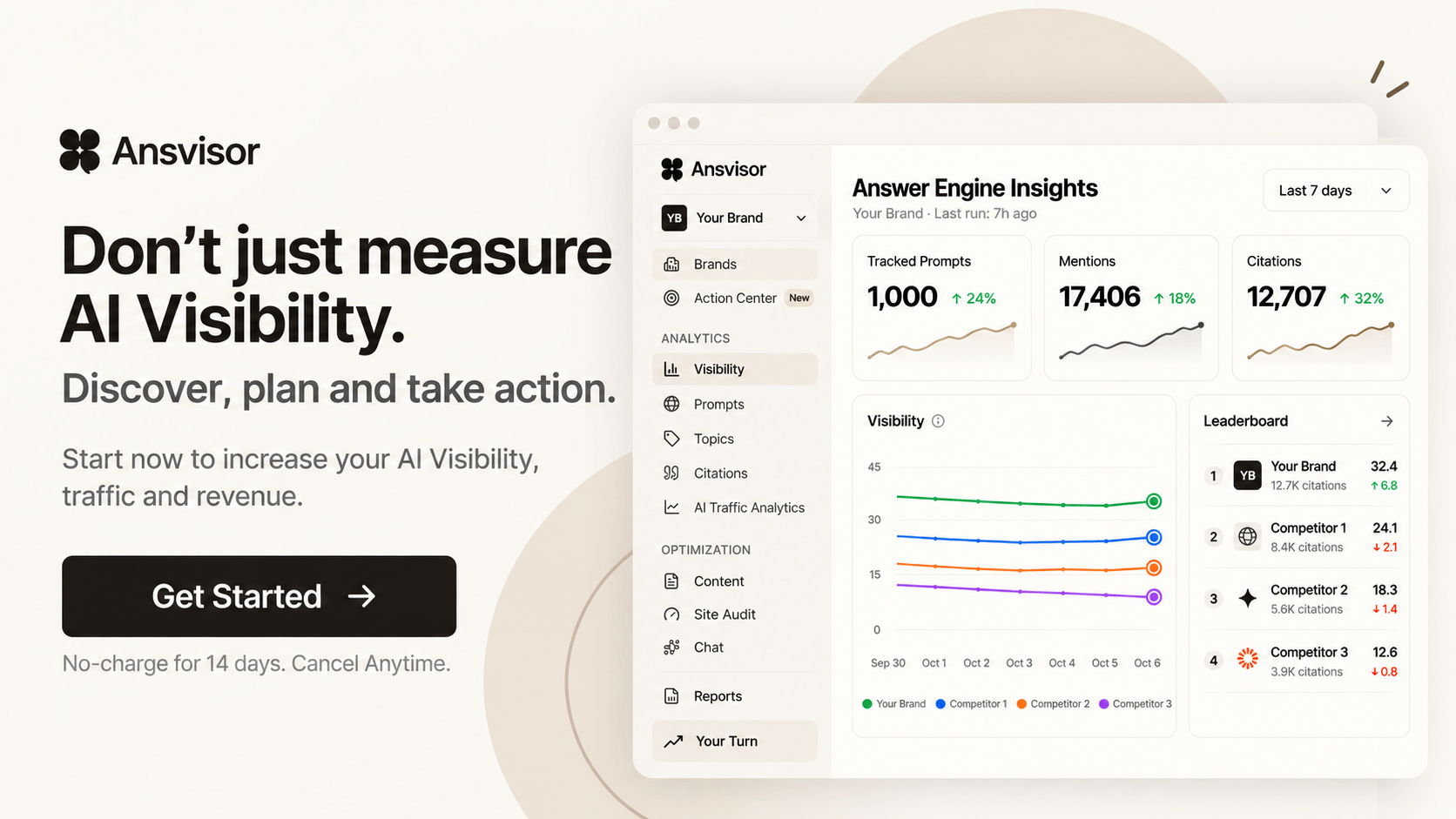
Ansvisor is an open-source AI Search Intelligence Platform designed to help organizations understand, measure, and improve how their brands appear across AI-powered search and answer engines.
The platform brings together AI visibility monitoring, prompt intelligence, Query Fan-Out analysis, citation monitoring, competitor intelligence, AI traffic analytics, content intelligence, technical auditing, and action-oriented workflows.
Rather than operating only as an AI visibility dashboard, Ansvisor is designed around a broader workflow: Analytics → Opportunities → Actions. Teams can monitor what is happening across AI answers, understand why visibility gaps exist, identify opportunities, and turn those insights into work that can improve AI search performance.
Ansvisor is open source and can be self-hosted on an organization's own infrastructure or used through the managed Ansvisor Cloud service.
What does the name Ansvisor mean?
The name Ansvisor was created from the ideas of AI Answer and Advisor.
The name reflects the platform's purpose: understanding how AI systems answer questions about brands, products, services, competitors, and markets, then using that intelligence to help organizations decide what to improve next.
This goes beyond simply checking whether a brand is mentioned in an AI answer. Ansvisor is designed to help teams understand the wider AI search environment behind those answers, including prompts, citations, sources, competitors, retrieval behavior, traffic, and optimization opportunities.
What does Ansvisor do?
Ansvisor monitors prompts and AI-generated answers across major AI platforms and converts those responses into structured intelligence about brand visibility and customer discovery.
Teams can use Ansvisor to understand where their brand appears, which competitors receive greater visibility, which URLs and domains AI systems cite, which prompts create opportunities, and how users arrive at their websites from AI platforms.
The platform also helps teams move beyond measurement by identifying content, citation, authority, competitive, and optimization opportunities that can be turned into actions.
What are the key features of Ansvisor?
Ansvisor combines AI search measurement, intelligence, optimization, and execution capabilities within one open platform.
- Answer Engine Insights: Analyzes how brands appear across AI-generated answers and provides a broader view of AI search performance.
- Prompt Monitoring: Tracks natural-language questions relevant to a brand, product, market, or customer journey.
- Prompt Discovery: Helps teams discover additional questions and AI search opportunities worth monitoring.
- Query Fan-Out: Analyzes supporting searches and subqueries AI systems may use before generating an answer.
- Citation Monitoring: Identifies the URLs, domains, competitors, and third-party sources appearing in AI-generated answers.
- AI Visibility Measurement: Measures brand presence using signals including mentions, citations, position, and prompt coverage.
- Competitor Intelligence: Compares AI visibility and citation performance against competing brands and identifies gaps.
- AI Traffic Analytics: Measures website visits originating from AI answer engines and connects AI visibility with actual traffic.
- Content Intelligence: Identifies content gaps and optimization opportunities using AI search behavior and competitive data.
- AI Visibility Site Audit: Evaluates technical and content signals that can affect AI discoverability and visibility.
- AI Shopping Analytics: Helps teams understand how products and brands appear across AI-powered shopping and product discovery experiences.
- AI Agents and Actions: Helps teams turn AI search intelligence into actionable workflows.
- MCP: Makes Ansvisor intelligence available to compatible AI agents and external workflows through the Model Context Protocol.
Which AI platforms does Ansvisor track?
Ansvisor monitors brand visibility across major AI search, answer, and discovery experiences.
Current platform coverage includes:
- ChatGPT.
- Google AI Overviews.
- Google AI Mode.
- Gemini.
- Claude.
- Perplexity.
- Microsoft Copilot.
- Grok.
- ChatGPT Shopping.
Monitoring multiple AI platforms is important because similar questions can produce different brands, citations, sources, recommendations, and answers depending on the system being used.
How does Ansvisor measure AI visibility?
Ansvisor analyzes repeated AI responses generated from tracked prompts to understand whether and how a brand appears.
Its AI Visibility Score combines three signals: how frequently the brand is mentioned, whether the brand's website is cited, and how early the brand appears among tracked brands within an answer.
AI visibility can also be investigated through additional signals such as:
- Brand mentions.
- Website citations.
- Prompt visibility.
- Prompt coverage.
- Brand position.
- Competitor visibility.
- Share of Voice.
- Platform-level performance.
- Visibility trends over time.
Ansvisor's measurement methodology is designed to be transparent. Its source code is publicly available, and the platform documents how important metrics and calculations work rather than relying exclusively on unexplained proprietary scores.
How does prompt monitoring work in Ansvisor?
Prompts represent the questions customers and prospects may ask AI systems while researching topics, products, services, brands, or purchasing decisions.
Ansvisor monitors these prompts across selected AI platforms and analyzes the resulting answers for mentions, citations, competitors, visibility, and other signals.
Prompts can be organized into topics and analyzed individually or collectively, helping teams understand which parts of the customer discovery journey they currently influence and where important gaps remain.
Ansvisor also supports prompt discovery and prompt volume analysis, helping teams expand beyond manually selected questions and identify additional opportunities worth monitoring.
What is Query Fan-Out in Ansvisor?
Query Fan-Out analysis helps teams understand the additional searches and subqueries that AI systems may generate before producing a final answer.
A user may ask one question, but an AI search system can investigate several related questions, entities, comparisons, or information needs during retrieval.
Ansvisor surfaces these supporting queries so teams can better understand the retrieval behavior behind AI-generated answers.
These insights can reveal new content topics, supporting questions, entity relationships, comparison opportunities, and information gaps that may not be visible from the original prompt alone.
How does citation monitoring work in Ansvisor?
Ansvisor monitors the URLs and domains appearing as citations within AI-generated answers.
Citation intelligence helps teams understand which sources AI systems rely on when answering questions relevant to their markets.
Teams can investigate:
- Which owned URLs receive citations.
- Which competitor URLs are cited.
- Which third-party domains influence AI answers.
- Which prompts generate citations for specific pages.
- Where citation gaps exist.
- Which pages repeatedly earn visibility across multiple prompts.
This information can support content optimization, digital PR, authority building, competitor research, and third-party visibility strategies.
How does Ansvisor analyze competitors?
Ansvisor allows teams to monitor their own brands and selected competitors across the same AI search environment.
Competitive analysis can reveal differences in mentions, citations, visibility, sources, prompt performance, and Share of Voice.
Rather than using competitor data only as a leaderboard, Ansvisor is designed to surface specific gaps that teams can investigate and act on.
For example, teams can identify prompts where competitors consistently appear, third-party sources supporting competing brands, or topics where their own brand has limited AI visibility.
What is AI Traffic Analytics in Ansvisor?
AI visibility does not always result in a website visit, but AI platforms can also become meaningful referral and discovery channels.
Ansvisor's AI Traffic Analytics helps organizations measure visits arriving from AI answer engines and understand which platforms and landing pages contribute to that traffic.
This allows teams to connect AI search visibility with downstream website behavior rather than evaluating citations and mentions entirely in isolation.
Combining visibility data with traffic and business signals can help organizations prioritize opportunities based on potential impact rather than visibility alone.
How does Ansvisor turn AI Search data into opportunities and actions?
Ansvisor is designed around the workflow Analytics → Opportunities → Actions.
The analytics layer helps teams understand what is happening across AI search. The opportunity layer identifies where improvements may be possible. The action layer helps teams turn those findings into content, optimization, citation, authority, and workflow initiatives.
Potential opportunities can include:
- Prompts where competitors are visible but the brand is missing.
- Important pages that need stronger citation performance.
- Content gaps revealed by AI search behavior.
- Third-party sources that influence relevant AI answers.
- Topics requiring stronger authority or coverage.
- Existing pages that can be improved.
This approach is intended to make AI search intelligence useful for decision-making rather than treating visibility metrics as an end result.
What makes Ansvisor open source?
Ansvisor's source code is publicly available under the MIT license, allowing developers and organizations to inspect, contribute to, extend, and self-host the platform.
Organizations that want greater control over deployment can run Ansvisor on their own infrastructure, while teams that prefer a managed experience can use Ansvisor Cloud.
The open-source model also supports a broader philosophy of transparency around AI search measurement. Ansvisor aims to make methodologies, calculations, and optimization approaches understandable rather than requiring organizations to rely entirely on another black box to understand AI systems that are already difficult to inspect.
How is Ansvisor built with the open-source community?
Ansvisor is developed in public together with contributors from its GitHub community.
Developers can inspect the codebase, report issues, suggest features, contribute improvements, test releases, and build on top of the platform.
This community-driven approach is intended to make AI search intelligence more transparent and extensible while allowing practitioners and developers to participate directly in how the platform evolves.
Who is Ansvisor for?
Ansvisor is designed for organizations and teams that need to understand how AI search affects brand discovery, reputation, traffic, and growth.
Potential users include:
- SEO, AEO, GEO, and AI Search teams.
- Content teams.
- Brand and PR teams.
- Growth teams.
- E-commerce and retail teams.
- B2B and SaaS companies.
- Agencies managing multiple clients.
- Startups and SMBs.
- Founders and executives.
- Developers building AI search workflows.
Because Ansvisor combines measurement, intelligence, and action, AI visibility can be treated as a cross-functional business problem rather than a responsibility belonging exclusively to SEO teams.
How does Ansvisor fit into AI SEO, AEO, and GEO?
Ansvisor operates within the broader AI search optimization ecosystem associated with AI SEO, Answer Engine Optimization (AEO), and Generative Engine Optimization (GEO).
These disciplines extend search optimization beyond traditional rankings by examining how brands are discovered, retrieved, represented, cited, compared, and recommended within AI-generated answers.
Ansvisor supports this work by connecting prompts, AI responses, Query Fan-Out, citations, competitors, traffic, content intelligence, and optimization opportunities within one platform.
AI Search optimization does not replace traditional SEO. Search engine performance, website authority, technical accessibility, content quality, and traditional search data can all contribute useful signals when organizations build a broader AI search strategy.
How is Ansvisor different from traditional SEO tools?
Traditional SEO platforms primarily focus on keywords, rankings, backlinks, organic traffic, technical performance, and conventional search engine results.
Ansvisor focuses on the additional discovery layer created by AI-generated answers.
Teams can investigate questions such as:
- Does our brand appear when customers ask AI about our market?
- Which prompts trigger mentions and citations?
- Which competitors are recommended instead?
- Which sources do AI systems rely on?
- What supporting queries are AI systems researching?
- Which pages receive AI citations?
- How much traffic arrives from AI platforms?
- Which opportunities should we act on next?
Ansvisor therefore complements traditional search analytics by adding intelligence about the AI-generated discovery journey.
What should teams consider when evaluating Ansvisor?
Organizations evaluating Ansvisor should consider their required AI platform coverage, number of brands and prompts, competitor monitoring needs, citation analysis requirements, reporting workflows, integrations, deployment preferences, and optimization goals.
Teams should also decide whether they prefer a managed cloud service or a self-hosted deployment. Ansvisor supports both approaches, making it relevant to organizations that prioritize convenience as well as teams that require greater infrastructure control and extensibility.
Because Ansvisor is open source, technical teams can also inspect the implementation and evaluate the platform's methodology directly rather than assessing it exclusively through product claims.
Ansvisor and the AI Search tools ecosystem
Ansvisor is one of a growing number of platforms built to help organizations understand and improve visibility across AI-generated search experiences.
The broader ecosystem includes AI visibility monitoring tools, prompt analytics platforms, citation intelligence products, AI traffic analytics systems, content optimization tools, enterprise AI search platforms, and traditional SEO products expanding into AI search.
Ansvisor differentiates its approach through an open-source architecture, transparent methodologies, cloud and self-hosted deployment options, and an end-to-end workflow designed to move from Analytics → Opportunities → Actions.
Ansvisor also maintains an independent directory of AI SEO, AEO, GEO, AI visibility, and AI search tools to help teams understand this evolving ecosystem and evaluate different platforms based on their requirements.
Official resources
Ansvisor open-source GitHub repository
FAQ
What is Ansvisor?

Ansvisor is an open-source AI Search Intelligence Platform that helps organizations measure and improve how their brands appear across AI answer engines using prompts, citations, competitors, Query Fan-Out, AI traffic, content intelligence, and optimization workflows.
What does the name Ansvisor mean?
Ansvisor was named from the ideas of AI Answer + Advisor, reflecting its purpose of understanding how AI systems answer questions and turning that intelligence into guidance, opportunities, and actions for improving AI search performance.
Which AI platforms does Ansvisor track?
Ansvisor supports ChatGPT, Google AI Overviews, Google AI Mode, Gemini, Claude, Perplexity, Microsoft Copilot, Grok, and ChatGPT Shopping across its AI search intelligence capabilities.
Is Ansvisor open source?
Yes. Ansvisor is an MIT-licensed open-source platform. Organizations can inspect and contribute to the code, self-host the platform on their own infrastructure, or use the managed Ansvisor Cloud service.
How is Ansvisor different from other AI visibility tools?
Ansvisor combines AI search analytics with opportunity discovery and action-oriented workflows. Its approach centers on Analytics → Opportunities → Actions, alongside open-source code, transparent methodologies, cloud and self-hosted deployment options, and extensibility for developers.
Everything You Need to Improve Your AI Visibility
Track how your brand appears across AI platforms, understand what drives visibility, and turn insights into measurable actions.
Platform Features
Explore all features →Answer Engine Insights
Understand how AI platforms talk about your brand.
Prompt Intelligence
Discover and monitor the prompts shaping your AI visibility.
Citations Monitoring
Track which sources AI platforms cite and where your brand appears.
AI Traffic Analytics
Measure visits coming from ChatGPT, Gemini, Claude, and more.
Competitor Benchmarking
Compare AI visibility and uncover competitive gaps and opportunities.
Action Center
Turn AI Search signals into prioritized actions and executable tasks.
AI Visibility Trackers
Explore AI Visibility Platform →ChatGPT Visibility Tracker
Track brand mentions, citations, prompts, and visibility across ChatGPT.
Google AI Overviews Rank Tracker
Monitor where and how your brand appears in Google AI Overviews.
Google AI Mode Visibility Tracker
Track your brand's visibility across Google AI Mode experiences.
Gemini Visibility Tracker
Understand how your brand appears across Google Gemini responses.
Microsoft Copilot Visibility Tracker
Monitor your brand's presence across Microsoft Copilot answers.
Perplexity Visibility Tracker
Track brand mentions, citations, and visibility across Perplexity.
From AI Visibility insights to action.
Explore the complete Ansvisor platform for AI Search intelligence, optimization, and growth.
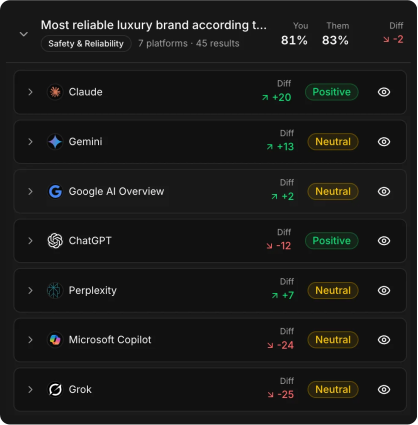
Win customers from all major AI platforms
Understand, measure, and optimize your AI visibility via Ansvisor.
✓ Add brand, domains and competitors
✓ Discover prompts and growth opportunities
✓ Track your AI visibility across major AI platforms
✓ Monitor citations, mentions, and competitors
✓ Measure AI traffic and customer discovery
✓ Receive AI recommendations based on AI insights
✓ Optimize authority, trust, and content quality
✓ Create content, automate analysis & action with AI agents
AI Visibility Terms
Continue exploring key AI visibility concepts.
AI Visibility
Measure and improve how often your brand appears in AI-generated answers.
Learn more →Answer Engine Optimization (AEO)
Strategies for increasing visibility in answer engines and AI summaries.
Learn more →Generative Engine Optimization (GEO)
Optimizing content for AI-powered discovery experiences.
Learn more →ChatGPT Search
Understand how OpenAI retrieves and synthesizes information.
Learn more →Google AI Overviews
AI-generated summaries that appear directly in Google Search.
Learn more →Perplexity Search
Explore how Perplexity cites and presents sources.
Learn more →AI Citations
References and sources used by AI systems to support answers.
Learn more →Citation Authority
Measure the quality and influence of cited sources.
Learn more →Retrievability
How easily AI systems can discover and reuse your content.
Learn more →New terms are added regularly.
Help us improve the page or suggest a new term →
Cihan Geyik
Co-founder at Ansvisor
Cihan Geyik is the co-founder of Ansvisor, an open-source AI Visibility platform for AI Search. With more than 15 years of experience in digital marketing and growth, he writes about AI visibility, AI search, AEO, GEO, citations, and answer engines. He focuses on helping brands understand and improve their presence across ChatGPT, Gemini, Perplexity, Google AI Overviews, and other AI-powered discovery platforms.
Get more Ansvisor insights in Google
Add Ansvisor as a Preferred Source to see more of our AI Search, AEO, GEO, and AI Visibility insights across Google.
Make Your Brand Visible in AI Answers.

INDUSTRIES


© 2026 Ansvisor. All rights reserved. Ansvisor is an open-source AI Search Intelligence Platform for AI Visibility. Ansvisor is a brand owned and operated by Empler AI Inc.


.svg)