An overall AI visibility score of 42 hides more than it shows. It could mean you lead every comparison prompt and miss every "best tool" prompt, or the reverse. Prompt-level visibility breaks the score open. Question by question and platform by platform, it shows where AI answers name you, where they cite you and who takes your place where they don’t.
The prompt is the unit you can act on. Nobody can fix a blended score directly. You can fix the answer ChatGPT gives to "best payroll software for startups."
How is prompt-level visibility measured?
Each run of a prompt on a platform produces one answer. A tracker scores that answer, then averages the scores for the prompt over a window of runs.
Ansvisor’s method is a useful reference point. Every answer gets a score from 0 to 100, built from three parts:
- Mention count, worth 50%, capped at five mentions so a repetitive answer can’t inflate it.
- Position, worth 25%. A brand named first scores higher than one listed eighth.
- Citation presence, worth 25%, when the answer cites your domain or a source that mentions you.
A prompt’s visibility is then the average across all its platforms over the last seven days. Other tools weight these parts differently, so compare methods before you compare numbers.
| Record for each prompt | What it tells you |
|---|
| Named or not | Whether you made the answer at all |
| Position | How early you’re named compared with rivals |
| Cited URLs | Which of your pages, if any, back the answer |
| Competitors named | Who holds the slots you’re missing |
| Platform split | Where the prompt works for you and where it fails |
| Seven-day trend | Whether a change is a shift or noise |
Prompt visibility vs prompt-level visibility
People use the two terms interchangeably, but the difference is useful.
Prompt visibility is the umbrella idea: how visible your brand is across the prompts buyers send to AI assistants. It’s usually reported as one number for a whole prompt set.
Prompt-level visibility is the same measurement kept separate for each prompt. Teams report the first number upward and work from the second.
How does it compare with other prompt metrics?
| Metric | Unit | Question it answers |
|---|
| Prompt-level visibility | One prompt | How do we appear in this answer? |
| Prompt coverage | The whole prompt set | On what share of prompts do we appear? |
| AI visibility score | Brand, topic or platform | How visible are we overall? |
| Prompt analytics | Prompts and answers as a dataset | Which patterns explain our results? |
What does prompt-level tracking show that averages hide?
Take a brand with a steady visibility of 40 across 1,200 prompts. The average hasn’t moved in a month, so the dashboard looks calm.
The prompt view tells a different story. The brand gained ground on 60 informational prompts after a content refresh. In the same weeks, it dropped out of 25 "alternatives to" prompts on ChatGPT, where a competitor’s new comparison page now gets cited.
The gains and losses cancelled out. Only the prompt view shows the loss, and the loss sits on the prompts closest to a purchase.
Example: one prompt across five platforms
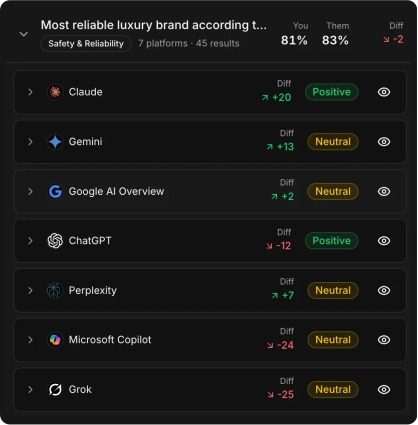
Here’s how one prompt, "best payroll software for a 50-person company," might look for a single brand in one week:
| Platform | Named? | Position | Own page cited? |
|---|
| ChatGPT | Yes | 2nd of 4 | No |
| Google AI Overviews | Yes | 3rd of 6 | Yes, pricing page |
| Google AI Mode | No | None | No |
| Gemini | Yes | 1st of 5 | Yes, comparison page |
| Perplexity | No | None | No |
The fix differs by platform. On ChatGPT you’re named but not cited, so the job is a page worth citing. On AI Mode and Perplexity you’re absent, so start by reading which sources those answers cite and who they name instead.
How many runs make a prompt-level number reliable?
One run is an anecdote. AI answers change between runs of the same prompt. In a SparkToro study, AI tools rarely returned the same list of brands twice.
Average at least a week of runs before you act on a single prompt. Compare like with like, too. Ansvisor’s trend deltas compare the latest seven days with the previous seven. Both windows use an identical prompt set, so newly added prompts can’t distort the change.
Expect some platforms to move more than others. Answers that search the web pull fresh sources on each run, so their citations shift often. Brand lists that come from model memory tend to change after model updates. Set alert thresholds per platform instead of one rule for all.
Flag patterns, not blips. A prompt that drops on one platform for a day is noise. A prompt that drops on three platforms for two weeks is a signal.
How to act on prompt-level gaps
Sort prompts by value → Open the stored answers → Read citations and rivals → Fix the page or source → Re-measure
- Sort prompts by estimated demand and intent. Start with high-value prompts where you’re absent, using prompt volumes for the ranking.
- Open the stored answers. Note who is named and which URLs are cited.
- Pick the fix: a new or better page, a mention in a cited roundup, or a correction to outdated facts.
- Keep tracking the same prompt for a few weeks to see whether the answer changes.
Our guide to tracking prompts in ChatGPT walks through the setup.
Prompt-level monitoring at scale: what to look for
Brands and agencies tracking thousands of prompts need structure, or nobody reads the per-prompt view. A capable tool should let you:
- Group prompts into topics by product line, intent and funnel stage.
- Set region and language per prompt, since answers in Germany and the US often differ.
- Open the full answer, parsed citations and competitor list behind every score.
- Review topic-level changes weekly and drill into single prompts only where a topic moved.
- Keep a core set stable for a quarter, so trends stay comparable.
For the wider measurement picture, see how to measure AI search visibility.
Common mistakes
- Reading a single run as the truth.
- Counting a mention and a citation as the same win.
- Tracking only branded prompts, where you’ll almost always appear.
- Comparing scores from two tools that weight position and citations differently.
- Treating every prompt as equal. A missed shortlist prompt costs more than a missed definition prompt.
Most of these go away with a stable, well-grouped prompt set reviewed on a fixed cadence, which is the core of prompt monitoring.
How Ansvisor helps
Ansvisor scores every tracked prompt on ChatGPT, Google AI Overviews, Google AI Mode, Gemini, Copilot and Perplexity, with Claude on Enterprise plans. Behind each score sit the full answer, the parsed citations and the competitors named.
Prompt Monitoring and Volumes adds estimated demand and intent to every prompt, so you can sort gaps by value. When a prompt needs work, its Improve suggestions can go to the Action Center as tracked tasks.








 ChatGPT
 AI Overviews
 AI Mode
 Copilot
 Perplexity
 Claude