Why Semantic Search matters
Semantic Search is a search approach that retrieves information based on meaning, context, entities, and user intent rather than relying solely on exact keyword matching. It enables search engines and AI systems to understand what users mean instead of simply matching the words they type.
As search behavior becomes increasingly conversational and AI-driven, semantic search has become one of the foundational technologies behind modern search engines, answer engines, and AI assistants.
Benefits of semantic search include:
- Improve search relevance.
- Understand user intent.
- Reduce keyword dependency.
- Support conversational search.
- Improve retrieval accuracy.
Semantic search allows AI systems to identify relationships, concepts, and meanings that traditional keyword search often misses.
How Semantic Search works
Semantic search systems use multiple techniques to understand and retrieve information.
- Analyze user intent.
- Identify entities.
- Understand context.
- Generate semantic representations.
- Retrieve related information.
- Rank results by meaning.
For example, a search for "best tools for AI visibility" may retrieve results discussing answer engine optimization, AI search analytics, or AI monitoring platforms even if those exact words are not used.
This ability to understand concepts rather than keywords is one of the defining characteristics of modern AI search.
What technologies enable Semantic Search?
Semantic search combines several AI and search technologies.
Modern answer engines often combine semantic search with retrieval, grounding, query expansion, and reasoning systems.
How Semantic Search affects AI visibility
Semantic search fundamentally changes how brands and content are discovered.
Organizations with broad topical coverage, strong entity relationships, and authoritative content are more likely to perform well in semantic retrieval systems.
Strategies such as AI Content Optimization, Answer Engine Optimization (AEO), and LLM Optimization increasingly focus on semantic understanding rather than keyword optimization alone.
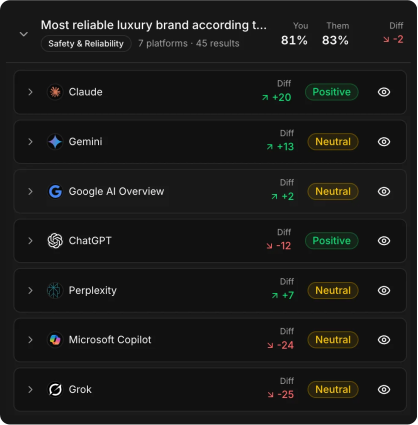
Platforms such as Ansvisor help organizations analyze semantic visibility by monitoring prompts, citations, entities, competitors, retrieval patterns, and AI visibility performance across answer engines.
Common misconceptions
Common misconceptions about semantic search include:
- Keywords no longer matter.
- Semantic search only uses synonyms.
- Semantic search and vector search are identical.
- All AI platforms use the same semantic models.
- More content automatically improves semantic visibility.
Semantic search represents one of the biggest shifts in search technology because it enables systems to optimize for meaning, context, and user intent rather than exact keyword matching.








.svg)
