



LLM SEO
LLM SEO, or Large Language Model SEO, is the practice of improving how a brand, website, product, or piece of content is discovered, understood, retrieved, mentioned, cited, and represented in answers generated by large language models and AI Search systems.
Traditional SEO primarily focuses on visibility within search engine results. LLM SEO extends this work into AI-generated discovery environments, where users increasingly receive synthesized answers, recommendations, comparisons, summaries, and cited sources instead of only a list of links.
The goal is not simply to insert keywords into content. LLM SEO connects technical accessibility, clear content, entity understanding, topical relevance, source authority, citations, external corroboration, and measurement to improve a brand's presence across AI-generated answers.
How Does LLM SEO Work?
AI Search systems can use different combinations of pretrained model knowledge, web search, retrieval systems, indexes, structured information, and other sources when generating answers. Because these mechanisms vary between platforms, there is no single universal LLM ranking formula.
LLM SEO therefore focuses on making useful information accessible, understandable, relevant, and sufficiently supported so that it has a stronger opportunity to participate in AI-powered discovery.
A practical LLM SEO workflow can include:
- Identify the questions and topics important to the audience.
- Monitor the prompts that represent those information needs.
- Measure current brand, competitor, mention, and citation visibility.
- Analyze which sources and pages appear in relevant AI answers.
- Identify content, citation, authority, and coverage gaps.
- Improve existing content or create genuinely useful new resources.
- Strengthen brand and entity signals across owned and third-party sources.
- Track changes in AI visibility and business outcomes over time.
Teams can use AI prompt monitoring and volumes to identify and monitor prompts connected to important topics rather than treating every possible AI question as equally valuable.
LLM SEO vs. Traditional SEO
LLM SEO does not make traditional SEO irrelevant. Many technical, content, authority, and accessibility principles remain useful across both search environments. The major difference is the type of visibility being measured and optimized.
| Area | Traditional SEO | LLM SEO |
|---|---|---|
| Discovery | Search queries and search results | Prompts, conversations, and AI-generated answers |
| Primary Visibility | Organic search result presence | Brand mentions, citations, recommendations, and answer presence |
| Measurement | Rankings, impressions, clicks, CTR, traffic | Prompt visibility, mentions, citations, Share of Voice, sources, AI-referred traffic |
| Competition | Domains competing in search results | Brands and sources competing for representation in AI answers |
| Content Goal | Earn relevant organic search visibility | Be accurately understood and represented in relevant AI-generated answers |
LLM SEO: Prompt → AI Answer → Brand / Source Visibility → Mention or Citation → Potential Visit or Decision
LLM SEO, GEO, and AEO
LLM SEO, Generative Engine Optimization (GEO), Answer Engine Optimization (AEO), AI SEO, and related terms describe overlapping areas of AI Search optimization. There is not one universally accepted industry taxonomy that creates a strict boundary between all of these terms.
LLM SEO is useful when the emphasis is specifically on how large language model-powered systems discover, interpret, retrieve, and represent information. GEO often emphasizes visibility within generative experiences, while AEO commonly emphasizes being selected or surfaced within direct answers.
In practice, the disciplines share much of the same work: understanding audience questions, producing useful content, improving machine accessibility, strengthening authority, earning relevant mentions and citations, and measuring visibility across AI-generated answers.
What Should You Optimize for LLM SEO?
1. Technical Accessibility
Important content should be accessible to the search and AI systems that a business intends to reach. Technical foundations such as crawlability, indexability, internal linking, canonicalization, page performance, and understandable site architecture remain important.
LLM SEO should therefore be treated as an additional AI Search opportunity layer built on strong web and SEO foundations rather than as a reason to abandon those foundations.
2. Clear Answers to Real Questions
Content should clearly address the questions users are likely to ask. Definitions, comparisons, steps, examples, tables, supporting evidence, and concise explanations can make complex information easier for both humans and machines to interpret.
This does not mean every page should be transformed into an FAQ. The goal is to provide complete and useful information in a structure appropriate for the topic and search intent.
3. Entity Clarity
AI systems need to distinguish companies, products, people, concepts, and relationships between them. Consistent naming, descriptive product information, organization details, author information, relevant structured data, and corroborating information across the web can help reduce ambiguity.
4. Original and Useful Information
Repeating information already available across hundreds of pages creates limited differentiation. Original research, proprietary data, first-hand experience, useful examples, product information, expert analysis, and clearly documented methodologies can make a resource more distinctive.
5. Topical Coverage
A single page rarely represents every question people can ask around a complex topic. LLM SEO can involve building connected content that addresses definitions, comparisons, use cases, problems, alternatives, implementation, measurement, and related questions.
Internal links then help connect these resources into a coherent information architecture for both users and machines.
6. External Authority and Corroboration
AI Search visibility is not limited to information published on a company's own website. Relevant third-party publications, reviews, communities, directories, research, expert references, and other independent sources can influence the wider information environment surrounding a brand.
This makes off-site brand presence an important part of many LLM SEO strategies. The objective should be legitimate relevance and authority, rather than manufacturing artificial mentions.
LLM SEO and AI Citations
Citations are one of the clearest observable signals in AI Search because they show which websites, domains, or URLs are being surfaced as sources within supported AI-generated experiences.
Using AI citation monitoring, teams can analyze which pages receive citations, which domains are repeatedly used as sources, where competitors earn citations, and where their own content has potential citation gaps.
A citation should not automatically be interpreted as an endorsement, recommendation, website visit, or conversion. Citation visibility is one component of AI Search performance.
LLM SEO and Brand Mentions
A brand can appear in an AI-generated answer even when its website is not cited. This makes brand mentions another important LLM SEO signal.
Citation → Source Presence
AI Visibility → Broader presence across relevant AI-generated answers
Measuring mentions and citations separately provides a clearer picture of whether AI systems recognize the brand, use its website as a source, or both.
LLM SEO Across ChatGPT, Gemini, Claude, and Other AI Platforms
LLM SEO performance can vary between platforms. Different AI products can use different models, retrieval mechanisms, search systems, source sets, interfaces, and answer-generation processes.
For this reason, teams should avoid assuming that strong visibility on one AI platform automatically means strong visibility everywhere.
ChatGPT
A ChatGPT Visibility Tracker can help measure how a brand appears across relevant ChatGPT prompts, including mentions, citations, competitors, and changes in visibility.
Gemini
Teams can use a Gemini Visibility Tracker to analyze brand presence across relevant Gemini answers and compare visibility with competitors.
Google AI Overviews
Google AI Overviews combine AI-generated information with the wider Google Search experience. A Google AI Overviews Rank Tracker can help monitor website visibility, citations, competitors, and relevant queries within AI Overviews.
Google AI Mode
Teams can separately track Google AI Mode visibility to understand how their brand and competitors appear within Google's conversational AI Search experience.
Claude
A Claude AI Visibility Tracker can measure brand presence and other observable visibility signals across a monitored set of Claude prompts.
Microsoft Copilot
A Microsoft Copilot Visibility Tracker provides a platform-specific way to analyze visibility across monitored Copilot answers.
Perplexity
A Perplexity Visibility Tracker can help analyze brand mentions, citations, competitors, and source visibility across relevant Perplexity answers.
How Do You Measure LLM SEO Performance?
There is no single metric that represents complete LLM SEO performance. Measurement should combine several signals depending on the organization's goals and the AI platforms being monitored.
| Metric | What It Helps Measure |
|---|---|
| AI Visibility | How frequently or prominently a brand appears across the monitored AI answer set. |
| Prompt Coverage | How much of the strategically important prompt set generates brand visibility. |
| Brand Mentions | How often the brand is explicitly referenced in monitored answers. |
| Citations | How often tracked websites or pages appear as cited sources. |
| Share of Voice | How brand visibility compares with competitors across the monitored dataset. |
| Source Visibility | Which domains and URLs are used as sources for relevant answers. |
| AI-Referred Traffic | Visits attributed to identifiable AI platforms where referral data is available. |
| Business Outcomes | Signups, leads, sales, revenue, or other outcomes associated with AI-driven discovery. |
Answer Engine Insights can provide the answer-level context needed to investigate why visibility differs between prompts, competitors, citations, and sources.
How to Find LLM SEO Opportunities
LLM SEO opportunities become easier to prioritize when visibility data is connected to actual audience demand and competitive gaps.
Examples include:
- high-value prompts where the brand is absent;
- questions where competitors are repeatedly recommended;
- answers where competitor domains receive citations but the brand does not;
- important topics with weak or incomplete website coverage;
- third-party sources that repeatedly influence relevant AI answers;
- pages that receive citations on one platform but not others;
- high-demand topics where AI visibility is declining; and
- prompts where existing content does not directly satisfy the underlying information need.
Why LLM SEO Requires Continuous Measurement
AI-generated answers are dynamic. Models, retrieval systems, search integrations, source selection, and user interfaces can change, and similar prompts do not necessarily produce identical responses every time.
As a result, teams should avoid treating one answer as a permanent ranking. Monitoring a consistent portfolio of strategically relevant prompts over time provides a more useful view of direction and change.
This is where LLM SEO connects with AI visibility tracking: optimization creates the changes, while repeated measurement helps determine whether those changes are associated with stronger visibility.
LLM SEO Is More Than Content Optimization
Improving a single article is only one possible LLM SEO action. Visibility can depend on the broader information ecosystem surrounding a brand.
Depending on the identified opportunity, work may involve:
- creating or improving first-party content;
- strengthening internal linking and information architecture;
- improving technical accessibility;
- clarifying brand, product, and entity information;
- adding original research, data, examples, or expert evidence;
- earning relevant third-party mentions and citations;
- improving product, documentation, comparison, or educational pages;
- closing competitor citation and content gaps; and
- measuring whether actions improve AI Search performance.
LLM SEO and AI Search Intelligence
LLM SEO becomes more actionable when optimization decisions are connected to measurable AI Search data rather than assumptions about what an LLM might prefer.
Using an AI Search Intelligence Platform, teams can connect prompts, AI answers, brand visibility, citations, competitors, sources, and performance data to identify opportunities and prioritize what to improve.
The purpose of LLM SEO is therefore not to optimize for a mysterious universal AI algorithm. It is to understand where AI-powered discovery matters to the business, measure how the brand currently appears, identify meaningful gaps, improve the underlying information and authority signals, and evaluate whether those actions strengthen visibility and business outcomes over time.
FAQ
What is LLM SEO?

LLM SEO is the practice of improving how a brand and its content are discovered, understood, retrieved, mentioned, cited, and represented across large language model-powered answers and AI Search experiences.
How is LLM SEO different from traditional SEO?
Traditional SEO primarily measures visibility in search results through rankings, impressions, clicks, and traffic. LLM SEO expands measurement to AI-generated answers, where brand mentions, citations, prompt coverage, competitors, source visibility, and AI-referred traffic can also matter. The two disciplines share many technical and content foundations.
Are LLM SEO, GEO, and AEO the same thing?
They substantially overlap, and there is no universally accepted taxonomy separating them. LLM SEO emphasizes visibility within large language model-powered systems, GEO focuses on generative search visibility, and AEO generally emphasizes visibility within direct answers. In practice, many optimization activities apply across all three.
What should you measure for LLM SEO?
Useful measurements can include AI visibility, prompt coverage, brand mentions, citations, cited URLs, competitor Share of Voice, source visibility, historical changes, AI-referred traffic, and downstream business outcomes.
How can a brand improve LLM SEO?
A brand can start by identifying important audience questions, measuring its current AI visibility, analyzing competitor and citation gaps, improving technical accessibility and useful content, strengthening entity clarity and third-party authority, and then monitoring whether those actions improve visibility over time.
Everything You Need to Improve Your AI Visibility
Track how your brand appears across AI platforms, understand what drives visibility, and turn insights into measurable actions.
Platform Features
Explore all features →Answer Engine Insights
Understand how AI platforms talk about your brand.
Prompt Intelligence
Discover and monitor the prompts shaping your AI visibility.
Citations Monitoring
Track which sources AI platforms cite and where your brand appears.
AI Traffic Analytics
Measure visits coming from ChatGPT, Gemini, Claude, and more.
Competitor Benchmarking
Compare AI visibility and uncover competitive gaps and opportunities.
Action Center
Turn AI Search signals into prioritized actions and executable tasks.
AI Visibility Trackers
Explore AI Visibility Platform →ChatGPT Visibility Tracker
Track brand mentions, citations, prompts, and visibility across ChatGPT.
Google AI Overviews Rank Tracker
Monitor where and how your brand appears in Google AI Overviews.
Google AI Mode Visibility Tracker
Track your brand's visibility across Google AI Mode experiences.
Gemini Visibility Tracker
Understand how your brand appears across Google Gemini responses.
Microsoft Copilot Visibility Tracker
Monitor your brand's presence across Microsoft Copilot answers.
Perplexity Visibility Tracker
Track brand mentions, citations, and visibility across Perplexity.
From AI Visibility insights to action.
Explore the complete Ansvisor platform for AI Search intelligence, optimization, and growth.
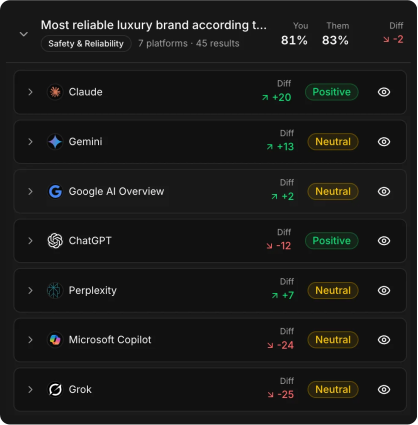
Win customers from all major AI platforms
Understand, measure, and optimize your AI visibility via Ansvisor.
✓ Add brand, domains and competitors
✓ Discover prompts and growth opportunities
✓ Track your AI visibility across major AI platforms
✓ Monitor citations, mentions, and competitors
✓ Measure AI traffic and customer discovery
✓ Receive AI recommendations based on AI insights
✓ Optimize authority, trust, and content quality
✓ Create content, automate analysis & action with AI agents
AI Visibility Terms
Continue exploring key AI visibility concepts.
AI Visibility
Measure and improve how often your brand appears in AI-generated answers.
Learn more →Answer Engine Optimization (AEO)
Strategies for increasing visibility in answer engines and AI summaries.
Learn more →Generative Engine Optimization (GEO)
Optimizing content for AI-powered discovery experiences.
Learn more →ChatGPT Search
Understand how OpenAI retrieves and synthesizes information.
Learn more →Google AI Overviews
AI-generated summaries that appear directly in Google Search.
Learn more →Perplexity Search
Explore how Perplexity cites and presents sources.
Learn more →AI Citations
References and sources used by AI systems to support answers.
Learn more →Citation Authority
Measure the quality and influence of cited sources.
Learn more →Retrievability
How easily AI systems can discover and reuse your content.
Learn more →New terms are added regularly.
Help us improve the page or suggest a new term →
Cihan Geyik
Co-founder at Ansvisor
Cihan Geyik is the co-founder of Ansvisor, an open-source AI Visibility platform for AI Search. With more than 15 years of experience in digital marketing and growth, he writes about AI visibility, AI search, AEO, GEO, citations, and answer engines. He focuses on helping brands understand and improve their presence across ChatGPT, Gemini, Perplexity, Google AI Overviews, and other AI-powered discovery platforms.
Make Your Brand Visible in AI Answers.

INDUSTRIES


© 2026 Ansvisor. All rights reserved. Ansvisor is an open-source AI Search Intelligence Platform for AI Visibility.


.svg)
