Why Prompt Engineering matters
Prompt Engineering is the practice of designing, structuring, and optimizing prompts to improve the quality, accuracy, relevance, and usefulness of AI-generated outputs. It focuses on how instructions, context, examples, and constraints influence the behavior of AI systems.
As generative AI systems have become more capable, prompt engineering has emerged as an important discipline for improving interactions with large language models, AI assistants, and answer engines.
Benefits of prompt engineering include:
- Improve response quality.
- Increase consistency.
- Reduce ambiguity.
- Improve reasoning performance.
- Enhance user experience.
Effective prompt engineering helps users and organizations obtain more reliable and useful outputs from AI systems.
How Prompt Engineering works
Prompt engineering involves designing prompts that provide AI systems with sufficient context and guidance.
- Define objectives.
- Provide context.
- Specify constraints.
- Include examples.
- Structure instructions.
- Iterate and optimize.
Different prompting techniques can significantly influence how AI models interpret requests and generate responses.
Common approaches include zero-shot prompting, few-shot prompting, chain-of-thought prompting, and role-based prompting.
What affects Prompt Engineering performance?
Several factors influence the effectiveness of prompt engineering.
Because different models are trained and aligned differently, prompt engineering strategies often vary across AI platforms.
How Prompt Engineering relates to AI visibility
Prompt engineering and AI visibility are related but distinct concepts.
- Prompt engineering improves AI interactions.
- AI Visibility measures discoverability.
- Prompt engineering influences outputs.
- AI visibility influences retrieval.
- Prompt design affects user experiences.
- Optimization affects brand discovery.
While prompt engineering can improve how users interact with AI systems, it does not directly increase brand visibility within public AI search platforms.
Instead, factors such as Entity Authority, Source Authority, and Retrievability typically play a larger role in determining whether brands appear in AI-generated answers.
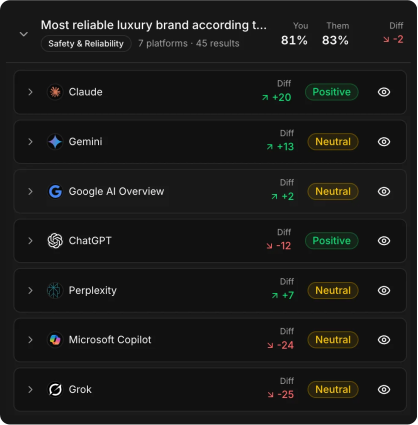
Platforms such as Ansvisor help organizations understand the difference between prompt optimization and AI visibility optimization by analyzing prompts, citations, competitors, answer engines, and retrieval behavior across AI search ecosystems.
Common misconceptions
Common misconceptions about prompt engineering include:
- Prompt engineering changes model training.
- Prompt engineering improves public AI visibility.
- One prompt works equally well across all models.
- Longer prompts always produce better answers.
- Prompt engineering eliminates hallucinations.
Prompt engineering remains an important technique for interacting with AI systems, but long-term AI visibility depends primarily on authority, retrieval, citations, and trusted information sources rather than prompt design alone.








.svg)
