


Google AI Overviews Tracker
A Google AI Overviews Tracker is a tool for monitoring whether and how a website, brand, product, or competitor appears in Google AI Overviews for important search queries.
Instead of measuring only a webpage's traditional organic search position, an AI Overviews tracker can analyze signals such as AI Overview presence, website visibility, brand mentions, citations, cited URLs, competitors, source domains, queries, and historical changes.
This provides a measurement layer for understanding how a brand participates in Google's AI-generated search experiences and where opportunities may exist to improve visibility.
How Does a Google AI Overviews Tracker Work?
A Google AI Overviews tracker starts with a set of queries relevant to a business, website, product, topic, or audience. Those queries are monitored repeatedly to determine whether an AI Overview appears and what information is visible within it.
Depending on the tracker and methodology, the resulting data can show:
- whether an AI Overview appears for the tracked query;
- whether the tracked brand is mentioned;
- whether the tracked website is visible or cited;
- which URLs are cited as sources;
- which competing brands appear;
- which competitor websites receive citations;
- which source domains influence the answer; and
- how these signals change over time.
A dedicated Google AI Overviews Rank Tracker can bring these signals together so teams can monitor AI Overview visibility across a consistent set of relevant queries.
What Does a Google AI Overviews Tracker Measure?
| Signal | What It Measures |
|---|---|
| AI Overview Presence | Whether Google displays an AI Overview for a monitored query. |
| Brand Visibility | Whether the tracked brand appears within the AI-generated result. |
| Website Visibility | Whether pages from the tracked website appear as visible sources or citations. |
| Brand Mentions | Whether the brand or product is explicitly referenced in the AI-generated content. |
| Citations | Which websites and pages Google surfaces as supporting sources. |
| Competitors | Which competing brands appear for the same monitored queries. |
| Source Domains | Which domains repeatedly appear as sources across relevant AI Overviews. |
| Historical Change | How AI Overview presence, visibility, citations, and competitors change over time. |
Google AI Overviews Tracking vs. Traditional Rank Tracking
Traditional SEO rank tracking typically records where a webpage appears in Google's organic search results for a keyword. Google AI Overviews tracking requires a broader set of measurements because the generated result can synthesize information and surface multiple sources within one answer.
Query → Organic Result → URL Position
Google AI Overviews tracking:
Query → AI Overview → Brand Presence → Website Citations → Sources → Competitors
An AI Overview therefore should not automatically be interpreted as a conventional #1, #2, or #3 ranking environment. Where no genuine numerical position exists, visibility should be described using observable signals rather than an artificial ranking.
Google AI Overviews Tracker vs. Google AI Overviews Rank Tracker
The terms Google AI Overviews Tracker and Google AI Overviews Rank Tracker are often used to describe closely related tools. The difference is primarily one of emphasis.
An AI Overviews tracker can refer broadly to monitoring AI Overview presence, sources, brands, citations, competitors, and historical changes. An AI Overviews rank tracker emphasizes measuring a website or brand's visibility for a defined portfolio of queries.
In practice, a comprehensive tracking workflow can combine both:
Google AI Overviews Website Tracking
Website-level tracking focuses on determining where pages from a domain appear across monitored AI Overviews.
This can help answer questions such as:
- Which pages from our website are cited in AI Overviews?
- Which queries generate citations to our website?
- Which pages receive citations repeatedly?
- Where do competitors receive citations while we are absent?
- Which topics generate brand mentions without website citations?
- Are our AI Overview citations increasing or declining?
This makes AI Overviews website tracking useful for understanding both entity visibility and source visibility.
Google AI Overviews Citation Tracking
Citations are a particularly useful observable signal because they identify websites and pages surfaced as sources within supported AI Overviews.
With AI citation monitoring, teams can analyze cited domains and URLs, compare their citation presence with competitors, and identify sources that repeatedly appear across important AI-generated answers.
Website Citation → Source Presence
AI Overview Tracking → Measures both signals in the context of queries and competitors
A citation should not automatically be interpreted as an endorsement, recommendation, website visit, or conversion. It measures source visibility within the AI-generated result.
Tracking Competitors in Google AI Overviews
Competitor tracking helps reveal where other brands have stronger visibility across the same query set.
For example, a tracker can identify:
- queries where competitors appear but the tracked brand does not;
- competitors that are frequently mentioned together;
- competitor domains receiving repeated citations;
- topics where competitors have broader visibility;
- source domains that support competitor visibility; and
- changes in competitor presence over time.
These gaps can provide a more useful optimization signal than looking at total visibility alone.
Query-Level Google AI Overviews Tracking
Query-level measurement connects each AI Overview to the search that triggered it. This makes it possible to understand exactly where a brand or website has visibility rather than relying only on an aggregate score.
Teams can use prompt monitoring and search demand data to connect tracked topics and questions with demand, helping prioritize the queries that matter most.
Query-level data can reveal an important distinction: a brand may have strong visibility for informational questions while being absent from comparison, recommendation, alternative, or purchase-oriented searches.
Historical Google AI Overviews Tracking
One observation only shows what appeared at a particular moment. Historical tracking creates a series of comparable measurements that can reveal broader changes.
Historical AI Overview data can help teams determine:
- whether visibility is increasing or declining;
- which queries gained or lost AI Overview presence;
- whether the website is earning more citations;
- which competitors are gaining visibility;
- whether cited source domains are changing; and
- whether visibility changed after content or authority-building work.
How to Analyze Google AI Overview Answers
A visibility metric tells teams what happened. The underlying AI-generated answer can provide additional context about why the measurement matters.
Using Answer Engine Insights, teams can investigate the relationship between queries, AI-generated answers, brand mentions, competitors, citations, and sources.
For example, two queries may both record the brand as visible while producing very different outcomes. In one answer the brand may be central to the response; in another it may receive only a minor reference. Answer-level analysis helps preserve this context.
Google AI Overviews vs. Google AI Mode Tracking
Google AI Overviews and Google AI Mode are related Google AI Search experiences, but teams should not automatically combine their measurements into a single dataset.
AI Overviews are generated experiences surfaced within Google Search results, while AI Mode provides a more conversational AI Search experience. Because the interfaces and user journeys differ, platform-specific measurement can provide a clearer view of performance.
Teams can track Google AI Mode visibility separately and compare it with Google AI Overviews performance.
Comparing Google AI Overviews With Other AI Search Platforms
Strong Google AI Overviews visibility does not necessarily mean a brand will have the same visibility across other AI Search platforms. Different systems can use different models, retrieval mechanisms, search technologies, source sets, and answer-generation processes.
Multi-platform tracking can therefore reveal whether a visibility gap is specific to Google AI Overviews or part of a broader AI Search pattern.
ChatGPT
A ChatGPT Visibility Tracker can measure brand presence, citations, competitors, and historical changes across a monitored portfolio of ChatGPT prompts.
Gemini
A Gemini Visibility Tracker provides a separate view of how a brand appears across relevant Gemini answers.
Claude
A Claude AI Visibility Tracker can measure observable brand and source visibility across monitored Claude prompts.
Microsoft Copilot
A Microsoft Copilot Visibility Tracker provides platform-specific measurement across relevant Copilot answers.
Perplexity
A Perplexity Visibility Tracker can measure brand mentions, citations, competitors, and source visibility across relevant Perplexity answers.
How to Use a Google AI Overviews Tracker
A practical Google AI Overviews tracking workflow begins with measurement and ends with validation rather than simply collecting more data.
- Define important topics. Identify the products, services, problems, and questions that matter to the business.
- Select relevant queries. Build a representative query portfolio around those topics.
- Establish a baseline. Measure current AI Overview presence, brand visibility, citations, and competitors.
- Monitor consistently. Repeat measurements so changes can be evaluated over time.
- Find visibility gaps. Identify valuable queries where competitors appear while the brand is absent.
- Analyze citations. Study the domains and URLs Google surfaces for those queries.
- Inspect the answers. Understand how brands and sources are represented.
- Take relevant action. Improve content, coverage, authority, or other signals based on the identified gap.
- Measure again. Evaluate whether visibility changes after the work is completed.
How a Google AI Overviews Tracker Supports SEO, AEO, and GEO
AI Overviews tracking provides a measurement layer for understanding how traditional SEO visibility intersects with AI-generated search experiences. It can also support Answer Engine Optimization (AEO) and Generative Engine Optimization (GEO) by revealing which questions, sources, citations, and competitors shape AI visibility.
The tracking data itself does not optimize a website. Its value comes from helping teams identify evidence-based opportunities.
What Makes a Google AI Overviews Tracker Useful?
A useful tracker should provide enough underlying data to move beyond a single visibility score. Depending on the use case, teams may want to inspect:
- individual queries;
- AI Overview presence;
- brand mentions;
- website citations;
- cited URLs and domains;
- competitor visibility;
- historical changes;
- answer-level context; and
- cross-platform differences.
The objective is to connect high-level visibility metrics with the actual queries, answers, citations, and competitors behind them.
Limitations of Google AI Overviews Tracking
Google AI Overviews tracking should be interpreted as structured measurement rather than a perfect record of every possible search experience.
AI-generated results can change, and visibility can differ according to query wording, timing, location, language, interface, and other contextual factors. The set of queries monitored by a tracker is also a sample of a much larger search universe.
Visibility should also not be confused with business outcomes. A brand mention does not guarantee preference, a citation does not guarantee a website visit, and a visit does not guarantee a conversion.
For this reason, AI Overviews tracking is most useful when consistent measurement is combined with other search, traffic, and business performance data.
Google AI Overviews Tracking and AI Search Intelligence
Google AI Overviews are one part of a wider AI-powered discovery environment. Tracking becomes more actionable when Google data can be analyzed alongside visibility across other answer engines and AI Search platforms.
Using an AI Search Intelligence Platform, teams can connect Google AI Overviews data with prompts, answers, citations, competitors, sources, and multi-platform visibility.
This turns a Google AI Overviews tracker from a passive reporting tool into part of a broader workflow for understanding AI Search performance, identifying meaningful opportunities, and measuring whether subsequent actions improve visibility over time.
FAQ
What is a Google AI Overviews Tracker?

A Google AI Overviews Tracker monitors whether and how a brand or website appears in Google AI Overviews for important queries. It can track AI Overview presence, brand visibility, citations, cited URLs, competitors, sources, and historical changes.
What is the difference between a Google AI Overviews Tracker and a rank tracker?
An AI Overviews tracker broadly monitors AI Overview presence, brands, citations, sources, competitors, and changes. A Google AI Overviews Rank Tracker emphasizes measuring a website or brand's visibility across a defined set of queries. In practice, comprehensive tools can provide both types of measurement.
Can you track website rankings in Google AI Overviews?
You can track whether and how a website appears across AI Overviews for monitored queries, including citations and source visibility. However, AI Overviews do not always provide conventional numerical organic positions, so tracking should not create artificial #1, #2, or #3 rankings where those positions do not actually exist.
What should a Google AI Overviews Tracker measure?
Useful signals include AI Overview presence, website visibility, brand mentions, citations, cited URLs, source domains, competitors, query-level performance, and historical changes.
How is Google AI Overviews tracking different from Google AI Mode tracking?
Google AI Overviews and Google AI Mode are related but distinct AI Search experiences. AI Overviews tracking measures visibility within AI-generated results surfaced in Google Search, while Google AI Mode tracking focuses on Google's more conversational AI Search experience. They can be measured separately and compared.
Everything You Need to Improve Your AI Visibility
Track how your brand appears across AI platforms, understand what drives visibility, and turn insights into measurable actions.
Platform Features
Explore all features →Answer Engine Insights
Understand how AI platforms talk about your brand.
Prompt Intelligence
Discover and monitor the prompts shaping your AI visibility.
Citations Monitoring
Track which sources AI platforms cite and where your brand appears.
AI Traffic Analytics
Measure visits coming from ChatGPT, Gemini, Claude, and more.
Competitor Benchmarking
Compare AI visibility and uncover competitive gaps and opportunities.
Action Center
Turn AI Search signals into prioritized actions and executable tasks.
AI Visibility Trackers
Explore AI Visibility Platform →ChatGPT Visibility Tracker
Track brand mentions, citations, prompts, and visibility across ChatGPT.
Google AI Overviews Rank Tracker
Monitor where and how your brand appears in Google AI Overviews.
Google AI Mode Visibility Tracker
Track your brand's visibility across Google AI Mode experiences.
Gemini Visibility Tracker
Understand how your brand appears across Google Gemini responses.
Microsoft Copilot Visibility Tracker
Monitor your brand's presence across Microsoft Copilot answers.
Perplexity Visibility Tracker
Track brand mentions, citations, and visibility across Perplexity.
From AI Visibility insights to action.
Explore the complete Ansvisor platform for AI Search intelligence, optimization, and growth.
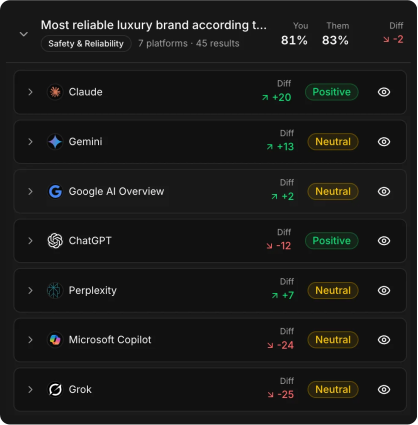
Win customers from all major AI platforms
Understand, measure, and optimize your AI visibility via Ansvisor.
✓ Add brand, domains and competitors
✓ Discover prompts and growth opportunities
✓ Track your AI visibility across major AI platforms
✓ Monitor citations, mentions, and competitors
✓ Measure AI traffic and customer discovery
✓ Receive AI recommendations based on AI insights
✓ Optimize authority, trust, and content quality
✓ Create content, automate analysis & action with AI agents
AI Visibility Terms
Continue exploring key AI visibility concepts.
AI Visibility
Measure and improve how often your brand appears in AI-generated answers.
Learn more →Answer Engine Optimization (AEO)
Strategies for increasing visibility in answer engines and AI summaries.
Learn more →Generative Engine Optimization (GEO)
Optimizing content for AI-powered discovery experiences.
Learn more →ChatGPT Search
Understand how OpenAI retrieves and synthesizes information.
Learn more →Google AI Overviews
AI-generated summaries that appear directly in Google Search.
Learn more →Perplexity Search
Explore how Perplexity cites and presents sources.
Learn more →AI Citations
References and sources used by AI systems to support answers.
Learn more →Citation Authority
Measure the quality and influence of cited sources.
Learn more →Retrievability
How easily AI systems can discover and reuse your content.
Learn more →New terms are added regularly.
Help us improve the page or suggest a new term →
Cihan Geyik
Co-founder at Ansvisor
Cihan Geyik is the co-founder of Ansvisor, an open-source AI Visibility platform for AI Search. With more than 15 years of experience in digital marketing and growth, he writes about AI visibility, AI search, AEO, GEO, citations, and answer engines. He focuses on helping brands understand and improve their presence across ChatGPT, Gemini, Perplexity, Google AI Overviews, and other AI-powered discovery platforms.
Make Your Brand Visible in AI Answers.

INDUSTRIES


© 2026 Ansvisor. All rights reserved. Ansvisor is an open-source AI Search Intelligence Platform for AI Visibility.


.svg)
