Rank Tracking Data is the historical measurement data
collected when the visibility of a website, brand, product, or competitor is
monitored repeatedly across search queries, AI prompts, and AI-generated
answers.
In traditional SEO, rank tracking data commonly refers to keyword positions
in search engine results. In AI Search, the concept is broader because many
AI-generated experiences do not return a simple ordered list of webpages.
AI rank tracking data can therefore include brand visibility, mentions,
citations, cited URLs, competitors, prompts, answer context, platforms, and
historical changes.
Query or Prompt → Search / AI Answer → Visibility Signals → Recorded Data → Historical Comparison
What Does Rank Tracking Data Include?
The exact fields depend on the platform and measurement methodology.
For AI Search, useful rank tracking datasets can contain several signals
associated with each monitored prompt or query.
| Data Point |
What It Measures |
| Query or Prompt |
The search query or AI prompt being monitored. |
| Platform |
The search engine or AI Search environment where the measurement was collected. |
| Brand Presence |
Whether the tracked brand appears in the result or AI-generated answer. |
| Brand Mentions |
Whether and how the tracked entity is explicitly mentioned. |
| Citations |
Whether a tracked website, page, or domain is used as a cited source. |
| Cited URLs |
The specific pages referenced within supported AI-generated answers. |
| Competitors |
Competing brands that appear for the same query or prompt. |
| Answer Context |
How the brand, competitor, or source is represented within the generated answer. |
| Date |
When the measurement was collected, enabling historical comparison. |
Traditional Rank Tracking Data vs. AI Rank Tracking Data
Traditional SEO rank tracking is primarily based on the relationship between
a keyword and a webpage's position in search results. For example, a tracker
might record that a URL ranks in position 4 for a specific keyword on a
particular date.
AI Search creates a different measurement problem. A generated answer may
mention several brands, cite multiple sources, recommend one company over
another, or provide an answer without presenting conventional numbered
organic positions.
Traditional SEO rank data:
Keyword → URL → Search Position → Date
AI Search rank tracking data:
Prompt → AI Answer → Brand Visibility → Mentions → Citations → Competitors → Sources → Date
This means AI rank tracking should not simply convert every generated answer
into an artificial position such as #1, #2, or #3. Where a genuine ordered
position does not exist, visibility should be measured using signals that
accurately describe the answer.
Why Is Historical Rank Tracking Data Important?
A single ranking or AI-generated answer provides only a snapshot. Historical
rank tracking data shows how visibility changes across repeated measurements.
Historical data can help teams answer questions such as:
- Is brand visibility increasing or declining?
- Which prompts have recently gained or lost visibility?
- Are competitors appearing more frequently?
- Are more pages from the website receiving AI citations?
- Did visibility change after a content update?
- Are new sources beginning to influence relevant answers?
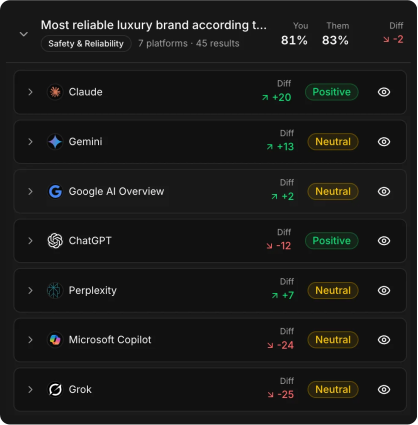
- Does performance differ across AI Search platforms?
Repeated measurements are especially useful in AI Search because generated
answers can change over time and may vary between observations.
Rank Tracking Data and AI Visibility Tracking
AI visibility tracking uses repeated measurements to
understand whether and how a brand appears across a strategically selected
set of AI prompts and answers.
Rank tracking data forms part of the underlying evidence for that analysis.
Instead of relying on one aggregate score, teams can examine the individual
prompts, mentions, citations, competitors, sources, and historical changes
behind overall visibility.
Raw Rank Tracking Data → Historical Trends → AI Visibility → Gaps → Opportunities
Prompt-Level Rank Tracking Data
In AI Search, the prompt is an important unit of measurement. Different
questions about the same topic can produce substantially different answers
and brand visibility.
For example, a company may appear when a user asks for a definition but be
absent when the user asks for the best tools, alternatives, comparisons, or
recommendations within the same topic.
Using
AI prompt monitoring and volumes,
teams can build a monitored prompt portfolio and connect individual prompt
results with broader demand and topic opportunities.
Rank Tracking Data and Answer-Level Analysis
A visibility metric becomes more useful when teams can inspect the answer
behind it. Answer-level analysis provides context for understanding why a
brand was recorded as visible, mentioned, cited, or absent.
Answer Engine Insights
can connect measurement data with AI-generated answers, prompts, sources,
citations, and competitors so teams can investigate the context behind
visibility changes.
Citation Data in AI Rank Tracking
Citation data records which domains and URLs are referenced as sources in
supported AI-generated answers. It should be analyzed separately from brand
mentions because the two signals describe different types of visibility.
Mention data → Entity visibility
Citation data → Source visibility
Rank tracking data → Historical measurement of these and other visibility signals
With
AI citation monitoring,
teams can examine cited domains and URLs, compare citation visibility with
competitors, and identify sources that repeatedly appear for relevant prompts.
Rank Tracking Data Across AI Search Platforms
AI Search visibility should generally be evaluated by platform as well as in
aggregate. Different systems can use different models, retrieval methods,
search technologies, sources, and answer-generation processes.
As a result, the same or similar prompt can produce different visibility
signals across different AI experiences.
ChatGPT Rank Tracking Data
A
ChatGPT Visibility Tracker
can record historical visibility signals for monitored ChatGPT prompts,
including brand presence, citations, competitors, and changes over time.
Gemini Rank Tracking Data
A
Gemini Visibility Tracker
can help measure how brand visibility changes across a consistent portfolio
of relevant Gemini prompts.
Google AI Overviews Rank Tracking Data
A
Google AI Overviews Rank Tracker
can monitor website visibility, brand presence, citations, competitors, and
historical changes for important Google Search queries that surface AI Overviews.
Google AI Mode Tracking Data
Teams can
track Google AI Mode visibility
separately to analyze how brands and sources appear within Google's
conversational AI Search experience.
Claude Rank Tracking Data
A
Claude AI Visibility Tracker
can record observable visibility signals across a monitored set of Claude
prompts and compare those measurements over time.
Microsoft Copilot Rank Tracking Data
A
Microsoft Copilot Visibility Tracker
provides platform-specific tracking data for monitored Copilot answers,
including relevant brand and source visibility signals.
Perplexity Rank Tracking Data
A
Perplexity Visibility Tracker
can help track mentions, citations, competitors, sources, and historical
visibility across relevant Perplexity answers.
How to Analyze Rank Tracking Data
Raw data becomes useful when it helps explain meaningful changes rather than
simply creating more metrics. A practical analysis can move from individual
observations to trends, gaps, and actions.
- Establish a baseline. Record visibility across the initial prompt or query set.
- Segment by platform. Avoid assuming all AI systems behave the same way.
- Compare over time. Look for persistent gains or losses rather than overreacting to one observation.
- Analyze competitors. Identify where competing brands consistently appear while the tracked brand is absent.
- Inspect citations. Determine which domains and URLs repeatedly influence relevant answers.
- Investigate the answer. Review the context behind important visibility changes.
- Prioritize opportunities. Connect visibility gaps with business relevance and audience demand.
- Measure again. Compare subsequent data after relevant actions have been completed.
Baseline → Track → Compare → Investigate → Act → Measure Again
Rank Tracking Data vs. AI Visibility Score
A visibility score is usually an aggregated metric designed to summarize
performance. Rank tracking data is the more granular dataset underneath the
measurement.
This distinction matters because two brands can receive similar aggregate
visibility scores while having very different underlying performance. One
may dominate a small number of high-value prompts, while another appears
weakly across a much broader prompt set.
Teams should therefore be able to move from an aggregate KPI back to the
underlying prompts, answers, mentions, citations, competitors, and sources
that produced it.
How Rank Tracking Data Identifies AI Search Opportunities
Historical rank tracking data can reveal gaps that would be difficult to
identify from individual AI answers.
Examples include:
- important prompts where the brand is consistently absent;
- queries where competitors appear more frequently;
- topics where competitor websites receive citations but the tracked website does not;
- pages that are losing citation visibility;
- new sources beginning to appear across relevant answers;
- platforms where the brand underperforms relative to others; and
- visibility changes following content or authority-building actions.
This transforms rank tracking from passive reporting into an input for
prioritizing AI Search work.
Limitations of AI Rank Tracking Data
AI rank tracking data should be interpreted with the characteristics of
generated answers in mind. AI responses can vary, and results may differ
according to platform, model, retrieval behavior, interface, location,
language, timing, or other contextual factors.
A monitored prompt portfolio is also a sample rather than a complete record
of everything users ask AI systems. External tools generally cannot observe
all private user conversations.
For these reasons, individual observations should not automatically be
interpreted as permanent rankings. Consistent methodology and repeated
measurements are more useful for identifying broader patterns.
Rank tracking data also measures visibility, not necessarily business
impact. A brand mention does not guarantee preference, a citation does not
guarantee a click, and a visit does not guarantee a conversion.
From Rank Tracking Data to AI Search Intelligence
The value of rank tracking data increases when it is connected to decisions.
Historical measurements can reveal what changed, answer-level analysis can
help explain why it matters, and opportunity analysis can identify what to
work on next.
Using an
AI Search Intelligence Platform,
teams can connect rank tracking data with prompts, visibility, citations,
competitors, sources, and historical performance rather than analyzing each
signal in isolation.
Rank Tracking Data → Analytics → Opportunities → Actions → New Data → Measurement
This creates a continuous measurement cycle in which rank tracking data is
not simply stored for reporting. It becomes evidence for understanding AI
Search performance, identifying meaningful visibility gaps, prioritizing
actions, and evaluating whether those actions produce measurable change.








.svg)
