

AI & Infrastructure

Retrieval Pipeline

The sequence of processes that AI systems use to retrieve, rank, validate, and prepare information before generating responses.
June 27, 2026
Cihan Geyik
Table of Content

Why Retrieval Pipelines matter

A Retrieval Pipeline is the sequence of processes and components that AI systems use to retrieve, rank, validate, and prepare information before generating responses. It defines how information flows from a user's query to the final AI-generated answer.

As AI search systems increasingly rely on external knowledge rather than model memory alone, retrieval pipelines have become one of the most important architectural components of modern answer engines.

Benefits of retrieval pipelines include:

  • Improve answer accuracy.
  • Reduce hallucinations.
  • Support real-time knowledge.
  • Increase source reliability.
  • Enable complex reasoning.

The quality of an AI system's retrieval pipeline often determines the quality, trustworthiness, and usefulness of its answers.

How a Retrieval Pipeline works

Modern retrieval pipelines typically perform multiple stages of information processing.

  • Interpret user intent.
  • Expand the query.
  • Retrieve candidate documents.
  • Rank and rerank results.
  • Validate retrieved sources.
  • Provide context to the model.

The retrieved information is then incorporated into the model's context window and used during answer generation.

Many modern AI systems execute multiple retrieval passes before generating final responses.

What technologies power Retrieval Pipelines?

Retrieval pipelines combine multiple AI and search technologies.

Advanced retrieval pipelines often incorporate embeddings, vector search, reranking, grounding, multi-step retrieval, and source validation mechanisms.

How Retrieval Pipelines affect AI visibility

Retrieval pipelines determine which brands, entities, and information sources become visible within AI-generated answers.

Organizations with authoritative, well-structured, and easily retrievable information are more likely to be surfaced by retrieval pipelines and incorporated into AI-generated responses.

Strategies such as AI Content Optimization, Answer Engine Optimization (AEO), and LLM Optimization often focus on improving performance throughout retrieval pipelines.

Platforms such as Ansvisor help organizations understand retrieval pipeline behavior by analyzing prompts, citations, retrieval patterns, competitors, authority signals, and AI visibility performance across multiple answer engines.

Common misconceptions

Common misconceptions about retrieval pipelines include:

  • AI models retrieve information directly.
  • Retrieval pipelines only perform search.
  • More retrieved documents always improve answers.
  • All answer engines use identical pipelines.
  • Model size matters more than retrieval quality.

Retrieval pipelines have become a critical layer of modern AI systems because they determine what information is retrieved, trusted, synthesized, and ultimately presented to users.

Also known as; Retrieval Workflow, Retrieval Architecture, Information Retrieval Pipeline, AI Retrieval Pipeline

FAQ

Frequently asked questions.

What is a Retrieval Pipeline?

A Retrieval Pipeline is the sequence of processes used by AI systems to retrieve, rank, validate, and prepare information before answer generation.

Why are Retrieval Pipelines important?

They improve answer quality, reduce hallucinations, enable real-time information access, and support trustworthy AI experiences.

How does a Retrieval Pipeline work?

It interprets queries, retrieves information, ranks sources, validates results, and provides context to language models.

How do Retrieval Pipelines affect AI visibility?

They determine which brands, entities, and sources are retrieved, cited, and included in AI-generated answers.

Which tools help analyze Retrieval Pipelines?

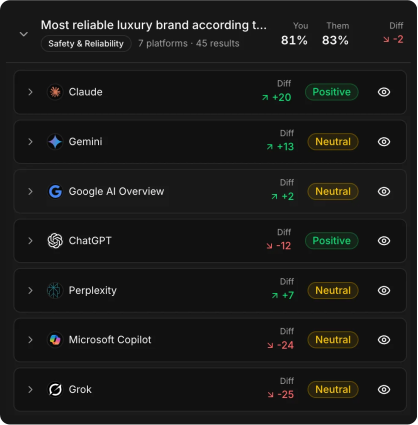
AI Visibility Platforms like Ansvisor help organizations analyze retrieval behavior, citations, competitors, authority signals, and AI visibility performance across answer engines.
Build your AI visibility advantage.

Understand, measure, and optimize your AI visibility.

✓ Add brand, domains and competitors
✓ Discover prompts and growth opportunities
✓ Track your AI visibility across major AI platforms
✓ Monitor citations, mentions, and competitors
✓ Measure AI traffic and customer discovery
✓ Receive AI recommendations based on AI insights
✓ Optimize authority, trust, and content quality
✓ Create content, automate analysis & action with AI agents


Start Free Trial →Take Product Tour →
Help us grow the AI Visibility Grossary

New terms are added regularly.

Help us improve the page or suggest a new term →
About the Author
Cihan Geyik

Cihan Geyik

Co-founder at Ansvisor

Cihan Geyik is the co-founder of Ansvisor, an open-source AI Visibility platform for AI Search. With more than 15 years of experience in digital marketing and growth, he writes about AI visibility, AI search, AEO, GEO, citations, and answer engines. He focuses on helping brands understand and improve their presence across ChatGPT, Gemini, Perplexity, Google AI Overviews, and other AI-powered discovery platforms.

Summarize with ChatGPT
Summarize with Claude
Summarize with Google
Summarize with Perplexity
Summarize with Grok