


Citation Rate
Citation Rate is a measurement of how frequently a brand, domain, website, or other tracked source is cited across a defined set of AI-generated answers. It helps teams understand how consistently their content is being used or referenced as a source within the AI Search environments they monitor.
Citation Rate is particularly useful in Answer Engine Optimization (AEO), Generative Engine Optimization (GEO), and AI Search analytics because brand visibility and source visibility are not the same thing. A brand can appear in an answer without its website being cited, while a website can sometimes be cited as a source even when the brand itself is not prominently discussed.
How is Citation Rate calculated?
The exact methodology can vary between AI Search analytics platforms, so the definition of the denominator should always be documented.
A straightforward prompt-level Citation Rate can be expressed as:
For example, suppose a domain is cited in 24 of 100 eligible AI-generated answers in a defined measurement set.
This means the tracked domain received at least one citation in 24% of the eligible answers included in that particular measurement.
However, Citation Rate can also be defined at different levels. A platform might calculate it across prompts, answer runs, topics, platforms, or another defined observation unit. For this reason, Citation Rate values from different tools should not automatically be treated as directly comparable.
What does Citation Rate measure?
Citation Rate measures the frequency of source inclusion within a defined AI Search dataset.
Depending on the analysis, it can be calculated for:
- A brand's primary domain.
- An individual URL.
- A competitor domain.
- A third-party publication.
- A group of owned domains.
- A topic or prompt cluster.
- A specific AI platform.
- A defined market, language, or location.
This flexibility makes Citation Rate useful for both brand-level measurement and deeper source analysis.
Why is Citation Rate important for AI Search?
AI-generated answers can use external web sources when producing or supporting responses. Monitoring citations helps organizations understand whether their content is participating in that observable source ecosystem.
Citation Rate can help identify:
- How consistently owned content is cited.
- Which prompts generate citations.
- Which topics have strong or weak citation coverage.
- Which competitors receive citations more frequently.
- Which third-party sources repeatedly influence relevant answers.
- Whether citation performance is improving or declining over time.
Citation Rate should therefore be interpreted as one component of AI Search performance rather than a complete measure of AI visibility.
What is the difference between a mention and a citation?
A mention occurs when a brand, product, company, or other entity appears within an AI-generated answer.
A citation occurs when a source, such as a domain or URL, is referenced or linked as supporting material within the observable answer experience.
Citation → Source Presence
These signals can overlap, but they should not be treated as interchangeable.
A company may receive strong brand visibility while its own website receives few citations. Conversely, a page may be cited as a source without the brand becoming a central recommendation in the answer.
Citation Rate vs Mention Rate
Citation Rate and Mention Rate measure different forms of presence in AI-generated answers.
| Citation Rate | Mention Rate |
|---|---|
| Measures source presence | Measures entity or brand presence |
| Tracks cited domains or URLs | Tracks named brands, products, or entities |
| Useful for source visibility analysis | Useful for brand visibility analysis |
| Can reveal citation gaps | Can reveal mention gaps |
| Does not necessarily indicate recommendation | Does not necessarily indicate citation |
Tracking both metrics provides a more complete picture of how a brand participates in AI Search.
What is a domain-level Citation Rate?
Domain-level Citation Rate measures how frequently any eligible URL from a tracked domain receives a citation within the selected measurement set.
For example, citations to:
- example.com/product
- example.com/blog/article
- example.com/research/report
can all contribute to the Citation Rate of example.com when the metric is calculated at the domain level.
Domain-level measurement is useful for evaluating the overall source visibility of a website, while URL-level analysis helps identify the specific content earning citations.
What is a URL-level Citation Rate?
URL-level Citation Rate measures how frequently a specific page is cited across eligible AI-generated answers.
This can help identify:
- Pages repeatedly selected as sources.
- Content that performs well for particular prompt clusters.
- Pages gaining citation visibility after optimization.
- Pages losing citations over time.
- Content formats that appear frequently in cited answers.
URL-level analysis can therefore turn a high-level Citation Rate into more actionable content intelligence.
How do prompts affect Citation Rate?
Citation Rate is highly dependent on the prompts included in the measurement set. A domain may receive strong citation coverage for one topic while being almost absent from another.
For example, a company could have:
- Strong citations for educational questions.
- Moderate citations for product comparisons.
- Low citations for commercial recommendation prompts.
- No citations for an emerging topic cluster.
This is why citation measurement should be connected to a structured prompt portfolio rather than interpreted only as a site-wide aggregate.
Ansvisor's AI Prompt Tracking & Analytics connects monitored prompts with visibility, citations, demand, competitors, and historical performance so citation coverage can be evaluated in the context of the questions that matter.
How do you measure Citation Rate by topic?
Prompts can be grouped into topic clusters and Citation Rate can then be measured separately for each cluster.
For example:
| Topic | Eligible Answers | Answers With Citation | Citation Rate |
|---|---|---|---|
| Topic A | 100 | 32 | 32% |
| Topic B | 100 | 14 | 14% |
| Topic C | 100 | 4 | 4% |
Topic-level measurement makes it easier to identify where a domain already has source visibility and where significant citation gaps remain.
How do you compare competitor Citation Rates?
Competitor Citation Rate compares how frequently selected competing domains are cited across the same or comparable measurement set.
The comparison should use consistent:
- Prompts.
- AI platforms.
- Time periods.
- Locations and languages where relevant.
- Eligibility rules.
- Citation definitions.
This helps reveal situations where competitors are being used as sources more frequently for strategically important questions.
A lower Citation Rate does not automatically mean a competitor has better content. Differences can reflect topic coverage, source selection, brand authority, content formats, platform behavior, or other factors that require deeper analysis.
What is a citation gap?
A citation gap is an opportunity identified when relevant AI-generated answers cite competitors or other sources while the tracked brand or domain is absent.
Citation gaps can occur at different levels:
- Prompt-level citation gaps.
- Topic-level citation gaps.
- Competitor citation gaps.
- Platform-specific citation gaps.
- Third-party source gaps.
For example, if a competitor is repeatedly cited across high-value comparison prompts while the tracked domain receives no citations, that pattern may represent a meaningful source visibility opportunity.
Can Citation Rate be measured across multiple AI platforms?
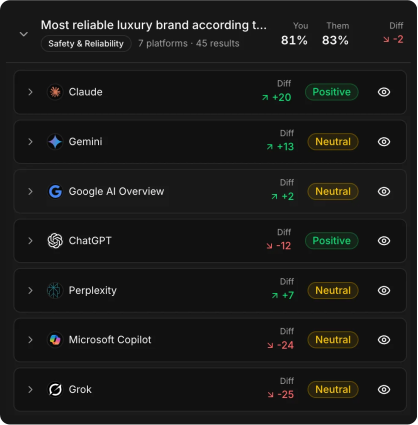
Yes. Citation Rate can be segmented by individual AI Search platforms when citations or source references are observable in the measured answer experience.
This is useful because citation behavior can differ between platforms. A domain may receive strong source visibility in one environment and limited visibility in another.
Platform-level Citation Rate can help answer:
- Where is our domain cited most consistently?
- Where are competitors cited more frequently?
- Which platforms show the largest citation gaps?
- Are citation gains broad or isolated to one platform?
Cross-platform totals should be interpreted carefully because different systems can expose citations in different ways and may not produce equivalent answer structures.
How should Citation Rate be tracked over time?
Citation Rate becomes more useful when measured consistently across comparable time periods.
Historical tracking can reveal:
- Long-term citation growth.
- Sudden citation losses.
- Topic-specific improvements.
- Competitor citation gains.
- Changes following content updates.
- Changes in platform-level citation behavior.
Because AI-generated answers can vary, isolated changes should not automatically be interpreted as lasting gains or losses. Repeated measurement provides more context.
What is a good Citation Rate?
There is no universal Citation Rate that is “good” for every organization.
Citation Rate depends on:
- The prompts being measured.
- The topic and industry.
- The AI platforms included.
- The number and strength of competitors.
- The measurement methodology.
- The time period.
- The language and market.
A 20% Citation Rate across one dataset cannot automatically be considered better or worse than a 30% Citation Rate measured with a different prompt set or methodology.
More useful comparisons often include:
- Your Citation Rate versus your historical baseline.
- Your Citation Rate versus competitors using the same dataset.
- Citation Rate across different topic clusters.
- Citation Rate across different platforms.
Does a higher Citation Rate mean higher AI visibility?
Not necessarily.
Citation Rate and AI visibility are related signals, but they measure different things.
A website can receive citations while its brand is not prominently discussed. A brand can also receive frequent mentions without its own website being cited.
AI Visibility → Broader Brand Presence
Citation Rate should therefore be analyzed alongside mentions, Prompt Coverage, Share of Voice, answer prominence, competitor performance, and other relevant AI visibility metrics.
Does a higher Citation Rate mean more AI traffic?
No. A citation does not guarantee that a user will click through to the cited website.
Citation Rate measures source presence, while AI Referral Traffic measures identifiable visits from AI-powered platforms.
These are different stages of the user journey and should be measured separately.
A page can have strong citation visibility and relatively little referral traffic. Conversely, a smaller number of citations associated with high-intent questions may produce valuable visits.
Is an AI citation the same as a recommendation?
No.
A citation indicates that a source was referenced within the observable answer experience. It does not automatically mean the AI system recommends, endorses, or prefers the cited brand.
The source may be used for:
- Supporting a factual statement.
- Providing background information.
- Referencing product details.
- Supporting a comparison.
- Providing evidence for part of an answer.
Citation context should therefore be analyzed separately from citation frequency.
Citation Rate vs backlinks
Citation Rate is not a backlink metric.
Traditional backlink analysis examines links between web pages. Citation Rate measures how frequently a tracked source appears within a defined set of AI-generated answers.
| Backlink Metrics | AI Citation Rate |
|---|---|
| Measures links between web pages | Measures citations in AI-generated answers |
| Based on web link graphs | Based on observed AI answer sets |
| Often analyzed at domain and page level | Can be analyzed by domain, URL, prompt, topic, and platform |
| Reflects web linking relationships | Reflects observable source inclusion in AI answers |
A domain can have many backlinks and still have limited citation visibility for a particular AI Search topic. Likewise, an AI-cited page does not necessarily have an unusually large backlink profile.
What are the limitations of Citation Rate?
Citation Rate is useful, but it should not be interpreted without understanding its measurement boundaries.
Important limitations include:
- AI-generated answers can vary between runs.
- Not every AI platform exposes citations in the same way.
- Tracked prompts represent a selected measurement portfolio.
- Private AI conversations are generally not observable.
- A citation does not necessarily indicate endorsement.
- A citation does not guarantee referral traffic.
- Different analytics tools may calculate Citation Rate differently.
- Aggregate Citation Rate can hide topic-level or platform-level gaps.
For these reasons, Citation Rate should be analyzed together with the methodology, prompt set, time period, platforms, competitors, and other AI Search metrics.
How do you improve Citation Rate?
Improving Citation Rate begins with understanding where citation gaps exist and what sources are currently being cited instead.
Potential actions can include:
- Identifying high-value prompts where competitors are cited but your domain is absent.
- Analyzing the pages and sources repeatedly cited for those prompts.
- Improving existing content around uncovered questions and topics.
- Creating content that directly addresses important information gaps.
- Strengthening factual clarity and source-worthy information.
- Improving technical accessibility and crawlability.
- Building relevant third-party brand and source presence where appropriate.
- Tracking whether citation coverage changes after optimization.
Citation improvements should be validated through repeated measurement rather than assumed immediately after content or distribution work is completed.
Ansvisor's AI Search KPIs & Actions connects measurable signals such as citation gaps with evidence, opportunities, prioritized actions, and validation.
Citation Rate and AI Search Intelligence
Citation Rate answers a focused measurement question:
How consistently is our brand, domain, or content being cited across the AI-generated answers we measure?
AI Search Intelligence adds the context required to understand why that metric matters by connecting citation data with prompts, demand, mentions, competitors, Share of Voice, source analysis, traffic, opportunities, and actions.
An AI Search Intelligence Platform can connect Citation Rate with the broader customer discovery environment so teams can move from measurement to prioritization and execution.
Citation Rate is therefore most valuable not as an isolated percentage, but as part of a broader measurement system that explains where source visibility exists, where competitors are stronger, where citation gaps remain, and what should be investigated next.
FAQ
What is Citation Rate in AI Search?

Citation Rate measures how frequently a tracked brand, domain, or source is cited across a defined set of eligible AI-generated answers. It is primarily a measure of source visibility rather than overall brand visibility.
How is AI Citation Rate calculated?
A basic prompt-level calculation is the number of eligible AI answers containing a citation to the tracked source divided by the total number of eligible answers, multiplied by 100. Exact methodologies can vary between platforms, so the denominator and citation rules should always be defined.
What is the difference between Citation Rate and Mention Rate?
Citation Rate measures how frequently a domain or source is cited, while Mention Rate measures how frequently a brand or entity is mentioned. A brand can be mentioned without its website being cited, so the two metrics measure different forms of AI Search presence.
What is a good Citation Rate?
There is no universal good Citation Rate because results depend on the prompts, industry, platforms, competitors, market, time period, and measurement methodology. Historical trends, topic-level performance, and comparisons with competitors using the same dataset are usually more informative than an isolated percentage.
Does a higher Citation Rate mean more AI traffic?
Not necessarily. Citation Rate measures source presence in AI-generated answers, while AI Referral Traffic measures identifiable website visits from AI platforms. A citation can increase the opportunity for discovery without necessarily producing a click.
Win customers from all major AI platforms
Understand, measure, and optimize your AI visibility via Ansvisor.
✓ Add brand, domains and competitors
✓ Discover prompts and growth opportunities
✓ Track your AI visibility across major AI platforms
✓ Monitor citations, mentions, and competitors
✓ Measure AI traffic and customer discovery
✓ Receive AI recommendations based on AI insights
✓ Optimize authority, trust, and content quality
✓ Create content, automate analysis & action with AI agents
AI Visibility Terms
Continue exploring key AI visibility concepts.
AI Visibility
Measure and improve how often your brand appears in AI-generated answers.
Learn more →Answer Engine Optimization (AEO)
Strategies for increasing visibility in answer engines and AI summaries.
Learn more →Generative Engine Optimization (GEO)
Optimizing content for AI-powered discovery experiences.
Learn more →ChatGPT Search
Understand how OpenAI retrieves and synthesizes information.
Learn more →Google AI Overviews
AI-generated summaries that appear directly in Google Search.
Learn more →Perplexity Search
Explore how Perplexity cites and presents sources.
Learn more →AI Citations
References and sources used by AI systems to support answers.
Learn more →Citation Authority
Measure the quality and influence of cited sources.
Learn more →Retrievability
How easily AI systems can discover and reuse your content.
Learn more →New terms are added regularly.
Help us improve the page or suggest a new term →
Cihan Geyik
Co-founder at Ansvisor
Cihan Geyik is the co-founder of Ansvisor, an open-source AI Visibility platform for AI Search. With more than 15 years of experience in digital marketing and growth, he writes about AI visibility, AI search, AEO, GEO, citations, and answer engines. He focuses on helping brands understand and improve their presence across ChatGPT, Gemini, Perplexity, Google AI Overviews, and other AI-powered discovery platforms.
Make Your Brand Visible in AI Answers.

INDUSTRIES


© 2026 Ansvisor. All rights reserved. Ansvisor is an open-source AI Search Intelligence Platform for AI Visibility.


.svg)
