


Copy AI
What is Copy.ai?
Copy.ai is a go-to-market AI platform designed to automate and scale workflows across marketing, sales, customer success, and other revenue functions.
Originally known primarily as an AI writing tool, Copy.ai has expanded into a broader GTM AI platform built around AI agents, automated workflows, centralized data, integrations, and content operations.
Within AI search, Copy.ai is primarily an execution and content optimization platform rather than a dedicated AI visibility monitoring tool. Teams can use its content agents and workflows to research, create, structure, optimize, and scale content intended to perform across traditional search and AI-generated discovery experiences.
What does Copy.ai do?
Copy.ai helps organizations codify repeatable go-to-market processes and automate them using artificial intelligence.
For content and search teams, this can include workflows for:
- Content research.
- Content ideation.
- SEO content briefs.
- Long-form content creation.
- Content optimization.
- Thought leadership.
- Landing pages.
- Sales enablement content.
- Social content.
- Content repurposing.
- Personalized marketing assets.
These workflows can be standardized and reused across teams, helping organizations increase content production while maintaining consistent brand messaging.
What are the key features of Copy.ai?
Copy.ai combines AI agents, workflow automation, content creation, brand governance, and go-to-market data within one platform.
- Content Agent Studio: Creates specialized AI agents trained on examples of a company's existing content.
- Content Agents: Generate repeatable content for specific formats and use cases while following brand voice and structure.
- AI Workflows: Automate multi-step processes involving research, generation, analysis, transformation, and other GTM activities.
- Brand Voice: Helps generated content maintain consistent tone, style, structure, and messaging.
- SEO Content Creation: Automates research, content briefs, drafting, and search-focused content production.
- Content Repurposing: Transforms existing assets into new formats and channels.
- AI Chat: Provides access to multiple leading language models through one environment.
- GTM Data Foundation: Connects structured and unstructured go-to-market information with automated workflows.
- Integrations: Connects Copy.ai workflows with existing marketing, sales, and revenue systems.
- Multi-Model AI: Uses multiple language models rather than requiring every workflow to depend on a single model provider.
What is Copy.ai Content Agent Studio?
Content Agent Studio is Copy.ai's platform for creating specialized AI content agents.
Instead of repeatedly prompting a general-purpose AI model, teams provide examples of high-quality existing content that represent their preferred voice, structure, and style.
Copy.ai states that an agent can be created using three representative content examples.
The resulting agent can then repeatedly create a particular type of content while following the patterns learned from those examples.
Organizations can create separate agents for formats such as:
- Blog articles.
- Landing pages.
- Thought leadership.
- Social posts.
- Case studies.
- Email campaigns.
- Sales collateral.
- Product marketing content.
This approach is designed to make AI content production repeatable without requiring marketers to rebuild detailed prompts for every asset.
How do Copy.ai Content Agents work?
Content Agents are specialized AI systems configured around a specific content task and a company's existing content standards.
A team can provide representative examples, define the content type, and then supply new briefs whenever another asset is required.
The agent uses the learned characteristics of the reference content to generate new drafts with similar brand voice, structure, and formatting expectations.
This allows organizations to codify parts of their editorial process into reusable AI systems rather than relying entirely on one-off prompting.
What are Copy.ai Workflows?
Copy.ai Workflows automate multi-step go-to-market processes.
A workflow can combine research, data processing, AI generation, transformation, decision logic, and integrations into a repeatable sequence.
For example, a content workflow could:
- Receive a topic or keyword.
- Research the topic.
- Analyze relevant information.
- Create a content brief.
- Generate an outline.
- Produce a draft.
- Apply brand guidelines.
- Review or transform the content.
- Send the resulting asset into another GTM system.
Once created, the same workflow can be reused across large numbers of topics or campaigns.
How can Copy.ai be used for SEO?
Copy.ai provides workflows specifically designed for SEO content creation.
Teams can automate activities such as SEO research, content ideation, brief creation, drafting, and optimization.
Instead of manually repeating the same research and writing process for every keyword or topic, organizations can encode their preferred methodology into reusable workflows.
This can help content teams increase production volume while maintaining consistent standards across large SEO programs.
How can Copy.ai be used for AI search?
Copy.ai can be used to create and improve content intended to appear within AI-generated search and answer experiences.
The company explicitly discusses AI Search Visibility, Generative Engine Optimization (GEO), Answer Engine Optimization (AEO), AI Answer Optimization, citation strategies, and citability optimization within its AI search guidance.
Teams can use Copy.ai to operationalize these strategies by creating workflows that produce content designed around:
- Clear answers.
- Structured information.
- Entity clarity.
- Topical depth.
- Authoritative claims.
- Verifiable evidence.
- Machine-readable structure.
- Buyer questions.
- Commercial-intent queries.
Copy.ai therefore functions primarily as an AI search content execution layer rather than an answer-engine monitoring layer.
How does Copy.ai approach Generative Engine Optimization?
Copy.ai describes Generative Engine Optimization as the practice of structuring content and a brand's digital presence so generative AI systems can recognize, trust, surface, and cite that information.
Its GEO guidance emphasizes several principles, including:
- Providing direct answers.
- Using clear content structures.
- Building semantic depth.
- Establishing entity clarity.
- Supporting claims with evidence.
- Using structured data.
- Creating authoritative content.
- Addressing relevant buyer questions.
Copy.ai's role is primarily to help organizations scale the content and workflows required to implement these practices.
How does Copy.ai approach Answer Engine Optimization?
Copy.ai describes Answer Engine Optimization as optimizing content so AI-powered search systems can select it when constructing direct answers.
Traditional SEO primarily attempts to earn visibility within ranked search results, while AEO focuses on making information suitable for inclusion within generated answers.
Copy.ai can support this process by helping teams systematically produce direct, structured, comprehensive, and authoritative content around the questions their audiences ask.
What is ChatSearch Optimization in Copy.ai?
Copy.ai has also used the term ChatSearch Optimization, or CSO, for optimization focused specifically on conversational AI search environments.
CSO targets discovery through platforms such as ChatGPT, Perplexity, and other conversational AI systems.
Copy.ai's guidance emphasizes characteristics such as:
- Direct answers.
- Conversational clarity.
- Structured readability.
- Useful information.
- Content that can be easily interpreted by AI systems.
CSO overlaps substantially with broader concepts such as AEO, GEO, and AI Search Optimization.
Does Copy.ai track AI visibility?
Copy.ai publishes extensive guidance about AI Search Visibility and how organizations can improve their presence within AI-generated answers.
However, Copy.ai is primarily positioned as a GTM AI, content agent, and workflow automation platform rather than a dedicated AI visibility monitoring platform.
Dedicated AI visibility tools typically run prompts across systems such as ChatGPT, Gemini, Claude, Perplexity, or Google AI Overviews and measure resulting brand mentions, citations, Share of Voice, competitors, and visibility trends.
Copy.ai's primary role in this ecosystem is different: it helps teams produce and operationalize the content and go-to-market workflows that can influence those outcomes.
Organizations may therefore use dedicated AI search intelligence tools to identify visibility opportunities and Copy.ai to help execute content-related actions at scale.
Does Copy.ai track ChatGPT or Perplexity prompts?
Copy.ai should not be confused with dedicated prompt-monitoring platforms.
Its core product is not primarily designed around repeatedly running a fixed prompt set across ChatGPT, Perplexity, Gemini, Claude, and other answer engines to calculate historical AI visibility metrics.
Instead, Copy.ai focuses on helping teams automate content and GTM processes using AI agents and workflows.
For organizations building an AI search stack, prompt intelligence and content execution can therefore be treated as separate but complementary layers.
Does Copy.ai provide citation tracking?
Copy.ai publishes guidance around AI citation strategy and citability optimization, including techniques for making content easier for AI systems to verify, trust, reference, and surface.
This should be distinguished from dedicated citation monitoring platforms that systematically collect AI-generated responses and measure which URLs or domains receive citations over time.
Copy.ai primarily helps teams create and scale citation-ready content rather than functioning as a dedicated citation intelligence database.
How can Copy.ai help improve AI citability?
Copy.ai can help teams create content structured around characteristics associated with stronger machine comprehension and citation readiness.
Potential improvements include:
- Clear definitions.
- Direct answers.
- Structured headings.
- Concise paragraphs.
- Tables and lists.
- Verifiable facts.
- Original expertise.
- Explicit entities.
- Consistent terminology.
- Authoritative sources.
These characteristics can make information easier for both traditional search engines and AI retrieval systems to interpret.
However, creating citation-ready content does not guarantee that an AI platform will cite a particular page.
How can Copy.ai support an AI search content strategy?
AI search optimization can require producing and maintaining content across a much larger set of questions than traditional keyword-focused SEO programs.
Copy.ai can help operationalize this by turning repeatable content processes into workflows.
For example, a team could build separate processes for:
- Definition pages.
- Comparison pages.
- Alternative pages.
- Product use cases.
- Industry pages.
- FAQ content.
- Thought leadership.
- Research-driven articles.
- Bottom-of-funnel content.
AI agents can then help produce drafts according to predefined brand and editorial standards.
How can Copy.ai support content velocity?
Copy.ai places significant emphasis on increasing content production without requiring teams to manually repeat every stage of the process.
Content Agent Studio and Workflows allow organizations to turn established processes into reusable systems.
Instead of starting every asset from a blank page, teams can codify research methods, brand voice, content structures, review criteria, and other best practices.
This can be particularly relevant to AI search strategies because brands may need authoritative content covering many related questions, entities, use cases, comparisons, and buyer intents.
How does Copy.ai maintain brand voice?
Copy.ai Content Agents can learn patterns from examples of a company's existing high-quality content.
These examples help the agent understand characteristics such as:
- Tone.
- Structure.
- Writing style.
- Formality.
- Messaging patterns.
- Content format.
The goal is to make scaled AI-generated content more consistent with the organization's established brand rather than producing generic outputs from isolated prompts.
Does Copy.ai use multiple AI models?
Yes. Copy.ai describes its platform as LLM agnostic rather than being permanently tied to one model provider.
Different language models can be used according to the requirements of a particular workflow or task.
Copy.ai's AI Chat also provides access to models from providers including OpenAI, Anthropic, and Google.
A multi-model approach allows organizations to select different model capabilities without rebuilding their entire GTM process around one LLM vendor.
How does Copy.ai connect AI with GTM workflows?
Copy.ai's broader positioning extends beyond content creation into go-to-market automation.
The platform is designed to codify business processes across marketing, sales, customer success, and revenue operations.
AI agents and workflows can combine internal data, research, content generation, analysis, and connected GTM systems.
This means content produced for AI search does not have to exist as an isolated SEO activity. It can be connected with broader product marketing, sales enablement, customer intelligence, and revenue workflows.
How can Copy.ai support revenue-focused GEO?
Copy.ai uses the concept of Revenue-Focused GEO to connect AI search optimization with commercial outcomes rather than treating visibility as an end goal.
This approach prioritizes queries associated with buying intent, including:
- Product comparisons.
- Best-tool queries.
- Alternative searches.
- Solution-specific questions.
- Vendor evaluation queries.
The objective is to create content that can influence buyers while they use AI systems to research, compare, and shortlist potential solutions.
Copy.ai's GTM workflows can help teams produce and maintain this type of commercially focused content at scale.
How is Copy.ai different from traditional AI writing tools?
Basic AI writing tools primarily generate text in response to individual prompts.
Copy.ai has expanded beyond this model toward reusable agents and automated multi-step workflows.
Instead of repeatedly asking an AI assistant to write individual assets, organizations can encode processes such as:
- Research.
- Brief creation.
- Drafting.
- Brand alignment.
- Content transformation.
- Personalization.
- Distribution workflows.
This makes Copy.ai closer to a content and GTM automation platform than a standalone AI copy generator.
How is Copy.ai different from AI visibility platforms?
AI visibility platforms primarily measure what happens inside AI-generated search results.
They typically answer questions such as:
- Does ChatGPT mention our brand?
- Which prompts generate citations?
- Which competitors have greater Share of Voice?
- Which URLs are cited?
- How is visibility changing over time?
Copy.ai primarily operates on the execution side of the workflow.
It helps teams answer questions such as:
- How can we create content for this opportunity?
- How can we scale GEO content production?
- How can we keep AI-generated content on-brand?
- How can we automate our SEO and AEO workflows?
- How can we turn our content process into a repeatable system?
The two product categories can therefore be complementary rather than direct substitutes.
How does Copy.ai fit into AI SEO, AEO, and GEO?
Copy.ai operates primarily within the content creation, optimization, and execution layer of AI SEO, Answer Engine Optimization, and Generative Engine Optimization.
Its workflows and agents can help organizations produce content designed around AI search requirements while maintaining consistent brand and editorial standards.
A broader AI search workflow can therefore look like:
Measure → Identify Opportunity → Research → Create → Optimize → Publish → Measure Again
Dedicated AI search intelligence platforms can provide the measurement and opportunity signals, while Copy.ai can support research, creation, and execution.
Who is Copy.ai for?
Copy.ai is designed primarily for go-to-market teams that want to automate repetitive work and scale content or revenue processes using AI.
Potential users include:
- Content marketing teams.
- SEO teams.
- AEO and GEO practitioners.
- Product marketing teams.
- Growth teams.
- Sales teams.
- Revenue operations teams.
- Customer success teams.
- Agencies.
- Enterprise marketing organizations.
It can be particularly relevant to organizations that already understand what content they need to produce but want a scalable system for creating and maintaining that content.
What should teams consider when evaluating Copy.ai?
Organizations evaluating Copy.ai for AI search should first determine whether their primary requirement is measurement or execution.
Important considerations include:
- Content production volume.
- SEO, AEO, and GEO requirements.
- Brand voice requirements.
- Workflow complexity.
- Required GTM integrations.
- Human review processes.
- Content governance.
- Personalization requirements.
- Enterprise automation needs.
Teams looking primarily for prompt monitoring, citation tracking, AI Share of Voice, or historical AI visibility measurement may need a dedicated AI search intelligence platform alongside Copy.ai.
Teams whose primary challenge is turning AI search opportunities into scalable, repeatable content production may find Copy.ai's agent and workflow approach particularly relevant.
Copy.ai and the AI Search tools ecosystem
Copy.ai occupies the content execution and workflow automation layer of the AI search tools ecosystem.
Its Content Agent Studio, AI Workflows, brand controls, SEO content capabilities, and broader GTM automation platform help organizations turn search and market opportunities into repeatable content processes.
The broader ecosystem also includes AI visibility monitoring platforms, prompt analytics tools, citation intelligence products, AI search data providers, crawler analytics systems, technical optimization tools, and traditional SEO platforms expanding into AI search.
Ansvisor maintains a broader directory of AI SEO, AEO, GEO, AI visibility, and AI search tools to help teams understand these different layers and evaluate platforms according to their specific requirements.
Official sources
FAQ
What is Copy.ai?

Copy.ai is a GTM AI platform that combines AI agents, automated workflows, content creation, brand controls, data, and integrations to automate go-to-market processes across marketing, sales, and other revenue teams
Can Copy.ai be used for GEO and AEO?
Yes. Copy.ai provides content and workflow capabilities that can support Generative Engine Optimization and Answer Engine Optimization, including producing structured, authoritative and answer-focused content intended for AI-powered discovery.
Does Copy.ai track AI visibility across ChatGPT and other platforms?
Copy.ai publishes extensive AI Search Visibility guidance, but its core platform is primarily focused on GTM automation, content agents, and workflows rather than dedicated recurring prompt monitoring and AI visibility measurement.
What is Copy.ai Content Agent Studio?
Content Agent Studio allows marketers to create specialized AI content agents using examples of their existing content. The agents learn characteristics such as brand voice and structure and can repeatedly generate specific types of branded content.
How is Copy.ai different from an AI visibility platform?
AI visibility platforms primarily measure prompts, mentions, citations, competitors, and visibility across AI engines. Copy.ai primarily helps teams execute content and GTM workflows, making it more of an execution layer that can complement AI search intelligence platforms.
Everything You Need to Improve Your AI Visibility
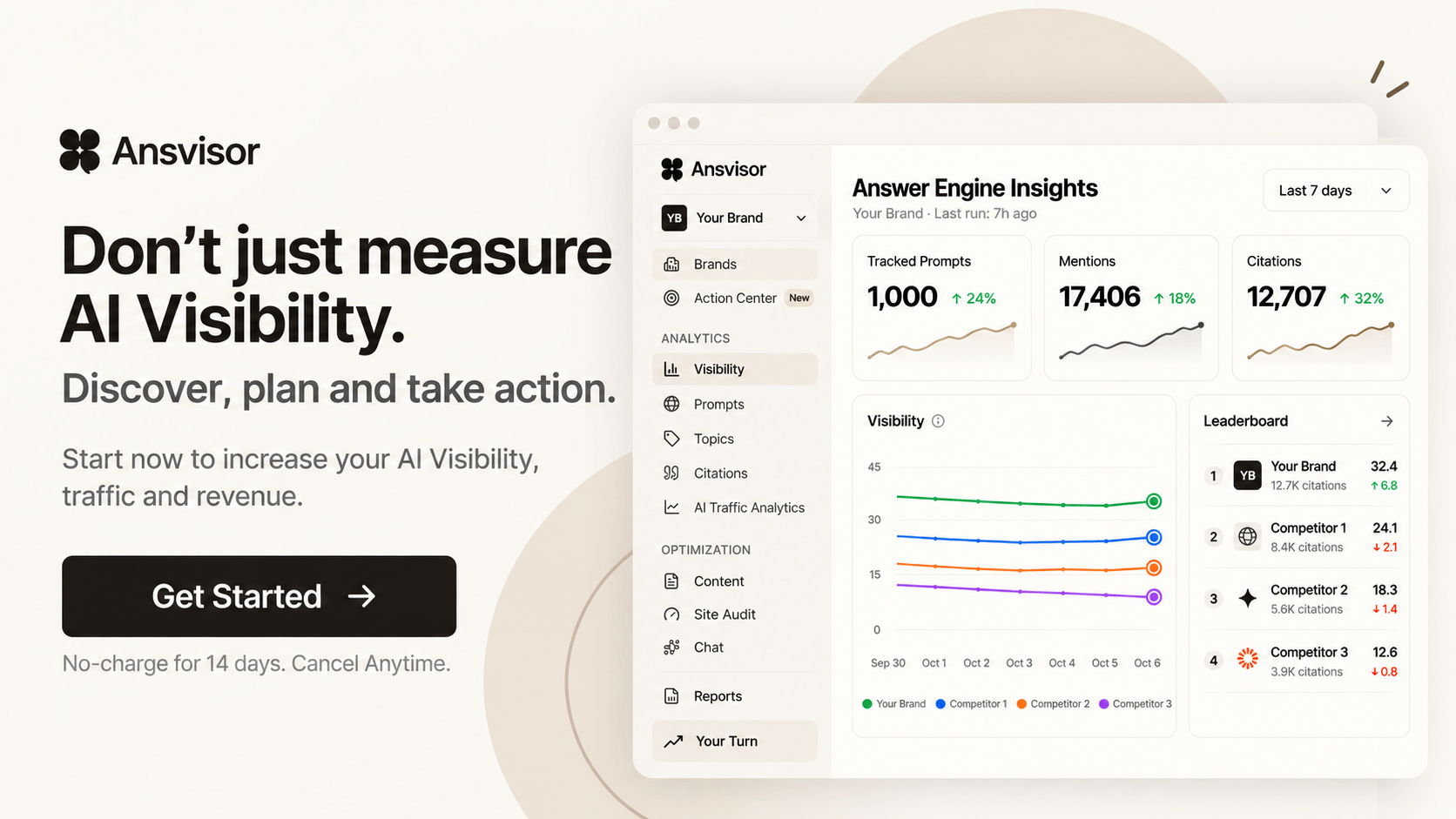
Track how your brand appears across AI platforms, understand what drives visibility, and turn insights into measurable actions.
Platform Features
Explore all features →Answer Engine Insights
Understand how AI platforms talk about your brand.
Prompt Intelligence
Discover and monitor the prompts shaping your AI visibility.
Citations Monitoring
Track which sources AI platforms cite and where your brand appears.
AI Traffic Analytics
Measure visits coming from ChatGPT, Gemini, Claude, and more.
Competitor Benchmarking
Compare AI visibility and uncover competitive gaps and opportunities.
Action Center
Turn AI Search signals into prioritized actions and executable tasks.
AI Visibility Trackers
Explore AI Visibility Platform →ChatGPT Visibility Tracker
Track brand mentions, citations, prompts, and visibility across ChatGPT.
Google AI Overviews Rank Tracker
Monitor where and how your brand appears in Google AI Overviews.
Google AI Mode Visibility Tracker
Track your brand's visibility across Google AI Mode experiences.
Gemini Visibility Tracker
Understand how your brand appears across Google Gemini responses.
Microsoft Copilot Visibility Tracker
Monitor your brand's presence across Microsoft Copilot answers.
Perplexity Visibility Tracker
Track brand mentions, citations, and visibility across Perplexity.
From AI Visibility insights to action.
Explore the complete Ansvisor platform for AI Search intelligence, optimization, and growth.
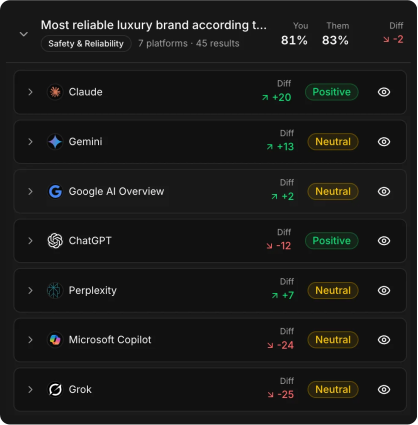
Win customers from all major AI platforms
Understand, measure, and optimize your AI visibility via Ansvisor.
✓ Add brand, domains and competitors
✓ Discover prompts and growth opportunities
✓ Track your AI visibility across major AI platforms
✓ Monitor citations, mentions, and competitors
✓ Measure AI traffic and customer discovery
✓ Receive AI recommendations based on AI insights
✓ Optimize authority, trust, and content quality
✓ Create content, automate analysis & action with AI agents
AI Visibility Terms
Continue exploring key AI visibility concepts.
AI Visibility
Measure and improve how often your brand appears in AI-generated answers.
Learn more →Answer Engine Optimization (AEO)
Strategies for increasing visibility in answer engines and AI summaries.
Learn more →Generative Engine Optimization (GEO)
Optimizing content for AI-powered discovery experiences.
Learn more →ChatGPT Search
Understand how OpenAI retrieves and synthesizes information.
Learn more →Google AI Overviews
AI-generated summaries that appear directly in Google Search.
Learn more →Perplexity Search
Explore how Perplexity cites and presents sources.
Learn more →AI Citations
References and sources used by AI systems to support answers.
Learn more →Citation Authority
Measure the quality and influence of cited sources.
Learn more →Retrievability
How easily AI systems can discover and reuse your content.
Learn more →New terms are added regularly.
Help us improve the page or suggest a new term →
Cihan Geyik
Co-founder at Ansvisor
Cihan Geyik is the co-founder of Ansvisor, an open-source AI Visibility platform for AI Search. With more than 15 years of experience in digital marketing and growth, he writes about AI visibility, AI search, AEO, GEO, citations, and answer engines. He focuses on helping brands understand and improve their presence across ChatGPT, Gemini, Perplexity, Google AI Overviews, and other AI-powered discovery platforms.
Get more Ansvisor insights in Google
Add Ansvisor as a Preferred Source to see more of our AI Search, AEO, GEO, and AI Visibility insights across Google.
Make Your Brand Visible in AI Answers.

INDUSTRIES


© 2026 Ansvisor. All rights reserved. Ansvisor is an open-source AI Search Intelligence Platform for AI Visibility. Ansvisor is a brand owned and operated by Empler AI Inc.


.svg)